I think we can all agree that Keats’s Endymion (1818) was a critical and commercial failure. As Renee discusses in her post, Tory reviewers lambasted the poem because of Keats’s affiliation with outspoken radical Leigh Hunt. Although the poem’s most notorious critic, John Gibson Lockhart, notes its metrical deviations from the traditional heroic couplet form, he spends more time attacking Keats personally: “He is only a boy of pretty abilities, which he has done every thing in his power to spoil.” It’s no wonder, then, that Keats’s letters written in the months that followed show a recurring preoccupation with self-improvement, or “turning over a new leaf.” In a short letter to Richard Woodhouse (friend and editor) dated December 18, 1818, he writes “Look here, Woodhouse – I have a new leaf to turn over: I must work; I must read; I must write.” He’d repeat the phrase again that April in a letter to his sister, complaining that he had “written nothing and almost read nothing – but I must turn over a new leaf.”
Due to my unfortunate tendency to self-identify with whomever I’m reading (“OMG, Keats, I know EXACTLY what it’s like to have your work rejected and then mooch off your friends because you have no money. WE ARE THE SAME PERSON.”), Keats’s desire to “turn over a new leaf” resonates as I prepare for a new semester of graduate school in the new year. While our situations are slightly different – constructive criticism of a seminar paper not quite as devastating as the complete and utter failure of a published book – his mantra for self-improvement sounds eerily like that of a graduate student: “I must work; I must read; I must write.” In the spirit of turning over a new leaf, and hopefully transforming that Endymion-esque seminar paper into a Lamia, I present to you my academic resolutions for 2014. I should note that many of these will be obvious to the more seasoned scholars among you, but for all of you newer grads out there, I hope you’ll find my mistakes instructive.
Resolution #1: I will develop arguments from texts instead of making texts conform to my arguments.
This one seems easy in theory, but it’s something I’ve been struggling with throughout the semester. I’ll read one text – Endymion, let’s say – and then a bunch of criticism, and its reviews, letters, etc. Then, I’ll develop an idea about how Keats’s later poems revisit the same genre and politics as Endymion, but ultimately rewrite them. Except, I’ll form this connection even before I’ve read the later poems, just because it sounds so smart and will make such a good paper. Then, I’ll set about writing the paper and finally get around to reading Lamia, Isabella, The Eve of St. Agnes, and other poems (1820), and only then will I realize that the texts interact in completely different ways than I had originally thought. Of course, there’s not enough time to completely rewrite my paper, so I stick with the argument, praying that the reader doesn’t realize I made this crucial error.
So, simply put, I resolve to stop doing this faulty method of research. I’m going to let myself be confused by texts, and stop trying to develop beautiful, complex arguments before I’ve had time to fully read and think about them. If a brilliant idea pops into my head before I’ve done this, I’ll write it down, set it aside, and consider it later. As a wise professor once told me, “Always start with close reading. If you leave it till the end, it will always most certainly change your argument.”
Resolution #2: I will accept that I am, first and foremost, a student.
A wise man (Michael Gamer) once told a group of English majors, “graduate students are full of themselves.” I hate to say it, but I’m living proof of this. I started graduate school last August under the impression that I was a Romanticist. In my undergrad days I was merely an “aspiring Romanticist,” but starting a Ph.D. program gave me the right to crown myself with the full title. Once I was accepted, I thought that I had made the transition from student to scholar, and deceived myself into believing that I knew more about my field than I actually do. Thankfully, the enormous ego that Michael prophesied was soon deflated when I realized a few weeks into class that, in fact, I know very, very little about the period in which I claim to specialize. Of course, this realization was accompanied was a decreased sense of self-worth, doubt about whether I was in the right line of work, and a frantic conversation with my advisor in which I dramatically exclaimed, “I KNOW NOTHING!” “That’s ok,” he assured me, “you’re a student, and you’re not supposed to. Frankly, you’d be surprised how many people in the field don’t know much either.” So, for 2014, I resolve to remind myself that I’m not a scholar yet; I’m a student. I will accept the limits of my knowledge while doing my best to expand them.
Resolution #3: I will overcome writing anxiety.
This problem plagues many of us, and it’s one of my biggest areas for improvement in the new year. Sometimes, the sheer size of what I need to write, the nearness of the deadline, and difficulty of the subject matter create a Kafka-esque paralysis in which no writing is accomplished. I can tell I’m experiencing this when I go to extra lengths to avoid starting a paper, whether it’s extra research, extensive outlining, or a meticulously organized Spotify playlist entitled “Writing.” As many of us know, talking about writing and thinking about writing is not actually writing. The only way to overcome this problem is simply to write more. At the advice of many of my peers, I plan to write everyday, especially while I conduct research. There were simply too many times this year when I was tempted to end my seminar papers in the way that Milton ended “The Passion” (1620): “This Subject the Author finding to be above the years he had when he wrote it, and nothing satisfied with what was begun, left it unfinished.” I’m pretty sure only Milton could pull off that one.
Resolution #3.5: I will write my blog posts on time.
This probably should’ve been number one. Thank you, Jake and fellow NASSR grads, for your patience.
Happy 2014!
Towards a Tangible Romanticism; or, One Student’s Search for the “Real”
I have a confession to make: I’m not getting a Ph.D. in English because I’m interested in literature. An avid reader since childhood, books were something I enjoyed, but not necessarily found interesting enough to study. Sure, Pride and Prejudice was a great read, but I’d never thought it more than that. My early thinking went like this: “Fiction is entertaining, but it’s not real. What’s the value in studying something that isn’t real? If it isn’t real, what’s there to study?” This line of thought must abhor many of you, but I confess that I struggled (and still struggle) to convince myself that studying literature was a worthwhile, productive endeavor. It didn’t help that I went to a college where most students viewed education as a means to a well-paying job—a degree worthwhile for the job at Goldman it could score you. I was certainly influenced by this environment, and haven’t entirely discarded its thinking. I was, for better or worse, interested in the real, the tangible.
My quest to study something “real” (quite literally) led me to declare a major in Archeology, a field where I got to touch things and feel their realness. Literature was about ideas, archeology was about objects. A poem didn’t have the same tangible meaning for me that, say, a clay pot did. The pot was created for a purpose: to hold liquid, cook food, decorate a home. I liked that I could touch the artifacts I studied; they had real meanings behind them, not the “imaginary” meanings that people superimposed over novels and poems. You could find an object’s meaning within its material form—it had been shaped a certain way for a reason.
Yet a few months later, I found myself missing literature. I started to crave the “humanness” of books from which artifacts, although made by humans, felt detached. I started taking more English classes, mainly for fun, when an idea struck me: what if books could be read, not as abstractions upon which readers inserted meaning, but as objects? This watershed moment transformed the way I thought about literature, and led me to switch my major. I stumbled across a new kind of reading that I want to call an “archeological hermeneutics.”
How this works: I read a book as a material object, not only significant because it’s the product of a distinct cultural moment, but because it has a relationship to all other objects of the same type. In archeology, we think about a decorated Tlingit mask as it exists alongside hundreds of undecorated masks. The mask is both an independent object with a unique history, and a type working within a tradition of objects. Likewise, books are interesting, as opposed to entertaining, when I can read even the smallest moment in a text as related to the book’s position in its unique cultural moment, and as a product within a history of moments. So, when Keats writes Hyperion in unrhymed heroic verse, it’s significant on a local level—revising the verse form after the critical failure of Endymion—but also engages within a tradition of verse that hearkens to Chaucer, Spenser, Milton, Pope, and others. Books are both local and transhistorical artifacts.
In archeology, material constraints dictate what kind of objects people create. The indigenous peoples of the Great Basin make baskets out of yucca, a material which obviously constrains their shapes and colors. Applying this to my studies in Romanticism, the material conditions of a book’s creation, publication, and dissemination are important to my understanding of its content. As I’ve learned in my current course on Romantic Drama with Jeffrey Cox, the material conditions of Regency theatre culture—there were only 2 theatres in London allowed to perform spoken drama—led to the development of musical forms like melodrama, pantomime, and other forms of Jane Moody’s “illegitimate theatre.” And then there are the constraints of publication: Why does Equiano choose to publish by subscription, and why does he include a list of subscribers on the first page of his Narrative? Does it affect our reading of the narrative that follows? These are the questions, inspired by Romanticism’s material conditions, that I find worth discussing. To me, they are real, almost tangible.
Yes, there are benefits to reading books as closed systems. It’s useful to understand how a text functions within itself, how it teaches the reader to read. But often with this approach, the meaning I find within texts is one I’ve placed there myself. Nietzsche (and Paul Youngquist, from whom I first heard it paraphrased) explained it thus: “If someone hides something behind a bush, looks for it in the same place and then finds it there, his seeking and finding is nothing much to boast about.” In my burgeoning career as a Romantic scholar, I want to discover truths that emanate from texts without having to place them there myself.
Perhaps I ought to rephrase my opening statement: I’m not getting a Ph.D. in English because I’m interested in literature; I’m getting a Ph.D. in English because I’m interested in literature’s interaction with the material world and the truth that emerges from it.
Never Have I Ever Read

At the beginning of summer, my husband, our two basset hounds, the cat and I moved into a little white rental house with a backyard. And once we had unpacked all our books, installed a makeshift closet in the back room (in the whole house, we have one tiny little 2×3 feet closet in the bedroom), and felt sufficiently settled to have company, we threw a housewarming party.
Naturally, ninety-percent of our guests were English grad students, and, as we were sitting around the fire-pit in our new backyard, someone suggested we play a literary version of the party classic “Never Have I Ever.” In the original game, the players take turns admitting to something they have never done (never have I ever been skiing–a sad truth!), and each person who has done the event loses a point until only one person is left with points, or something of the sort. In our version, we shamefully admitted works we had never read, and the other players were to put down a finger of the full ten with which they started. Of course, we awarded a slight handicap of negative five points to the only three non-bookish types (my husband the mathematician, a former history major, and a physicist) to make the game somewhat fair.
We were never quite clear on the goal of the game, since in our circle there seemed more pride in “losing” the game than surviving to the end with fingers still raised. In fact, one of our friends “lost” twice by the time we called the game. And we were all envious. But we went round and round, enjoying ourselves immensely.
“Never have I ever read Moby Dick.”
“Never have I ever read Huck Finn.”
“Never have I ever read Beloved.”
I have been studying for comprehensive exams for the past five months, and while I have read a significant number of the works on my lists in past graduate seminars, I feel like the whole process is a long game of “Never have I ever read…”
At the University of Kansas, where I am in my third year of doctoral studies, you compose three lists with your committee–two of which are time period lists (your area and an adjacent time period) and the third is a list of your own choosing (often an author, literary theory, a genre, etc). As a Romanticist with a fairly extensive background in Victorianism, I have chosen my period lists to form the full nineteenth century in British literature, and my final list is geared toward the Leigh Hunt Circle as I prepare for a dissertation focusing on Keats, the Cockney School, and how this context shaped his conception of “work.”
After reading criticism and biographies for the last two months as I try to whittle away at the dissertation list, I have switched to fiction for a much needed breather. I find it heartening to zip through a couple of novels in a week, when I have been slogging through nonfiction for what seems like a lifetime (and I will say I have read several “lifetimes” in that list, and highest praise must go to Nicholas Roe’s 2012 Keats biography. I have added it to the ever-growing list of books I wish I had written). In anticipation of the Halloween season, I scheduled myself several gothic novels in a row. And last week, I read Wuthering Heights for the first time.
Perhaps I just permanently altered your opinion of my clout as a nineteenth-century scholar. Well, so be it. I certainly admit the sad fact with a touch of shame. But now I have checked it off my list of never-have-I-ever-reads, and I have moved on to the next novel that somehow fell through the gaps in my long tenure as a literature student.
I feel this game “Never Have I Ever Read” haunts literature scholars. It certainly helps us flesh out syllabi–how else will we force ourselves to finally pick up Dombey and Son if we do not assign our students (and ourselves!) to read it?–and the game even fuels our research, it seems.
Three weeks ago, I had the pleasure of traveling to Portland and presenting on a Romanticism panel at the Rocky Mountain MLA. This conference has become a tradition for a couple colleagues and me, who would likely never travel and present together otherwise since our areas are so diverse. I presented on the connection between architectural structures and female bodies in Keats’s romances. I looked at the way in which the lived experience of female bodies, specifically in rape narratives, becomes abstracted into a symbol (the first step of which is the equation of the female body to the house or palace that protects her–i.e. Madeline is endangered because her house is penetrated in “The Eve of St. Agnes”). This cultural phenomenon is allegorical in so far as the female body comes to represent social bodies (structures) in various forms through literature and even political propaganda. The specific and material become crystallized into a generic trope that can be circulated, translated, and exchanged, depending upon the terms of its use, its ability to anger, inspire, manipulate.
In the Q&A portion of the panel, another presenter asked if I had read Cymbeline. I shook my head and shyly admitted I had not. Despite taking two courses in Shakespeare and Renaissance drama, never had I ever read, seen, or even heard a plot summary of the play. Nor is the classic John Middleton Murry volume Keats and Shakespeare listed among my secondary texts for comprehensive exams.
Nevertheless, I did my research that evening in my hotel room, and discovered much speculation on the play’s influence in Keats’s portrayal of Madeline’s boudoir. Indeed, Charles Cowden Clarke wrote, “I saw [Keats’s] eyes fill with tears, and his voice faltered,” as the poet read aloud from the play in summer 1816 (qtd. on page 56 of Walter Jackson Bate’s biography of Keats). In addition to speculation on the scenery, importantly, Imogen has been reading the story of Tereus and Philomela before falling asleep. According to Greek mythology, Tereus rapes Philomela and cuts out her tongue so that she cannot report the assault. Jove later transforms Philomela into a nightingale, and her song becomes an echo of sexual violence throughout literature, including T.S. Eliot’s “The Fire Sermon” in The Wasteland (a piece I have read many times since first crossing it off my never-have-I-ever list in high school).
Scholars speculate on what the literary greats have read (or not read) as an everyday practice. My fellow-scholar who asked if I had read Cymbeline was presenting truly stellar archival research that sought to uncover whether Keats had read various seventeenth-century ballads on nightingales. She lamented that we do not know to what volumes he had access while staying with Benjamin Bailey at Oxford in the summer of 1817. And as she had not yet read Roe’s recent Keats biography, she did not know the conflict between Bailey and Keats’s London friends, and why Charles Brown and other early biographers would not have contacted him to inquire about Keats’s reading that summer. Even in their lifetimes, Keats and Leigh Hunt gained the label “Cockney” as a class slur partially due to the fact that they never had ever read mythology in the original Greek, and instead got their knowledge of the classics through translations.
Next up on my reading schedule is Northanger Abbey, and I will be reading it for the first time. This will be my last novel for a while, and, as I want to preserve my reputation with you at least beyond my first blog post, I will not admit the Romantic poetry I will be reading next week–for the first time.
Last-Minute Gift Ideas for Academics (or what to get with your holiday Amazon giftcards)
My department has recently introduced these two books to the grad students through reading groups and classes. Both give great professionalization advice for various stages in the studying, working, and writing processes.
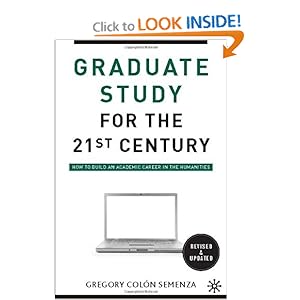 Semenza, Gregory Colón. Graduate Study for the 21st Century: How to Build an Academic Career in the Humanities. New York: Palgrave Macmillan, 2010.
This is a book that practically anyone involved in graduate studies, from newly-accepted students to scholars about to defend their dissertations, would find an invaluable resource. As its introduction boasts, it’s geared towards students who have already made the decision to dedicate their time and energy to graduate school, studying with faculty in order to become faculty themselves, thereby bypassing any discussion of applying to grad school or whether or not grad school is for you. The first three chapters focus on providing insight into aspects of the graduate education we deal with every day but that are rarely taught in any official capacity: how to negotiate department politics, how to field questions and misconceptions from those who don’t understand academia, how to use the different stages of the process wisely instead of just getting by, and how to structure and organize your time. Though the advice is detailed and helpful, the tone of the book is in no way warm or sanguine: Semenza does not sugar-coat anything. He knows the job is tough, and the process of getting there is even tougher. He talks about problems we all know about: the highly-competitive job market, the numbers of grad students admitted versus jobs available, the hiring of adjuncts instead of full-time faculty. He also criticizes the structure of graduate school itself, placing a lot of responsibility on advisors and faculty, who, even with the very best of intentions, simply treat their grad students as they, themselves were treated in grad school, thereby perpetuating the system. He offers his book as an extra advisor to supplement their guidance.
Chapters four through eight discuss, in-depth, the different stages of graduate school—the graduate seminar, the seminar paper, teaching, exams, and the dissertation. Some of the advice is simplistic and may already be part of your academic practices, like note-taking and organizing folders, but other advice simply helps you make sense of what you’re doing and why. Though Semenza recommends not reading these chapters selectively, I read the exam chapter and the section on the dissertation proposal while studying and writing for each, before I read any of the other chapters, and I still found the advice helpful. The next three chapters cover activities we engage in throughout our graduate career: conferences, publishing, and service. Some of the advice in the seminar paper and publishing chapters I even found useful for teaching writing in my own classroom, something that I found with the Belcher book discussed below, as well. The appendix includes several “professional documents,” such as C.V.s, job letters, abstracts, syllabi, and other important formats to guide you through seeking publications, conference presentations, and jobs.
I do highly recommend this book for individual academics, but I think the way that my department handled it was particularly effective: we gathered the grad students and a few faculty who were interested and formed a reading group, where we discussed one or two chapters per session. As I said, the book does not ease up on the harsh reality of the academic state of the humanities, and the dooms-day tone, though completely realistic and necessary (and appreciated for the respect it gives academics), could easily send grad students already on the edge into a serious panic. Reading the book as a group allowed for conversations that quelled this kind of panic and allowed us to measure our own experiences against Semenza’s and to make the most of the tough-love approach. This could be a book to hold onto through grad school, graduation, and even when we (fingers crossed) have grad students of our own to advise.
Bel cher, Wendy Laura. Writing Your Journal Article in 12 Weeks: A Guide to Academic Publishing Success. Thousand Oaks, CA: SAGE Publications, Inc., 2009.
Belcher’s book, on the other hand, offers a more optimistic “you-can-do-it” approach to one single aspect of being an academic, both for grad students and established scholars: publishing an article. This workbook-style text demarcates a chapter per week, giving you specific activities to do each day for a specified amount of time, ranging from half an hour to about two hours. For example, the chapter for week 5: Reviewing the Related Literature opens with this list of tasks:
Day 1, Read through the pages in the workbook, 60 minutes
Day 2, Evaluate your current citations, 60 minutes
Day 3, Identify and read related literature, 8 hours (this is very unusual)
Day 4, Evaluate the related literature, 60+ minutes
Day 5, Write or revise your related literature review, 120+ minutes
Theoretically, if you are able to stay on task for every day (only five days per week, so there is some flexibility), you should be able to complete and polish up an article and follow Belcher’s advice for choosing a journal and submitting your final draft. My department offered a one-credit class that followed this book like a syllabus, completing the tasks for each day and spending about half an hour per week workshopping one another’s work along the way. The book does seem to work best if you have a piece of work already in mind, like an old seminar paper or conference paper. There really isn’t a chapter that guides you through starting from scratch, which is obviously the most time-consuming stage of the process. For me, the most effective part of Belcher’s method is just setting time aside everyday to work on my article and sticking to a schedule (though, to be honest, there were many weeks were I was barely able to fit in an hour or two). Belcher is both adamant and realistic: she insists that you should be able to find at least fifteen minutes per day to work on your article, even if it’s just on the back of an envelope in an airport. In a section in which she addresses common obstacles to writing, she bluntly states that, “If you really are too busy to fit in fifteen minutes of writing a day, then this workbook cannot help you. I recommend that you plan, in the very near future, a weekend away from it all where you can really think about your life” (26). On the other hand, she begins many of the later chapter with the concession that it is very possible that you haven’t been putting in your time every day or every week and offers some (shaming) encouragement: if you haven’t been working, now is a good time to start—it’s never too late!
I think my fellow grad students would agree that this book is very helpful in just getting you to work and write every day towards one specific (and necessary) goal and that it provides some really solid writing advice and techniques. I personally found the chapter on structure the most helpful. Some smaller sections within the chapters, however, I suggest taking with a grain of salt at times to determine whether they are really helpful for you. Some of the anecdotes seem slightly unrealistic and out of context at times and may discourage rather than encourage, as I think happens in many of these academic advice books. Like Semenza’s book, Belcher’s book also seems to underestimate the extent to which academics make themselves visible electronically, through blogs, online journals, etc. Semenza mentions almost nothing about these venues, and Belcher treats them fairly condescendingly. Nevertheless, her book offers guidelines and tips that could also extend beyond article-writing to teaching and other types of writing, like the chapters on editing sentences and on presenting evidence. Also similar to the Semenza book, this text is another useful tool that I think is best read amongst a group of students and faculty in order to make the most of its advice through further discussion and personal experience.
You can access some of the forms and schedules, like this weekly schedule, at Wendy Laura Belcher’s website: http://www.wendybelcher.com/pages/WorkbookForms.htm
Getting to the Good Parts: Chapbooks and Blue Books

 One of my favorite things about Broadview Press’s 2006 edition of Zofloya (1806), by Charlotte Dacre, is the inclusion of a chapbook version of the original text in the appendix.[i] Dacre’s novel, which occupies 216 pages in this edition, has been condensed into a 19-page document that speeds through the tale, sidestepping scenes of excessive emotion, dialogue, and prolonged action and cutting right to the barebones plot. A scene early on in the novel, in which the main character’s father is mortally wounded by his wife’s lover, the count, reads:
“Draw, monster, devil, and incendiary!” exclaimed the frantic husband, at the same time snatching his stiletto from his bosom.
“I have no sword,” cooly returned the count; “but I have, like yourself, a stiletto, that shall be at your service.”
The Marchese heard no more: he struck and struck again with desperate fury at the body of his antagonist; but his aim was rendered unsure by his thirst for vengeance, by the raging and uncontrouled passions of his soul. The count, calm, and self-collected, parried with hellish dexterity his indiscriminate attempts; but receiving, at length, the point of his adversary’s stiletto in his shoulder, he suffered an impulse of rage to nerve his hand; and, retreating for an instant, then furiously advanced, and plunged his dagger to the hilt in the breast of the unfortunate Loredani. (50)
In the chapbook, this same scene simply reads:
“Draw monster and defend yourself!” exclaimed the husband, snatching his stiletto from his bosom.
“I have no sword,” said the Count; “but I have a stiletto.” The Marchese struck at him with great fury. The indignant Count plunged his dagger into the breast of the unfortunate Leonardo. (280)
It sounds almost like an outline or as if recorded from memory. The chapbook, called The Demon of Venice: An Original Romance, By a Lady (1810), like most chapbooks, has been blatantly plagiarized from Dacre’s original, though Adriana Craciun speculates in her footnote to the Broadview introduction that there is a slim chance that Dacre could actually be the author (31). Regardless, the “borrowing” of plot details as the norm does not seem to bother either reader or author, and Alison Milbank claims that changing the names avoids any direct legal ramification for the often-anonymous authors.[ii] Milbank explains the difference between chapbooks and blue books (named, of course, for their blue covers): chapbooks are prominent in the seventeenth and eighteenth centuries and had begun to die out in the early nineteenth century, whereas blue books—Gothic in nature and featuring a more sophisticated illustration style—were prevalent in the early nineteenth century and dealt closely with booksellers (perhaps even those carrying the original novels upon which they were based). Though I have only seen reference to The Demon of Venice as a chapbook, I suspect that it qualifies more as a blue book for these reasons. While books and even library membership were expensive, blue books “provided racy, entertaining and cheap reading for the literate poor,” and like many other more accessible forms of entertainment, such as theater, helped to perpetuate and continue the Gothic legacy among both the well-educated upper classes and the lower classes hoping occupy their minds for relatively cheap (Milbank). Milbank describes two lengths of these small books or pamphlets: “sixpence for 36 pages, and a shilling for 72 pages,” though some were even shorter.
I am just beginning to enter the world of chapbooks and blue books, hoping that this may offer insight into many Gothic novels that have not survived through to modern publishing and digitalization. Even Ann Radcliffe’s monstrous tome The Mysteries of Udolpho has been squeezed into under a hundred pages and re-titled as The Veiled Picture. I’m also interested in these types of abbreviations and how they change the stories themselves as well as the reading experience. I like to think of them as similar to today’s comic books or the series of Great Illustrated Classics with which many of us grew up (the ones with a picture on every other page. You know the ones!). They provide a different type of access to great stories. As Milbank points out, even our most revered literary figures, such as Percy Shelley, had a fondness for blue books, particularly in his youth.
Finding these texts today, however, is not easy. One of my goals for this post is to share with you a recent discovery that’s trying to make such texts as they were intended: accessible again. Literary Mushrooms, a spinoff project of Zittaw Press, is in the process of reprinting and re-illustrating fifteen Gothic chapbooks. They have just set up a great project page here, in order to gather funding for this project, which supports the 50’s-style comic illustrations, printing, and hand-stitching costs. Both Zittaw and Literary Mushrooms are dedicated in revitalizing an interest in these forgotten texts and to combine both nineteenth and twentieth-century elements to create a new (truly Gothic?) reading experience. I’ve just ordered a slew of copies of The Bloody Hand for the Gothic Reading Group that I run, distributing cheap thrills to the (poor) grad student masses, and we are anxious, amidst our regular studies of lengthy volumes, to discuss the difference in shifting from plot-driven novels to plot-only chapbooks, full (I might add) of exclamation points!
[i] Dacre, Charlotte. Zofloya. Ed. Adriana Craciun. Peterborough, Ontario: Broadview Press, 2006.
[ii] Milbank, Alison. “Gothic Satires, Histories, and Chap-Books.” Gothic Fiction: Rare Printed Works from the Sadleir-Black Collection of Gothic Fiction at the Alderman Library, University of Virginia. Marlborough, Wiltshire, UK: Adam Mathew Publications, 2003. http://www.ampltd.co.uk/digital_guides/gothic_fiction/AlisonMilbank3.aspx.
On Starting a Reading Group
 Once I’d finished my coursework requirements, I found myself really missing the chance to regularly gather with fellow grad students and talk about reading. Studying for exams and writing the dissertation can be isolating experiences. Some large programs may have a few students studying or writing within similar fields, but smaller programs don’t always have this kind of ready-made specialized community. Even so, it can be refreshing to chat analytically and appreciatively about literature with others, even if that literature is outside your particular interests. Aside from just hanging around the office and asking, “Read any good books lately?” the best way I’ve found to foster this type of discussion is to start and join reading groups.
Planning your group:
Numbers are important. If you put out a call for interest and the entire department wants to sign up, you might want to split off into smaller reading groups with narrower topics. I’ve found that between three and ten members is best for good discussion that allows everyone to participate. Choose a location that is comfortable and as far from a classroom as you can get: a more informal building on campus, a café or pub, or even someone’s living room. You’ve all done your time in the classroom, and members will be more likely to show if they don’t feel like someone’s taking attendance. Choosing a day and time when people can feel more relaxed also helps, like a late afternoon after everyone’s taught for the day while still leaving time to do some writing or grading later that night.
There are a number of ways to decide what the group will read. In some reading groups I’ve joined, a group leader knows the most about the topic and just chooses all the readings. If you don’t like a particular reading, you don’t have to show up that day. There are also more diplomatic ways. In my group, I usually ask for suggestions, make a survey of all the responses, and let the group vote on what they want to read. Sometimes, if someone has a text they’re particularly excited or knowledgeable about, he or she can lead that meeting. For the most part, though, discussion seems to run itself, with perhaps a few back-up questions in case of awkward silences. In terms of book-length, everyone is usually pretty busy: shorter is better. Short story collections can work really well if the group chooses one or two to read together, letting members read around the rest of the book if they have the time. It also depends on cost. Department or university funding for reading groups is available at some schools, but not all.
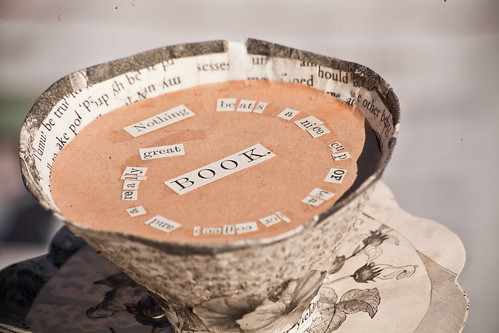
When it comes to the meetings themselves, I really try to emphasize an informal atmosphere, as you can see. Not all groups I’ve been in have been like this, though, and there is something to be said for a structured group in the midst of unstructured diss-writing and exam-studying. Shoot for a middle ground: it’s not the neighborhood book club, but it’s not class, either (especially with so many teachers in the room). One thing that will come as no surprise is that grad students are more likely to show up to any event if there’s food and drink involved. Especially if you have a mix of M.A. and PhD. Students, this informal atmosphere can help everyone feel comfortable contributing to conversation and bring their own interests to the table. You can also do some more creative things like readings of plays/poems or looking at film alongside other texts to make meetings social while still discussing the material. Starting a reading group can help you re-connect with the other scholars in your department, inadvertently bringing out the many different types of reading and discussion that can often be forgotten when you’re doing independent work… while, at the same time, having fun and relaxing with good books, good food, and good people.
Comprehensive Exam Preparation
This is my exam semester. When I began my PhD in West Virginia University’s program “exams” existed in an intangible future; now, they are here. No matter the format, no matter the number of texts on your list, the comprehensive exams are one of the legendary hurdles of obtaining a literature PhD. Critical to your success, exams help prepare students to tame the beast that is the dissertation. At various conferences over the past 6 months I’ve discussed exam format with peers from Massachusetts, California, Illinois, Colorado and Oregon—all over the country in a range of programs and concentrations; each institution formats their exams differently. The exam narrative, however, is largely the same: a feeling of dread coupled with excitement about the prospect of reading the materials related to their project for those who have yet to take exams and for those who have completed exams: relief for having them behind them but a knowledge that the dissertation holds its own challenges and intellectual rewards. It is a rite of passage that seemingly few would ever choose to relive. As I’ve prepared for my exams the process has been incredibly educational—not just because I’ve immersed myself in critical discussions regarding the constructions of gender and sexuality in Romantic and Victorian England or varying theorizations of ‘error’ but also because I’ve (re)discovered a great deal about my work process and ability (and sometimes lack thereof) to deal with the anxieties and stresses of examination.
Here are a few things I wish I’d known beforehand or did know, but lost sight of in the process:
1. Keep track of how you spend your time. One thing I found frustrating about the exams was the absence of tangible progress. Yes, I could cross a book off of the list. Yes, each book I read helped me to further understand what I wanted from my scholarship. Yes, I now have a clearer idea of what kind of book I’d like to publish in the future. All of these things are well and nice but they aren’t very helpful today. Reading and taking notes for your exams can feel like running in place sometimes. I like the tangible outcomes of my work, and I am sure I am not alone. A seminar paper, an article, a presentation, a talk, a curriculum: these are all concrete productions of the work many of us do. The comprehensive exams are disconnected from their outcome: passing the exams, writing the dissertation. To help you see how much work you are doing and how you are spending your time, keep a work log. A spreadsheet in Google Docs is ideal because you can access it anywhere through your Google account. It has been helpful for me to see how many hours I’ve devoted to exam preparation (and to other things like course preparation, grading, publication, conferences, etc.).
2. Letting yourself down is not the same as failing. When I wrote my reading schedule last February my plan was to finish reading by late May. I poorly estimated how much time it would take me to read the texts for my exams; I found the reading process to be different than what I’d experienced in the past. I wasn’t prepared for the additional hours I’d spend taking notes, trying to synthesize the texts and write cogent summaries that would serve to refresh my memory months after completing the book. I couldn’t have known about the reading rut I would hit in April. When I crafted the schedule in February I was enthusiastic about reading 12 books on the history of England from 1789-1850…and the semester had just started. My enthusiasm waned around book 7 and mid-terms distracted me with a seemingly never-ending stack of grading. I didn’t meet my schedule. I had to learn that this was okay. I had plenty of time to finish reading; I had plenty of time to study before my exams. I had not failed (even if I felt like I had). I’ve discovered through this process that while knowledge of the material is certainly important, the knowledge gained regarding my own habits as a worker, reader, writer, teacher, and scholar has equally useful and important value.
3. Help yourself avoid distraction. When I first started reading I found myself wandering down various research paths inspired by my materials. Rather than finishing a chapter I would investigate a footnote or, curious about a possible gap in research, look for scholarship on the topic. In other words, I would find seemingly productive (even tangentially related) ways to pass the time without actually working on the task at hand (finishing the book, preparing for the exams). About half way through Susan Wolfson’s Borderlines, the third book I read for my exams, I decided to keep a “Distraction Relocation” journal. It is a just a spiral bound notebook but in it are all of the questions and future projects that I’ve identified during my exam reading. Rather than finding all of the scholarship on errata sheets, a distraction I full-heartedly considered while reading Seth Lerer’s Error and the Academic Self, I jotted down a note about how it might be interesting to investigate how errata sheets were used in Romantic print practices (and whether their use differed between literary periods). The thoughts I’ve labeled here as ‘distractions’ are important and I’m certain that at least two things that made it into my “Distraction Relocation” notebook will find a place in my dissertation project. My notebook helped me to keep track of these thoughts without allowing them to derail my progress.
4. Stay in touch with your community. During exam preparation it can be easy to excuse hermit-like behavior. Fight against the impulse to hole up in your office or house; instead, stay in touch with your community. Do not feel guilty for spending time at lunch with friends. Keep in contact with your director(s) and mentor(s). Talk to people about the process and find out what works/worked for others.
5. Find healthy ways to release the stress and pressure of exams. Exams can cut off your social life if you let them; they can also be a catalyst to putting you at the bottom of your to-do list. It can be easy to excuse poor health habits because you are so busy: skipping out on your exercise routine, foregoing fresh food choices for easier, quicker options. I learned to love running as I prepared for my exams. It gave me a place to clear my mind, to release any of my anger, frustration and anxiety, and reminded me that exams are not everything (which can be a difficult thing to remember in the middle of the process).
6. Schedule the exams. Concrete dates on your calendar and on the calendars of your committee are an effective way to keep yourself in check. The earlier you do this the better, for at least two reasons: 1) Once the dates are set you can’t go back, motivating you to stay on schedule, and 2) Your committee members have busy schedules; the earlier you schedule your exams the more availability they will have.
7. Your committee is on your side. You have selected a group of people to support you and your project, to provide feedback and offer critical suggestions to improve your scholarship. They are all rooting for you; they want to see you succeed.
I’m sure there are other things that should be added to this list. What do you wish you knew about the comprehensive exam experience before you took/take them? Do you have any bits of wisdom to share?
'Tis The Season to Apply for Research Fellowships
 It’s that time of year… and no, I don’t mean for busting out the Holiday music (for that please refrain until after Thanksgiving. Thank you.). This, my friends, is the season to consider applying for research fellowships! With so many thrilling archives around, full of material ripe for analysis, it would really be a shame for scholars like us not to use them in our research—especially because libraries often offer us money to do so! Both short- and long-term fellowships are available at many major libraries and archives, and although some of these are reserved for scholars who already have their doctorate degrees, others specifically aim to help PhD candidates complete their dissertations or research for a specific article they plan to publish.
Of course, to get a fellowship you have to apply, and the competition is stiff—which is exactly the reason I’m posting about it right now. If you’ve found a specific archive with which you want to spend some quality time, it behooves you to start NOW, drafting your application and asking people to write your letters of recommendation. For the libraries I’ve looked at, most fellowship application deadlines fall between December 1st and March 1st.
I’m still new to writing research fellowship applications myself, but I’ll pass along a few pieces of advice I’ve been counseled to keep in mind. They’re pretty intuitive, but worth mentioning nevertheless.
First, define your target. There’s no sense in visiting a specific archive if it doesn’t have the materials that will be useful to you, or if those materials are also available somewhere closer to home. Also, libraries will see no sense in supporting your visit if you don’t have a specific project for which to use their materials. Thus, it’s imperative that you clearly articulate both the nature of your specific research project, and what role the library’s holdings play within that project. The former is (I think) one of the most challenging things we do in this profession, but the latter is pretty easy to manage: comb through the library catalogues and start making lists of items you would look at if you could. Although many library catalogues are not comprehensive, searching them and making wishlists will help you get the lay of the land, so to speak, and plan future academic projects and research trips, whether or not you get the fellowship. In your application, mention some of these specific items from your list (and check in Worldcat to make sure they’re not also at the library of your home institution!).
Second, know your audience. Most committees assessing applications consist of librarians whose job it is to match their knowledge of the library’s holdings to projects that will use these holdings to develop exciting new ideas. Even if readers do have training in your field, it is unlikely that they will be experts in your specific area. Therefore, your project description should eschew all jargon, so as to be lucid and interesting to an intelligent general reader. Preserve your sense of the project’s intervention and be specific about what’s at stake, but craft it for people who are not necessarily Romanticists. (This is a useful skill to hone for the job market as well!).
Third, write with authority. While avoiding jargon, show that you have a solid understanding of what your work will accomplish, as well as the competence to accomplish it. Avoid passive voice: instead of saying “It will be demonstrated that…,” go for “I will demonstrate that….”.
Fourth, specify expected outcomes. What will this fellowship enable you to do? Finish a chapter? Complete an article for publication? You don’t need more than a sentence or two, but you should show that your research will result in production of a tangible piece of scholarship. Your readers aren’t going to pay you just to think about stuff—they need to know your work is going somewhere.
Fifth, organize, organize, organize. Most of these applications are quite short, meaning you must pack a serious punch in very few words. Have a thesis statement, clearly articulate your project’s intervention and importance in your field, and be as clear and precise as possible. Ask colleagues and professors to read your proposal, and then be willing to revise (sometimes repeatedly). Again, whether or not you get the fellowship, this process is useful just for your yourself! It will help you comb through the tangled web of thoughts and find the golden thread that holds it all together—the ultimate quest of any project, right?
There are big, comprehensive archives, and small, specialized archives, so I thought we could start building a list of favorites! Below I provide links to three fellowship-offering biggies: huge institutions with something for everyone. But there are so many others! If you know of a great archive, or have experience using it (like Michele at the Huntington, or Jacob at the Yale Center for British Art, or Kelli at the British Library), please leave a note in the comments!
Newberry Library (Chicago, IL) – Dec. 12, 2011
Huntington Library (San Marino, CA) – Dec 15, 2011
Beinecke Library (Yale) – March 2, 2012 (also, they have a Fall application in October)
Others for you to look up, or comment on: New York Public Library, McNeil Center for Early American Studies, The American Antiquarian Society, Winterthur Library, the Library Company of Pennsylvania, the Massachusetts Historical Society, Dumbarton Oaks Library, the Getty Research Institute, Kew Library (Royal Botanic Gardens), RHS Lindley Library. . . .
Again, we’d love to hear your recommendations or personal experiences with any useful archives! Thanks for sharing.
Happy Application Days to All!
-Kelli
Spring Planning (before November!): Selecting Works for Teaching Intro. to Women's Lit.

I just received my spring teaching assignment in my mailbox, and am delighted to find that I’m teaching “Intro. to Women’s Lit.” for the first time. I am a little kid in a candy store (or a rock climber in a gear shop) when it’s time to select possible works to teach for the next semester’s course. I’ve also noticed a trend in romanticists’ online communities, in that we enjoy suggesting works to teach on a certain theme. For example, on Romantic Circles’ Teaching Romanticism blog, Katherine Harris requested suggestions for her Gustatory Romanticism graduate course, and Roger Whitson did the same for his Visualizing Nineteenth Century Poetry course. In addition, the NASSR-L recently saw a flurry of responses to Diane Hoeveler’s call for suggestions for her Romanticism and Religion graduate seminar, and she very generously collected all of the responses in this Word doc. I’m going to use our forum for a similar kind of request–please help me decide what to teach. And following Katherine Harris’ example, I plan to post my final reading list and course description to our blog as a follow-up discussion.
I’m especially interested in your suggestions for American authors and works to teach from earlier periods, within the romantic-era, and post-romantic periods. To date, I have been transatlantically challenged, so to speak, as far as including American texts in my teaching and scholarship. (Well, I’ve been specifically assigned to teach Shakespeare and surveys of British literature for the past 3 years.) Though I have chosen to specialize mostly in British romantic works for my dissertation, I see this course as a great opportunity to begin to fill in a gap or two in my reading.
Course theme: “Adventure.” I envision the theme of “adventure,” broadly, as one that will include the genres of travel literature, the gothic, experiments with form like those found in Edgeworth’s Castle Rackrent, as well as experiments with media, like Shelley Jackson’s electronic literary work Patchwork Girl. Namely, I’m interested in drawing attention to women writers over time who have ventured beyond society’s prescribed boundaries and who have taken risks that they convey one way or another in their authorship.
The CU catalog description requires that this course “[introduce] literature by women in England and America. Covers both poetry and fiction and varying historical periods. Acquaints students with the contribution of women writers to the English literary tradition and investigates the nature of this contribution.”
Initial brainstorming: I’m thinking of including the following authors/works (listed early to late): Sappho’s fragments (ed. Ann Carson), Julian of Norwich (med.), Mary Rowlandson’s captivity narrative (17th c.), Eliza Haywood (18th c.), Mary Shelley (rom.), Joanna Baillie (rom.), Ann Radcliffe (rom), Mary Wollstonecraft (rom), Isabella Bird (Vict.), Dickinson (Vict.), Woolf (mod.), Angela Carter (contemp.), Annie Dillard (contemp.), Jeannette Winterson (contemp.)
All reading and assignment suggestions are welcome, and I’m especially interested in your ideas for:
- 18th and 19th c. American authors and works–drama, fiction, poetry, essays
- I work on the gothic quite a bit — any American women gothic writers or works to recommend?
- 17th c works
- If you’ve taught this course, have you used a particular anthology that you would recommend?
- Assignment recommendations: I have been experimenting with my British Literature survey course with putting together student-made collections or exhibits that relate to works we’re studying in class. Any ideas how we could put together an adventure-themed exhibit for this course? (I’m thinking digital exhibit.)
Thanks in advance!
Using the Yale Center for British Art
This week marked my first time working with an actual William Blake manuscript, having looked at the sole complete copy of Jerusalem at the Yale Center for British Art in New Haven. As a result—following (the always-insightful) Kelli Towers Jasper’s post on visiting the British Library—I thought I’d do well to write my own post on an equally wonderful, although similarly daunting (for some of us, anyway), institution.
Conduct Research Beforehand: Gaining access to the Center for British Art’s collection is both surprisingly easy and astonishingly free. Their prints, drawings, rare books, and manuscripts collection encompasses some 30,000+ objects. So, you can be assured there’s something in New Haven for just about any anglophile. No appointment is necessary to access the collections, nor is it required to let the Center’s staff know which works you’ll be accessing beforehand. That said, in order to make the best use of the collection possible, you’ll do well to take advantage of the Center’s fabulous search engine, which includes a wonderful “subject” component that may allow you to find works associated with whatever primary object(s) you’re visiting the Center to take a look at, in the first place.
Arriving in New Haven: It’s no secret that New Haven is inconveniently located in terms of accessible nearby airports. While you can fly into New Haven Tweed Airport, served by U.S. Airways Express through Philadelphia, your best bet will likely be to fly into Hartford Bradley International. It’s served by Southwest, every grad student’s favorite airline—in Windsor Locks, CT, 50 miles north. While the Yale University website alludes to shuttle service that serves the institution out of Bradley, I’ve yet to figure that one out. Your best bet will be to either rent a car, provided your research budget allows, or cab it from Bradley to the nearby Amtrak station and take the train into New Haven (my fav). Once in New Haven, the British Art Center is a fairly straight-shot by cab and your fare should be low.
Once at the British Art Center: All you need to do is arrive at the Center during the Prints, Drawings, Rare Books, and Manuscripts Room’s open hours (Tuesday through Friday, 10.00a to 4.30p) with picture ID (a university ID or driver’s license will do). You’ll need to check your bag at the door, but will be allowed to bring whatever research materials you need (books/laptop or tablet/notes/etc.) with you. Once in the room you’re looking for—on the second floor—the wonderfully courteous staff will greet you and ask what object(s) you’ve arrived to see. From there, you’ll need to present your identification and complete a brief registration card. While the staff prepares the materials you’re after, you’ll need to wash your hands in the sink next to the front desk.
Working with Your Object: The Center’s staff, having prepared your study area, complete with an easel, will instruct you on how your object should be handled. In the case of Jerusalem, it was important not to hold any of the separate plates vertically, since not all of them had been matted equally. The staff will monitor your work closely, and gently coach you—should you start to do something wrong (which they assured me occurs almost inevitably when you’re working materials there for the first time). You’ll be able to take notes with a pencil and be free to search through materials you’ve brought with you or request additional items along the way. My advice is to plan your visit so that after an initial period of engaging with your object, you’re able to take a break for lunch in order to process what you’ve looked at thus far. The staff will keep your study exactly as you’ve left it and—at least in my case—I returned with a renewed sense of energy and clear mind to continue to wrestle with Blake’s art.
In Conclusion: Visiting the Center proved to be a great and astoundingly stress-free experience. I highly recommend seeing what their collection might offer with respect to enriching most anyone’s research. Cheers to any other NGSC-ers completing primary-source research this summer. I’d love to hear what you all have been looking at and what your experience was like, in the comments, as well.
See you all in Park City.
Jake