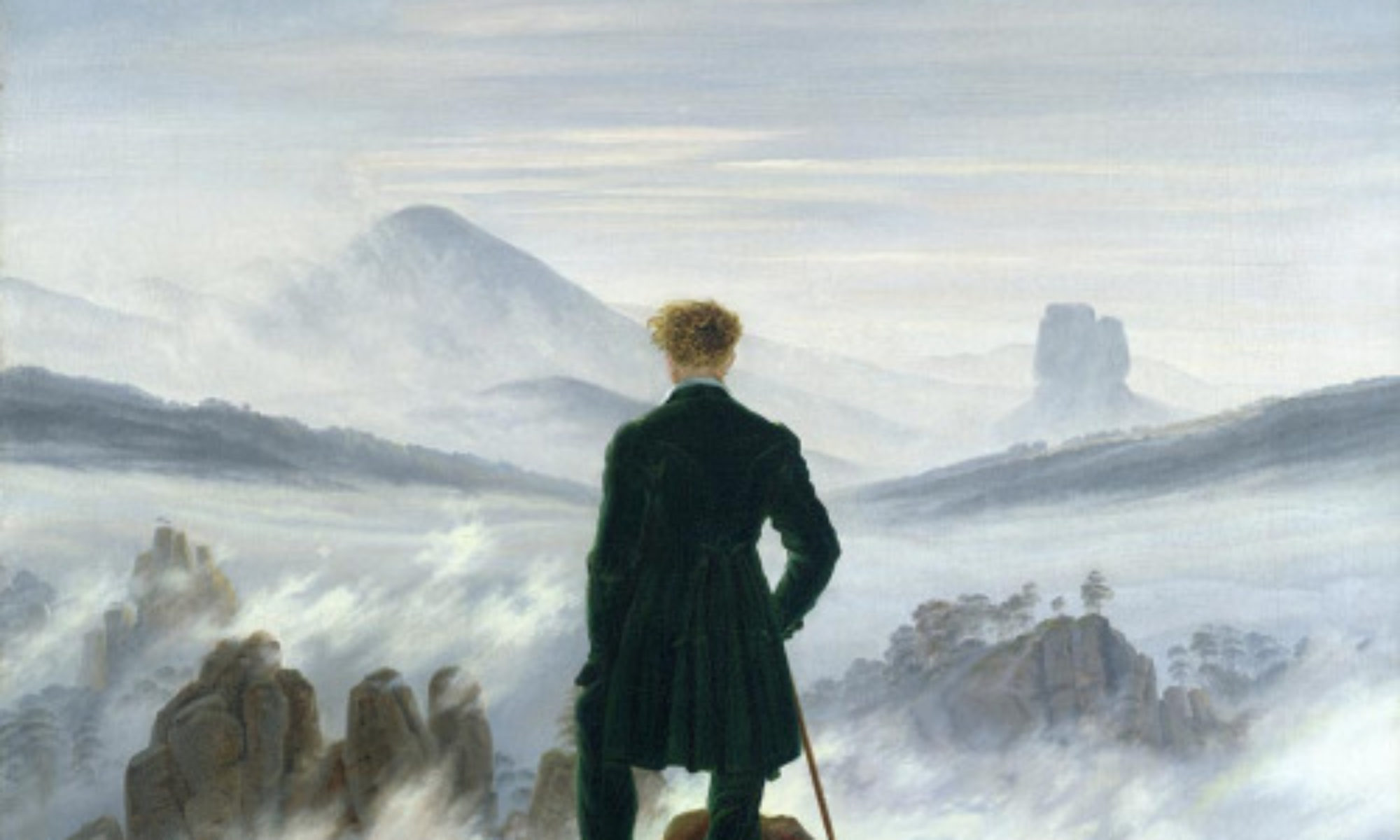
One option out of a wide array of graduate seminars to choose for this current Spring semester ranging from the theory heavy to the literature heavy, and usual contenders (i.e. my much beloved courses on Modernism and the 18th c. novel) stood out among the rest in sheer ambiguity: the public humanities. The seminar is an interdisciplinary course that includes graduate students from various departments. Continue reading “The Romantic Reply to the that Terrible Question: Valuing the Humanities”
Ancient Pedigrees, Old Trees and Numinous Rocks

In Edmund Burke’s attack on the “metaphysic rights” (152) of men that inspired the French Revolution, he urged Britons to look to their “breasts” rather than their “inventions” for the source of liberty. Burke deployed the language of sensibility to naturalize a political system organized around the idea of heredity. The argument goes that inheritance binds English citizens to their constitution with the instinctive force of a bond of kinship. But Burke has to admit that the awe-inspiring aspects of the state –its “pedigree and illustrating ancestors” (121)—are just so many “pleasing illusions” that make “power gentle, and obedience liberal” (171). Psychologically, however, Britons need these institutions because they have so thoroughly internalized the principles that they represent that those principles have become second nature. What keeps property and political representation in the hands of the few is what ties Britons to a shared past and future. Burke’s logic would be like Foucault’s if Foucault had wanted to celebrate the panopticon. Continue reading “Ancient Pedigrees, Old Trees and Numinous Rocks”
"We are here!" Interstellar Messages and Why the Humanities Matter
By Caroline Winter
Why study the humanities? It’s a question that doesn’t seem to go away no matter how many times it’s answered or in how many different ways. Here, I’d like to propose yet another answer, one that also answers a related question: why study Romanticism? This answer was inspired by two videos about science, of all things: an episode of Neil deGrasse Tyson’s series Cosmos: a Spacetime Odyssey, and a YouTube video in the Vsauce series that describes our efforts to send messages into space, in the hope that we’re not alone in the universe.
Continue reading “"We are here!" Interstellar Messages and Why the Humanities Matter”
A Bird’s Song, and Two Men Divided by Death, United by Age
 It’s nearing the end of the year, finals are over, papers are due, but we’re literature majors here, so of course the only thing that matters is the symbolism of winter. The year is dying and ready to sleep forevermore — bringing in its death a spark of new life, new possibilities, and the mass cultural/capitalistic orgy that is the Christmas season. Parting with the cynicism, however, I decided that rather than construct coherent argument, I would instead remember a moment from one of my Romanticism courses and muse on the experience. Continue reading “A Bird’s Song, and Two Men Divided by Death, United by Age”
Teaching Close Reading: Nietzsche, Metaphor and Romantic Poetry
This fall, I’ve been assigned to instruct a class called ‘Introduction to Writing about Literature.’ While the course is designed to transmit a specialized skill-set (textual analysis), it’s not organized around a historical period, event, or philosophical discourse. As an instructor, I’m required to jump around—across periods, genres and continents—in an effort to give students the most comprehensive possible familiarity with literature in English. The only thing that holds the course together is a persistent focus on form and figuration. This is both liberating—it’s great to get close to some of my favorite texts in the classroom–and a little terrifying—unmoored from thematic, historical and philosophical contexts, I’ve found myself wondering if I know anything about how literary language works. In this post, I’ll outline some of the theoretical and pedagogical dilemmas I’ve bumped up against teaching close reading and then explain how I’ve decided to talk about metaphor and figuration in my requirement-level lit course. Though the post turns on my own experiences, I’m hoping that the problems and solutions that I address here may be relevant to readers working out their own ideas about how to teach and test close reading skills.
Continue reading “Teaching Close Reading: Nietzsche, Metaphor and Romantic Poetry”
Dear Mr. Southey, Jump in a Lake: Byron and Epic Humor

There’s a recurring question that springs to mind whenever I sit in the Starbucks in the Barnes & Noble in my little East Texas town and stare up at the mural of authors who all seem to have transcended time and space to have coffee alongside the hipsters: who put Oscar Wilde next to George Eliot, Rudyard Kipling, and Trollope? Seriously, is it any wonder that the man looks so bored? Wilde shouldn’t be surrounded by those Victorian fogies, he should be sipping gin with Truman Capote, Christopher Hitchens, Walt Whitman, and the one man who would almost certainly guarantee a good time, and who also happens to be the focus of this  essay, George Gordon, Lord Byron. The reason for such inclusion is simple: Byron could be an absolutely trenchant satirist when he wanted to be. Byron, like Wilde, Capote or Hitchens, could bring out his own breed of sharp wit whenever someone at a dinner party decided to be cleverer than him, only to be left decimated in a single sentence by his superior rhetorical ability. I know this is a platitude, but sometimes I really wish I could have been a fly on the wall whenever Byron let loose one of those glorious aphorisms that sealed his entrance into the hall of “Truly Spectacular One Liners,” if only to see and understand how it was that Rodney Dangerfield sealed his membership before the poet. (Then again, when you’ve starred in Caddyshack, your “Immortality card” is pretty much secure, unless you’re that blond kid who was the protagonist, and does anybody have any clue what happened to that guy?) Continue reading “Dear Mr. Southey, Jump in a Lake: Byron and Epic Humor”
Sleep, Dreams, and Poetry
Endymion is one of the funniest heroes in Romantic poetry, mainly because he is so frequently fainting and falling asleep. He sleeps so often that I struggle to separate his waking and sleeping, a common problem for Keats that I want to talk about in this post. I have written previously about shared feeling and cognition, and dreaming is a particularly interesting case study for these topics, I think.
Let me catch you up to the ideas I’ve been toying with for my dissertation. I have come to believe that for Keats communion across time and space is enabled by acts of reading and the shared feelings reading encourages. Feelings circulate, via a text, among the bodies engaged in acts of reading (or other aesthetic experiences), and feeling is always an embodied cognitive experience. Therefore communion is realized (not just imagined) in the embodiment of transferred or circulated affect, a reactivation or revitalization of feelings in the moment of reading. From these assumptions, I begin my study of sleep and dreams. Continue reading “Sleep, Dreams, and Poetry”
The Art of the Book and Romanticizing Landscape
For several months now, I have had the pleasure to work on a project with my friend and fellow artist Cat Snapp. On a Texas summer evening, we discussed over dinner our overlapping interests in the outdoors and the influence it has on our work. Through connection to the geological past or ties to personal culture, we each use print media to speak about the personal, historical, and psychological relationships we have with the world around us. At a certain point, we realized that the project that would best unite our voices and express the feeling we wanted was a letterpress printed artist’s book. It has the power to be intimate with the reader, yet it transcends the starkness of simple text on a page – it can reach into places travelled and landscapes desired.
Continue reading “The Art of the Book and Romanticizing Landscape”
Guest Post: Reading, or Ardor
By Andrew Welch
Rereading Keats’s Poems of 1817, I’m struck by how many pieces belong to the noble & distinguished tradition of poetry that frets about its own inadequacy. Keats begins “To My Brother George” in accordance:
Full many a dreary hour have I past,
My brain bewilder’d, and my mind o’ercast
With heaviness
What’s wrong, dear Keats?
I’ve thought
[…]
That I should never hear Apollo’s song
[…]
That still the murmur of the honey bee
Would never teach a rural song to me:
That the bright glance from beauty’s eyelids slanting
Would never make a lay of mine enchanting,
Or warm my breast with ardour to unfold
Some tale of love and arms in time of old.
Continue reading “Guest Post: Reading, or Ardor”
Guest Post: Ways for English Graduate Students to Scare Landlords with Terrible Fridge Magnet Poetry
By Katherine Magyarody-Sigal
A few days ago, I climbed the stairs to my apartment and encountered my landpeople, who let me know that they had been in to check on some electrical wiring. They are extremely nice and shy about coming into our space. Anyways, I made it up the final flight of stairs and dumped my bookbag onto the kitchen table. And I looked over. And I froze. And I hoped that in their journey across the apartment, they did not look at the kitchen table and did not see the cookie sheet there, on which I had composed the worst fridge-magnet poetry ever. Poetry…not even poetry…words that makes me seem delusional, lovelorn, possibly homicidal. It begins:
if nevermore
I mourn that kiss
my silent scream
will make him howl Continue reading “Guest Post: Ways for English Graduate Students to Scare Landlords with Terrible Fridge Magnet Poetry”