One of the great advantages we have as scholars is the opportunity to form communities beyond our institutions — not just at annual conferences in remote locales, but also in ongoing conversations on the web. These online communities are fora for scholarly dialogue and informal queries, requests for crowdfunding special projects and historical sites, and repositories of archival material. Here’s a brief roundup of selected sites, listservs, and communities available to Romanticists (and if you know of more, please get in touch!). Academic listservs:
(1) NASSR List — the list of the North American Society for the Study of Romanticism (subscription required). The list is frequented by many major scholars in the field, but also graduate students and junior faculty; this is a particularly excellent resource for answers to obscure and arcane historical questions, and for links to major awards and opportunities in the field. Continue reading “Romantic Web Communities”
By Andrew Welch
Rereading Keats’s Poems of 1817, I’m struck by how many pieces belong to the noble & distinguished tradition of poetry that frets about its own inadequacy. Keats begins “To My Brother George” in accordance: Full many a dreary hour have I past, My brain bewilder’d, and my mind o’ercast With heaviness
What’s wrong, dear Keats? I’ve thought
[…] That I should never hear Apollo’s song
[…] That still the murmur of the honey bee Would never teach a rural song to me: That the bright glance from beauty’s eyelids slanting Would never make a lay of mine enchanting, Or warm my breast with ardour to unfold Some tale of love and arms in time of old. Continue reading “Guest Post: Reading, or Ardor”
Since beginning to write for this blog, I’ve been thinking back to a paper I once wrote on Keats’ “Ode to Psyche.” The poem is fascinating to me because of the way it describes the poet’s mind as a sort of bower in which Psyche may live. I’ve written a poem in response to this image, although I’m not so much interested in the poem itself (it’s not exactly Keats!) as in how it has allowed me to think more about the mind as a growing thing. Continue reading “Poem: When I consider the mind”
The Problem:
As sometimes happens when reading Romantic literature, I recently came across a chance reference to something that seemed uncannily modern. In A Vindication of the Rights of Woman (1792), Mary Wollstonecraft begins suddenly to comment on the practice of tattooing among “weak-minded” women:
I agree with Rousseau that the physical part of the art of pleasing consists in ornaments, and for that reason I should guard girls against the contagious fondness of dress… When the mind is not sufficiently opened to take pleasure in reflection, the body will be adorned with sedulous care; and ambition will appear in tattooing or painting it. A Romantic-era girl imprudently reading a novel
What?! Wollstonecraft!! Should I be adding sleeve tattoos to my mental image of flighty young ladies prancing around Almack’s in gauzy empire-waist dresses? Continue reading “A Mystery: Romantic Tattoos”
I’ve lately been dabbling in cognitive cultural studies in efforts to understand the physiological registry of emotions and how the second generation Romantics theorized the phenomenon as embodied or immersive reading. I thought for this post, I would give a little background on how I got to this area of study and why scholars have linked it to eighteenth and nineteenth century British thinkers and Romantic poets, in particular. I limit this post to Gabrielle Starr’s work, as her book Feeling Beauty focuses on the cognitive processes involved in aesthetic experience, and I am particularly interested in the aesthetic experience of reading poetry. Continue reading “Fellow-Feeling, Cognitive Science, and Keats”
With New Year’s Day behind us, the holiday season may seem to be over… but the great Romanticism-inspired festivals of the bleak midwinter are just beginning. With its plethora of anniversaries, birthdays, saints’ days, and bicentennials, January offers many occasions to host scholarly-themed celebrations that will brighten up your new semester! Below is a sampler of top hits: 2015: Celebrate Artistic Bicentennials with This Reading List
Wordsworth, Collected Poems and The White Doe of Rylstone
Scott, Guy Mannering
Austen, Emma
Peacock, Headlong Hall
Byron, Hebrew Melodies
Shelley, Alastor (written 1815; published Feb. 1816)
Malthus, An Inquiry into the Nature and Progress of Rent
Schubert, Der Erlkönig Grimm’s Fairy Tales, vol. 2 Continue reading “Romantic Midwinter Festivals”
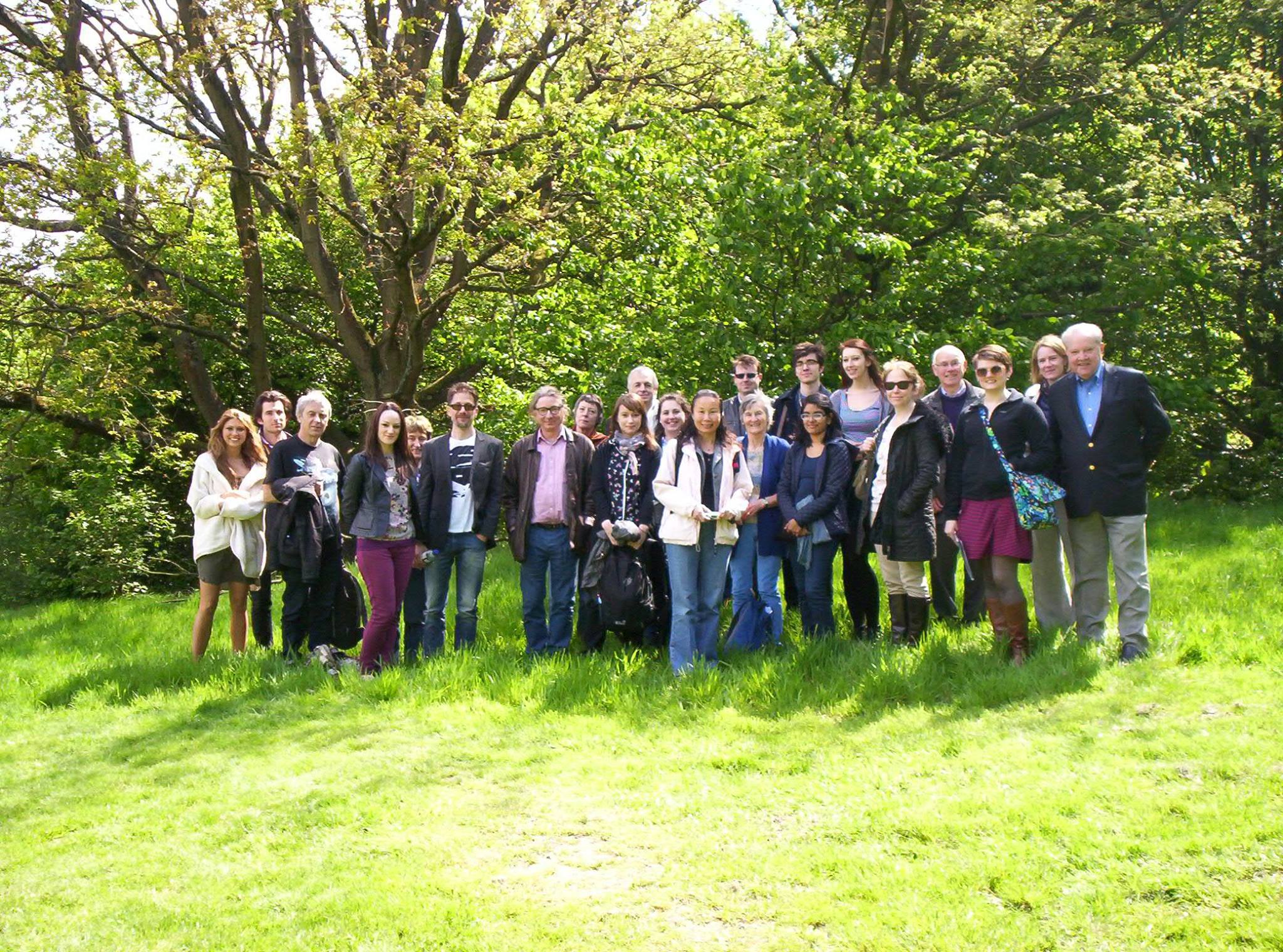
May 3, 2014: Keats and His Circle Conference participants on Hampstead Heath. Not all of us, but quite a few!
Hello and happy summer! Since I last blogged, I passed my Ph.D. comprehensive exams and spent two weeks in England. I presented at the Keats and his Circle conference along with my fellow blogger, Arden Hegele, and of course the conference was everything a Keatsian (or Romanticist) could wish it to be. Our weekend at Wentworth Place came complete with three days of really smart and innovative Keats studies, phenomenal featured lectures, and a “Keats walk” through Hampstead. But what I will talk about today is what I learned in the week after the conference. Continue reading “Archival Research: The Poetic Personalities Of Keats And His Circle”
Perhaps surprisingly for its canonical status as a tale of romantic love, Pride and Prejudice (1813) is governed by many distinctly unromantic states of negative affect. Distress, embarrassment, depression, shame, and disbelief are all integral to Austen’s portrayals of character. But one emotional state stands out as being distinctively Austenian: mortification. Elizabeth Bennet is “most cruelly mortified” by her father; Kitty experiences “mortification” at the Forsters’ preferment of Lydia; Darcy feels “incredulity and mortification” at Elizabeth’s initial rejection, and later, “trouble and mortification” as he searches for the renegade Bennet sister in London; and even Miss Bingley “was very deeply mortified by Darcy’s marriage.” Most famously, at the scene of the Netherfield ball, Elizabeth’s “mortification” accrues with each outrageous Bennet performance, and she even enters into “dances of mortification” with Mr. Collins. The Austen reader might well ask, what is this state of mortification, and why is it such a key term for describing Austen’s characters?
As a synonym for silent humiliation, “mortification” has a particularly Romantic shade. The term had been used in Shakespeare’s plays, and by Swift in his “Drapier’s Letters,” but it appears considerably more frequently in the prose fiction of the early nineteenth century. Walter Scott’s Rob Roy (1817) features its narrator, Frank Obaldistone, claiming that he is “Not mortified, certainly not mortified”; Amelia Opie’s short story “Mrs Arlington: Or All is Not Gold that Glitters” (1818) describes one character as “humbled, offended, mortified, and self-condemned”; and other works by Maria Edgeworth, Charlotte Smith, and Clara Reeve all feature mortification as a key term for describing the emotional plights of society heroines. But “mortification” seems to be an especially potent term for Austen. In Northanger Abbey and Persuasion, published together in 1817, the term appears at least 8 times, and Austen typically modifies it to increase its severity: Catherine Morland experiences “deep mortification” and “severe mortification” at a ball with Henry Tilney, while Anne Elliot, shocked by Captain Wentworth’s sudden appearance, “fully submitted, in silent, deep mortification” to his comment that her person is altered beyond recognition. As with Elizabeth and Darcy, both Anne and Catherine must experience mortification, and especially public mortification, as a key stage in their trajectory to marital bliss.
Where did Romantic-era mortification come from? Austen’s repeated uses of the term are fascinating, since “mortification” occurs much more often in non-literary Romantic fields. Rather, the term could refer to a religious practice of personal deprivation in the interest of spiritual self-improvement: as Ezekiel Hopkins wrote in 1807, “THE GREAT DUTY OF MORTIFICATION” required personal penance, since “without mortification, no [after]life is to be expected.” And, as A Daily Exercise and Devotions, for the Young Ladies and Gentlemen (1816) suggested, “The constant exercise of mortification is another fruit of penance” and the young lady or gentleman in question might “draw” “vast fruit” from the spiritual exercises of personal deprivation, or even the “voluntary toleration of bodily pain or discomfort” (as the OED would have it).
More intriguing, though, was Romantic mortification’s medical sense, as the word for the necrosis of bodily tissue — that is, as gangrene. The vast majority of references to mortification during the early nineteenth century appeared indeed in this pathological sense. “Mortification” is a central heading in John Hunter’s seminal work on battlefield surgery, A Treatise on the Blood, Inflammation, and Gunshot Wounds (1794), and the term appears with great regularity in medical textbooks in the early 1800s. One particularly clear definition appears in Sir Robert Carswell’s Pathological Anatomy: Illustrations of the Elementary Forms of Disease (1838):
The term mortification is generally employed in this country to express the state which has been induced in a part of the body by the complete and permanent extinction of its vital properties. On the Continent, however, the term gangrene is employed to signify the same state, whilst in England it is more commonly used to denote the incipient stage of mortification … The extinction of the powers of life, the complete cessation of the circulation, and an entire want of sensibility, characterize the second or last stage of mortification, which is called sphacelus…
But what could the horrifying condition of gangrenous mortification have to do with Mr Darcy’s embarrassment? One place to look for an answer is in the medical notes of John Keats, literature’s best representative of Romantic medicine. In his Anatomical and Physiological Note Book (published 1934), Keats discusses the connections between aneurism and mortification, and — in a cautionary tale for graduate students — mentions how “Those who have been addicted to Study from Keeping up a continued determination of Blood to the Brain have often the Vessels of that part ossified,” making the scholarly brain “subject to mortification” even among “the Young.” As Keats noted elsewhere, mortification could also take place among those who “lead a life of Intemperance.” Thus, since one of the main ambitions of Pride and Prejudice is to temper the unrestrained outbursts of the romantic leads, it makes a strange sort of sense that their intemperance of character — their respective pride and prejudice — leads to mortifying social punishment.
Although he does not use the term “mortification” in his poetry (to my knowledge!), Keats, who himself experienced “occasional ridicule, & some mortification” as a result of his “Pride and conceit […] amongst mere Medical students” (in the words of his friend Henry Stephens), is perhaps the touchstone for Romantic embarrassment. As Christopher Ricks’s 1974 book, Keats and Embarrassment, discusses, “a particular strength of Keats is the implication that the youthful, the luxuriant, the immature, can be, not just excusable errors, but vantagepoints” (12). Austen, too, uses moments of mortification to give insight and perspective, and the embarrassment her characters feel is not the result of “excusable error,” but of betrayal by their biology (their desires, or, more often, their desires thwarted by their foolish relatives). Thus, it seems no coincidence that Mary Ann O’Farrell’s discussion of “Austen’s Blush” (1994), another important work on Romantic embarrassment, touches on the biological underpinnings of socially coded desire. The blush, which Austen associates explicitly with mortification (Catherine, for instance, displays a “blush of mortification”), is for O’Farrell a marker of the body’s involuntary expression beyond the socially regulated codes of signals: “Austen necessarily invokes that about the body which is most inimical to manners, what makes manners most vulnerable to disruption” (127). Thus, in my view, the affect of shameful mortification in Austen’s novels arises from the tension between the socially appropriate suppression of desire (analogous with religious mortification), and desire’s rebellious expression in the outer tissue of the organism (similar to medical mortification).
Austen’s union of the two external mortifications in producing her characters’ affect of humiliation established a convention that extended later into the century, and an interesting point of comparison is Anne Brontë’s novel, The Tenant of Wildfell Hall (1848), which uses mortification as a key plot-point. Helen Huntingdon mortifies her would-be suitor, Mr Hargrave: “I cut short his appeal, and repulsed him so determinately […] that he withdrew, astonished, mortified, and discomforted, and, a few days later, I heard he had departed for London.” Helen’s power to mortify figuratively seems also to result (indirectly) in the death of her abusive husband, Arthur Huntingdon, whose alcoholism has led to actual mortification. In his last days, Arthur experiences “freedom from pain” and “deadness to all sensation where the suffering was most acute”; Helen writes, “My worst fears are realized — mortification has commenced.” In contrast to the extremely painful affect of mortification experienced by Austen’s characters, Arthur Huntingdon’s mortification passes from the first stage, gangrene, into the painless, fatal stage of sphacelus. His death releases Helen from her personal mortification at his hands, and leaves her free to marry Gilbert Markham. As in Austen’s novels, mortification is a developmental stage through which characters must pass to reach their marital goals; but unlike Austen’s mortification, Brontë literalizes the experience into its medical form, offering a much grislier model of character shaping.
But even marriage could not keep the advances of mortification entirely at bay. Elizabeth’s vigilance in “shield[ing]” Darcy from her humiliating relatives culminates in her permitting him to speak only to “those of her family with whom he might converse without mortification.” Et in Austen ego — even at the satisfying end of an Austen novel, then, is the encroachment of gangrenous necrosis.
I think we can all agree that Keats’s Endymion (1818) was a critical and commercial failure. As Renee discusses in her post, Tory reviewers lambasted the poem because of Keats’s affiliation with outspoken radical Leigh Hunt. Although the poem’s most notorious critic, John Gibson Lockhart, notes its metrical deviations from the traditional heroic couplet form, he spends more time attacking Keats personally: “He is only a boy of pretty abilities, which he has done every thing in his power to spoil.” It’s no wonder, then, that Keats’s letters written in the months that followed show a recurring preoccupation with self-improvement, or “turning over a new leaf.” In a short letter to Richard Woodhouse (friend and editor) dated December 18, 1818, he writes “Look here, Woodhouse – I have a new leaf to turn over: I must work; I must read; I must write.” He’d repeat the phrase again that April in a letter to his sister, complaining that he had “written nothing and almost read nothing – but I must turn over a new leaf.”
Due to my unfortunate tendency to self-identify with whomever I’m reading (“OMG, Keats, I know EXACTLY what it’s like to have your work rejected and then mooch off your friends because you have no money. WE ARE THE SAME PERSON.”), Keats’s desire to “turn over a new leaf” resonates as I prepare for a new semester of graduate school in the new year. While our situations are slightly different – constructive criticism of a seminar paper not quite as devastating as the complete and utter failure of a published book – his mantra for self-improvement sounds eerily like that of a graduate student: “I must work; I must read; I must write.” In the spirit of turning over a new leaf, and hopefully transforming that Endymion-esqueseminar paper into a Lamia, I present to you my academic resolutions for 2014. I should note that many of these will be obvious to the more seasoned scholars among you, but for all of you newer grads out there, I hope you’ll find my mistakes instructive. Resolution #1: I will develop arguments from texts instead of making texts conform to my arguments.
This one seems easy in theory, but it’s something I’ve been struggling with throughout the semester. I’ll read one text – Endymion, let’s say – and then a bunch of criticism, and its reviews, letters, etc. Then, I’ll develop an idea about how Keats’s later poems revisit the same genre and politics as Endymion, but ultimately rewrite them. Except, I’ll form this connection even before I’ve read the later poems, just because it sounds so smart and will make such a good paper. Then, I’ll set about writing the paper and finally get around to reading Lamia, Isabella, The Eve of St. Agnes, and other poems (1820), and only then will I realize that the texts interact in completely different ways than I had originally thought. Of course, there’s not enough time to completely rewrite my paper, so I stick with the argument, praying that the reader doesn’t realize I made this crucial error.
So, simply put, I resolve to stop doing this faulty method of research. I’m going to let myself be confused by texts, and stop trying to develop beautiful, complex arguments before I’ve had time to fully read and think about them. If a brilliant idea pops into my head before I’ve done this, I’ll write it down, set it aside, and consider it later. As a wise professor once told me, “Always start with close reading. If you leave it till the end, it will always most certainly change your argument.” Resolution #2: I will accept that I am, first and foremost, a student.
A wise man (Michael Gamer) once told a group of English majors, “graduate students are full of themselves.” I hate to say it, but I’m living proof of this. I started graduate school last August under the impression that I was a Romanticist. In my undergrad days I was merely an “aspiring Romanticist,” but starting a Ph.D. program gave me the right to crown myself with the full title. Once I was accepted, I thought that I had made the transition from student to scholar, and deceived myself into believing that I knew more about my field than I actually do. Thankfully, the enormous ego that Michael prophesied was soon deflated when I realized a few weeks into class that, in fact, I know very, very little about the period in which I claim to specialize. Of course, this realization was accompanied was a decreased sense of self-worth, doubt about whether I was in the right line of work, and a frantic conversation with my advisor in which I dramatically exclaimed, “I KNOW NOTHING!” “That’s ok,” he assured me, “you’re a student, and you’re not supposed to. Frankly, you’d be surprised how many people in the field don’t know much either.” So, for 2014, I resolve to remind myself that I’m not a scholar yet; I’m a student. I will accept the limits of my knowledge while doing my best to expand them. Resolution #3: I will overcome writing anxiety.
This problem plagues many of us, and it’s one of my biggest areas for improvement in the new year. Sometimes, the sheer size of what I need to write, the nearness of the deadline, and difficulty of the subject matter create a Kafka-esque paralysis in which no writing is accomplished. I can tell I’m experiencing this when I go to extra lengths to avoid starting a paper, whether it’s extra research, extensive outlining, or a meticulously organized Spotify playlist entitled “Writing.” As many of us know, talking about writing and thinking about writing is not actually writing. The only way to overcome this problem is simply to write more. At the advice of many of my peers, I plan to write everyday, especially while I conduct research. There were simply too many times this year when I was tempted to end my seminar papers in the way that Milton ended “The Passion” (1620): “This Subject the Author finding to be above the years he had when he wrote it, and nothing satisfied with what was begun, left it unfinished.” I’m pretty sure only Milton could pull off that one. Resolution #3.5: I will write my blog posts on time.
This probably should’ve been number one. Thank you, Jake and fellow NASSR grads, for your patience.
Happy 2014!
When I was a junior in college, I studied abroad in England for a semester, and as part of my Modern British Poetry class, I took a literary pilgrimage to Wentworth Place, Keats’s home in Hampstead. This trip was genuinely transformative for me, as it fueled a fantasy that I was John Keats’s lover in another life (hey, we all have our literary crushes). And more importantly it began my creative and scholarly work on the poet. As I wandered room to room, swooning over the handwritten manuscript of “Ode to a Nightingale” in the corridor and tearing up at the death mask encased in the library, I hadn’t a thought of my future with the poet. But this week I received an acceptance to the first ever Keats Foundation conference at the Hampstead house. And I began to reflect back on my 20-year-old self and how she would laugh to know that she would return to Wentworth Place as a career Keatsian almost a decade later.
Over the last month, I have been thinking a lot about how identity gets organized, both my own as I am beginning to define myself as a young scholar and that of the poets I study. This all came about as I prepared proposals for the Keats and His Circle conference in Hampstead and NASSR 2014. For each of these, I am looking to begin some foundational dissertation work that looks at identity organization in the Cockney School.
Journalist, poet, and radical Leigh Hunt attempts to organize the second generation of Romantic poets in his creative works and his weekly newspaper The Examiner. Though he never writes an overt manifesto and never claims the emergent artists of Romanticism’s second generation as “his” school, I believe he constructs a clear political and artistic mission for himself and his friends. In The Examiner on December 1, 1816, Leigh Hunt published the “Young Poets” article, which announced a new school of poetry led by Percy Shelley, John Hamilton Reynolds, and John Keats (with a nod to Lord Byron). As he writes here and elsewhere, this new school was not innovative so much as restorative, returning the focus of modern poetry to “true” nature and more genuine understandings of “human nature.”
Hunt organizes their poetic identity both as an extension of and reaction to the first generation (esp. after the publication of Wordsworth’s Excursion, lambasted by Byron, Hunt, and Hazlitt as the mark of Wordsworth’s establishment allegiance). He says the new poets are continuing the cultural work begun with the linguistic and political experiments of Lyrical Ballads, a project he believes the now conservative first generation has abandoned. As he defines the cultural work to be done by his school of artists and political reformers, he touts the revolutionary power of loose versification and conversational language (he maintains that the language of conversation is the language of “true nature” and “nativeness”), but he also touts cheerfulness and sociality, as opposed to the Wordsworthian egotistical sublime–poetic insight emerging through solitude. Hunt and crew value brotherly love, charity, and a mutual support of fellow beings. And they uphold these virtues in contrast to the modern vices of extreme individualism, commercial interests, and exploitation of the disenfranchised.
As applied to this circle, the term “Cockney School” in itself demonstrates the ways in which identity gets imposed upon a person or group. Famously, “Z,” a semi-anonymous critic for the Edinburgh Review, printed a series of vicious essays on this group of liberal (and often dissenting) intellectuals from the London suburbs, titled “On the Cockney School of Poetry.” According to Z, the school was headed by Leigh Hunt, and included such figures as Keats, Webb, Haydon, and Hazlitt. His reviews frequently digressed from the work of this school, using ad hominem attacks to belittle the men with their shortcomings in class–all with the intent to discredit this second generation of Romantic artists because of their politics. Intriguingly, pieces of this class prejudice against Cockneys precedes the era, and the stereotype can be seen today in the classic appropriation of Liza Doolittle style Cockney accents in parodies of the English. A particular favorite of mine in the last year has been Fred Armisen’s portrayal of Queen Elizabeth II as a sort of Cockney thug on Saturday Night Live.
Nevertheless, the Hunt circle appropriated the qualities of this pejorative stereotype and other labels applied to them, reading into these intended delimitations a revolutionary power for greater liberty. Z complained of their inferior education, their limited knowledge of Greek and Latin, but for Cockneys like Hunt, Keats, and Reynolds translations and retellings proved more democratic, opening new worlds of knowledge and opportunity for people of middle and working class backgrounds. Chapman’s Homer introduces Keats to new peaks, new oceans, new planets, horizons previously inaccessible. Z complained of their vulgarity and obscenity, but Hunt, Keats, and Shelley celebrated sensual overflow and freedom of expression. Their poems portray this liberty literally by catalogues of sensory images and metaphorically by unconventional representations of love (sympathetic idolaters, demon lovers, love triangles, etc.).
In a trend I find problematic, Keats scholars of the twentieth- and early twenty-first centuries perpetuate a prejudice against Keats’s supposed Cockney roots, often undervaluing the politically engaged young Keats of 1816-1817. Moreover, they divorce his later work from Hunt’s influence (rightly so, perhaps, as Keats distanced himself from Hunt for numerous personal and professional reasons). As a young scholar just beginning my work on Keats’s Cockney roots, I don’t know yet to what extent I agree that Keats’s work transcends his Cockney identity. Though his 1820 volume may demonstrate sophistication well beyond the wrenched rhymes or weak adverbial descriptors of Huntian style, his thematic concerns remain deeply Cockneyfied. Romances like Isabella; Or the Pot of Basil and Lamia betray his continued resistance against a modern capitalist economy that exploits both human and nonhuman resources. And even his great ode sequence, which ostensibly celebrates a pure aestheticism, carries the taint of political agenda and historicity. The nightingale disappears, the poet awakes. He returns to a historical reality of the Six Acts, the Corn Law Protests, Peterloo, disenfranchisement, disease, and personal loss. To say the least, his 1820 volume shows a conflicted relationship with the Hunt school (perhaps a topic for another post).
Armisen’s Queen from SNL 2013
I feel immensely fortunate to have the opportunity to explore London and its suburbs again, as a slightly more seasoned romanticist, Keatsian, and anglophile. And while I will not adopt a phony Cockney accent for the duration of my visit, I will expand upon my original pilgrimage, exploring the sites that were key to the school’s development. On the list thus far, other than Hampstead Heath, of course: Edmonton, Enfield, Guy’s Hospital, and the Vale of Health. I will keep you apprised of my plans for exploration as well as archival research as the reality of this trip continues to set in.