Report from the 12th Biennial IGA Conference: Gothic Migrations

By Caroline Winter

I haven’t been to too many conferences yet, but I imagine that blithe comments about necrophilia and incest are relatively rare, and them being met with easy laughter is rarer still. Perhaps I shouldn’t have been surprised that this happened at the conference of the International Gothic Association (IGA), but I didn’t expect the atmosphere to be so lighthearted. That’s not to say that there wasn’t serious scholarship happening; to the contrary, the amount of fascinating research presented on everything from Shakespeare to Supernatural was a little overwhelming.
Continue reading “Report from the 12th Biennial IGA Conference: Gothic Migrations”

Report from the Front: Professor Jeffrey N. Cox on the Waterloo Bicentennial

June 18, 2015 marked the two-hundredth anniversary of the Battle of Waterloo, that decisive event that signaled the end of the Napoleonic Wars and, more broadly, constant military conflict on the European continent since 1756. Notable not only for Napoleon’s defeat by the combined forces of England, Prussia, and the Netherlands under the command of the Duke of Wellington and the Prince of Orange, Waterloo remains one of the bloodiest military conflicts in history with nearly 48,000 causalities in only ten hours. Yet, even more than a political turning point, Waterloo left an inedible mark on the period’s cultural productions; as graduate students studying Romanticism, we remember the battle in terms of the massive literary and artistic output it inspired. From Wordsworth’s “Thanksgiving Ode” to a theatrical production at Sadler’s Wells that included the song ‘The Bellerophon, or Nappy napped,'” Waterloo became a permanent fixture in Europe’s cultural memory. Continue reading “Report from the Front: Professor Jeffrey N. Cox on the Waterloo Bicentennial”

Behind the Scenes: A First Experience Co-Organizing a Conference

I love conferences; I might even call myself a conference junkie. I’ve been to about a dozen of them in my academic life, and I’ve enjoyed pretty much every single one: visiting new places, staying in hotels, meeting the same people over and over, getting conference food and coffee and drinks and swag… not to mention attending panels and getting feedback on my work. It’s all my favorite part of being an academic.
But, I will never look at a conference the same way again after co-organizing our department’s first Annual Literature and Social Justice Grad Conference. I have a new appreciation for all of the stuff I love about conferences, which is painstakingly planned by people behind the scenes, people who usually don’t even get to participate in much of the conference once it happens. After almost two semesters of planning and a successful final product last weekend, here is my guide to organizing a conference.
Continue reading “Behind the Scenes: A First Experience Co-Organizing a Conference”

Geology, The Sleeping Giant

Geology is ever-present and abundant in the most expansive and also the most microscopic ways. I’ve been asked to serve on a panel next month at Southern Graphics Council International with three other printmakers who also incorporate geology as major themes in their work, and I’ve used this post as a research opportunity to develop my opening remarks. There are many ways that we use the history of the earth, rocks, and the crisis of the Anthropocene to make artistic statements. Some artists approach the work through the realm of the story teller. Others realize that our societal and economic structures depend on geological resources. Still others are interested in the multitude of phenomena that shape our world to create the landscapes we see before us. In all these ways we become thinkers that overlap artistic training with scientific thought and experimentation.
Continue reading “Geology, The Sleeping Giant”

Archival Research: The Poetic Personalities Of Keats And His Circle

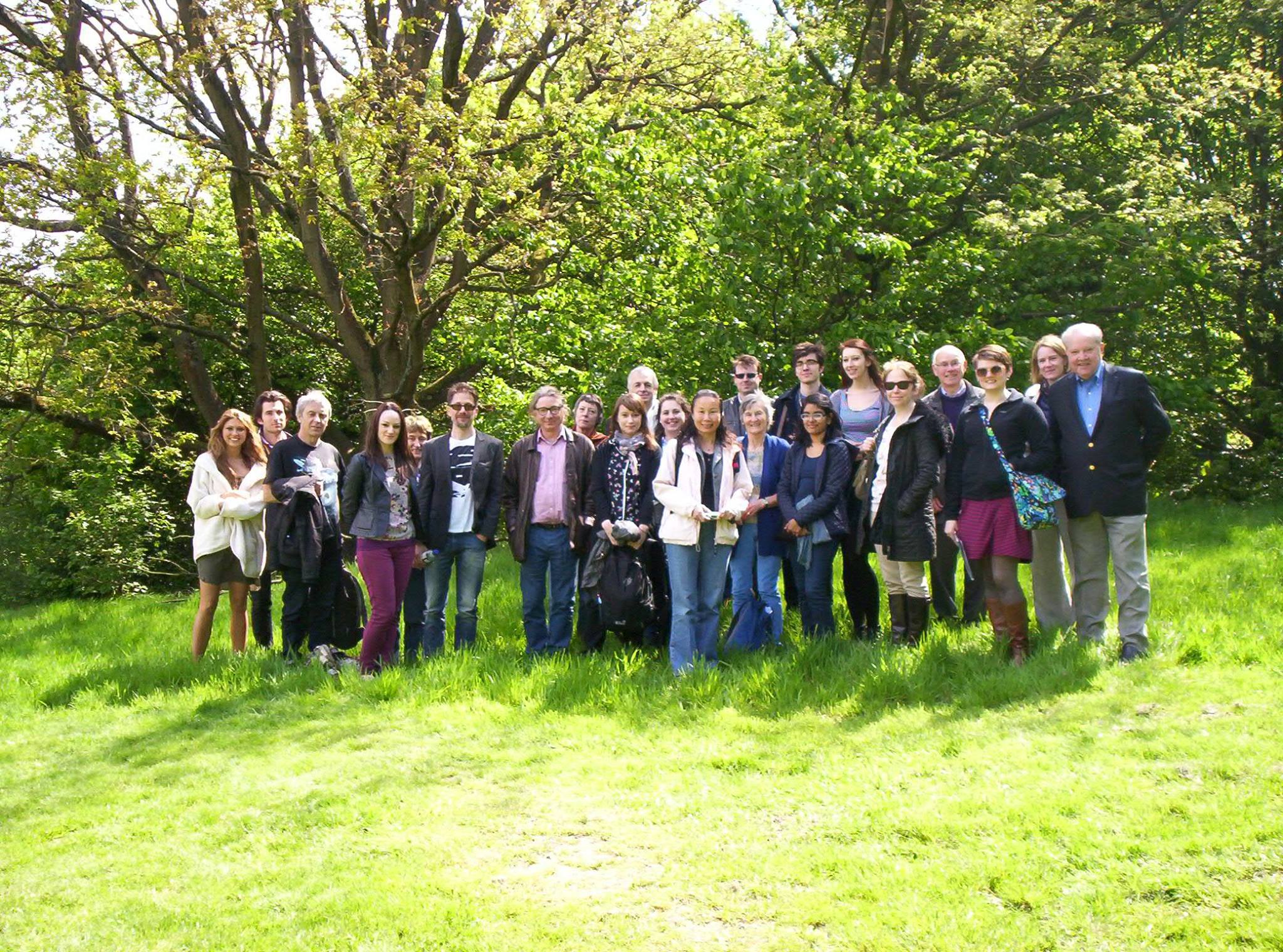
Participants on the Heath.  Not all of us, but quite a few!
May 3, 2014: Keats and His Circle Conference participants on Hampstead Heath. Not all of us, but quite a few!

Hello and happy summer!  Since I last blogged, I passed my Ph.D. comprehensive exams and spent two weeks in England.  I presented at the Keats and his Circle conference along with my fellow blogger, Arden Hegele, and of course the conference was everything a Keatsian (or Romanticist) could wish it to be. Our weekend at Wentworth Place came complete with three days of really smart and innovative Keats studies, phenomenal featured lectures, and a “Keats walk” through Hampstead. But what I will talk about today is what I learned in the week after the conference. Continue reading “Archival Research: The Poetic Personalities Of Keats And His Circle”

Reflections on NASSR 2012

I’m on the train, heading in the direction of Germany, with Lake Neuchâtel slipping by in gray-blue early morning light. The experience of “Romantic Prospects” has been saturated by landscape. From the window of our student housing accommodation each morning the Swiss Alps marched sharply around the lake, appearing to advance and retreat with the shimmering heat. Last night at the closing dinner, held at the picturesque house in which once Rousseau lived, rows of verdant grapevines crawl up steep slopes and crumbling stone-walls demarcate historical pathways. I watched swallows like scraps of silver wheel in flight.
I won’t pretend that this is a comprehensive overview of the conference because in actual fact it’s quite personal and particular. I attended many sessions, and I even chaired one for the first time. Of the sessions I attended, the conversations, debates and experiences I had, and the people I met, the very best part was prospective: thinking about a future filled with more conversation, debate, learning, language and poetry. A romantic prospect, to be sure.
Best represented at NASSR 2012 were the fields Digital Humanities, Book History, and German Romanticism, though it seemed the most popular sessions were DH and Book History. Beginning with the DH Workshop on the first day, the idea of books containing “data” (words) to be text-mined and topic-modeled took hold of many of our imaginations. The general mood about DH seemed both skeptical and intrigued, with many scholars having already implemented these fairly new (to the study of the humanities, anyway) technologies in their research.
DH also has major pedagogical implications. Using DH as a teaching tool, according to Neil Fraistat, “won’t be optional in the next 10-15 years.” Probably sooner, I’d say, as class blogs become more commonplace and Franco Moretti’s Graphs, Maps and Trees (required reading) has launched a generation of graduate students interested in “distant reading.”
The words “Book History” appeared in the title of three different sessions and the topic was a major theme in many more. From a special session organized by Alex Dick and Nicholas Halmi about “Textual Prospects: Poetry, Bibliography, and Book History,” to the “Prospects for Book History” panels 1 and 2, and evident in panels on Media Studies, “Varieties of the Novel,” and Genre Theory, the study of books as historical objects has truly permeated Romantic scholarship. Taken over, perhaps. I was interested to see how the broadening of the definition of “books” has lead to the inclusion of scrapbooks, collections of letters, keepsakes and “Books in Pieces” as Michael Macovski puts it, under the auspices of Book History. Thus the physical manipulation of books (with scissors, as Deirdre Lynch illustrated) played an important role in this conference, by providing insight into the Romantic-era readers, writers, and literary participants.
Books as nooks took center stage after Robert Darnton’s plenary lecture, “Blogging: Now and Then,” in which he illustrated the ways in which scraps of information embed themselves in the cracks and crannies opened up by communications technologies. Darnton described how printed information in the early modern and Romantic periods created places to organize their fragmentary materials—such as in the tell-all books about public figures’ private lives, in early newspapers, and in the scandalous dailies. You can read my live-blogging during the reactions and responses seminar to Darnton’s lecture HERE.
German Romanticism was also represented in multiple specific sessions. My own special research interest, the poetry of Friedrich Hölderlin, got more attention than is usual in North American conferences and in fact, the special session on Hölderlins Ströme (Hölderlin’s Rivers), organized by the Bernhard Böschenstein was completely German-language. I don’t know if non-English panels have been done before at NASSR, but it was a fitting addition to the conference’s Swiss iteration. In addition, on the panel I chaired, I very much enjoyed Elena Pnevmonidou’s paper on Hölderlin’s Hyperion and questions of language, landscape and the body.
Overall, the two academic experiences that stood out for me at NASSR 2012 were the “Romantic Media Studies” session and Thomas Pfau’s seminar “After Sentimentalism: Liberalism and the Discontents of Modern Autonomy.”
For “Romantic Media Studies,” Lauren Neefe from SUNY Stony Brook read her paper “General Indistressible: Towards a Theory of Romantic Epistolarity,” with charm, panache and sharp insight. Her paper was fascinating and her dissertation sounds even more so. Yohei Igarashi from Colgate University discussed DH pedagogies alongside ideas of Romantic perception in his timely presentation, and Celeste Langan brought an inspired reading of the efficacy of news reports in her paper “The Future of Propaganda.” This session stood out for me because it both recognized the materiality of books (in the broad sense described above) and treated texts as particular sites for close reading and critique. I found Lauren’s characterization of Coleridge’s letter to himself in the Biographica Literaria to be unique as well as creative of openings in which more questions, more avenues for investigation, and more texts to read and re-read arose. I have so many excitedly scribbled notes from that session.
Thomas Pfau’s special session was so necessary and deserves the highest praise. It was totally en point, the kind of session that is a call for change, a meta-analysis of the state not only of Romantic scholarship but of our most pressing current philosophical and political issues, and that makes a strong argument for more wide-ranging, philosophically-sophisticated and responsible. To complain of Romantic scholarship’s irrelevance to practical contemporary concerns is not to have read Pfau.
The sun is now past noon. We’ve already sped through the Black Forest and the landscape is flattening out, dotted with farms and polka-dot Austrian flower boxes. I’m left with a feeling of satisfaction and fatigue, as well as a deep gratitude for the conference organizers, Angela Esterhammer of the University of Zürich (soon to be of the University of Toronto) and Patrick Vincent of the University of Neuchâtel. Merci beaucoup, Vielen Dank, and thanks.

Digital Humanities Summer Institute: Nerds Welcome!

Full disclosure: I am a Digital Humanities Summer Institute (DHSI) convert, and I want to share the good news. I’ve recently returned from my second year attending DHSI at the University of Victoria, and I have only great things to say.

The Chronicle of Higher Education has called DHSI a “Summer Camp for Digital Humanists,” and my own experiences verify this description. DHSI is five days of glorious nerdy exploration and collaboration, and I thought it might be worthwhile to introduce the DHSI to those unfamiliar with it.


What is it?

Unlike a traditional conference, DHSI does not offer panels of 20-minute papers.

Instead, it is what its name implies—a digital training institute.

DHSI offers a wide range of courses from basic introductions to text encoding and digitization to advanced programming and mobile application design. (For a list of the courses that happened this year, click here.) Each day, participants attend roughly five hours of class. Beyond the individual courses, DHSI provides numerous opportunities to see work-in-progress presentations, attend breakout skills training sessions and discussions, and hear plenary talks. This year, it was possible to attend events from 8AM to 6PM—not to mention post-conference frivolity at one of the bars near the University. In short, DHSI is intense, invigorating, and exhausting.


Even though the programs at DHSI have been growing at an impressive rate—this year seventeen different courses were offered and more than 400 people attended—it still manages to maintain a collaborative and surprisingly intimate atmosphere.  The hierarchies that are sometimes present at other conferences are entirely absent at DHSI. The Institute prides itself on an friendly “opt-in” policy. You are encouraged to invite yourself along to other people’s dinner plans and discussion groups. It’s a great opportunity to meet both Romanticists and people from other fields.


Funding

According to the DHSI Director Ray Siemens’s closing remarks, the course offerings for next year’s DHSI will be released shortly. The dates are already set: June 10-14, 2013. As you begin to look ahead to planning the coming year’s conference and research schedule (and funding options for both), it may be worth putting DHSI in your calendar. There are many scholarships available for DHSI. For those working in the nineteenth-century, the Networked Infrastructure for Nineteenth-Century Electronic Scholarship (NINES) offers tuition scholarships. The Institute itself also offers tuition scholarships (early registration is key for these). The Association for Computers and the Humanities also offers travel bursaries to ACH members. More information will be available on the DHSI website soon.  Moreover, because DHSI offers training that is not easily available elsewhere, it may be possible to get funding from your own institution.

I already have DHSI marked on my calendar for next year, and I hope to see many more Romanticists there.

Wading Into the Conference World

As a first year doctoral student in literature at Arizona State University, there have been many occasions where I feel as if I have no idea what I should be doing (outside of my enormous course load and teaching requirements) or how I am supposed to be moving forward in what seems sometimes to be a never-ending academic journey. The last thing I want is to be bogged down with stress and forget why I signed up for this life, why I LOVE this life. I have found (at least it works for the moment) that the best way to deal with these questions, which arise on a regular basis, is to take everything step by step. As we attempt to professionalize ourselves amidst the daily hustle and bustle of the halls of the English department at our universities, submitting abstracts and presenting at conferences is an activity we need to be doing, but for those who are new to conferences like me, the whole process is a bit daunting.
Just three weeks ago, I presented at my first conference. Saying I had nervous butterflies in my stomach is an understatement. The nervousness started with the writing of the abstract, and it didn’t really subside until I got up from the presenter table and walked out the door. An abstract is a difficult thing to write but so important to our professionalization. Abstracts also are something we rarely get a lot of training on in our day-to-day course work, which makes attempting to write them a bit more stressful. Summing up what I will be arguing, or more realistically, what I hope I will be arguing in a ten page paper in 250 words is a trying activity. I’ve started to look at abstracts like movie trailers. Hit the best, most entertaining aspects and sell the readers that it is worth looking at the whole thing. And remember, every word counts, so focusing on style is important. Style is something I have been working on in my scholarly writing, and adding the pressure of the importance of style in an abstract raises the anxiety levels. But ultimately, I have been reminding myself that everyone has to write a first abstract, and it gets easier each and every time. Practice does make perfect when it comes to abstract writing. Plus, ask your colleagues or professors if they would let you look at some of their abstracts; it really helped me to see how other people prepare an abstract when I was working on my own.
Preparing the paper for the conference was probably the easiest aspect for me. I write papers all of the time—so I was confident with my ability to write a solid paper to present at the conference. The actual presentation of the paper was nerve racking, and then as luck would have it, I found out I was selected to chair my panel. I felt completely lost; I had no idea what I was supposed to do. After an email exchange with the panel coordinators and the other presenters on my panel, I was at least more confident about my roles as a panel chair: introduce everyone before their reading and moderate the question and answer section. I was hoping that my duties as the chair of the panel would keep me focused and calm my nerves before I read my own paper (but that obviously wasn’t the case ☺). Most people would suggest attending panel sessions before your own to get an idea of how the conference works. That would have been a really useful tool for me, but my panel was scheduled during the first time slot in the morning. I arrived early, found the room with plenty of time, and let the butterflies flutter. As soon as it was time to start, I introduced the first presenter and everything flowed from there. At the end of my reading it was time to start the question and answer time. I was prepared for no one in the audience (of seven people) to ask any questions, so I had thought up some of my own just in case. A colleague of mine has presented at numerous conferences and she had never been asked a question—so secretly I was hoping no one would ask me a question either. It was scary enough to read my paper, but then to have to answer more questions was a lot to think about. However, we had an enthusiastic audience that was ready to discuss the different papers. In the end, I am so glad that I was asked a specific question about my paper because it not only gave me the opportunity to discuss something I am fascinated with in more detail, but it also gave me an idea of how to adjust my paper to make it that much stronger (and my colleague had her first question too—conference success).
For all of the anxiety that I felt during the entire process from starting to write the abstract to answering the last question at the end of the presentation, it was a wonderful experience. If you haven’t experienced a conference presentation yet, you can trust me when I say, if I made it through fine—so can you. In the end, I had a lot of fun. And now I feel much more prepared for future conferences.
With a couple weeks left before many of the MLA Romanticism CFP deadlines, if you haven’t submitted an abstract yet, you still have time. If you are like me, and a novice to conference presentations doubting whether or not to send out an abstract, just jump in! And hopefully, I will see you there ☺

Romanticism: A State of the Union

Inspired by the President’s recent State of the Union address, I have decided to offer you, my Romantic brethren, a review of the state of Romantic studies. Despite our brooding Byronic ways, our Union is getting stronger. The house of cards may indeed have fallen, but our field is not languishing on the marble steps. Moneta will come!
::obligatory applause break::
The 2010 NASSR Conference in Vancouver, British Colombia took the idea of “Romantic Mediations” as its theme. Participants were encouraged to submit proposals that explored communication technologies and print culture. As the call for papers makes clear, “The era that saw the invention of semaphore, telegraphy, the continuous-feed press, and the difference engine, the Romantic in all its senses might be characterized as a period of significant experimentation in media and ideas of mediations” (NASSR). While many papers engaged with new inventions and their effects on Romantic era works – I heard an excellent paper regarding the influence semaphore had on theatrical gesturing practices – others utilized the concepts and language of media and mediation in order to offer new and perhaps more precise ways of engaging with and understanding key Romantic writers and texts.
The issues and concerns of last year’s NASSR conference are also being addressed by McGill University’s ongoing collaborative endeavor “Interacting with Print: Cultural Practices of Intermediality 1700-1900.” Founded in 2005, the interdisciplinary and interinstitutional research group headed by Susan Dalton, Andrew Piper, Tom Mole and others sets out to investigate “how people interacted with printed matter, how they used print media to interact with other people and how printed texts and images interacted within complex media ecologies.” The group focuses on the relations and interactions between various media. In order to more accurately, in its terms, “situate” print, the collaborative group sets out to debunk three prevalent scholarly “myths”: that print displaced other media, that print equals letterpress or engraving, and that print culture is national culture. In the online manifesto for “Interacting with Print,” the group claims that their “research activities will provide a more specific understanding of print’s place in the production, dissemination and reception of culture in a period that saw the development of mass media.” Print, as this quotation makes clear, was only one of many mediums for producing and disseminating culture and oftentimes incorporated other forms of media such as printed images.
Together, the conference and working research group speak to a set of issues being addressed by current critics of the Romantic period. Many scholars, including myself, have asked why this interest in media and mediation is emerging at the present moment. I believe that the answer, at least in part, lies in the new descriptions and definitions of the Romantic period and Romanticism offered by thinkers like Walter Ong and Friedrich Kittler. In his 1982 work Orality and Literacy, Ong claims that the Romantic desire for “autonomous utterance” is facilitated by print and speaks to the “alliance of the Romantic movement with technology” (158). That is, print mediates the Romantic desire for interiority and individuality. According to Ong, there is a clear correlation between the mediums of Romantic art, in this instance print, and the prevalent artistic ideology of the period. Relying on and citing Ong’s work with notable frequency, John David Black’s recent book The Politics of Enchantment: Romanticism, Media, and Cultural Studies labels Romanticism as one of the effects of print: “Coming some three centuries after the invention of the mechanical press, romanticism was the mature cultural expression of the cumulative effects of Gutenberg’s breakthrough” (134). This quotation makes Romanticism the result of the proliferation of print that started with Gutenberg’s press.
Similarly to Ong, Kittler’s landmark work Discourse Networks 1800/1900, published in 1985 in the original German and translated into English in 1990, draws attention to the relationship between media and Romanticism. Especially important to Kittler’s text is Foucault’s essay “Maurice Blanchot: The Thought from Outside.” In this early work, Foucault develops what David Wellbery calls “a lexicon of exteriority” (xii). The French thinker sets out to distinguish between language itself and “the apparatuses of power, storage, transmission, training, reproduction, and so forth that make up the conditions of factual discursive occurrences” (Wellbery xii). Like Foucault before him, Kittler’s work situates what is said or written in a secondary position and instead focuses on these “apparatuses.” His decision to title his 1987 follow up work Gramophone, Film, and Typewriter further underscores the important role communication and storage apparatuses play in his thinking. For Kittler, scholars are always dealing with media, with the technological possibilities of any given epoch because it is through the media of a given moment that “something like “poetry” or “literature” can take shape” (Wellbery xiii). As Thomas Streeter points out, Kittler “suggests that one should understand romanticism, not as a collection of texts or a historical period, but as a way of organizing discourse through practices of writing, reading, and relating” (777). Streeter and other critics, however, also feel that Kittler’s work often places too much emphasis on technologies and, at times, veers towards techno-determinism. Yet, these criticisms aside, the German thinker’s influence over contemporary literary studies in general as well as Romantic criticism is undeniable.
Clifford Siskin and William Warner’s collection of essays, This Is Enlightenment, elaborates upon the ideas present in Discourse Networks as well as Gramophone, Film, and Typewriter. The two critics argue that every history constructed by literary scholars has its benefits but a history of what they term “mediation” has the potential to “clarify both the singularity of each local event and what those events have in common” (11). They “use “mediation” here in its broadest sense as shorthand for the work done by tools, by what we now call “media” of every kind – everything that intervenes, enables, supplements, or is simply in between” (4). In this passage we can begin to see the similarities to Ong, Foucault, and Kittler’s focus on the technologies and “apparatuses” of given historical moments. Siskin and Warner, who were the keynote speakers at the NASSR conference referred to at the start of this post, show that “mediation was always necessary but the forms of mediation differ over time” and therefore there exists “a history of mediation” (9). Under this new framework, the Enlightenment becomes “an event in the history of mediation” (1). The Enlightenment was facilitated by a historically specific set of forms of mediation such as print, reading, writing, and other associational and relational practices.
Naturally, redefining the Enlightenment in such a manner leaves critics of the Romantic and Victorian eras asking what place in the new history their own periods hold. Siskin and Warner address this question in their 2011 article in The European Romantic Review, “If this is Enlightenment, Then What Is Romanticism?” According to the article, “Enlightenment is an event, Romanticism is an eventuality, and Victorianism is a variation” (290). The forms of mediation do not change or proliferate in equal measure. That is, some moments, in this instance the Enlightenment, have both a greater variety and number of forms of mediation than others. The claim that Romanticism can be seen as an “eventuality” also reflects John David Black’s claim that Romanticism is the “mature cultural” result of the Gutenberg press.
If the “apparatuses” of storage, transmission, communication, etc. are worthwhile objects of inquiry and if the Enlightenment is an event in the history of mediation, then how is the current scholar of the Romantic period to engage with and comment upon a work or a collection of works? Or, as John Richetti asks in his review of the This Is Enlightenment collection, “How would foregrounding mediation change the kinds and areas of inquiry in our own epoch?”
Yours in Romanticism,
Randall Sessler, NYU
What Does This Mean: Unanswered Questions about the Evolution of ‘Performance’

During the Performance Seminar at NASSR 2011 Jeffrey Cox and Gillen D’Arcy Wood gave presentations which resulted in fervent discussion about performance in the Romantic period and the development and growth of Romanticism(s). As the seminar continued those in the room engaged in a conversation about where performance studies is going (in and out of Romanticism); ultimately, the question was posed about just how valuable ‘performance’ is as a term, but I could hardly re-present those perspectives here. So, I’m left with my own reflection on the conversation.
I left the seminar wondering about particular facets of the conversation and spent some time since the seminar questioning ‘performance’ as a term; as I continued to work through my summer reading list I found performance to be central to many authors’ arguments. The discussion at NASSR (and my reading since then) left me asking, “Has ‘performance’ become too broad? Has the term lost its value and poignancy precisely because the field of study has expanded beyond those literal performances of the stage?”
I assure you, I do not have an answer. Instead, my hope here is to leave you asking as well, to share some of this blogger’s thinking following a NASSR seminar, and perhaps to continue the conversation that began in Park City (as there are numerous other ways to define and theorize performance beyond what I mention below).
When I arrived home from Park City I read Donald Hall’s Reading Sexualities: Hermeneutic theory and the future of queer studies; in his introduction, Hall summarizes Judith Butler’s “implication of individual agency in changing sexual and gender norms through disruptive performances” (10). He writes,

In [Gender Trouble], Butler argues famously that the specific critical and political task that her politically engaged readers should assume is to locate sites for subversion, ‘to affirm the local possibilities of intervention through participating in precisely those practices of repetition that constitute identity and, therefore, present the immanent possibility of contesting them’ (Butler 1999:188). She issued a call to arms, suggesting that gender parodies (such as drag) and other disruptive social performances might work to create a better world for queers. (Hall 11)

Lady Gaga as Jo Calderone @ the 2011 VMAs: Image from Getty Images at MTV.com

In other words, by removing the theater from ‘performance,’ Butler linked activism and the academy—she made an intellectual “call to action” which resounded beyond (and simultaneously within) the academic community, including within “social-action groups such as Queer Nation” (Hall 11). (Though, as Hall points out, Butler “backtracked quickly” just three years later in Bodies that Matter, disclaiming the political potency of parody and subversive performance [12].) No matter where Butler stands on the usefulness of her theorization, what is most valuable is Butler’s definition of ‘performance’ locatable in the every day—the unconscious and involuntary. I’ve found that thinking about and teaching social constructivism through performance—by discussing everyday life as a form of theater, by expanding the definition of ‘audience’ to those with whom we interact within our educational institutions, workplaces, and shopping malls—is quite useful for me and particularly accessible for my students. I do wonder if I could teach social constructivism without talking about performance in this way. Even if I could, would my students or I benefit from it? Why does this approach seem to resonate with students? To some degree, this notion of ‘performance’ is individually empowering.  Knowing that the way one acts out one’s life has an immediate effect on the ‘audience’ can lead to a shift in thinking about interpersonal communication—even if one accepts that these performances are involuntary and never has the idea or intention of purposefully manipulating self-performance.  This type of ‘performance’ helps some students understand that they can have agency over their performances and, to some degree, the ways that audiences receive those performances. For example, if they want to be perceived as a hard-worker they begin to act like a hard-worker, which is difficult to do without actually working hard. I think my students are willing to consider social constructivism this way because it helps them understand something more about themselves and the way they are seen in the world. (It also resonates with the materialist culture they are familiar with; after teaching  Susan Alexander’s “Stylish Hard Bodies: Branded Masculinity in Men’s Health Magazine  it became clear that the students in my Popular American culture course fully grasp this “You are what you buy” definition of ‘performance.’) However, in many ways this definition is limitless. It becomes possible to think of everything and anything as a performance. If everything is performance we (literary and cultural studies communities, those of us at the NASSR Performance Seminar) begin to question just how useful performance is, and for good reason, I think.
Even if we wanted to, could we go back to a pre-Butler definition of performance? I’m not sure that we could, though we can certainly limit the ways that we use the term to understand the histories and cultures which interest us. Kristina Straub employs a definition of performance which bridges the space between the performances of the theater and the every day. In Domestic Affairs: Intimacy, Eroticism, and Violence between Servants and Masters in Eighteenth-Century Britain, Straub “draws from performance theory, as developed by critics such as Joseph Roach” (111); her analysis in the chapter “Performing the Manservant, 1730 to 1760” includes “performances of masculinity” that “occur on both the London stage—in the dramatic characters of footmen—and in the theater audience’s sometime violent contention between these servants and their ‘betters’” (112).  Straub’s theorization of ‘performance’ “stresses the social formation of masculine gender and sexuality through repeated, publicly visible behaviors in the theater, ones that resonate with changing power relations that were more broadly played out in society” (Straub 111). This definition articulates a critical link between the stage and Main Street (so to speak); it organically connects the performances of both locations and again emphasizes the stage as a way of reading and understanding part(s) of the culture at large. It doesn’t limit the stage to a re-presentation of what is going on within larger cultural systems but makes cultural phenomena more visible to the audience/reader.
Straub’s definition offers a way of seeing the connection between the beginnings of ‘performance’ and its evolution into a concept that shapes a large number of identity fields.  With this evolution in mind, I find it difficult to restrict ‘performance’ to the study of drama. The performances taking place on the stage at my local theater are certainly not the same as those taking place in my classroom; however, understanding one paradigm has helped me to understand the other. Through its expanded purview, performance theory leads to tangible shifts in the discourse(s) of identity politics and births intellectual work that expands the fields of literary and cultural studies in productive ways. Has ‘performance’ become too broad? Perhaps it has, but I speculate that this broadness is a reflection of theoretical usefulness. ‘Performance’ isn’t a term devoid of value and poignancy; on and off the stage it has reshaped the ways that we think about identities, bodies, languages, and rituals for (at least) the last twenty years.
*Thank you to presenters Jeffrey Cox and Gillen D’Arcy Wood, moderator Angela Esterhammer, and all of the audience members who contributed to such a thought-provoking conversation!