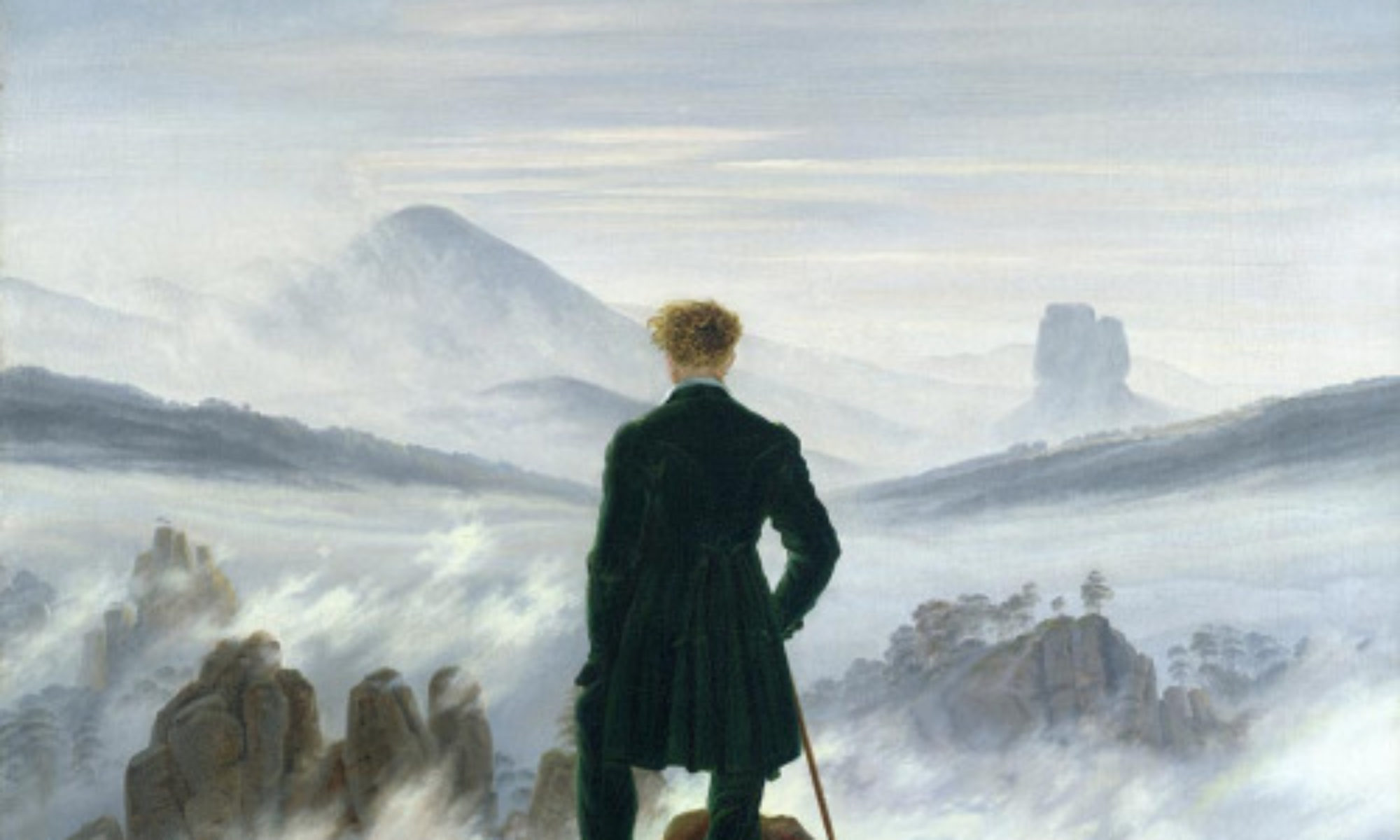
At the midpoint of the spring quarter, my first term as a graduate teaching fellow (the ‘classy’ University of Oregon term for a TA), I thought it’d be wise to use my third piece as a way to reflect on my first weeks teaching Art History, detail an icebreaker that I will most likely be using in the future (having found it pretty effective), and to speak a bit to how I’ve experienced teaching primarily from images. I’m happy to report that from the beginning, while teaching has certainly been as—if not more—challenging than I thought it’d be going in, the experience has proved even more gratifying than I could have imagined. Playing the role of initiating many of my students into the humanities has been incredibly fulfilling.
Generally, I’ve attempted to proceed from what I’ve realized is a similarly student-centered course organization and teaching strategy to that which I think Teresa expressed so well in her most recent piece, albeit on a bit smaller scale since my first-year teaching is limited to discussion sections in support of the main History of Western Art: Baroque to Contemporary survey lectures. Walking into the classroom for the first time committed from the beginning to a occupying a sort of headspace where I’d be completely open to the direction my students wish to take the discussion in relation to the materials explored in lecture really helped to alleviate the nerves I felt before teaching for the very first time.
Given the broad transnational and transhistorical nature of the course, its pace is totally relentless. As a result, I recognized pretty early the necessity of setting up my discussion sections as contraries to the lectures, meaning to promote my students’ progression in ways that connect the material to their own personal interests—given that only a handful are actually Art History majors, with the majority coming from History, English, Philosophy, Environmental Studies, and Graphic Design. It was important to me, as I’m sure it is for most teachers, that I craft a classroom experience in which information could be engaged and connected to in ways students would find pragmatically applicable to their other passions and meaningfully relevant, generally.
To establish this from the start, I decided on an ice breaker exercise that would encourage students to both personally identify with the art they’d been lectured on and with one another. Knowing that I’d have to be creative in devising a good icebreaker—since in my own experience they’ve tended to be haphazardly thought out and ineffective—two days before our first discussion section (after about two weeks worth of lecture meetings) I sent my students an email asking them to select and print their favorite image encountered in lecture to date and to bring it to class. To begin the first class discussion, after being pleasantly surprised that the vast majority of my students actually completed the assignment, I asked them to take a moment to reflect on their individual selections and think about how it might exhibit one aspect of their personalities and/or interests in order to introduce themselves and share with the class. To my excitement, the students seemed generally thrilled by the prospect of connecting to the lecture’s material they had been all too rapidly moving through in a more personal way. Thereafter, my classes rarely have had extended moments of silence, and students usually arrive eager to actively engage with the art and each other in discussion. I’d like to think taking the time to craft an unusual icebreaker might have helped, in this regard.
All in all, teaching’s been an enjoyable experience and I have to say, while I hope to be in a better position to bring literary texts into dialogue with visual art in future classes I’ll design and execute on my own as I continue to progress through the trajectory of my graduate studies and—optimistically—beyond, I’ve really enjoyed the immediacy that seems to accompany teaching primarily from images. While in my own scholarship I’m still navigating what constitutes substantive differences between verbal and visual artistic media, I’ve become taken by the way I can throw an image into one of my powerpoints that the students have yet to see previously, and have them become quickly able to engage with and describe its formalistic qualities in comparison to other paintings, sculptures, or architectural examples. I’m wondering if this can occur as easily/spontaneously when working with texts. To cite one example, when we were looking at Baroque art, one of my students brought up a contemporary American artist who she’s particularly interested in, which I was able to locate on a Google image search projected in front of the class in real time, and catalyze a fabulous discussion where we used her artist as a means to draw out some of the germane characteristics of Italian art from the 1600s. Perhaps I’m essentializing my own experience as an art historian, but I’m wondering if this is one area where classroom experience in an Art History/Visual Culture program might differ from that of an English one. As a result, I’m interested in knowing whether or not you all think there is more of a sense of immediacy in play when teaching visual art as opposed to literature (since I know that some of you do use images in your classes, as well)?
At any rate, I’ve definitely enjoyed reading everyone’s posts over these last few months and am looking forward to meeting many of you in Park City in August. The NASSR conference schedule looks really fantastic.
Grad Students In the Moonlight…
Here’s a shocker: Graduate School is a significant financial investment. Some begin graduate school with already significant school debt. A fortunate few attend schools that can afford to fully financially support their graduate students, but it’s tough to find a Master’s program that guarantees funding; even PhD programs that give tuition waivers and stipends for teaching can still require students to pay all or some of their health insurance and their student fees. We all know how many worthy things we can spend our precious stipends on—books, conferences, travel for research, rent, utilities, groceries—and we also know how quickly those stipends can run out. Fellowships and grants are fantastic when granted; loans are slightly terrifying; none of this is news. It is not my purpose today to complain or dredge up all of our financial worries; I actually feel very fortunate to spend hours of each day researching interesting things and teaching great students, and for now I find a certain bohemian charm in this life of genteel poverty. I do, however, want to acknowledge the reality that, given our financial positions, most of the graduate students I know find creative ways to supplement their income. In this season of scrambling for summer employment, I thought it would be interesting to take a closer look at the moonlighting second-lives of scholars.
In talking with my friends and fellow graddies, I’ve actually been really impressed with the range of jobs people do in addition to their teaching. Some stick close to academia, working as research/administrative assistants, freelance writers/editors, tutors, library instructors, and department office staff. Summer teaching positions at community colleges and year-round high schools level are at a premium. I feel incredibly lucky to moonlight as instructor of an online community-college Humanities course, based in another state (it’s a carryover from my previous life teaching there in person). One friend has a paid position organizing/running an annual conference. Some folks pick up short-term gigs as AP graders (a one-week commitment), and the shortest-term jobs are always welcome: just this week I received emails offering 5 hours of employment helping run graduation festivities, or two hours helping to proctor a final exam; I imagine the positions filled within seconds.
I’ve been interested to find how many graduate students take second jobs outside academia. Nannying seems to be a popular one, and a natural result of department professors seeking childcare. Bookstores and coffeeshops are favorites. Some love waiting tables. Hotel desk clerks can discreetly do homework during slow times. I even have a friend who walks dogs. Some are fortunate to have jobs directly related to their hobbies (play in a band with paying gigs, anyone?), or even to their dissertation work: one of my good friends works as a full-time administrator for a humanitarian organization that helps women in Uganda, while dissertating on contemporary literature and transnational female identity (Tackling so many things has put her “on the slow boat,” as she says, but how cool that it’s all connected!). I’m sure all you readers could name dozens more interesting odd jobs you and your friends have taken as graduate students, or various ways you save your hard-earned cash– anything to keep from selling our plasma, right? (Um, not saying I haven’t thought about it….)
The fact that grad-students moonlight is not at all strange or difficult to understand; what is strange is how reluctant I have felt to talk about it. Maybe it’s just me, but that little phrase in my offer letter, “you may not accept other University employment that would result in your being employed more than 50% time by the University unless you receive approval by the Associate Dean of the graduate school,” has had me a little bit spooked—as though extra employment, even outside the University, is at least a breach of trust, if not of contract. “A second job?!,” I imagine a shocked voice say, “How dare you squander the investment we’re making in you by not spending every spare hour in the library!”. Judging from Brittany’s last post, I’m not alone in feeling some of this anxiety. Now, there are some fellowships that do not allow recipients to have other employment during the time of support, since the point really is to enable him/her to spend every waking, working hour on research. You might want to check the terms of your own contracts, but I’m willing to bet that for average grad students with part-time teaching loads, this stipulation doesn’t apply.
This isn’t to say that holding down extra employment is easy, or that our schoolwork and/or the job don’t sometimes suffer. We all have that haunting feeling that somewhere, someone is spending more time than we are researching and writing and publishing brilliant articles—because let’s face it, that person probably does exist. Still, today I want to send a shout-out to all the folks who, like me, are cobbling together a living while also managing grad school, and might have felt a little sheepish to admit it. Way to go, I say! I think we should give ourselves a collective pat on the back for supplementing our income, minimizing our student loans, making ends meet, and acting like responsible adults. Best of luck to all of you in your summer endeavors!
Post written in early spring
Scene: Last Friday, the elevator in the English department building, 6 pm. Having just polished off this semester’s pile of marking, I was headed home to relax: watch reruns of bad 80s sci-fi, or attack the issues of Scientific American that had been accumulating on my desk since March. In the elevator, I met one of our department’s senior scholars. I asked her casually if she was also headed home for some leisure time. She looked at me—to steal a line from A Christmas Story—as if I had lobsters crawling out of my ears. She then laid out, with good-humored acquiescence, her workload over the next few weeks. Between marking, administrative duties, conference-papers, and her own research, there was no “one day / [to] give to idleness.”
The episode set me thinking about my own future as an academic. One defining feature of our profession is its status as “vocation” in the older sense, from Latin vocare: a calling, not a job. We’re not in it for the money. Dedication to liberal humanism doesn’t clock in at 9 and clock out at 5, because our quotidian commitments are simply the lens through which we focus the larger “life of the mind” we’re supposed to be living. The inculcation of this attitude in our students—the love of knowledge and its importance to creating engaged citizens—is the M-4 carbine in the humanist’s self-defense arsenal: standard issue.
All of this is well and good, but I sometimes wonder if it also enables the development of a sort of martyr mentality. We’ve all, I’d venture, participated in commiseratory gripe-sessions with our colleagues in which we detail just how much work we’ve got on our plates, how little time we’ve got to do it, and how much sleep/fun/sanity we’ve burnt on the altar of academic aspiration. These conversations are a great pressure-valve, a useful communal catharsis, but in my experience they also carry a slight flavor of underlying competition. What we’re willing to sacrifice for academia becomes, like Isaac, an index of our devotion. Standing in the elevator, having just revealed that I had indeed “clocked out” for the day, I felt a twinge of guilt: was I a bad academic? Having committed myself to this calling, was it a moral and professional lapse to want to mute that call (even for a weekend)?
I think the answer is “no,” but an answer we’re oddly ambivalent about endorsing. I literally-just-now received a facebook message from a friend postponing our coffee date to discuss the new Doctor Who: “Holidays don’t matter in Grad School. No plans, just this albatross on my neck.” Really? The albatross, of course, is hung “instead of the cross.” My friend’s comment thus casts academia as convulsive penitential submission, the mortification required of sinners who will never meet the ideal. Where did this attitude come from?
I’ve already suggested one possible source, our need to distance ourselves from the utilitarian mentality that increasingly dominates university culture. I think another might be the job market, which has gotten so competitive that it sometimes seems like the only way to land a tenure-track position is to don the albatross. My colleague in the elevator may not have gotten where she is today if she didn’t sacrifice as much as she did. I guess, if that’s what it takes. But I can’t help wondering if that level of commitment drains our vocation of what made it so attractive in the first place. After all, Wordsworth may have celebrated reading and thinking “long and deeply,” but he still nagged Hazlitt (excuse me, “Matthew”) to ditch the books and go outside.
Then again, maybe all of the above is a manifestation of my own anxieties. Have any of you encountered the attitude I’m describing, and if so, what do you think of it? What is the right balance between academic-life and other-life? On this most fitting of days to discuss martyrdom, how much academic self-sacrifice do you feel is appropriate or virtuous?
NASSR 2011 Program Draft Posted
If you will be at the 2011 NASSR Conference this summer in Salt Lake City, Utah, you can now see a draft of the conference program.
The NASSR Graduate Student Caucus Roundtable on the Job Market is scheduled to take place from 10:30 – noon on Thursday, August 11 (day 1 of the conference).
Participants will include:
- Rob Anderson (Oakland University)
- Alan Bewell (University of Toronto)
- Julie Carlson (University of California, Santa Barbara)
- Frances Ferguson (Johns Hopkins University)
- William Galperin (Rutgers University, New Brunswick)
- Jonathan Mulrooney (College of the Holy Cross)
- Juan Sanchez (University of California, Los Angeles)
Legitimacy and the Graduate Student
We’ve all heard it: “I don’t feel like I belong here”—the clarion call of English graduate students and the hyper-obsession of meta-conversations within Literature departments at the highest level. What is this obsession, and who really does belong in graduate programs or the academy, if not those who are there already? This problem has been my preoccupation for some time now, so much so that it has crept into my dissertation, in an attempt to unravel the problems of legitimacy, sovereignty, authorship, etc. embedded in Romanticism and Romantic studies.
Trying to tackle these problems as a total framework, or as a problem even at the level of pedagogy, has been met with lots of resistance. My upcoming Fall course on “Banned Books and Novel Ideas” will look at illegitimate textual problems in Ossian’s Tales of Fingal, Byron’s issues with piracy, the thorny controversies in Shakespeare and Defoe, as well as the whole regime of intellectual property surrounding Scott and Coleridge. To inaugurate this course, I began my description with the famous quote from Foucault’s famous essay which he “borrowed” from Beckett: “What matters who’s speaking?” Quite a moment of reflexivity, where Foucault not only questions the regime of authorship, but also uses a phrase that is syntactically tangled and, apparently, illegitimate. I say this because my proposal, after explanation and several revisions, was greeted with disapproval from the legitimizing force of the English department heads; Beckett and Foucault have non-standard English and tangled syntax, it was said—students will be confused and find the course doesn’t have authority! Hmmm…. I have my own responses to this line of argument, but I would be delighted to hear your thoughts on the subject. That is, how does one negotiate teaching texts that are non-standard, taboo, illegitimate etc. while still telling them that plagiarism is naughty-naughty and they must write in standard, syntactically clear English? One easy explanation is making the distinction between discursive and non-discursive texts but, in keeping with truth-telling, even that distinction breaks down with enough interrogation.
Within this same matrix of problems, I have often asked the question of how one can really integrate radical politics into a classroom space? How can one develop a quasi-democratic, anarchic pedagogy when all available models have some basis in logics of sovereignty and authority, delegitimizing certain ways of learning and production of scholarship? Your thoughts are very much appreciated, particularly in relation to your experiences of teaching problematic Romantic texts.
Organizing 2,350 Minutes
For every single 3-credit course I teach each semester I spend approximately 2,350 minutes in front of the classroom. Like most of you, before I even step foot in the classroom or meet a single student, I sit down with an assortment of desk copies—anthologies, novels and the like—and try to decide on the content of those 2,350 minutes. Before I meet my students, learn anything about their interests or goals, I must guess at what materials will interest them and help maintain active thinking and discussion throughout the 16-week semester. As the end of the spring semester approaches and I prepare for my fall course assignment, I find myself once again asking, “What does it take to plan a course? What principles guide the choices we make? How do we, as educators and students, decide what to include and what must be forsaken in the interest of time, depth and focus?”
When I received my Spring 2011 course assignment in November 2010, I was utterly elated; my assignment was English 262: British Literature II (1789-present), the latter portion of two British literature surveys taught at West Virginia University. I was wrapping up the last few weeks of English 261 (beginnings-1789), which had gone better than I expected: the texts I selected were of interest to my students and a narrative about performance and “Englishness” emerged through the texts creating thought-provoking, intellectually invigorating discussions for my students and me. (My students claimed to love the metaphysical poets…I was shocked!) The text selections for 261 successfully produced a dialogue amongst my students in ways that I could not have anticipated. (I can’t take credit for this; I had a group of students who were willing to challenge one another’s ideas in the interest of a deeper, more detailed understanding of the texts. If not for this attitude in my students, the course might have been an entirely different experience for all of us.) Because of the successes (and lessons learned) in 261, I felt confident in my ability to plan a successful version of 262; plus, I had an organizing principle: selfhood! I could not wait for the calm of winter break to organize a syllabus bursting with texts in which my soon-to-be students and I could trace the construction of the self (a national self, a Seigelian self, etc.) in Romantic, Victorian, and Modern British literatures.
As I flipped through the pages of various anthologies in mid-December, I realized I had an unexpected problem (a desirable problem, I’d say): teaching 262 meant that I was more familiar with the vast selection of texts. I hadn’t felt this way when planning most of English 261, particularly the Middle Ages unit which began the course (as the Romantic unit would in 262). I was less connected to the texts in 261, unlike the texts for 262 which are on my mind regularly. Wollstonecraft, Hemans, Keats, Wordsworth, Coleridge (to name just a few) all have a place in what makes me passionate about Romantic literature. I glanced through the list of names and works in the anthology’s table of contents and wondered how I could possibly give my students everything they’d need to be “good” English scholars in a single semester. Could I, in good conscience, skip Lord Byron in favor of Joanna Baillie? The part of me which reacts against the traditional canon screamed, “Yes! Of course!” while undergraduate me, who ached for knowledge of “the classics” and sought out courses which prepared for me the GREs (since I had hopes for graduate school) urged me to keep Byron. All of a sudden, the weight of literary history was on my shoulders; I felt like it was my responsibility to show my students why the Romantic, Victorian and Modern periods were worthy of their attention and reflection. I created one reading list and then another but found myself asking the same question each time: How can I select (and ignore) particular texts for a course which claims to survey the Romantic, Victorian, and Modern periods? What makes for a “good” survey course? I began to question selfhood as my course theme and considered abandoning the project.
I learned the hard way (while teaching 261) that many of the undergraduate students find British literature un-relatable and prefer the offerings focused on American literature. I was baffled by this division—how could students write-off an entire literary canon? Then, I realized: American literature is more popular because students are better able to connect with it! They view American literature as part of their selfhood—whether they articulate it in such a way or not, reading the literary history of their nation means something to them. It helps them understand who they are (as Americans, as future fiction/poetry/nonfiction writers, as American literary scholars). I had to find a way to make British literature relevant in the same ways without devaluing the separate (yet connected) British identity it helps to articulate. It seemed that “selfhood” might be a way in after all– a way to make the connections I was so desperately seeking. I returned to the anthology’s table of contents and selected a list of texts I thought would help place American and British literatures in dialogue with one another–hoping to show my students that understanding one aids your understanding of the other. I then narrowed that list with “selfhood” in mind. As I stared at that list I again began to question my choices: Are these the texts that students want to read? Am I selecting texts that I am comfortable and familiar with because I am comfortable and familiar with them? Does this reading list prepare my classroom of English and English education majors for the exams many of them will take to continue on their career paths (PRAXIS, GRE)?
As teachers (and lovers of literature) we want to give our students all we can but sometimes doing so is just overwhelming (for them and us). If I forced Coleridge and Wordsworth into the same 50 minute class meeting, students would be introduced to both authors but would likely miss the depth each author’s works have to offer. In organizing our courses each semester we are forced to decide whose interests will shape the course. If we choose our own interests and the texts we prefer, then our students are likely to learn more about those particular authors and texts; our familiarity with the texts means we bring a deeper understanding to the classroom (as we will 10 years from now with a vast selection of texts [after we’ve taught a few surveys]). If we select texts that are only of interest to students then it is likely that we’ll overlook cornerstones of English literature; for example, few of my students would choose Felicia Hemans (if they’ve even heard of her). Most of us seem to find a middle ground; we teach the authors we love alongside the authors we wish we could skip right over in order to provide exposure to the various voices which compose the British literary canon and to allow our students to form their own opinions about the value(s) of such voices (politically, historically, aesthetically, etc.).
By using selfhood as an organizing theme for English 262, I made a decision about the focus of the course; there is a plethora of other themes (or lack of themes) which I could have selected. However, this particular theme fit my goals for the semester (which included showing students that British and American literatures are connected and can offer them insight into understanding themselves). Not only do we have to select which texts we’ll teach, but we must also decide which themes (or theoretical framing devices) will shape the way we teach those texts. No matter what we wish we could do, it is impossible to do it all; in a single semester we can’t offer all there is to know about genre, psychoanalysis, feminism, queerness, narrative, form, etc. in relation to the texts we finally decide to include in a syllabus. Oftentimes, class discussion in English 262 ignores selfhood entirely in favor of debate about how much we trust a narrative voice or what a particular lines or phrase “means.” More often, my students begin discussion with their ideas about the role of class, nationality, race, religion, gender, and so on in a text and by the end of said discussion, they’ve linked those ideas to selfhood. Theming English 262 has not limited how my students read literature; instead, it has enabled them to connect the various ideas their peers have about a text to a concept they are all comfortable with. It has allowed them to see literature as multi-faceted and empowered them to bring their own readings to the classroom. Our best hope as educators, as course planners, is to spend 2,350 minutes inciting our students’ desire to know more, to read closer, to take risks, and to learn to love various literatures and voices!
Unabashed Admiration for the BWWC
Last week I attended the 19th annual British Women Writer’s Conference in Columbus Ohio, and I’m still on a kind of academic natural high. In the interest of full disclosure I must tell you that I went partly to present a paper and partly because I’m co-chairing the conference in Boulder next year, and thus needed to observe its workings. It was quite a large conference: 250 people, as many as 6 concurrent panels, and fantastic keynote speakers. I was impressed by the smooth operation of it all, but more than that I found myself impressed by the conference’s ethos. It was genuinely inspiring. I’m going to struggle not to gush in this post, but seriously—what a wonderful experience.
One of the most important things I realized over the three days I spent there was just how indebted I am to the scholars who have gone before me, a fact made all the more clear since many of them were in attendance! I had not realized how recently the canon of 18th and 19th century British Literature has opened to include many of the women writers now considered some of its pillars—but only 19 years ago did a group of graduate students recognize the dearth and decide to do something about it by organizing the BWWA. One speaker pointed out the importance of the tenure system, since many of those who have published books on what were obscure women writers, did not venture to do so until after they had tenure; this seemed incredible to me, but in later conversations several people I spoke to confirmed the statement. Somehow I had imagined that the women’s movements of the 1970s had accomplished all this work; realizing that it has happened in my young-adult lifetime, and that many of the scholars who brought it about are still in the midst of their careers, really humbled and inspired me. The very people I was mingling and chatting with were some of those who had made it possible for me to work on the things I’m working on. Even more incredible is that so many of them were graduate students when they began to make a difference!
This brings me to the second reason my respect for the BWWA has increased: they really, truly believe in the power of graduate students and this belief is built into both the structure and spirit of the organization and conference. Though many of the students who began the BWWA are now full professors who serve on the executive board, they entrust the planning and running of each year’s conference to grad students at the host university. Responsibilities include all the logistical things (location, lodging, food), but also the academic things like choosing and inviting keynote speakers, choosing a theme and writing the call for papers, and reading submissions and organizing panels. I was so impressed with the group who ran this year’s conference, and likewise impressed by the many expressions of trust, confidence, and appreciation the BWWA board and many of the higher-ranking conference attendees expressed to them. (And it really was a beautifully-run event; completely well-organized, and in a gorgeous location). The BWWA also strives to sponsor a few travel grants especially for graduate students, and this year they added a grant for “contingent faculty,” to reach out and include those in the tough space between graduating and finding a tenure-track position. In short, the whole feeling of the conference seemed to be one of graciousness, inclusion, and enthusiasm for everyone’s work—a real collegiality that reached across rank and age and letterhead. I chaired a panel that featured two imposing professors (one the editor of an academic journal and the other from Yale), and I was a little nervous…but then I found myself taking notes as much on their manners as on their papers, because they were so impressively gracious! Each time she was asked a question, the Yale professor would share her thoughts and then say, “Thank you so much for bringing that up! What do you think about it?” Great conversations and intellectual exchanges took place in that panel.
I do wonder what some of the male attendees thought of their BWWC experience, because the conference population is overwhelmingly female. I’m not sure whether this happens because women scholars tend to be more interested in women writers, or because the conference itself mirrors its project of creating space for the women of history to speak by creating space for today’s women scholars to speak, but it’s certainly noticeable, and in a really cool way. I find myself often thinking about how I navigate my professional life as a woman—the personae I adopt when I teach, when I write, when I present. A recent study found that when letters of recommendation portrayed a candidate (regardless of that candidate’s gender) as “nurturing” or “warm,” they were less likely to be hired than a candidate recommended as “assertive” or “independent.” The point is, gender stereotypes still materially affect our professional lives, and I know many women scholars feel a bit more conscious of playing the professional part than men do. There were more men at this year’s conference than in some years, I’m told; the BWWA board is not exclusively female, and men make valuable contributions to the organization and conference—but still, one of the really wonderful things about the BWWC was a sort of communal letting down of the hair. It didn’t necessarily feel any less professional, just a little more…down to earth, maybe? It’s difficult to describe. Conversations might as likely turn to the challenges of breastfeeding in a suit or helping a 12-year-old with his homework, as they would to Mary Wollstonecraft or Elizabeth Gaskell (and I can just imagine Wollstonecraft and Gaskell discussing the same types of things!). On a bus trip a big group of us got laughing about what “type” of academics we were—the scarf academic, the chunky-jewelry Chico’s academic, the Birkenstocks academic, the e-bay Anthropologie academic, or (in my case) the Target sale-rack academic (they have great cardigans!). Nobody felt self-conscious about ordering a chocolate martini, or savoring a crème brulée, or complimenting someone on their shoes, or gushing about one of the Regency Reenactment dancers’ crocheted gloves (yes, we enjoyed a performance of Regency dancers). It was sort of like a super-smarty-pants girls’ weekend out. One professor who has attended the conference for years called it her “Old Girls’ Club.” While I generally feel pretty good about the respect shown to women in academia, there is still something to be said for female friendship, and I would say I really did make friends at the BWWC.
In all, I came back from Ohio with newfound respect for what the BWWA does and how they do it, as well as perspective on how the work we do as graduate students can palpably, materially affect the profession for good. Building the Association has clearly been a labor of love for those who have participated in it, and I’m excited for the opportunity to make my own contribution throughout this next year. Our committee here in Boulder will be pouring our hearts into planning the 2012 conference, to make it just as great of an experience for future attendees as I had last weekend—and even when our turn is over, I look forward to participating with the BWWA for many years to come.
Reading Suggestions for Grad Seminar
New Graduate Course Help entry on Romantic Circles Pedagogy Blog. Dr. Katherine Harris asked for our help recommending reading for her graduate seminar. Respond on her blog post at http://www.rc.umd.edu/pedagogies/pedagogies_blog/?p=264.
This Fall, I’m teaching a graduate course in Romanticism. The last time I offered a graduate course(2 years ago on William Wordsworth), it was cancelled for low enrollment (only 7 signed up; I needed at least 10). This means that an entire generation of our MA graduate students haven’t had any Romantic-era literature for their comprehensive exams. (The last class I taught in the graduate program was in 2008 and that was on Madness & Romanticism, based on an article I wrote for an Alexander Street Press database.) Most of the time, I hear them say that they had a Romantic-era survey in undergrad and don’t need a grad course in Blake, Byron, Keats, Shelley, Wordsworth, or Coleridge to pass the exams. Grad courses specifically do not cater to the comprehensive exams, but it’s been difficult erasing this culture from our program. They will take a Victorian course and read all of Middlemarch and 3 or 4 Dickens novels, but Romanticism falls flat. For the Fall, I have no shame; I will resort to bribery and pop culture-isms to attract students to this course.
Yes, dear Teaching Romanticism Collection, I am asking for your help. I want to teach a course on the development of aesthetics in Romantic-era literature — based on the summer NEH seminar with Stephen Behrendt. The readings will be based on those from the seminar plus any travel diaries, travelogues, ships’ manifestos, letters that involve this idea of travel. The title:
Eat, Look, Go”: Romanticism, Aestheticism, and the Sensualism of Travel
All of the usual suspects appear in the primary reading (MWS, PBS, STC, WW, DW, MW) but who else? Any suggestions? Perhaps we could create a map of their travel (staying with the digital theme that I typically incorporate). Or maybe I should kick it old school and just have them read, interact with the literature. I’m not quite sure how to get eating in there, too.
Any suggestions?
Against Standardized Curricula, or Romanticists Un-Bound
One thing I’ve noticed in Romantic studies is that most romanticists seem to have some interesting interdisciplinary bent to their work. From Romanticism and dance, to Romanticism and science, sociology, psychology, philosophy, and women and gender studies (to name just a few iterations of the interesting work some of the colleagues I’m closest to here at the UofO and elsewhere engage), there seems to be something wonderfully multivalent about the work romanticists tend towards. However, I’ve found that relative to my own work, existing on the (however well-tread) margins of Art History and English, I nevertheless find myself constantly pressing against limitations imposed by graduate curriculum requirements. Perhaps it’s because I’ve been thinking a lot about independence as of late, but I’ve found that breadth requirements, particularly in graduate school, tend to follow like a tedious argument of insidious intent. What curricula say to me is that I’m incapable of creating an effective, efficient, and—perhaps above all—enlightening trajectory of course work, for myself.
Like most graduate programs in established academic departments in American universities, my Art History program up in Eugene is designed around an extensive list of requirements. Specifically, we take: (1) A first-year seminar in the theories and methods of the discipline, (2) two first-year seminars on special topics germane to the research of the professors leading the seminars (offerings for my cohort included “text and image” [a definite ‘win’ for me!] and artistic “intention and interpretation”), (3) three first-year practicums (first, library research methods in Art History, then a faculty works-in-progress lecture series, and third a workshop geared towards expediting thesis proposals), and (4) four breadth requirements, satisfied by taking a course in the areas of ancient, medieval, Renaissance/Baroque, and modern art. As one might imagine, when one’s entire program (as is the case at the University of Oregon, where graduate studies in Art History are almost entirely geared towards the M.A. level) essentially consists of twelve-courses, with seven of which needing to be geared towards program requirements, and practicum work absorbing a number of hours per week plus teaching responsibilities on top of all that, one might end up feeling like “Time’s winged chariot” is constantly encroaching on one’s studies.
I definitely do, particularly when the most applicable coursework for myself might be offered outside my department when dealing with the long nineteenth century, new media studies, critical theory, etc. Yet, I’m inclined to believe this problem may pervade Romantic graduate studies, in general, when we might otherwise be able to create a most effective and more richly transdisciplinary trajectory for our studies, were we less concerned with fulfilling requirements than exposing ourselves to the most diverse and provocative ideas and methods possible.
This isn’t to say there’s no elasticity available here for the “picture-people” at Oregon (for instance, in my program our advisors can approve a specific term paper project for a general class as a means to satisfy an area requirement). But, it is to say that perhaps as graduate students, we ought to be afforded extensive—if not total—liberty in planning our individual curriculums, particularly if it takes place in close consultation with an advisor within our respective fields.
Loosening up curriculum requirements, moreover, has the effect of helping to ameliorate the never-ending feeling of being time-crunched that characterizes the work we’re up to as graduate students. When curriculum requirements are reduced to the greatest extent possible, students become able to gear their course work to their own interests, professors teach to their strengths, and I’d argue the likelihood of productive academic dialogue occurring becomes much increased. A criticism of this thinking, however, would of course have something to do with how required course work brings students into an engagement with a standard canon of knowledge that—however slippery the definition necessarily becomes—is always at play (e.g. if the student of Art History hasn’t learned to fully appreciate Michelangelo’s work, or if the student of English hasn’t taken a course in Shakespeare—with what has their education endowed them?).
Yet, I’d respond that the assumption underpinning such a response would be that course work is where—at least before a certain level I’ve yet to hear adequately defined—development takes place and that this development can then be neatly documented/packaged on a transcript. I maintain that by disbelieving students will find their individual paths to the images and/or texts that define an academic discipline and field of specialty, is to show a lack of faith in students’ own abilities that, if they’re well-taught, they’ll have already cultivated.
In conclusion, I think the general idea here, that curricula should be individualized and self-directed, gestures towards the fact that across the arc of my academic development, I’ve become increasingly of the opinion that people thrive on freedom—particularly when it comes to academia (wouldn’t this be a truism in any other context?). Allowing people who do good work already to be cut loose so as to exert their brilliance in whatever ways best reflect themselves potentializes cascading flows of change and transformation, stemming both from ourselves in our own work and from the way we interact with others in similarly liberated intellectual positions, across paths of students’ own choosing. The student becomes best able to take ownership of her or his own learning as she or he assumes responsibility for the course of study. From my point of view, the existence of curricula, particularly in graduate education, moves to predictably map out and contain, thereby curtailing, forms of intellectual growth that are necessarily indeterminate and always self-directed. All of this being said, I’m definitely excited by the way so many of my friends in interdisciplinary studies are stepping out of, and pushing against, institutional boundaries in their research and am eager to see how the field’s terrain shifts in coming years.
Bankrolling Education
I began my first post as a member of this blogging community as a reflection on course organization, but as the week progressed it has been impossible to ignore some of the larger issues facing higher education—Romanticists and non-Romanticists, faculty and students, graduate and undergraduate students alike. Public institutions around the nation are asking if they will have state support next year—support that (although less substantive than it was in the past) most state colleges and universities rely on.
Faculty members at various state institutions have made a stand this week, protesting the massive state budget cuts affecting education. For example, as reported by Slippery Rock University’s newspaper, The Rocket , students and faculty at Pennsylvania State School of Higher Education’s Slippery Rock University rallied together in protest of the proposed 51.4% budget cut. Meanwhile, in New York, thirty-three people were arrested during a non-violent protest. The proposed budget cuts in New York will reduce the budget of CUNY’s senior colleges by $95.1 million and community colleges by $17.5 million. Why should we all be concerned with the finances of these state institutions, you ask? Well, because these seemingly isolated incidents help to create a narrative about the importance of education in America. Educational funding is often framed as party politics or treated as an investment in some imagined future (raising/teaching the next generation, forming a future America). Perhaps those are both true but as a graduate student who learns with and teaches nearly 150 students a year, I’m most interested in how such changes dictate who is and is not able to attend college. State (and federal) funding opens or closes the doors of higher education for many Americans. If states’ education budgets are slashed in the ways proposed, universities must find a way to stay in the black. Who will bear the burden? How will our classrooms be affected by such changes, if at all?
I was recently asked a set of questions meant to provoke interesting material for a banquet introduction. One of the questions asked, “If you could rid the world of one thing, what would it be?” I thought through all of the typical answers: violence, bigotry, misogyny, hunger and disease. I even considered the entirely selfish answers: deadlines and comprehensive exams. In the end I decided my answer was college debt. Not only because I’d love to relieve my credit report of this particular burden but because I believe that education should be accessible for those of us who would like to learn. Education should come at a price—the loss of ignorance, some serious intellectual exercise– but it seems unjust that the cost of education should be a lifetime of debt. Many of us excuse such debt by calling it “good debt,” but deep down we know there is no such thing. If college loan debt were good debt then it wouldn’t prevent my cousin from qualifying for a home loan, especially since he works a full-time job that he is qualified for because of his college education; but that isn’t the case, he cannot buy his first home because his educational debts make it impossible for him to do so (and he attended a relatively low-cost state institution). The Chronicle of Higher Education recently reported on the Pell program, which provides “need-based grants to low-income undergraduate and certain postbaccalaureate students to promote access to postsecondary education” (which means that unlike loans, they do not have to be repaid). Even though the Pell program, through Congress’s continued support, has been able to
keep up with both inflation and a surge of new college students…low-income undergraduates are actually much worse off than equivalent students were 30 years ago. A student without a Pell Grant in 1980 paid less out of pocket to attend a public four-year university than a student with a Pell Grant pays today. That’s because between then and now, the cost of higher education has grown far faster than inflation. As a result, the federal government has gone from bit player to major investor in the educational part of higher education, to the point that it’s starting to rival states in the magnitude of support.
As state budget cuts continue, the reliance on federal support—through programs like Pell, FAFSA, and so on—will increase (as will educational debt). Students will be forced to make difficult choices about the financial viability of education. Whether we are (graduate) students and/or teachers at state funded universities or not, it is important that we advocate for education’s financial accessibility. None of this is new to those of us who annually navigate(d) those annoying, tax-like FAFSA forms in order to pay tuition bills. Even more familiar and heartbreaking are the pleas from students, “I just need a B in your course or I lose my (often state or federally supported) scholarship!” Robert Reich’s recent article might best summarize the importance of education, “Over the long term, the only way we’re going to raise wages, grow the economy, and improve American competitiveness is by investing in our people — especially their educations.” The ways that our governments approach, support, and finance education does and will continue to shape our classrooms.
Finally, hello! I am Teresa Pershing, another new NGSC blogger. I’m a proud member of the Mountaineer (West Virginia University) community and am happy to spend the next several months learning with all of you!