Teaching the Gothic

“We trust… that satiety will banish what good sense should have prevented; and that, wearied with fiends, incomprehensible characters, with shrieks, murders, and subterraneous dungeons, the public will learn, by the multitude of the manufacturers, with how little expense of thought or imagination this species of composition is manufactured.”
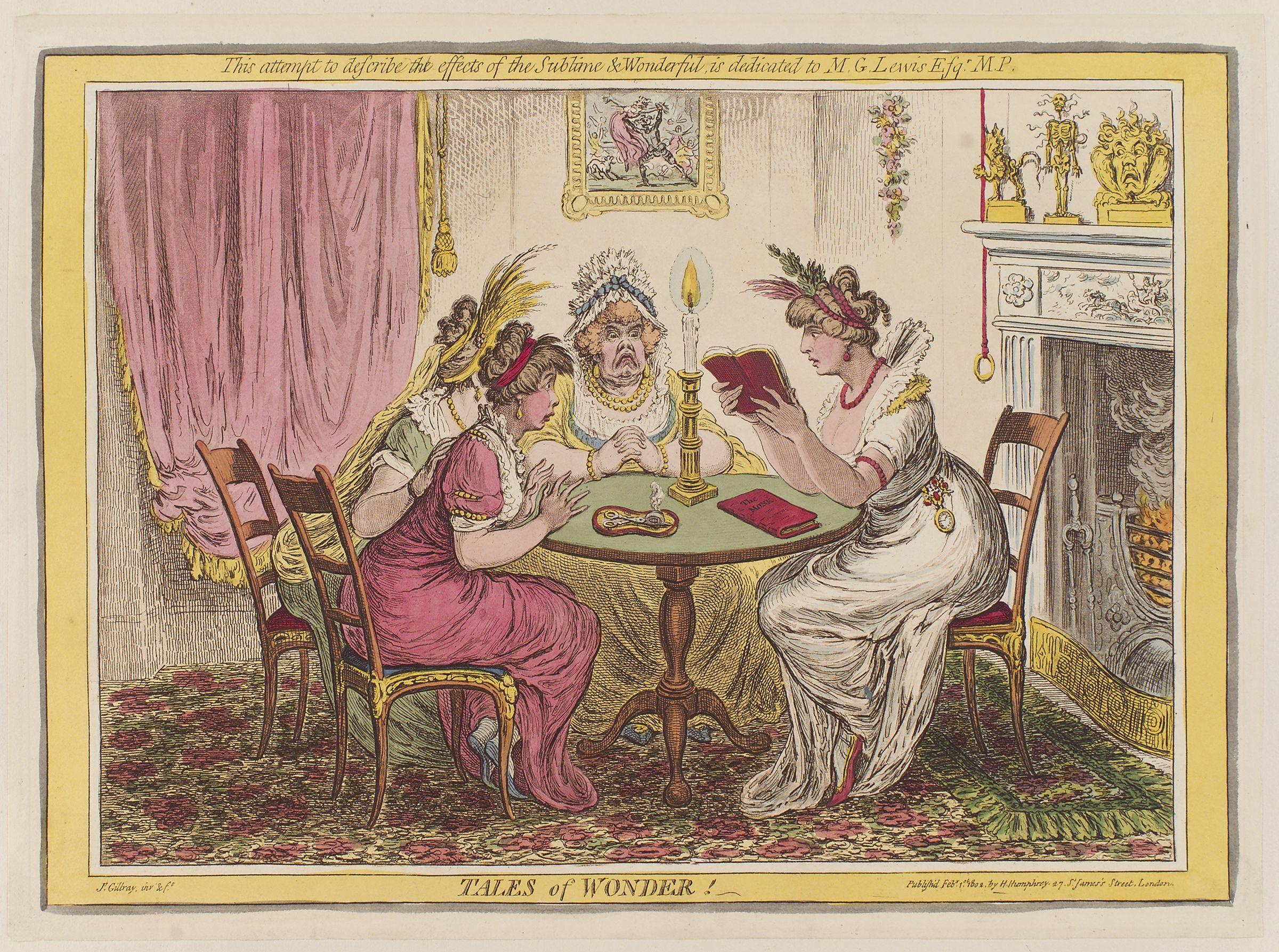
Thus says Samuel Taylor Coleridge in response to Matthew Lewis’s The Monk in 1797, a strange statement from the writer of “The Rime of the Ancient Mariner” and “Christabel.”[i]  Treated with a certain degree ambivalence by many of the Romantic poets—Wordsworth expressing an outright disdain for “frantic novels, sickly and stupid German Tragedies” in his Preface to Lyrical Ballads—the popularity of the Gothic in the late eighteenth century was difficult to ignore, as was the Gothic nature of the political climate that made most literary and visual descriptions of the French Revolution Gothic almost by default.  Indeed, the genre seems to almost anticipate such violent and bloody upheaval, revealing the period’s anxieties about tyrannical rulers and corruption of the aristocracy in its earliest texts.  Because of its popularity, bolstered through stage-productions and cheap chap-books, the Gothic’s place within “serious” Romantic literature, it would seem, is itself somewhat meta-Gothic: a position of ambivalence and abjection, of reluctant importance and acknowledgement.  It’s almost Twilight-esque status as “pop-lit” of the age (and most subsequent ages) deterred its recognition as a literature of value until surprisingly recently, despite the fact that many Romantic poets—Robinson, Southey, Byron, Shelley, and Keats to name a few… and, yes, even Wordsworth and Coleridge—experimented with the Gothic tradition or at least its features.  Clearly, it was something of which even the most established writers could not “weary.”  And some, like Mary Wollstonecraft, found ways of shifting Gothic tropes to work for their own purposes, to expose and contextualize the reality of horrors in the here and now:
“Abodes of horror have frequently been described, and castles, filled with spectres and chimeras, conjured up by the magic spell of genius to harrow the soul and absorb the wondering mind.  But, formed of such stuff as dreams are made of, what were they to the mansion of despair, in one corner of which Maria sat, endeavoring to recal her scattered thoughts!”[ii]
With these contemporary attitudes toward the Gothic in mind, I recently had the opportunity to give a guest lecture introducing the Gothic to an upper-level undergraduate class on Romantic Literature.  They had just finished Frankenstein and were two acts into The Cenci.  I will be taking my comps at the end of the semester, examining in the major field of Gothic literature, Romantic to Contemporary, and in the minor field of Romantic Literature.  I have, thus, had my head buried in Gothic texts for the past nine weeks, so it was easier said than done to distinguish between what I have been obsessing over and what might actually be useful for students in this survey class.
Some background: Gothic 101
We started with the basics: what does “Gothic” mean?  The term Gothic originated from the Goths, the Germanic tribes that brought about the fall of Rome.  Its original connotations were barbaric, primitive, uncivilized, and medieval.  Yet, around the mid-eighteenth century, a new interest arose in the Goths as conquerors, yes, but the conquerors of Britain.  As such, with a rise in nationalism, the British began to see the Goths as the origins of their own civilization and the values upon which it had been built.  Thus, the term “Gothic” came to have two meanings associated with the primitive: barbaric but also virtuous.[iii]  This second definition is facilitated by a subsequent glorification of the past, antiquity, and medievalism.  The perfect example of this is, of course, Horace Walpole, whose behavior even before he pens the Gothic grandfather, The Castle of Otranto, gives insight into the beginnings of the genre.  Obsessed with Gothic architecture and antiques, Walpole built Strawberry Hill, a construction which mixed styles, time periods, and materials to cater more to what Walpole considered Gothic than to the restrictions of historical aesthetics.  Thus, we have the fragmented mixing of pasts and present that would characterize the literary tradition, emphasizing atmosphere over realism in the interplay between truth and performance.  All it needed were a few ghosts. And thus we have the inspiration for the first Gothic novel.
What does that mean?: Making sense of the texts
While it seems obvious that The Cenci would fit into the same Gothic as The Castle of Otranto, it is less clear how Frankenstein can also fall into this classification.  We can trace the origins of the Goths, but the definition of what is “Gothic” is still (and probably always will be) contested among scholars, both past and present.  My favorite definition and one I see often-cited is Chris Baldick’s: “For the Gothic effect to be attained, a tale should combine a fearful sense of inheritance in time with a claustrophobic sense of enclosure in space, these two dimensions reinforcing one another to produce an impression of sickening descent into disintegration.”[iv]
By then breaking the two texts down according to how they depict time and space, we were then able to touch briefly on other important key terms and aspects.  We could begin to see how Victor’s dangerous preoccupation with the ancient forbidden texts of magical science and alchemy might line up with the dangerous power of the Cenci’s ancient and decaying line.  We noted the family structures in the two texts, highlighting the absence of the mother and the presence of incest.  We compared the structures of the texts themselves, both sprung from the fabrication of manuscripts that frame the narrative itself as old or dangerous.  Doubles, the uncanny, paranoia, isolation, excess, the return of the repressed: all could be structured, compared, and contrasted through time and space. I found that keeping it broad and simple, tempting though it was to go into other more dark and dusty corners of this tradition, provided the students with a general framework to apply to their upcoming readings… even those of Wordsworth and Coleridge.


[i] Coleridge, Samuel Taylor. Critical Review 2nd ser. 19 (February 1797): 194-200 in Matthew Lewis. The Monk. Ed. D.L. MacDonald and Kathleen Scherf. Ontario: Broadview, 2004. 398. Print.
[ii] Wollstonecraft, Mary. The Wrongs of Woman; or, Maria. Oxford: Oxford University Press, 2007. 69. Print.
[iii] Punter, David and Glennis Byron. The Gothic. Oxford: Blackwell Publishing, Ltd., 2004. Print.
[iv] Baldick, Chris, ed. The Oxford Book of Gothic Tales. Oxford: Oxford University Press, 2009. xix. Print.

Wading Into the Conference World

As a first year doctoral student in literature at Arizona State University, there have been many occasions where I feel as if I have no idea what I should be doing (outside of my enormous course load and teaching requirements) or how I am supposed to be moving forward in what seems sometimes to be a never-ending academic journey. The last thing I want is to be bogged down with stress and forget why I signed up for this life, why I LOVE this life. I have found (at least it works for the moment) that the best way to deal with these questions, which arise on a regular basis, is to take everything step by step. As we attempt to professionalize ourselves amidst the daily hustle and bustle of the halls of the English department at our universities, submitting abstracts and presenting at conferences is an activity we need to be doing, but for those who are new to conferences like me, the whole process is a bit daunting.
Just three weeks ago, I presented at my first conference. Saying I had nervous butterflies in my stomach is an understatement. The nervousness started with the writing of the abstract, and it didn’t really subside until I got up from the presenter table and walked out the door. An abstract is a difficult thing to write but so important to our professionalization. Abstracts also are something we rarely get a lot of training on in our day-to-day course work, which makes attempting to write them a bit more stressful. Summing up what I will be arguing, or more realistically, what I hope I will be arguing in a ten page paper in 250 words is a trying activity. I’ve started to look at abstracts like movie trailers. Hit the best, most entertaining aspects and sell the readers that it is worth looking at the whole thing. And remember, every word counts, so focusing on style is important. Style is something I have been working on in my scholarly writing, and adding the pressure of the importance of style in an abstract raises the anxiety levels. But ultimately, I have been reminding myself that everyone has to write a first abstract, and it gets easier each and every time. Practice does make perfect when it comes to abstract writing. Plus, ask your colleagues or professors if they would let you look at some of their abstracts; it really helped me to see how other people prepare an abstract when I was working on my own.
Preparing the paper for the conference was probably the easiest aspect for me. I write papers all of the time—so I was confident with my ability to write a solid paper to present at the conference. The actual presentation of the paper was nerve racking, and then as luck would have it, I found out I was selected to chair my panel. I felt completely lost; I had no idea what I was supposed to do. After an email exchange with the panel coordinators and the other presenters on my panel, I was at least more confident about my roles as a panel chair: introduce everyone before their reading and moderate the question and answer section. I was hoping that my duties as the chair of the panel would keep me focused and calm my nerves before I read my own paper (but that obviously wasn’t the case ☺). Most people would suggest attending panel sessions before your own to get an idea of how the conference works. That would have been a really useful tool for me, but my panel was scheduled during the first time slot in the morning. I arrived early, found the room with plenty of time, and let the butterflies flutter. As soon as it was time to start, I introduced the first presenter and everything flowed from there. At the end of my reading it was time to start the question and answer time. I was prepared for no one in the audience (of seven people) to ask any questions, so I had thought up some of my own just in case. A colleague of mine has presented at numerous conferences and she had never been asked a question—so secretly I was hoping no one would ask me a question either. It was scary enough to read my paper, but then to have to answer more questions was a lot to think about. However, we had an enthusiastic audience that was ready to discuss the different papers. In the end, I am so glad that I was asked a specific question about my paper because it not only gave me the opportunity to discuss something I am fascinated with in more detail, but it also gave me an idea of how to adjust my paper to make it that much stronger (and my colleague had her first question too—conference success).
For all of the anxiety that I felt during the entire process from starting to write the abstract to answering the last question at the end of the presentation, it was a wonderful experience. If you haven’t experienced a conference presentation yet, you can trust me when I say, if I made it through fine—so can you. In the end, I had a lot of fun. And now I feel much more prepared for future conferences.
With a couple weeks left before many of the MLA Romanticism CFP deadlines, if you haven’t submitted an abstract yet, you still have time. If you are like me, and a novice to conference presentations doubting whether or not to send out an abstract, just jump in! And hopefully, I will see you there ☺

Violence, Paint, Work: A Review of John Logan’s "Red"

The Seattle Repertory Theater recently began running John Logan’s Red, 2010 Tony Award winner for Best Play.  The story follows the fictional two-year relationship between abstract expressionist painter, Mark Rothko (Denis Arndt) and his assistant, Ken (Connor Toms).  Situated around Phillip Johnson’s 1958 commission for Rothko’s first set of murals to be displayed in the Seagram Building’s Four Seasons Restaurant, Ken is the outside invading the master’s space just as the master is about to invade the space of the affluent.  The apprentice’s mission: to keep Rothko from selling out in the face of a precipitously close obsolescence, that is, in the face of a burgeoning movement.  Namely, Andy Warhol.  At the sound of his name, Arndt howls and squirms in a chair beside his Mozart-warbling record player.  It is a play about the old and new, their clashes as well as their “symbiosis.”
For anyone studying romanticism, Logan’s story is familiar.  A genius, locked away in his temple of a studio, struggling with his work, on his own, of course.  When Ken arrives, it’s hokey, over the top, and a bit of a relief.  If you accept Red for what it is, at times it charms.  It’s a silly play about a young upstart learning from the old master, a throwback to the wise shepherd instructing the young swain.
But there is also violence.  Aside from romantic shout-outs to Turner, Wordsworth, and Byron, the predominant figure operating in the background is the early Nietzsche.  The two artists debate over The Birth of Tragedy, while Rothko pours bright red paint like wine into a bucket  The depth of the conversation is thin, but the importance is the historical situation.  In the late fifties, Nietzsche remains a dangerous name.  Only a decade earlier Hitchcock reminds his audience of the philosopher’s influence on Leopold and Loeb in Rope, and in his effort to spare future victims, Walter Kaufmann warns his readers not to read Nietzsche in “snippets” in the 1967 edition of The Genealogy of Morals (3).[i]  While Rothko corrects Ken to say Nietzschean conflict is symbiotic not violent, Rothko curses his assistant enough to clarify the point: symbiosis is not exactly tranquility either. 
While the philosophical discourse is entertaining, as Ken complains, all Rothko does is talk.  Screaming at the height of an aria, Ken wishes his mentor would start painting.  The audience agrees.  There is a brilliant scene where the two characters prime a canvas together with an energetic, romantic symphony driving their movement.  They paint, weaving around each others’ bodies within the canvass’s close framework.  It’s messy, it’s dynamic, a moment of entanglement.  The scene represents Logan’s best effort to demonstrate the Apollonian/Dionysian dance, paint splashing outside the contours of the canvass.  Perhaps it is best that they paint only the one time, because watching them work makes the story feel insignificant.  Rothko wants to eschew memory, history, geometry, “swamps of generalization,” he tells The Tiger’s Eye in 1949 (quoted in Fineberg, 111).[ii]  Only when the characters stop talking does Logan completely free us of the swamp.
The director, E.T. White, wisely capitalizes on Logan’s discussion of the paintings themselves.  When the lights come up, Rothko stares, brush in hand.  Arndt leans into the canvas, searching.  It’s unclear if he analyzes a vibrant block of paint or a face.  Or faces.  For the moment, the audience plays the role of painting and it’s suspenseful to think that at any point, with a lick of his brush, we’ll be different.  Later he describes his vision of the murals hanging in the Four Seasons, oppressing the rich and speaking to each other after hours.  The lights must remain dim in the studio to “protect” them.  Even though he describes himself as a “banker,” not an artist, as an “employer,” not Ken’s teacher, he treats the paintings as something sacred still.  They “matter.”  Rothko scowls at the commodification of the art object and the banality of those who buy it.  Everything to them is “fine.”  But he treats the paintings with a particular reverence: the paintings are not anthropomorphized; they’re apotheosized.
Logan’s play does not really challenge art or art criticism, but it’s not supposed to.  In the end, Red caters to the audience it pokes fun of, and they still laugh at the jokes.  It never taxes the patience, it never overwhelms, and most of the tension is displaced by a quirky joke or a zippy comeback.  Ironically, Rothko bemoans the fame he attains, and it is precisely Red’s popularity that will make it difficult to experience the play properly.  It belongs in a small space.  If companies want the audience to have some kind of phenomenological experience (as the dialogue gestures toward), then patrons cannot sit twenty-something rows back.  When the paint moves it can be seen.  It should also be heard.  And smelled.  It would be best if the audience was instructed, like Ken on his first day on the job, to dress for the part.  Art is not a “pretty picture,” it’s not “fine,” it’s work.
Red runs until March 18th at the Seattle Repertory Theater and at Portland’s Center Stage until March 18th along with a Rothko exhibit at the Portland Art Museum until May 27thRed is currently being staged in various cities across the country.  Check local listings for details.


[i] Nietzsche, Friedrich.  On the Genealogy of Morals.  Trans. W.R.J. Hollingdale and Walter Kaufmann.  New York: Vintage, 1989.  Print.
[ii] Fineberg, Jonathan.  Art Since 1940: Strategies of Being.  Upper Saddle River, N.J: Prentice Hall, 2000. Print.

Romanticism: A State of the Union

Inspired by the President’s recent State of the Union address, I have decided to offer you, my Romantic brethren, a review of the state of Romantic studies. Despite our brooding Byronic ways, our Union is getting stronger. The house of cards may indeed have fallen, but our field is not languishing on the marble steps. Moneta will come!
::obligatory applause break::
The 2010 NASSR Conference in Vancouver, British Colombia took the idea of “Romantic Mediations” as its theme. Participants were encouraged to submit proposals that explored communication technologies and print culture. As the call for papers makes clear, “The era that saw the invention of semaphore, telegraphy, the continuous-feed press, and the difference engine, the Romantic in all its senses might be characterized as a period of significant experimentation in media and ideas of mediations” (NASSR). While many papers engaged with new inventions and their effects on Romantic era works – I heard an excellent paper regarding the influence semaphore had on theatrical gesturing practices – others utilized the concepts and language of media and mediation in order to offer new and perhaps more precise ways of engaging with and understanding key Romantic writers and texts.
The issues and concerns of last year’s NASSR conference are also being addressed by McGill University’s ongoing collaborative endeavor “Interacting with Print: Cultural Practices of Intermediality 1700-1900.” Founded in 2005, the interdisciplinary and interinstitutional research group headed by Susan Dalton, Andrew Piper, Tom Mole and others sets out to investigate “how people interacted with printed matter, how they used print media to interact with other people and how printed texts and images interacted within complex media ecologies.” The group focuses on the relations and interactions between various media. In order to more accurately, in its terms, “situate” print, the collaborative group sets out to debunk three prevalent scholarly “myths”: that print displaced other media, that print equals letterpress or engraving, and that print culture is national culture. In the online manifesto for “Interacting with Print,” the group claims that their “research activities will provide a more specific understanding of print’s place in the production, dissemination and reception of culture in a period that saw the development of mass media.” Print, as this quotation makes clear, was only one of many mediums for producing and disseminating culture and oftentimes incorporated other forms of media such as printed images.
Together, the conference and working research group speak to a set of issues being addressed by current critics of the Romantic period. Many scholars, including myself, have asked why this interest in media and mediation is emerging at the present moment. I believe that the answer, at least in part, lies in the new descriptions and definitions of the Romantic period and Romanticism offered by thinkers like Walter Ong and Friedrich Kittler. In his 1982 work Orality and Literacy, Ong claims that the Romantic desire for “autonomous utterance” is facilitated by print and speaks to the “alliance of the Romantic movement with technology” (158). That is, print mediates the Romantic desire for interiority and individuality. According to Ong, there is a clear correlation between the mediums of Romantic art, in this instance print, and the prevalent artistic ideology of the period. Relying on and citing Ong’s work with notable frequency, John David Black’s recent book The Politics of Enchantment: Romanticism, Media, and Cultural Studies labels Romanticism as one of the effects of print: “Coming some three centuries after the invention of the mechanical press, romanticism was the mature cultural expression of the cumulative effects of Gutenberg’s breakthrough” (134). This quotation makes Romanticism the result of the proliferation of print that started with Gutenberg’s press.
Similarly to Ong, Kittler’s landmark work Discourse Networks 1800/1900, published in 1985 in the original German and translated into English in 1990, draws attention to the relationship between media and Romanticism. Especially important to Kittler’s text is Foucault’s essay “Maurice Blanchot: The Thought from Outside.” In this early work, Foucault develops what David Wellbery calls “a lexicon of exteriority” (xii). The French thinker sets out to distinguish between language itself and “the apparatuses of power, storage, transmission, training, reproduction, and so forth that make up the conditions of factual discursive occurrences” (Wellbery xii). Like Foucault before him, Kittler’s work situates what is said or written in a secondary position and instead focuses on these “apparatuses.” His decision to title his 1987 follow up work Gramophone, Film, and Typewriter further underscores the important role communication and storage apparatuses play in his thinking. For Kittler, scholars are always dealing with media, with the technological possibilities of any given epoch because it is through the media of a given moment that “something like “poetry” or “literature” can take shape” (Wellbery xiii). As Thomas Streeter points out, Kittler “suggests that one should understand romanticism, not as a collection of texts or a historical period, but as a way of organizing discourse through practices of writing, reading, and relating” (777). Streeter and other critics, however, also feel that Kittler’s work often places too much emphasis on technologies and, at times, veers towards techno-determinism. Yet, these criticisms aside, the German thinker’s influence over contemporary literary studies in general as well as Romantic criticism is undeniable.
Clifford Siskin and William Warner’s collection of essays, This Is Enlightenment, elaborates upon the ideas present in Discourse Networks as well as Gramophone, Film, and Typewriter. The two critics argue that every history constructed by literary scholars has its benefits but a history of what they term “mediation” has the potential to “clarify both the singularity of each local event and what those events have in common” (11). They “use “mediation” here in its broadest sense as shorthand for the work done by tools, by what we now call “media” of every kind – everything that intervenes, enables, supplements, or is simply in between” (4). In this passage we can begin to see the similarities to Ong, Foucault, and Kittler’s focus on the technologies and “apparatuses” of given historical moments. Siskin and Warner, who were the keynote speakers at the NASSR conference referred to at the start of this post, show that “mediation was always necessary but the forms of mediation differ over time” and therefore there exists “a history of mediation” (9). Under this new framework, the Enlightenment becomes “an event in the history of mediation” (1). The Enlightenment was facilitated by a historically specific set of forms of mediation such as print, reading, writing, and other associational and relational practices.
Naturally, redefining the Enlightenment in such a manner leaves critics of the Romantic and Victorian eras asking what place in the new history their own periods hold. Siskin and Warner address this question in their 2011 article in The European Romantic Review, “If this is Enlightenment, Then What Is Romanticism?” According to the article, “Enlightenment is an event, Romanticism is an eventuality, and Victorianism is a variation” (290). The forms of mediation do not change or proliferate in equal measure. That is, some moments, in this instance the Enlightenment, have both a greater variety and number of forms of mediation than others. The claim that Romanticism can be seen as an “eventuality” also reflects John David Black’s claim that Romanticism is the “mature cultural” result of the Gutenberg press.
If the “apparatuses” of storage, transmission, communication, etc. are worthwhile objects of inquiry and if the Enlightenment is an event in the history of mediation, then how is the current scholar of the Romantic period to engage with and comment upon a work or a collection of works? Or, as John Richetti asks in his review of the This Is Enlightenment collection, “How would foregrounding mediation change the kinds and areas of inquiry in our own epoch?”
Yours in Romanticism,
Randall Sessler, NYU

Romanticisms at the 2013 MLA

My morning conversation with a colleague reminded me that it’s time to look at the MLA 2013 CFPs. After doing a quick search in their online database for titles containing “romantic”, I found the following panels that pertain to our field of Romanticism and that would be lucky to have our scholarship and participation. This is most likely not an exhaustive list, but it will help get you started with your search for panels to apply to.
Reminder: you must be a member of the MLA in order to participate – if you’re not already a member, or if you’ve accidentally let your membership lapse, take care of that right now before you submit your abstract. It will only take 5 minutes and the graduate student annual membership fee is $20: http://www.mla.org/.
 
These CFPs are listed in the order in which the MLA database provided search results; their order does not represent any kind of intentional prioritization.
Reimagining the Romantic Imagination (Keats-Shelley Association of America)
Papers on any aspect of imagination in the Romantic era welcome, including physiological, cognitive, medical, philosophical, scientific, and esthetic constructions. 350-500 word abstracts by 20 March 2012; Alan Richardson (alan.richardson@bc.edu).
British Romantic Books (Wordsworth-Coleridge Association)
Essays should examine book production and publishing history, libraries and learned societies, relationships between authors and editors, elucidating how the publication process shaped the reception of British Romantic literature. Abstracts by 15 March 2012; James C. McKusick (james.mckusick@umontana.edu).
The University of Romanticism:
See Prelude VII:52-57. Relation of Romantic writers/writing to institutions, practices of learning, bodies of knowledge; egalitarianism/elitism/cultural capital; clerisy/heresy/secularism; letters/arts/sciences; clubs, societies, associations, print networks; autodidacticism. 500-word abstracts by 15 March 2012; Celeste G. Langan (clangan@berkeley.edu).
Amnesia and the Romantic Novel:
Papers discussing the role of amnesia, forgetting or forgetfulness in late-18th or early-19th century novels. Comparative approaches are welcome. Abstracts of 250-500 words by 15 March 2012; Matthew Russell (russelmr@uwm.edu).
British Romantic Expatriats:
Essays should examine real and imaginary journeys by British Romantic writers to the United States, and the publication and critical reception of their work in the U.S. before 1850. Abstracts by 15 March 2012; James C. McKusick (james.mckusick@umontana.edu).
Everyday Romanticism:
Papers are welcome that examine the category of ‘the everyday’ in transnational Romantic-era writing, including attempts to theorize the everyday in light of industrialization, imperialism, and world war. 300-word abstract by 15 March 2012; Michael Hardy (mhardy@eden.rutgers.edu) and William Galperin (william.galperin@gmail.com).
“A God-Intoxicated Man”: Romantic and Victorian Representations of Spinoza
This session invites papers examining the diverse literary and philosophical representations of Spinoza and “Spinozism” within Romantic and Victorian writing. 250-300 word abstracts by 15 March 2012; Jared McGeough (jared.mcgeough@gmail.com).
Grotesque Romanticisms:
The grotesque as an important aesthetic category within Romanticism and/or as a distortion of the period (grotesque accounts/interpretations of Romanticism). Papers on art, literature, or philosophy.  Please send 250 word abstracts by 15 March 2012; Alexander Regier (a.regier@rice.edu).
Independent Publishing in the Romantic Era:
Papers that explore self-publishing during the Romantic Era: inducements, advancements, and/or ramifications. 250-500 word abstracts. by 1 March 2012; Michael Demson (mtd007@shsu.edu).
Romantic Media Cultures:
Short papers for a roundtable of projects addressing questions of mediation, information, communication, systems, epistolarity, print, the book during the Romantic era. Also welcome: transatlantic, translation, digital humanities. 200-word abstracts. by 15 March 2012; Lauren Neefe (lauren.neefe@stonybrook.edu) and Yohei Igarashi (yigarashi@colgate.edu).
Teaching Romanticism in the Digital Classroom:
AI, avatars, students glued to tiny screens: what pedagogies work for “Walden” in today’s classroom? or for the “big six” poets and the Sublime? 500-word abstracts by 15 March 2012; Merle Lyn Bachman (mbachman@spalding.edu).
Romantic Science:
Papers on Romantic-era literature and the sciences, including but not limited to: the science of aesthetics; literature and the disciplines; Romantic-era science fiction. Abstracts by 15 March 2012; John Savarese (john.savarese@rutgers.edu).
Note: it also just came to my attention (thank you Leila!) that the CUNY Romanticism Group also has a helpful list of abstracts to investigate – find that list here. Good luck to us!

Welcome New Bloggers!

We’d like to welcome our new NASSR graduate student bloggers:

Kaitlin Gowan, Arizona State University
Laura Kremmel, Lehigh University
Kimberly Kaczorowski, University of Utah
Carmen Mathes, University of British Columbia
Aaron Ottinger, University of Washington
Randie Sessler, NYU
Cesar Soto, California State University
Mary Ellen Williams, University of California, Davis

As you can see, our new bloggers come from a variety of institutions.

 They also have diverse research interests.  All of them, of course, have a passion for Romanticism, and we’re looking forward to posts about everything from research resources and new digital tools to pedagogy and writing a prospectus.

Watch this space soon for new posts from new voices!

How to Dissertate

Well, it’s a new year and in the spirit of developing better habits, I thought I’d share my resolution: to become a more effective dissertator.  Please note that this article is not titled “How to write a dissertation,” because to me, “dissertating” involves a LOT more than the writing process. I know (basically) how to research and I know how to write… but what I don’t think I do well yet is focus—at least not on completing (or let’s be honest, starting and diligently continuing) a project of this magnitude. So, here I’m sharing a few bits of choice advice I’ll be implementing over the next several months to make my dissertating more sustainable and successful.
1.  Dedicate a few full work-days a week to dissertating. On other days, give at least a couple of hours.  This semester, my Wednesdays and Fridays are dissertation days. Mondays are for CV-building academic service, Tuesdays and Thursdays are for teaching, grading, and lesson-prep. Saturdays are for catching up, and Sundays are for recharging the spirit. I’m hoping that this schedule will help me focus on each task as I’m doing it, and give me permission not to worry about the tasks of other days. Less anxiety, less guilt, more productivity. Awesome.
2. Get out of the house.  I made the mistake of not doing this today (yes, a dissertation day. These are goals, people! I’m not perfect yet!)… and so I graded a few lingering student papers, wrote some thank-you notes, ran some errands, felt guilty, and sat down to write this blog as a record of my shame and a re-dedication to a better future. Then I’ll probably do the dishes, because I’m still at home, and the precariously-stacked dirty plates are driving me crazy. Don’t let this happen to you! Have a dedicated work-space someplace else, and go there early in the morning. Settle in, and focus on your work.
3. Check email at the end of the day, not the beginning.  Special thanks to Kirstyn Leuner and Lori Emerson for this piece of advice!  We all know how fast a quick email-check devolves into hours of correspondence, followed by (*ahem* undisclosed amount) of hours wasted watching slideshows of the Golden Globes’ best-dressed list. Once your browser is open, it’s hard to close. So stay away, at least for the first several hours of the day.
4. Just say no to side-projects. If you’re anything like me, then you don’t have trouble devoting large chunks of your time to worthy causes, both academic and non-. I think it’s healthy and important to have a few, but set a limit and don’t go over it! Especially clear out the little stuff that’s eating up your time and doing little for your CV. I have limited myself to my main teaching contract, one small, paying job for some extra cash, one major CV-building academic activity, and one church/community service. Even that is a lot! It’s painful to say no to projects that sound totally awesome (I turned down a gem just this week), but do it. Just say no. Protect your right to dissertate.
5. Set small deadlines for yourself. Currently, I’m scheduled to complete a chapter every three months. (I’m told this is about right in English, though apparently it’s pretty slow compared to some other disciplines). If chapters are 50-60 pages, then I need to write about ten pages every two weeks. Totally doable, right? Part of me resists, reasoning that it’s too modular and that my chapter will have no continuity… but I remind myself that revision can come later. For now, it’s important that research be linked to production all along the way, in small manageable chunks. Plus, as a bonus, ten pages is the perfect length to adjust into a conference paper!
6. Join (or form) a dissertation support group. Share work regularly, and keep each other accountable. My university has a general group for PhDs of all disciplines, which I think I might attend… but I also think it would be nice to form a group with folks in my own department. The idea is that you meet once a month, and everybody gives an update on their work. One person might be nominated to share 10 pages with the group, or everyone could bring 10 pages, and pair up to exchange. As long as you have deadlines, and people to keep you accountable (and probably some treats and commiseration and laughter), the effort will be worthwhile.
I’m starting with these six ideas, but if you have any tips that helped you dissertate more effectively, please do share them! The more wisdom, the better. And to all of us who are striving to stay on the wagon and produce some butt-kicking chapters these next few months, I say best of luck! Happy habit-building, folks. We can do it.
-Kelli

Call for New Bloggers

The NGSC is currently seeking applications for five new bloggers for 2012.

We ask that NGSC bloggers commit to writing at least one blog entry a month.

If you visit the blog often, you’ll know that our bloggers post about a variety of topics, including reflections about individual research, reviews of research tools and resources, information about libraries/collections/archives, updates about conferences, etc. More general posts about about graduate school and pedagogy are also welcome. It’s not formal, and it’s a great way to engage with a large community of people interested in Romanticism.

In order to apply, please email a one-page letter of intent along with a CV to: nassgrad@colorado.edu. Applications are on due on February 1, 2011. Applicants will be notified by February 10.

We look forward to hearing from you!

Using Zotero

Intro: Zotero’s my new favorite research tool. Why? Because it’s a Rhizome. But what isn’t (nowadays)? No, seriously. It is a rhizome and it happens to be a rhizome of the most useful sort. Zotero helps to visualize the relations between ideas, images, and texts in a way that few other research tools allow. For those unfamiliar, Zotero’s a powerful citation management program, frequently used as an extension of Firefox (but also can be used as a standalone application) that makes possible multiple points of entry and useful exits from information you’ve assembled in your research. Moreover, and maybe most importantly, Zotero offers a degree of scholarly peace of mind by backing up all your citations and notes on their server automatically, courtesy of the Mellon, Alfred P. Sloan Foundations and others. You receive 100 MB of space free, but can move into the 1 GB tier for only $20/year. I’ve been using Zotero pretty extensively for about six months and have used only about 9% of my storage space.
While perhaps the best introduction to Zotero can be found on their website (http://www.zotero.org/support/quick_start_guide), I’ve set out as my task (complete with screenshots) to show how I use this incredible tool in my own early graduate research (#bravery) in hopes it may spark some ideas that might be helpful you all in your own respective scholarly practices.
How I Found Out About Zotero & How I Found Zotero Useful: I discovered Zotero last spring on the recommendation of my adviser–who’s a wonderful advocate for the absorption of digital technologies into Art History methods. I found downloading the program easy  (http://www.zotero.org/download/). After beginning to use Zotero, I quickly became impressed with how great it is to save even basic citations for later use–why I even refused to use EndNote as an undergrad, I don’t even know.

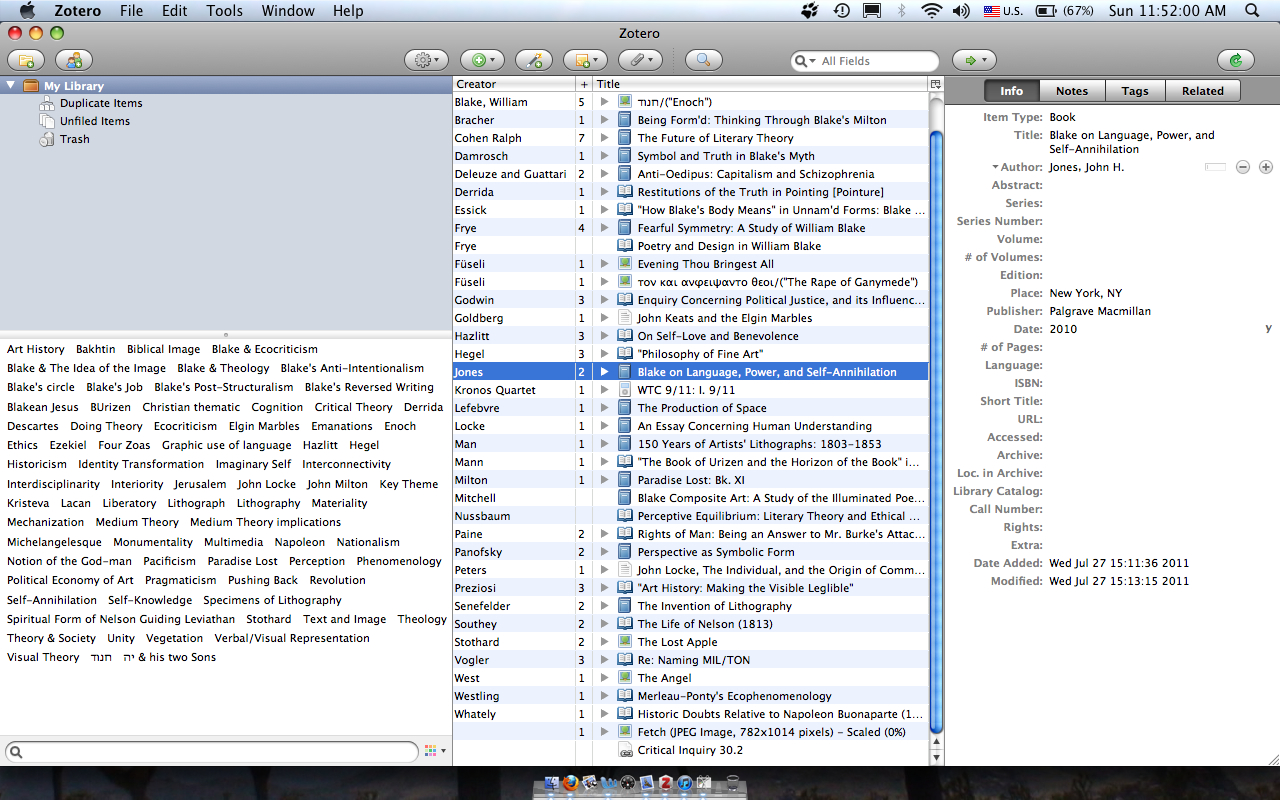
Zotero Main Screen Grab

I quickly became captivated by the usefulness of the “tag-function” as a means of exploring the interrelations between information. Indeed, in my case, this function allowed me to organize the flow of information between primary images, texts, and secondary source material in a really effective way. For instance, working on Blake and self-annihilation has generated certain challenges for me in navigating between where the idea comes up in Blake’s poetry, in the visual fields of the illuminated books, in other Blakean artistic media (his watercolors, his lithograph, etc.), its relation to period specific primary text materials, and more contemporary critical theory. Zotero allows me to see these phenomenon in relation to the ideas of scholars who have previously explored them, easily.
Quick & Dirty examples: For instance, hitting the tag “Self-Annihilation” allows me to visualize connections between the following range of texts, images, and tags I’ve created:
To the left, the blue tag indicates the primary idea I’m pursuing, while the remaining black tags indicate what other tags are related to the primary idea. To the right, Zotero displays what texts and images are tagged with the primary idea. As a second step, let’s say I’m interested in self-annihilation as it relates to Blake’s Enoch lithograph, specifically. To find new connections, I’d highlight both the tags “Self-Annihilation” and “Blake’s Enoch.”
The tag-function has allowed me to connect the lithograph to a diverse array of materials: two images I had tagged (but forgotten) as similar immediate objects of interest (“Christ Offers to Redeem Man” from Blake’s Butts Paradise Lost watercolor series and Jerusalem, pl. 41), a Hazlitt essay that I saw as exhibiting similarly self-annihilative concerns, and one of my favorite selections from Anti-Oedipus. Indeed, and also helpful, in this regard, is the ability to store copies of files–and namely images–within your personal Zotero database. With the way I use the interface, a simple click will load a stored image

(In the screen grab:) William Blake. “Christ Offers to Redeem Man” in Illustrations to Milton’s “Paradise Lost” (Butts Set), 1808. The William Blake Archive. Ed. Morris Eaves, Robert N. Essick, and Joseph Viscomi. 7 November 2011 <http://www.blakearchive.org/>.

Conclusion: In the end, after using Zotero for the last six months, I can’t even imagine going back to paper-based research note taking. It will be interesting to see how these new technologies drive humanities research forward in the future, and what new and more complex connections might be forged in all our studies. I also recognize that I’m not the only NGSC member who uses Zotero, and would appreciate comments on what tips and tricks you all have for using the program in your own work.

Comprehensive Exam Preparation

This is my exam semester. When I began my PhD in West Virginia University’s program “exams” existed in an intangible future; now, they are here. No matter the format, no matter the number of texts on your list, the comprehensive exams are one of the legendary hurdles of obtaining a literature PhD. Critical to your success, exams help prepare students to tame the beast that is the dissertation. At various conferences over the past 6 months I’ve discussed exam format with peers from Massachusetts, California, Illinois, Colorado and Oregon—all over the country in a range of programs and concentrations; each institution formats their exams differently. The exam narrative, however, is largely the same: a feeling of dread coupled with excitement about the prospect of reading the materials related to their project for those who have yet to take exams and for those who have completed exams: relief for having them behind them but a knowledge that the dissertation holds its own challenges and intellectual rewards. It is a rite of passage that seemingly few would ever choose to relive. As I’ve prepared for my exams the process has been incredibly educational—not just because I’ve immersed myself in critical discussions regarding the constructions of gender and sexuality in Romantic and Victorian England or varying theorizations of ‘error’ but also because I’ve (re)discovered a great deal about my work process and ability (and sometimes lack thereof) to deal with the anxieties and stresses of examination.
Here are a few things I wish I’d known beforehand or did know, but lost sight of in the process:
1. Keep track of how you spend your time.  One thing I found frustrating about the exams was the absence of tangible progress. Yes, I could cross a book off of the list. Yes, each book I read helped me to further understand what I wanted from my scholarship. Yes, I now have a clearer idea of what kind of book I’d like to publish in the future. All of these things are well and nice but they aren’t very helpful today. Reading and taking notes for your exams can feel like running in place sometimes. I like the tangible outcomes of my work, and I am sure I am not alone. A seminar paper, an article, a presentation, a talk, a curriculum: these are all concrete productions of the work many of us do. The comprehensive exams are disconnected from their outcome: passing the exams, writing the dissertation. To help you see how much work you are doing and how you are spending your time, keep a work log. A spreadsheet in Google Docs is ideal because you can access it anywhere through your Google account. It has been helpful for me to see how many hours I’ve devoted to exam preparation (and to other things like course preparation, grading, publication, conferences, etc.).
2. Letting yourself down is not the same as failing. When I wrote my reading schedule last February my plan was to finish reading by late May. I poorly estimated how much time it would take me to read the texts for my exams; I found the reading process to be different than what I’d experienced in the past. I wasn’t prepared for the additional hours I’d spend taking notes, trying to synthesize the texts and write cogent summaries that would serve to refresh my memory months after completing the book. I couldn’t have known about the reading rut I would hit in April. When I crafted the schedule in February I was enthusiastic about reading 12 books on the history of England from 1789-1850…and the semester had just started. My enthusiasm waned around book 7 and mid-terms distracted me with a seemingly never-ending stack of grading. I didn’t meet my schedule. I had to learn that this was okay. I had plenty of time to finish reading; I had plenty of time to study before my exams. I had not failed (even if I felt like I had). I’ve discovered through this process that while knowledge of the material is certainly important, the knowledge gained regarding my own habits as a worker, reader, writer, teacher, and scholar has equally useful and important value.
3. Help yourself avoid distraction. When I first started reading I found myself wandering down various research paths inspired by my materials. Rather than finishing a chapter I would investigate a footnote or, curious about a possible gap in research, look for scholarship on the topic. In other words, I would find seemingly productive (even tangentially related) ways to pass the time without actually working on the task at hand (finishing the book, preparing for the exams). About half way through Susan Wolfson’s Borderlines, the third book I read for my exams, I decided to keep a “Distraction Relocation” journal. It is a just a spiral bound notebook but in it are all of the questions and future projects that I’ve identified during my exam reading. Rather than finding all of the scholarship on errata sheets, a distraction I full-heartedly considered while reading Seth Lerer’s Error and the Academic Self, I jotted down a note about how it might be interesting to investigate how errata sheets were used in Romantic print practices (and whether their use differed between literary periods). The thoughts I’ve labeled here as ‘distractions’ are important and I’m certain that at least two things that made it into my “Distraction Relocation” notebook will find a place in my dissertation project. My notebook helped me to keep track of these thoughts without allowing them to derail my progress.
4. Stay in touch with your community. During exam preparation it can be easy to excuse hermit-like behavior. Fight against the impulse to hole up in your office or house; instead, stay in touch with your community. Do not feel guilty for spending time at lunch with friends. Keep in contact with your director(s) and mentor(s). Talk to people about the process and find out what works/worked for others.
5. Find healthy ways to release the stress and pressure of exams. Exams can cut off your social life if you let them; they can also be a catalyst to putting you at the bottom of your to-do list. It can be easy to excuse poor health habits because you are so busy: skipping out on your exercise routine, foregoing fresh food choices for easier, quicker options. I learned to love running as I prepared for my exams. It gave me a place to clear my mind, to release any of my anger, frustration and anxiety, and reminded me that exams are not everything (which can be a difficult thing to remember in the middle of the process).
6. Schedule the exams. Concrete dates on your calendar and on the calendars of your committee are an effective way to keep yourself in check. The earlier you do this the better, for at least two reasons: 1) Once the dates are set you can’t go back, motivating you to stay on schedule, and 2) Your committee members have busy schedules; the earlier you schedule your exams the more availability they will have.
7. Your committee is on your side. You have selected a group of people to support you and your project, to provide feedback and offer critical suggestions to improve your scholarship. They are all rooting for you; they want to see you succeed.
I’m sure there are other things that should be added to this list. What do you wish you knew about the comprehensive exam experience before you took/take them? Do you have any bits of wisdom to share?