The Sublimity of "2001: A Space Odyssey" (1968)

The Sublimity of 2001: A Space Odyssey (1968)
Stanley Kubrick’s 2001: A Space Odyssey is a sublime film.  Tracing the evolution of humanity from prehistoric hominids to space age explorers immersed in Cold War politics, the film considers the telos or final aim of the human: a sentient computer. In terms of plot and thematically the film is sublime indeed, but especially when it’s big.  Kubrick’s movie comes back to the theater this week as part of Seattle’s first Science Fiction Film Festival, using a 70mm print, which basically means the resolution is higher than a standard 35mm print.  But 70mm film was/is used to shoot very few films, and the Cinerama, where 2001 will be screened, is one of only three theaters in the world with the capacity to project one.  For everyone else, the DVD will have to suffice (at least you get the extras!).  While I always thought aesthetic theories of the sublime had much to contribute to a conversation about Kubrick’s futuristic journey, is a big screen really a prerequisite for such a discourse?
It doesn’t hurt.
Kubrick’s film opens with “The Dawn of Man.”  A group of apes scavenge for sustenance, fighting with other clans of apes for a nearby waterhole.  By today’s standards, the apes resemble homo erectus, bipeds prior to the use of tools.  The stage in their development is important because one morning, Moon-Watcher (as he’s called in the script), awakes to find a large, black, symmetrical object: the monolith.  Geometrical form, par excellence.  Following from the encounter, Moon-Watcher creates what amounts to the first tool, thus inaugurating the next step in human evolution.  Moon-Watcher sees a bone and anticipates its use as a weapon.  The film presents viewers with a radical notion, that an external object determines brain capacity.  In other words, the encounter with the monolith animates Moon-Watcher’s imagination, but as the German Enlightenment philosopher Kant would say, the monolith itself does nothing.
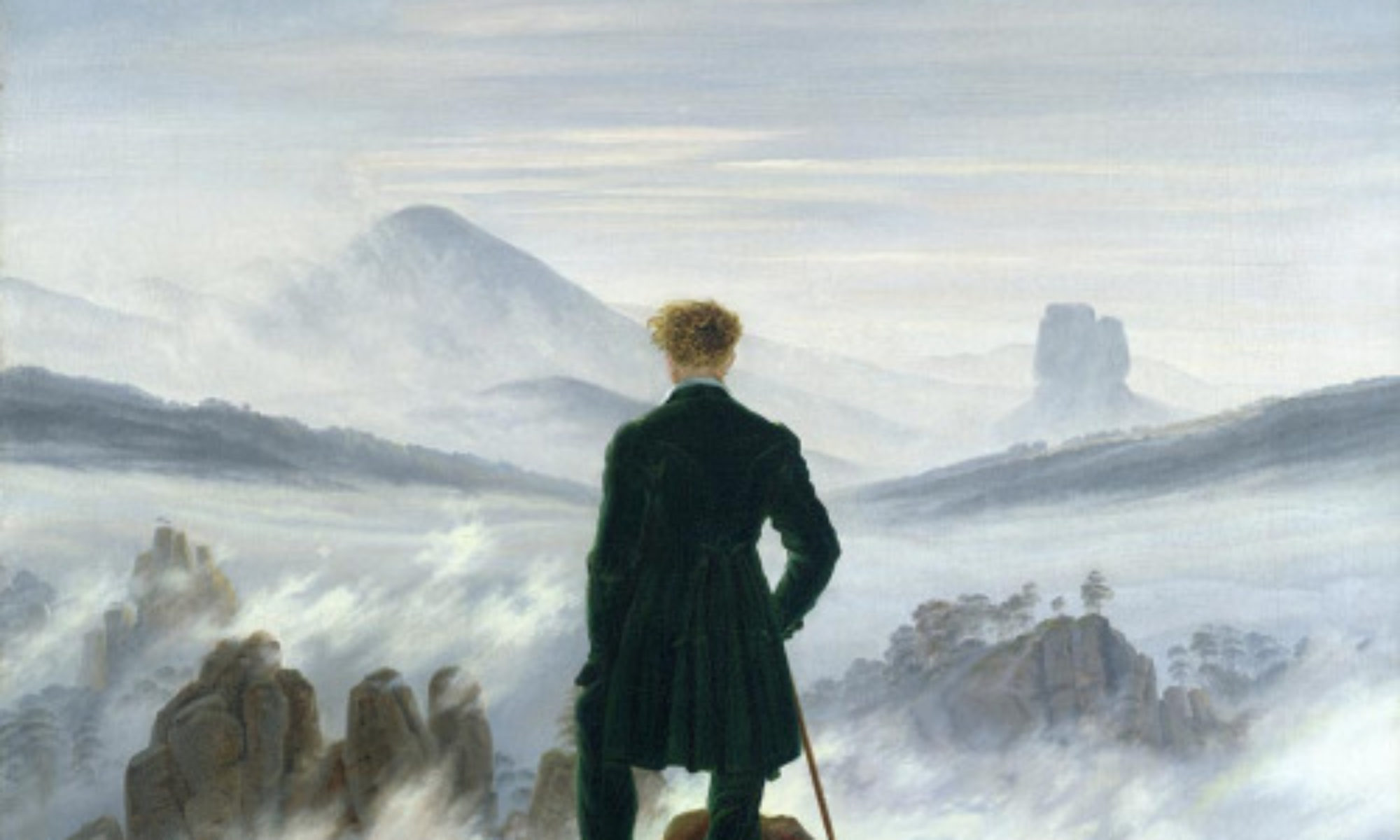
For Kant, writing on aesthetics in his Critique of Judgment (Berlin, 1790)—a foundational text for studies on the sublime—sublime experience occurs only in the mind.[i]  A sublime experience follows from the “might” exhibited in nature causing a feeling of “respect” in the viewer. A truly sublime effect turns its subject into a “brave” and “noble” character with a newfound sense of moral purpose (§§28-9.99-106).  However, Kant disavows any purpose within the sublime object itself.  If it’s an ocean it’s only an ocean; if it’s a volcano it’s only a volcano (§29.110).[ii]  So according to Kant, the monolith could be anything because, for the human, it is the mind that determines the object.
From the inauguration of the first tool, time is compressed.  Kubrick now jumps almost two million years into the future as the camera follows Moon-Watcher’s hurled weapon through the air.  In a vicissitudinous cut Kubrick links two tools at the limits of technology: From Early Pleistocene bone to a twenty first-century military vessel orbiting earth. The gesture forces us to ask, what’s the difference?  As Adrian Mackenzie might say, the bone is local while the spaceship is global.[iii]  But how local are bones?  Like the monolith, these objects seem to traverse time and geographic location.  Furthermore, despite the apparent innocuousness of the film, the accompanying evil (or banality) of the monolith reveals itself in that imagination’s inauguration ushers in weapons of war—first and foremost.
For film’s third section, Kubrick introduces a different kind of sublimity.  If the military spaceship doubles as Moon-Watcher’s bone, the monolith’s double is the HAL 9000 computer.  Faceless and seemingly indifferent, HAL is “the most reliable computer ever made.” On their mission to Jupiter, the crew is comprised of HAL, scientists in hibernation, as well as two conscious scientists, Dr. Poole and Dr. Bowman.  Next to his human counterparts, HAL appears fragmented without an actual body, restricted by the cameras determining his sight.  On the other hand, HAL acts as the ship’s nervous system; that is to say, he is totally mobile, ubiquitous, and dubiously inescapable.  If the sublime requires safe distance, as it did for Edmund Burke in 1757, HAL creates the illusion of distance, while in fact he is closer than anything else.[iv] Kubrick zeroes in on a sublime object that cannot be measured in terms of physical distance.  The object is remote in appearance but near in personality, distant in body but near in omnipresence.  In this sense Burke is wrong while Kant and Kubrick are right: measuring, identifying, and containing the sublime says nothing about sublimity.
Maybe a good reviewer would explain the film’s end, but in the spirit of the sublime I will not enact that violence.  To be fair, the end should be experienced on the big screen, which is why, should the opportunity arise, any fan of the sublime or science fiction ought to see the film in the theater.  But what does one gain from bigness?  If in the end we admit that size alters experience, have we not undone the whole point of this article?  To admit that proportion is part of the sublime experience is only to admit exactly what these various thinkers ultimately gesture toward: the sublime cannot be contained within a single criterion or tedious criteria.
The Seattle Science Fiction Film Festival runs from 4/19 to 5/2.  Among others, films include Metropolis, Dune, Barbarella (of course), but sadly not Bladerunner.


[i] Kant, Immanuel. Critique of Judgment.  Trans. J.H. Bernard.  New York: Hafner Press, 1951.  Print.
[ii] On this point see Paul de Man’s “Kant’s Materialism” in Aesthetic Ideology.  Ed. Andrzej Warminski.  Minnesota: University of Minnesota Press, 1996.  Print.
[iii] For an interesting commentary on the limits of technology, comparing Paleolithic hand-axes to thermal nuclear devices (57-86), see Adrian Mackenzie’s Transductions: Bodies and Machines at Speed.  London: Continuum, 2002.  Print.
[iv] Burke, Edmund.  A Philosophical Enquiry into the Origin of our Ideas of the Sublime and the Beautiful.  Ed. James T. Boulton.  Notre Dame: University of Notre Dame Press, 1958.
 

End of the Semester Writing Woes

As the end of the semester approaches (ASU’s last day of class is April 24th!) so too does an intense dose of anxiety and stress. As graduate students we have a LOT on our plates. Not only does the end of the semester signal grading a lot of composition papers and assigning final grades, but it also signals something even more treacherous: PAPER WRITING. A non-graduate student friend of mine called the other day and asked me if I was so excited that classes were almost over, my response: Excited?!? No, I am not excited, the fact that classes are over in a week means I need to write two seminar papers AND grade. Although she definitely did not deserve my tirade, it made me recognize how unique our situation as graduate students is. We love what we do, I LOVE WHAT I DO, but around this time of year I tend to forget that I am supposed to be enjoying this time of my life. I started thinking about why I feel this intense anxiety and pressure at the end of the semester, and from talking with so many of my peers, I know I am not the only one who feels this way. I know (or pretend to know) I am a competent writer and beginning scholar, right? I mean we all are in a graduate program so we have to have done something right along the way to get accepted. But why do we forget this come the end of the semester?
While sitting with one of my professors and talking about my final semester paper, I just said, “Ahh! I am so anxious about this paper that I don’t even know where I am going to start!” And, like all great professors, he recognized my high level of stress and calmed me down. He reminded me that the point of a PhD program is to produce scholars, the future of the field. He emphasized the word “produce”, and that no one expects us to be perfect right away. All of the work we do should be aimed or have the ultimate goal of being useful in the future, but all papers, seminar papers that lead to portfolio papers, papers that hope J to lead to publications, papers that lead to chapters in a dissertation, all papers have to start somewhere. And more importantly, they are never perfect on the first try REGARDLESS of the level of the writer. Everyone, even those untouchable Gods of Romanticism we work with on a daily basis, has to review, revise, and rework papers. My professor reminded me that this is a “first draft” of a paper and to give it my best, but relax.
Relax…as much as I wish I could relax, at least I walked away from the conversation with a much better perspective about the end of the semester paper writing rollercoaster. We are all students working incredibly hard to master our trade and each semester is a stepping-stone towards the ultimate goal. But it is just that, a step towards the goal, not the goal itself. So as I prep and begin to write my two seminar papers I am remembering (or attempting my best) to breathe, relax, and enjoy the process of becoming a scholar knowing that my papers will not be perfect by the time I submit them and that is okay because ultimately, it is only a “first draft” of something that can be so much more.
(My first fun read of the summer will be Daisy Hay’s biography of the Shelleys, Byron, Keats, and friends called Young Romantics, and I am excited to tell you all about it next month ☺)

Exploring the Genre of the Dissertation

During the hours that I assigned for my dissertation yesterday, I had a bit of a genre-identity crisis. I was editing and revising parts of a chapter in the morning when I discovered that I have been following no more than an idea *in my imagination* of what a dissertation should look like. Of course my prospectus outlined my chapters and my proposed argument, and has already been approved by my committee, but that piece of writing did not require me to think about the dissertation from within its draft or its guts.
I sought a model to consult — a concrete finished dissertation product to admire, toggle/flip through, and to orient my work in both form and content. Though I have read a small library of books and articles on the path to where I am now in my PhD, I have yet to read an entire dissertation. In fact, I haven’t even read a full dissertation chapter. In other words, yesterday I felt as though I was trying to compose a genre I knew nothing about and was not prepared to write. (Not true, I’ve since learned!)
The genre-identity crisis manifested in a swarm of questions. How much space should I allow to record the current critical conversation in which my argument intervenes? What belongs in a footnote and what belongs in my body paragraphs? Should my chapters be about 50 pages long and framed as long arguments/explorations of a single topic, or divisible into two articles of about 25 pages each, in order to make it easier to (try to) publish diss chapters as articles (the latter was my plan)? But is it prudent to write chapters as if they are articles, or multiple articles sewn together? How long should the arc of each chapter’s argument and investigation be? Why do I feel like I’m spelunking? Can I get away with writing shorter chapters that are the length of articles that I might submit to a peer-reviewed journal? In other words, what should the genre of the dissertation look like?
To prevent prolonged worrying and inefficiency during this busy part of the semester, I wrote to my dissertation committee co-chairs right away and posted some related questions on Twitter. I have received a collection of thoughtful and useful responses that I think are important to share.
I’m not writing a dissertation; I’m writing a book. This isn’t as pretentious as it sounds, I promise–I have no illusions about being able to produce a publication-quality book quite yet. However, I was advised to see the dissertation as the incunabulum, so to speak, of my first book project. “The dissertation,” I was told, “is a dead-end genre” and my future as scholar depends on my ability to write a good book. Furthermore, many scholars revise their dissertations to complete their first book project as a tenure-track professor.
Importantly, I was also cautioned against trying too hard to actually write a book –that is, a book both in form and content quality — while finishing my doctorate (see my disclaimer in the above paragraph). Efficiency and timely completion of my degree and entrance into the job market are important to me. While I strive to write a beautiful, organized dissertation that offers new ideas supported by a wealth of research in my field, I am also realistic about the time it would take (not to mention the learning curve) to do so as a proper book project and I’m cognizant of that fact that my funding will not last forever.
Numbers: The statistics I was given are the criteria for a book published by a university press: 75,000 to 90,000 words in length, and 4-6 chapters in length in addition to an introduction. Each chapter in typescript should run between 35-50 pages in length — I will lose about a third of my manuscript’s length when the book is typeset.
Chapters: Each chapter should focus on one major issue. Thus, it is unlikely that I will be able to derive two articles from a single chapter. Building this book project draft by thinking about each chapter as one slightly long article is a good idea, I was told. The difference between a chapter and an article is that a chapter allows for more exploration of a topic (so this is why I’ve been feeling a bit like an explorer, which I love).
Models: Find published books for models, not articles, dissertation chapters, or complete dissertations. These don’t necessarily need to be the books whose arguments I admire most–though they may be. Rather, they should be books that I would like my own book project to resemble when it is finished. The big questions are how do I want my project to resemble these works and how will my project differ?
The Department/Committee Factor: Each department has its own unique standards and each dissertation committee has its own set of expectations and criteria for what a good dissertation will accomplish within that department. These factors are more palpable during revision processes but it will pay off to consider them in advance as much as is possible and pragmatic. The expectations and precedents set by of the dept. and committee are also important when considering how to include or align work with digital projects or components of the dissertation. I do a lot of digital work on electronic texts and archives and will be putting a lot of careful thought into how my digital projects dialogue with my dissertation and how best to treat those projects to convey my argument and work as well as meet requirements.
Audience: One respondent on Twitter who is finishing her dissertation wrote that “a dissertation is for 3 people, a book has an audience.” At first, I found this depressing to say the least, but after some thought I have decided that I disagree and am therefore no longer depressed by this idea. Though the dissertation committee is the first audience that this project will see, it is not the only audience. As chapters will become articles and the work as a whole is an early draft of a book project, the dissertation’s components all “cook” together and will emerge to a larger readership than those on the dissertation team within the department. Furthermore, dissertation chapters are also the groundwork, potentially, for insightful conference papers as well as job talks.
Having solicited and received such useful advice, I have some reframing and planning to do with my current draft and I am on the hunt for five or so books that I hope to model my project on. What books would you pick as your models? How have you been conceiving of the form and content of your dissertation? As our department chair so cheerfully says, “Onward!”
 
Maze Image: By xOneca (Own work) [Public domain], via Wikimedia Commons http://commons.wikimedia.org/wiki/File:Hand_made_dense_labyrinth.png

On Creature Comforts

my fav ex-gymnast's kitty kat

James Harriet calls cats the “connoisseurs of comfort,” which is perhaps why so many academics are cat-lovers. Like having Of Grammatology on your nightstand, having a cat close at hand reminds you what it would be like to move through the world expressing yourself utterly as you see fit.
There is an inverse relationship between the size and comfort of one’s desk and the size of one’s research topic. When learning about, say, the entire political spectrum of Western Europe, you sit in a lecture hall in a tiny, left-handed desk at the end of the row, with schoolbag and jacket mashed underfoot, drinking scalding Starbucks from a paper cup clutched between your knees, which is surely leaving red marks on the insides of your thighs. The desk space is more suitable as an elbow rest. The chair seems to have been designed for torture. Even the professor looks uncomfortable, hiding up there behind the lectern. So, as the history of radical political change sweeps by you on power point slides, and the impossibility of note-taking becomes more and more apparent, you are likely to sigh and hope the information will be made available online. This is the plight of the undergrad. To be cramped, to be physically uncomfortable, to be held in check by what Althusser would recognize as the regulatory organization of classroom chairs which all face forward so that we must rub up against our peers but never look at them.
On the other hand, grad students—individuals whose educational spectrum has narrowed over the course of many years to a pinpoint (pinnacle?) of specific research interests—do not fit in tiny desks. We think tiny desks are bullshit. Grad students tackle the necessity of study-surfaces in one of two ways: either we dispense with desks altogether, bringing our MacBooks to coffee shops, where, for the price of a caramel macchiato we spend the afternoon balancing our research on our thighs; or, we take over large surfaces like kitchen tables and those long study-benches in the library, of which we require at least two-people’s-worth of length. In order to craft our tiny, complex arguments about the relationship of enthusiasm to the impotence of language in Hölderlin’s Hyperion (oh, wait, that’s just me), we require at least six books of literary criticism to be spread about us. We need our binders of photocopied articles close at hand. It is absolutely necessary that the fridge/our book bags be filled with snacks, and that the coffee maker be either warming up, actively brewing coffee, or keeping fresh coffee warm and at the ready. We require, in other words, all our creature comforts to be on hand.
Yet comfort is a fickle, tricksy feline. As soon as you think you’ve got her figured out, that little, Puritanical voice inside your head (the one that is terrified that you will never finish your dissertation, never get a job, never really be a success as an academic) notices how cozy you are and admonishes you, reminds you not to get too comfortable.
“Don’t get too comfortable!” With a self-indulgent little chortle, those exact words slid through my consciousness this morning. But what does that even mean, I asked myself. Is that some kind of a threat? Is my comfort impinging on anyone else’s comfort? Is there a limited amount of comfort in the world? Is there not enough to go around? DOES COMFORT NEED A BAIL OUT? Probably. Unlike money, however, I don’t believe comfort can be created out of thin air. Mein Gott! A small tangent, forgive me. What I was meaning to say is that even though I do everything in my power to create a life of ease and aesthetically pleasing coziness, I have this deep-rooted suspicion of comfort. Perhaps it’s too petite bourgeois, a bit too middle class. An aristocrat takes comfort for granted and seeks instead passion, adventure, intensity; he goes hunting for lions and some such, while the rest of us seek apartments with good central heating and a bowl of gourmet mac and cheese (gouda). Mostly, however, my suspicion of comfort arises from the fact that I make a direct correlation between comfort and productivity, which is to say that I fear that if I get too comfortable I will cease to produce scholarly work. This is why I need TAships and a (couple of) part-time job(s): just to keep me running around enough to make true comfort impossible.
Cats are comfortable because they refuse to be otherwise. But then again, they are also cats, and as Christopher Hitchens so aptly notes,
“Owners of dogs will have noticed that, if you provide them with food and water and shelter and affection, they will think you are god. Whereas owners of cats are compelled to realize that, if you provide them with food and water and shelter and affection, they draw the conclusion that they are gods.”
Finally, from this I take comfort. Comfort in the fact that I am neither a hopelessly naïve pup nor a sociopathic kitten, and will undeniably and reliably always return to the research at hand.

Romanticism: Periodization and Teaching

A Professor working outside of the period that scholars have come to call Romantic recently said to me, “You identify as a Romanticist? Cool.” Yes, it is indeed cool. The language that he chose to use, however, raised several questions in my mind. Defining Romanticism is a difficult task that has been productively addressed by numerous scholars. For a current and thought provoking definition, here is Michael Ferber’s “Romanticism” from the aptly titled Romanticism: A Very Short Introduction.
“Romanticism was a European cultural movement, or set of kindred movements, which found in a symbolic and internalized romance plot a vehicle for exploring one’s self and its relationship to others and to nature, which privileged the imagination as a faculty higher and more inclusive than reason, which sought solace in or reconciliation with the natural world, which ‘detranscendentalized’ religion by taking God or the divine as inherent in nature or in the soul and replaced theological doctrine with metaphor and feeling, which honored poetry and all the arts as the highest human creations, and which rebelled against the established canons of neoclassical aesthetics and against both aristocratic and bourgeois social and political norms in favor of values more individual, inward, and emotional.”
This definition is indeed a very useful one. I encourage my compatriots to engage with, laud, and/or put pressure on this definition.
For the purpose of this post, I want to examine the two important implications that loom behind defining Romanticism. The debate over what Romanticism means has clear implications for those of us who “identify” as “Romanticists.” In other words, locating the definition of the era/period/movement/ -ism changes what it means when I assert with confidence that I am Romanticist. What is a Romanticist an expert in?
For those pursuing graduate degrees, there is a bizarre bifurcation taking place. In my own work, in conversations with colleagues, and in response to contemporary critics, I often put pressure on Romanticism and the Romantic. When I teach, however, Romanticism is something with clear temporal, aesthetic, and political boundaries. To what extent should our scholarly debates influence the manner in which we teach Romanticism? Do we not participate in the debate when we choose to teach Romanticism in a certain way?
In order to get the conversation started, I have included a few charts that I use to teach Romanticism. Are these images similar to / different from / at odds with the way you have taught Romanticism?
Romanticism Charts
 

Reading List Adventures

This is the semester I am struggling to put together my reading list for the comprehensive exams. I have to admit it’s a rather exhausting process, much more exhausting than I initially planned for. I entered into the PhD thinking I had a firm grasp on what I wanted to do – pursue eco-criticism and animal studies in Romanticism. I’ve found out that’s a rather hard thing to do. Going into a relatively interdisciplinary field requires a lot of thinking about different kinds of texts, themes, and theories. Anyone who has read texts dealing with race or gender will tell you that animal metaphors work to separate different kinds of people. So, are these metaphors in some way worth talking about, given their obviousness in the texts? In what ways do they change as the Industrial Revolution takes hold and separates, in a somewhat larger way, mankind from nature? The most important question (for me at this point, anyway) is how can I begin to get a hold on this issue in time to create a cogent and defined 120-odd booklist?
As I began working on it, I knew that environmental metaphors animated critical gender discussions in the Romantic era. In Vindication of the Rights of Women, Mary Wollstonecraft argues that women are poisoned by their own culture, “for, like the flower which are planted in too rich a soil, strength and usefulness are sacrificed to beauty.” Yet, “the perfection of our nature and capability of happiness” is partially based upon “man’s pre-eminence over the brute creation.” Those are obvious metaphors, but the way in which they position a woman in relation to the environment intrigues me. I thought about several canonical works from the period, and then I consulted several anthologies as well as these lengthy lists:
http://graduate.engl.virginia.edu/oralsonline/
http://www.columbia.edu/cu/english/grad_orals.htm
http://www.english.ucla.edu/index.php/Current-Students/graduate-reading-list
There’s a lot of texts on there, some that I was only peripherally familiar with and some that I had never encountered before. I looked for texts written by women or texts that dealt with the question of women that also involved the environment or animals. As you can imagine, that led to a rather long list filled with novels, poetry, plays, travel essays, literary essays, and theory tracts.
Then, I had a sort of revelation that I was not expecting and it came from an odd place. I began looking at pretty pictures of dresses.
Yes, you read that right. Pretty dresses. When it is winter and I feel bogged down by reading, and grading, and writing, I like to look at art, clothes, and houses from the period I study. It’s mentally invigorating, but that might just be an excuse I tell myself to look at beautiful dresses.
I noticed through my cursory searching a rather huge difference between women’s fashion pre- and post-Romantic Era fashion, especially in terms of how much of the body is shown and what is on the linen.  Dresses changed from being highly structured and covered in flowers to being more flowing with less natural decorations. I am in no way claiming to be an expert on women’s fashion. How correct or incorrect these observations are is less important than the effect it had on my list-making. I began to wonder how animals and the environment were utilized to produce certain kinds of bodies. That began to narrow down my list, and it also gave me a clearer picture of what else to put into the list.
My advice for this whole process is pretty simple:
1.)   Look around a lot. Consult examples of lists, anthologies, your Amazon wish-list. You’ll need to balance the canonical, but also find the exciting, bizarre, and strange you believe you might want to read.
2.)   Be available for inspiration in whatever form it happens to take. Go to a museum. Go outside. Talk to your pet. Eat a good meal. Give your mind a moment to relax and you’ll find the Ah-ha!


A Gathering of Gothics

It was a dark and stormy afternoon, and a small group of learned scholars gathered to whisper amongst themselves the secrets of haunted castles, monstrous creatures, and dark forbidden crimes. The rain pelted against the large windows as the wind howled through the trees… the palm trees? San Diego, CA had found its own way to welcome the First Annual Studies in Gothic Fiction Conference to its usually-sunny shores.
Though I have only been studying the Gothic for a few short years now, I have had the privilege to attend several fantastic Gothic-focused conferences in the UK and Germany.  For Gothic scholars in the United States, however, such conferences are travel-intensive and hugely expensive.  Though conferences such as the PCA (Popular Culture Association) almost always include at least one panel on the Gothic, I struggle to remember a single recent conference devoted to the Gothic or Gothic topics that has taken place within the US. Until now, that is! This fact makes the very existence of The Studies in Gothic Fiction Conference, held March 16th and 17th and sponsored by National University, an incredible ray of hope for Gothic scholars in America. Though its numbers were small, the academics who attended the conference—ranging from first-year graduate students and high school teachers to members of the IGA (International Gothic Association)—seemed well aware of this fact and hugely appreciative to have such a rare opportunity.  Every panel that I saw was well-attended and extremely active during the Q & A portion, and participants seemed to relish this chance to speak in a like-minded community about the complexities of texts that are frequently pushed to the sidelines of more canonically-based academic forums.
Overall, the content of the conference included a mixture of different time periods, from Romantic to contemporary, as well as media forms, such as film, music, and blogging in addition to the traditional print forms.  Two full panels focused on the works of Anne Radcliffe and Matthew Lewis, and I heard papers that examined the religious background of these authors and their works, their contributions to the “Male” and “Female” Gothic, and aspects of economics and femininity within their texts.  The presence of Romantic-era Gothic was pervasive beyond these panels, however, as many papers on Victorian and Contemporary works referenced earlier works in newer contexts.  By far, the most frequent term used in many of the papers I heard was “hybridity,” a concept that, despite the Gothic’s aversion to definition, speaks to its unwavering dedication to its origins.  The keynote address, “A New Intensity of Feeling: Secretly Enjoying Ghosts, Banshees, and Derelict Lovers in Gothic Short Stories of British Literary Annuals,” was given by Katherine D. Harris.  Part literary analysis, part archival discussion, part technology demonstration, she shared her research with hard-to-find annuals from the perspective of the digital humanities.  Many papers throughout the weekend pursued similar contemporary takes on traditional works.   Some offered an analysis of a contemporary text in juxtaposition with a parallel or divergent analysis of a traditional Romantic or Victorian text in order to explore the direction in which more recent literature is taking the Gothic and Gothic Studies.  My own paper discussed certain aspects of Frankenstein in order to understand fragmentation in Chuck Palahniuk’s Haunted, and another paper on my panel did a fascinating study of the feminine, the community, and the mob in both The Monk and Shirley Jackson’s We have Always Lived in the Castle.
Though scholarship has, from time to time, frowned on overt and strained blending of literary periods, I believe that the Gothic lends itself particularly well to the benefits of such inter-period communication.  Itself born out of a revival and reimagining of the Medieval (often to a highly anachronistic extent), the Gothic has always carried its own contemporary concerns to foreign times and places, transplanting the here and now to the there and then.  Does this make strategies of Gothic studies themselves as Gothic as the works with which they engage? To a certain extent, possibly.
For further interest in the concerns of this conference, see the online peer-reviewed journal, Studies in Gothic Fiction.  According to Franz Potter, editor of the journal and one of the conference coordinators, there will be a forthcoming special edition of the journal highlighting papers presented on that dark and stormy California weekend.

The Speculative Turn and Studies in Romanticism

It might be fair to say where philosophy goes literary criticism follows, but the current destination is a little unclear.  Today’s graduate students of romanticism work with professors who rose up in academia when philosophical camps presented themselves in plain sight; one was either “influenced” by Derrida’s phenomenology, Foucault’s genealogies, Lacan’s brand of psychoanalysis, or some other wing of continental philosophy.  At this year’s MLA conference in Seattle I listened for hints of literary criticism’s current trajectory.  Mostly, I heard Fredric Jameson’s name but not so much in regards to a future direction.  However, peeking over the disciplinary line reveals a philosophical shift that has gained momentum in the last five years, commonly referred to as the “speculative turn.”
The speculative turn is a turn in the sense that the conversation has moved away from the linguistic one.  Speculative philosophy is generally metaphysical, systematic, and works outside the domain of the hard sciences.  The most recent emergence of speculative philosophy is interesting because of its investment in materialism and realism, and its engagement with the hard sciences.  Steering away from idealism (commonly associated with Kant and his successors), suggests that reality exists independent of human agency.  For many literature students, to declare one’s work materialist in 2012 will sound redundant, because materialist accounts of history in English departments have been prevalent for decades.  But that work was materialism without metaphysics, a discussion absent of the Absolute or the thing-in-itself, for better or worse.
What distinguishes the speculative turn is its posited problem, what Quentin Meillassoux calls “correlationism” (5).[i]  In short, correlationism is the insistence of the relationship between the concept of a thing and the thing itself, and it is this relationship that prohibits access to either.  Romanticists studying Kant and company know this story well; this “relationship” is what Kant refers to as the “transcendental schema,” a mediator between the object and the mind’s concept of that object (B 177, 181).[ii]  But, in Ray Brassier’s “Concepts and Objects,” included in the who’s who of continental materialism and realism, The Speculative Turn (2011), he says it is taken for granted that the “difference” or relationship between the thing and its concept is anything but conceptual (64).[iii]  To assume the difference is conceptual delimits the relationship to a strictly human imposition.
From the example of how one might interrogate a correlationist situation (Brassier uses George Berkeley to illustrate his point), it is clear that continental materialism and realism pursue further ways of engaging with the world without positioning the human as somehow detached or above the world engaged with.  Such an anti-anthropocentric line has been re-charged in late by Deleuze, especially in his critique of representation.  But if correlationism reinforces the linguistic turn’s abandonment, and hence the abandonment of representation, that does not necessarily mean “language is dead.”  The death of language holds especial concern for romanticists because English departments carry the burden of such a potential death.  Rather, the turn suggests that if an inquiry is to access anything immediately, to begin and end the investigation with language is to never even start.
So how does the speculative turn impact literary studies and studies in romanticism, in particular?  To be clear, philosophy and literary criticism are not the same.  There were many books of literary criticism from the 1980s and 90s “influenced” by deconstruction, but these books merely use a method in order to approach literary texts, which, initially, was not the method’s aim.  In some sense then, the new philosophical turn is quite remote from literary studies.  On the other hand, when the philosophy giant moves, its gravity impacts the academic milieu in general.  The fact that the speculative turn reasserts materialist and realist philosophy undoubtedly encourages a similar embrace in literary fields.  Especially for romantics, this re-emphasis is historically significant because Rousseau (our man!) largely marks the turn away from his hard-lined materialist predecessors.  But Rousseau is a signpost, not a gravestone.
The theories Rousseau sought to overturn did not die so much as criticism has preferred to focus on less thingly topics.  Materialist readings of romanticism have been lost for years, traded in for borderline idealist, dialectical ones. For instance, almost no critical reading of Wordsworth appears without citing the excellent and comprehensive Wordsworth’s Poetry by Geoffrey Hartman (1964), whose bibliography just so happens to dismiss W.H. Piper’s pantheistic materialist account of the romantic imagination, The Active Universe(1962).[iv] Current studies will not merely return to Piper’s history of ideas though.  Taking an object-oriented approach, coined by Graham Harman in his Tool-Being (2002), romantic studies might zero in on the object itself, independent of any relationship at all.[v]
In some sense, this “new” move is as much a return to the old as any new move is.  At the same time, it’s a return with a difference.  Derrida is back on the scene, but Martin Hägglund’s atheist Derrida.  Schelling has a starring role, but thanks to an increase in translations and Iain Hamilton Grant’s focus, the emphasis lands on Naturphilosophie.  In romantic studies, I suspect, given the recent emphasis on the more scientifically inclined Erasmus Darwin (e.g. Dahlia Porter’s work), a renewed interest in Newton and Locke will follow—hopefully, along with some “minor” figures that have gone overlooked.  In other words, if the speculative turn signals anything to us, it’s that we can do more.


[i] Meillassoux, Quentin.  After Finitude.  Trans. Ray Brassier.  London: Continuum, 2008. Print.
[ii] Kant, Immanuel.  Critique of Pure Reason.  Trans. Norman Kemp Smith.  New York: St. Martin’s Press, 1965.  Print.
[iii] Brassier, Ray.  “Concepts and Objects.”  The Speculative Turn: Continental Materialism and Realism.  Eds.  Levi Bryant, Nick Srnicek, and Graham Harman.  Melbourne: re.press, 2011. Print.
[iv] I was pleased to see an endorsement—not a ringing one—of Piper in Paul Fry’s excellent, Wordsworth and the Poetry of What We Are (2009).
[v] Harman, Graham.  Tool-Being: Heidegger and the Metaphysics of the Object.  Chicago: Open Court, 2002. Print.

On Being Exchanged

“Is it okay?” asks the German waitress who’s just served me sparkling water (1.70 €) instead of tap water. Of course it’s okay! By all means, take my change in Euros while I negotiate my personal existential crisis with regards to the gold standard of higher education.
What am I doing here? Cloistered in an undergraduate student dorm room I’m subletting from a French teenager, drinking instant coffee from a chipped mug advertising Nescafe, picking through a bag of museli for nutrients; I’m grumpy, jet-lagged, and have gotten none of my own work done since I arrived. Skype has replaced Facebook as my most-clicked icon, and I check my email obsessively. After three years of extreme joy living in Vancouver as a vibrant social being, I’m taking to my hermitage with a paradoxical kind of self-indulgent gusto. Everything, and I mean everything, is grounds for the most Harley-esque sentimental tears. I recognize that this is ridiculous.
Why did it happen? Months ago, more than a year ago in fact, when my supervisor offered up the experience of doing research in Germany as something that would aid my studies, it sounded like the ideal adventure. First, Romantic Aesthetics is the backbone of my dissertation. Investigations into formal lowering (or what I’m framing as the poetry of expressive letdown) in Hölderlin and Goethe comprise one half of my chapters. (The other half looks at Keats and Wordsworth). Second, I love Germany and Germanic culture. I even love German, which gets lambasted for not being such a romantic-sounding language as French or Italian. Finally, moving to Germany for six months kick-started a couple of personal goals I’d been thinking about passively for years: obtaining my Austrian citizenship and EU passport.
What does it all mean? To be “on exchange” begs the question, for what? For what have I exchanged one living situation for another? For an education, for an experience, for some privileged form of self-improvement, perhaps. To be exchanged brings to mind transactions, negotiations, and currencies; trades, loans, and valuations of all sorts; currents of people circling the globe like so many over-caffeinated commodities. In which case, perhaps it is not my living situation that has been exchanged but me. Baby Scholar AbroadTM, complete with laptop and moleskin. To act completely self-indulgent, as I’m currently doing, is to evacuate myself of any agency in this situation and blame the trade winds of academia for my having landed here.
Yet, this melancholy state is also a creative one, and it’s reminding me of something important that I’d been forgetting—something that I think remains at the forefront of the European mindset—which is that being uncomfortable keeps you alert. Living in cramped quarters, brushing up against people from all over the Continent and, at least in the University dorms, from all over the world, and trying to communicate across languages and cultures… all these day-to-day challenges disallow complacency. In Vancouver I’m very busy but I’m also very comfortable. Here, I’m getting lost, accidentally buying expensive sparkling water, communicating very poorly, problem-solving, learning, and busy as usual, which seems paradoxically to reinforce my belief that there is always enough time, that patience is more important than expedience, and that fidelity to the work will lead to its completion, so there’s no need to rush.
I’ve been here in Konstanz a week, and I’ll be here for many more.
***
About: Carmen Faye Mathes is a PhD candidate at the University of British Columbia, in Vancouver, Canada. Carmen studies Romantic aesthetics and the poetry of expressive let-down in William Wordsworth, Keats, Hölderlin and Goethe. Her dissertation asks how disappointing poetry reflects or responds to principles of aesthetic apprehension in Romantic-era Britain and Germany.
Carmen’s blog, the academic romantic, is a rich resource and features interviews with contemporary Canadian poets.

Now Playing: Byron's Manfred

Lord Byron’s first drama Manfred was published in 1817. While the play proved a commercial success, it never made it to the stage. In 1820, however, Marino Faliero was published and began being performed at Drury Lane later that year. As Thomas L. Ashton points out, Byron’s play is severely edited. Therefore, like Coleridge’s Remorse, the scholarly critic has multiple objects of inquiry: the original version of the play, the staged production, and the text of that production.
But perhaps what is most interesting about the staging of Marino Faliero is Byron’s response. In 1821, Byron published a collection of dramas containing Sardanapalus, Cain, and The Two Foscari separately from his regular verse. Contemporary reviewer William Gifford and Victorian commentator Matthew Arnold see the collection as the poet’s attempt to distance his weak dramatic experimentations from the rest of his work. Yet the features of this volume demand more attention. The collection lacks the usual Byronic trappings; most notably there is no frontispiece of the poet himself. Also, in his 1821 review of Sardanapalus, John Gibson Lockhart asks why Byron and his publisher John Murray decided to release the new collection during the same week that John Constable released Pirate, the new Walter Scott novel. Byron fought Murray to have his three dramas published at the end of theater season, despite the fact that such a release date would make the collection a commercial rival with Britain’s other top selling writer.
What if one of the plays in Byron’s 1821 collection made it to the stage in the poet’s lifetime? What are the implications of staging a play that the author contends was not written for the playhouse? In other words, what happens when the play is remediated? Furthermore, what happens to our scholarly narratives if we foreground the medium of the playhouse? Does Byron’s position in the canon change (he has proven disruptive and does not appear in certain foundational works including Natural Supernaturalism)?
Wordsworth and Coleridge’s early dramatic efforts have received attention but what of other prominent writers who forayed, or attempted to, into the playhouse? What are we to make of the fact that William Godwin continued writing plays, only one of which was staged and only once, when he had found success as a political philosopher and novelist? How are we to read the fact the only work of Shelley’s that needed a second edition in his lifetime was The Cenci?