I feel like these titles speak for themselves, but–honestly–if you are at MLA: this panel is going to be the talk of the town. {For more info, and clickable links, go to mediageist.com}

Touring The (Launched) 18th-Century Common
 As a Romanticist, I am always tickled when I read or listen to a news story that mentions the era that I study. I had an NPR “driveway” moment this fall during which I sat in my parked car and listened to the story about 18th-century scholar Natalie Phillips’ (MSU) research on Jane Austen, reading, and distraction. Phillips’ research uses modern neuroscientific tools to study the brain’s response to different ways of reading–close reading and casual reading–and also studies 18th-century conceptions of neuroscience and theories of cognitive attention. The blogged version of the story received a flurry of comments and other popular news outlets, including Salon.com and dailymail.co.uk, covered Phillips’ study as well.
The 18th-Century Common, “a public humanities website for enthusiasts of 18th-century studies,” is on to popular culture’s budding interests in 18th-century culture and, in particular, where science and the Humanities rub elbows. In fact, one of its first calls for contributions seeks responses to Phillips’ research or related pieces on cognitive science and the Humanities. This relatively new website will offer similar kinds of stories written by scholars about 18th-century topics that are geared toward a curious public, non-academic audience–much like NPR’s listeners. My first blog post about The 18th-century Common introduces the project; I wrote it after I presented on a NASSR panel with one of the website’s co-editors, Andrew Burkett (Union College). My second post provides a sneak peek at the blog’s features while it was still under construction this fall. This post will take you on a tour of the launched site and explain updates and improvements that you’ll find there that were not covered in my previous posts.
Three Feeds of Content in the Common
Historically, a “common” is private property that is open for various kinds of public use; it brings people together and is based on the idea of open access to a shared space. In this spirit, The 18th-Century Common aims to deliver scholarly research on 18th-century culture to a wide array of interested readers beyond the Academy, from students to pleasure readers. It accomplishes this by publishing three kinds of feeds on a single website. The first two (Collections and Blog) provide non-peer-reviewed essays, or digests of peer-reviewed published essays, for a broad public readership. In these, scholars write about their research while gleefully setting aside discipline specific jargon, dense theory, and allusions that would be abstruse to someone who has not done graduate coursework in the field. (If you find a “body without organs,” it will refer to a skeleton.) The third feed, called the Gazette, runs “shorts” that link to 18th-century content on the web and also calls for scholars to supply new content. New content can be cross-posted under multiple feeds if applicable. The Common also has a Forum page where users can leave feedback and a hearty Resources page that lists links to 18th-century DH projects, historical sources, online texts, bibliographies, blogs, and online periodicals. Here’s a little more about each of the three main feeds.
— Collections —
Collections are like issues or topics under which essays on a similar subject are grouped. For example, The Age of Wonder is The 18th-Century Common’s first collection of 7 essays (though it can grow to include more) written by scholars and students that respond in various ways to Richard Holmes’ popular book The Age of Wonder: How the Romantic Generation Discovered the Beauty and Terror of Science (Knopf, 2009). This collection contains Jessica Richard’s round-up of online resources referring to Sir William Herschel, in celebration of his November 15th birthday; Morna O’Neill’s essay on the visual and images of genius in Holmes’ book, Margaret Ewalt’s essay on pre-Romantic-era ideas of “wonder”; Grant McAllister’s essay on the figure of the German mad scientist; Richard’s essay on Mungo Park’s 1794 voyage to explore the Niger River as participating in the need to define Africa as a subject of wonder in scientific terms and within the context of the slave trade; Rebecca Kurzweil’s essay on Romantic-era poets’ esteem for scientific studies and the fusion of aesthetics and science in the poetic form of Percy Bysshe Shelley’s Mont Blanc; and Trista Johnson’s essay on Caroline Herschel’s contributions to astronomy.
A call for contributions to the website’s second collection, “Cognitive Science and the Humanities in 18th-Century Studies,” can be found in the Gazette section.
— Blog —
The Blog is a feed for short, non-peer-reviewed essays written by scholars on various 18th-century topics that do not necessarily form a cohesive collection. To me, this looks like a feed to which one could contribute a short essay based on research on the 18th century inspired by travel, teaching, politics, or a morsel or digest of a larger project. The blog feed is already populated with diverse entries, including “The University of Woodford Square and the Age of Obama” by Roncevert Almond; “‘African’ in Early Haiti, or How to Fight Stereotypes” by Lesley Curtis; “Taxes Are Evil” by Heather Welland; and “Fear and Love in a Revolutionary War” by Jake Ruddiman.
— The Gazette —
While the blog contains original short essays, the Gazette is a playful series of long updates, a bit like an embellished Twitter feed, that features content gathered from around the Web related to 18th-century studies as well as explanations and commentary on the content. It also features news and editors’ announcements, such as a call for contributions for a new collection. For example, Jessica Richard posted a Gazette short called “Daniel Defoe around the Web” in which she compiles websites with brief annotations for the Defoe-curious, such as Steven H. Gregg’s Defoe blog. The Gazette also announces an exhibition in New York City called “Radiohole: Inflatable Frankenstein!” and relates it to other recent Shelley exhibits in Manhattan, including the NYPL’s “Shelley’s Ghost: The Afterlife of a Poet.” In addition, this newsfeed calls for contributions to new collections, such as Cognitive Science and 18th-century Studies. The Gazette feed can be found on the right-side menu on the homepage.
New under the Hood: Technical Updates
Since my last blog post early this fall, there have been many significant technical updates to the website made by Damian Blankenship (Wake Forest) and his team. First, the homepage received a great makeover: a new nature-inspired background image (to invoke the idea of a “common”) and an improved layout that I think makes the different components of this website easier to locate.

Compared to the previous GUI, the remodel looks less like a website still in development and more like a new but up-and-running multi-faceted e-pub, which is its actual status. Also, the front page is no longer static — recent posts from collections and blogs are displayed at the bottom of the front page, and posts from the “Gazette” are listed on the right side.
Also of note, the site transitioned from .com to .org to more clearly communicate the non-commercial nature of the project. Conscious of the popular audience that the site hopes to reach, Blankenship is also modifying the site for improved use on tablets and smart phones as well as social media integration with a WordPress plug-in called Jetpack. Mobile users will be able to access all of the content on the website from a simplified menu and new posts will be automatically published on Facebook, and, in the near future, on the @18Common Twitter feed, as well.
Who Oversees The 18th-Century Common?
The 18th-Century Common has two advisory boards: an internal and an external board. The internal board is comprised of co-editors Burkett and Richard, as well as members who participated in the 2010-11 NEH-funded faculty seminar at Wake Forest, “Science and the Arts in the Eighteenth Century,” that led to the building of the website and who worked closely with the site’s co-editors. All WFU professors, the internal board includes Margaret Ewalt (Assoc. Professor, Spanish), Grant McAllister (Assoc. Professor and Chair, German and Russian), Morna O’Neill (Assist. Professor, Art History), John Ruddiman (Assist. Professor, History), Heather Welland (Assist. Professor, History), and Byron Wells (Professor of French, Chair of Romance Languages).
External board members include a star-studded line-up of distinguished professors from a variety of institutions who work in eighteenth-century studies and Romanticism studies and who are also heavily invested in Digital Humanities work. They include Devoney Looser (Missouri), Jack Lynch (Rutgers), Laura Mandell (Texas A&M), Benjamin Pauley (Eastern Connecticut State), and Linda Troost (Washington & Jefferson).
Contact, Follow, Contribute, Discuss
You can follow or tweet The 18th-Century Common on Twitter (@18Common) as well as follow on Facebook. Calls for contributions can be found here. Each entry in 18Common has a comment thread for readers to respond to posts and to each other.
Final Thoughts
I like this new project a lot and I admire the scholars that are behind it for their work, energy, and desire to make this a public scholarly endeavor — because of its expanded audience, there is a lot of room for it to grow in terms of technology, contributions, and conversations. I think that this website has the potential to create a vibrant interactive community of scholars and public intellectuals who are giddy about the same topics and who contribute meaningfully to the content and discussions about it. Since it’s the holidays, I offer a father/daughter, or non-scholar/scholar example. I’m studying 18th-century mirrors and optics for part of my dissertation on late-Romantic-era literature and media. My father, on the other hand, is not keen on old books or even fiction, but has a degree in engineering, has fun solving physics equations, and geeks out on technology and electronics. We may seem like intellectual opposites, but we meet at Herschel. I gifted him an e-copy of The Age of Wonder (Holmes) for Christmas for his Nook, with a link to The 18th-Century Common in my note.
[Author’s note: this blog was originally posted on HASTAC as part of a three-blog series. I repost it here because I think it will be of interest to our Romanticist graduate student community.]
Last-Minute Gift Ideas for Academics (or what to get with your holiday Amazon giftcards)
My department has recently introduced these two books to the grad students through reading groups and classes. Both give great professionalization advice for various stages in the studying, working, and writing processes.
 Semenza, Gregory Colón. Graduate Study for the 21st Century: How to Build an Academic Career in the Humanities. New York: Palgrave Macmillan, 2010.
This is a book that practically anyone involved in graduate studies, from newly-accepted students to scholars about to defend their dissertations, would find an invaluable resource. As its introduction boasts, it’s geared towards students who have already made the decision to dedicate their time and energy to graduate school, studying with faculty in order to become faculty themselves, thereby bypassing any discussion of applying to grad school or whether or not grad school is for you. The first three chapters focus on providing insight into aspects of the graduate education we deal with every day but that are rarely taught in any official capacity: how to negotiate department politics, how to field questions and misconceptions from those who don’t understand academia, how to use the different stages of the process wisely instead of just getting by, and how to structure and organize your time. Though the advice is detailed and helpful, the tone of the book is in no way warm or sanguine: Semenza does not sugar-coat anything. He knows the job is tough, and the process of getting there is even tougher. He talks about problems we all know about: the highly-competitive job market, the numbers of grad students admitted versus jobs available, the hiring of adjuncts instead of full-time faculty. He also criticizes the structure of graduate school itself, placing a lot of responsibility on advisors and faculty, who, even with the very best of intentions, simply treat their grad students as they, themselves were treated in grad school, thereby perpetuating the system. He offers his book as an extra advisor to supplement their guidance.
Chapters four through eight discuss, in-depth, the different stages of graduate school—the graduate seminar, the seminar paper, teaching, exams, and the dissertation. Some of the advice is simplistic and may already be part of your academic practices, like note-taking and organizing folders, but other advice simply helps you make sense of what you’re doing and why. Though Semenza recommends not reading these chapters selectively, I read the exam chapter and the section on the dissertation proposal while studying and writing for each, before I read any of the other chapters, and I still found the advice helpful. The next three chapters cover activities we engage in throughout our graduate career: conferences, publishing, and service. Some of the advice in the seminar paper and publishing chapters I even found useful for teaching writing in my own classroom, something that I found with the Belcher book discussed below, as well. The appendix includes several “professional documents,” such as C.V.s, job letters, abstracts, syllabi, and other important formats to guide you through seeking publications, conference presentations, and jobs.
I do highly recommend this book for individual academics, but I think the way that my department handled it was particularly effective: we gathered the grad students and a few faculty who were interested and formed a reading group, where we discussed one or two chapters per session. As I said, the book does not ease up on the harsh reality of the academic state of the humanities, and the dooms-day tone, though completely realistic and necessary (and appreciated for the respect it gives academics), could easily send grad students already on the edge into a serious panic. Reading the book as a group allowed for conversations that quelled this kind of panic and allowed us to measure our own experiences against Semenza’s and to make the most of the tough-love approach. This could be a book to hold onto through grad school, graduation, and even when we (fingers crossed) have grad students of our own to advise.
Bel cher, Wendy Laura. Writing Your Journal Article in 12 Weeks: A Guide to Academic Publishing Success. Thousand Oaks, CA: SAGE Publications, Inc., 2009.
Belcher’s book, on the other hand, offers a more optimistic “you-can-do-it” approach to one single aspect of being an academic, both for grad students and established scholars: publishing an article. This workbook-style text demarcates a chapter per week, giving you specific activities to do each day for a specified amount of time, ranging from half an hour to about two hours. For example, the chapter for week 5: Reviewing the Related Literature opens with this list of tasks:
Day 1, Read through the pages in the workbook, 60 minutes
Day 2, Evaluate your current citations, 60 minutes
Day 3, Identify and read related literature, 8 hours (this is very unusual)
Day 4, Evaluate the related literature, 60+ minutes
Day 5, Write or revise your related literature review, 120+ minutes
Theoretically, if you are able to stay on task for every day (only five days per week, so there is some flexibility), you should be able to complete and polish up an article and follow Belcher’s advice for choosing a journal and submitting your final draft. My department offered a one-credit class that followed this book like a syllabus, completing the tasks for each day and spending about half an hour per week workshopping one another’s work along the way. The book does seem to work best if you have a piece of work already in mind, like an old seminar paper or conference paper. There really isn’t a chapter that guides you through starting from scratch, which is obviously the most time-consuming stage of the process. For me, the most effective part of Belcher’s method is just setting time aside everyday to work on my article and sticking to a schedule (though, to be honest, there were many weeks were I was barely able to fit in an hour or two). Belcher is both adamant and realistic: she insists that you should be able to find at least fifteen minutes per day to work on your article, even if it’s just on the back of an envelope in an airport. In a section in which she addresses common obstacles to writing, she bluntly states that, “If you really are too busy to fit in fifteen minutes of writing a day, then this workbook cannot help you. I recommend that you plan, in the very near future, a weekend away from it all where you can really think about your life” (26). On the other hand, she begins many of the later chapter with the concession that it is very possible that you haven’t been putting in your time every day or every week and offers some (shaming) encouragement: if you haven’t been working, now is a good time to start—it’s never too late!
I think my fellow grad students would agree that this book is very helpful in just getting you to work and write every day towards one specific (and necessary) goal and that it provides some really solid writing advice and techniques. I personally found the chapter on structure the most helpful. Some smaller sections within the chapters, however, I suggest taking with a grain of salt at times to determine whether they are really helpful for you. Some of the anecdotes seem slightly unrealistic and out of context at times and may discourage rather than encourage, as I think happens in many of these academic advice books. Like Semenza’s book, Belcher’s book also seems to underestimate the extent to which academics make themselves visible electronically, through blogs, online journals, etc. Semenza mentions almost nothing about these venues, and Belcher treats them fairly condescendingly. Nevertheless, her book offers guidelines and tips that could also extend beyond article-writing to teaching and other types of writing, like the chapters on editing sentences and on presenting evidence. Also similar to the Semenza book, this text is another useful tool that I think is best read amongst a group of students and faculty in order to make the most of its advice through further discussion and personal experience.
You can access some of the forms and schedules, like this weekly schedule, at Wendy Laura Belcher’s website: http://www.wendybelcher.com/pages/WorkbookForms.htm
On the Secondary Source That Changed My Approach to Teaching Keats
In 2002, Charles Rzepka published a paper that brings critical attention to the footnote usually attached to John Keats’s “On First Looking into Chapman’s Homer”:
Keats’s mentor Charles Cowden Clarke introduced him to Homer in the robust translation of the Elizabethan poet George Chapman. They read through the night, and Keats walked home at dawn. This sonnet reached Clarke by the ten o’clock mail that same morning. It was Balboa, not Cortez, who caught first sight of the Pacific from the heights of Darien, in Panama, but none of Keats’s contemporaries noticed the error.
Rzepka quotes the Norton Anthology’s 7th edition. I’ve got the 9th handy: it says essentially the same thing. Interestingly, when I taught the poem two weeks ago with reference to Rzepka’s paper, one of my students noted that her 8th edition of Norton mentions that the error is contested. It mentions this in the very footnote that makes the error known. Why did Norton drop this equivocation in the 9th?
In his paper[1] Rzepka hones in on the supposed mistake, Cortez for Balboa, and proceeds to argue thoroughly and convincingly that it matters not whether Keats was mistaken. What matters is whether or not the poet meant to be mistaken, and if so why.
I admire many things about this paper, not least of which is the extreme practicality of its form and subject. It is pragmatic, accessible and applicable not just to the poem, or to Keats’s biography, or for readers, critics, and editors, but for our pedagogies. Rzepka has written a paper for teachers. That is, for us.
Why does it feel so singular to read a rigorous article that takes into account scholarly tradition, literary and cultural history, as well as critical debates, and still speaks for the right now? It’s not that the paper employs some presentism or anachronistic import about proto-neuro-psycho-something-or-other. It doesn’t claim to discuss Truth or Beauty or Nature or Man. No such thing. Rzepka’s paper asks that we entertain the idea that:
“Once we [stop reading “Cortez” as a mistake], we will see that the Darien tableau in which Keats has placed his belated conquistador brilliantly underscores the poignant theme, announced in the very title of his sonnet, of the belatedness of the poet’s own sublime ambitions” (39).
It’s a paper about the idea of interpretation, which offers an interpretation of Keats’s interpretive moves. Rzepka says that grappling with this issue “deserves to be taken seriously by every editor of Keats and every student of the ‘Chapman’s Homer’ sonnet” (38). It’s a paper you can take to class with you. And I will, and did.
As the final class in a week of lectures on Romantic Aesthetics, I taught the sonnet with these questions in mind:
Once your perception of an event or text is reoriented, can you ever see the text without some part of that perceptual shift remaining? Even if you refuse the new information, or even refuse to believe the shift occurred? Is Cortez always a mistake, even if you choose not to think so?
I had the intention of having the class interpret their interpretations, or to re-interpret the usual, received interpretations, of Keats’s sonnet and some of the well-known, often taught Odes. I am sure most of them read “Ode to a Grecian Urn” in high school or first year.
Over the course of the class I gave away biographical hints about Keats and historical clues about the Romantic period, something like this:

How would your perception of “Chapman’s Homer” change if you knew the following:
- Keats’s habits of study at Enfield were “most orderly,” according to Clarke, “[Keats] must have…exhausted the school library, which consisted principally of abridgements of all the voyages and travels of any note” (Rzepka 140).
- Keats owned the book in which Bonnycastle describes Herschel’s original discovery of Uranus (Andrew Motion, Keats, 1997).
- Keats once fought a butcher’s boy for bullying a kitten (Andrew Motion, Keats, 1997).
And this culminated in putting them into groups and passing out excerpts from Keats’s letters. Each group had to read their poem through the excerpt; they had to bring the biographical to bear on the poem in a way that would change the class’ perception of the poem.
It was totally illuminating—such a storm of brains! And the students’ realization that their interpretive power could be used to read the poems charitably or not, seemed to give their efforts that critical self-consciousness that Keats, himself, so utterly possessed.
[1] Charles Rzepka, “Cortez: Or Balboa, or Somebody like That”: Form, Fact, and Forgetting in Keats’s ‘Chapman’s Homer’ Sonnet, in Keats-Shelley Journal. 51. (2002): 35-75. http://www.jstor.org/stable/30213306
Toward a Map of the International Conference on Romanticism 2012: “Catastrophes”
Precatastrophe:
“[The] most common catastrophe, the end of life, may have already happened without our knowing it”
–Brian McGrath (Clemson U)
Two weeks prior to “Catastrophes,” the International Conference on Romanticism’s 2012 session, a hurricane had formed and began moving through the Caribbean with an East Coast trajectory:
10/25/2012 2:33 AM EDT, Updated: 10/26/2012 5:05 PM EDT
“Could a Hurricane Sandy, winter storm hybrid worse than the “Perfect Storm” of 1991 slam the East Coast just in time to ruin both Halloween and Election Day?”
A catastrophe does not start. Its beginning is not a fixed point in time and space. A catastrophic event develops, unfolds, and emerges. While the catastrophe eventually becomes identifiable, its obscurity is not suddenly contained. The causes and effects of a catastrophe are impossible to register entirely:
10/27/12 11:10 PM ET EDT
“‘We’re looking at impact of greater than 50 to 60 million people,’” said Louis Uccellini…The rare hybrid storm that follows will cause havoc over 800 miles from the East Coast to the Great Lakes.”
Wayne Parry and Allen G. Breed, “Hurricane Sandy, Approaching Megastorm, Threatens East Coast”
So how do we measure catastrophe? Does the number of people involved determine an event’s ontological status? Even when a catastrophe appears to impact a single person only, seemingly infinite multiplicities are required beforehand in order to arrive at the individual’s loss:
11/7/12 5:13 PM MST
Roger Whitson @rogerwhitson
Catastrophe By the Numbers:
In Eighteen Hundred and Eleven: A Poem, Barbauld examines “a national loss that can only conceal the individuals who bear that loss themselves.”
—Erin Goss (Clemson U)
Catastrophes are events that can be experienced but only through limited means. Different representational systems, from language to infrared technology and from maps to numbers, supply the conditions for making manifest that which an individual human cannot readily “see.”

This image shows ocean surface winds for Hurricane Sandy observed at 9:00 p.m. PDT Oct. 28 (12:00 a.m. EDT Oct. 29) (from NASA.gov).
With the aid of a representation, humans convert an event into something it is not, something containable, accountable, and meaningful:
ICR 2012: 175 attendees, 147 papers, 5 plenary speakers, 2 absentees due to weather.
Weather for Tempe, AZ: November 8-11, 2012
Average Temperature: 79/55.
Average Precipitation: 0.02
Containment: Once a catastrophe is converted, by way of a numerical system for instance, it becomes a representational thing over which humans can exert control:
11/9/12 12:53 PM MST
Bruce Matsunaga @BruceMatsunaga
@ICR2012 Please ask the MU to lower the thermostat in the Gold room!! #icr2012
Expand Reply Retweet Favorite
Expand Reply Retweet Favorite
Accountability: When a catastrophe is quantified, that conversion provides another way to represent the expenditure for an event. It allows us to ask who—or what—pays the cost:
Conference registration fee: $140
Discounted fee for students & independent scholars: $80
Banquet: $50 (with cash bar)
Hotel Fee at the Twin Palms: $331.96/$80 per evening plus tax
Plane Ticket: $365 round trip
CO2 Impact: 1,928 lbs.
Meaning: For decades, literary criticism has dismissed the numbers. But like words, numbers are representations and they express meaning. But when either words or numbers are used to represent a catastrophe and those involved, words and numbers can equally exclude the individuals represented in favor of their own proliferation.
After Catastrophes
“But when a scrap survives, disciplines come ‘limping back.’”
—Elizabeth Effinger (U of Western Ontario)
“A ghostly language can grow back over the damage.”
—Tristram Wolff (UC Berkeley)
Because catastrophes lack clear beginnings as well as endpoints, they cannot be represented by lines. Lines, by definition, require two endpoints. When winds gather together they form a storm, and when they scatter they leave artifacts in their wake. The manifold tendencies of these artifacts presuppose the catastrophe that initially altered their courses. Rather than reach an endpoint, a catastrophe transforms:
11/07/12 11:16 PM ET EST
“A nor’easter blustered into New York and New Jersey on Wednesday with rain and wet snow…inflicting another round of misery on thousands of people still reeling from Superstorm Sandy’s blow more than a week ago…Under ordinary circumstances, a storm of this sort wouldn’t be a big deal, but large swaths of the landscape were still an open wound.”
—Colleen Long and Frank Eltman, Huffington Post
So will a map of catastrophe look significantly different from a conference’s? An old storm is embedded in the winds of a new one much like a conference picks up the conversations from the last. The drift of arguments change and new topics gain emphasis, and yet, our function as scholars to preserve texts demands that the old data limp back into the dialogue, pending an apocalypse. Events like conferences are not entirely cut-off from one another despite being punctuated by seasons, locations, and all the infinitesimal bits for which we cannot account. Perhaps on a map, neither conferences nor catastrophes are lines with endpoints, but waves.
Many thanks to ASU and the conference organizers, Mark Lussier and Ron Broglio.
Congratulations to the graduate student essay winners:
First Place: Rebecca Nesvet (U. of North Carolina Chapel Hill), “Patagonian Giants, Frankenstein’s Creature, and Contact Zone Catastrophe.”
Second Place: Tristram Wolff (U. of California Berkeley), “Etymology and Slow Catastrophe: Tooke to Coleridge to Wordsworth.”
General and Special Session CFPs – NASSR 2013: Romantic Movements (Aug. 8-11, Boston, MA)
ICR 2012 is now behind us and we can at once look forward to writing and gathering for NASSR 2013, “Romantic Movements,” to be graciously hosted by the College of the Holy Cross and Boston University, August 8-11. All abstracts are due by January 15, 2013. Below I have copied the general CFP as well as the Special Sessions CFPs at the very bottom of this post. If you have general conference questions, you may find the answers the conference website. Please send all proposals or direct questions to the conference organizers, Jonathan Mulrooney (Holy Cross) and Charles Rzepka (Boston University) at nassr2013@holycross.edu. Good luck!
* * * * * *
NASSR 2013 invites submissions for its conference to be held on the banks of the Charles River in Boston, Massachusetts August 8-11, 2013. While especially interested in proposals prompted by the conference theme “Romantic Movements,” broadly conceived, the committee also looks forward to considering sessions and papers on all topics representing the best current work in the field. This is to say that the conference theme should be considered suggestive, but not proscriptive. To that end, both “Romantic” and “Movements” should be considered terms under investigation, and might yield conversations about any aspect of such topics as Romantic motion, emotion, mobility, transport, affect, infrastructure, importation, exportation, flow, obstruction, freedom, restriction, progress, regression, ascent, decline, development, diminution, migration, travel, gesture, dance, location, dislocation, displacement, exile, temporality, personality, rising, falling, diversion, direction, misdirection, speculation, experimentation, currents, contagions, fronts, feints, faints, scatology, scansion, prosody, prose, and so on.
Sponsored by the College of the Holy Cross and Boston University, NASSR 2013 aims to open conversations not only about Romantic scholarship but about the relationship between scholarly work and how we teach Romanticism now. We encourage proposals addressing these concerns as they engage a wide range of British, Continental, American, and world Romanticisms.
The conference organizers are open to several forms of proposal:
- Traditional 15-minute paper proposals (250-word abstracts), either grouped together as 3-paper panels or submitted individually.
- Proposals for open-call special sessions (250-word descriptions of potential session).
- Proposals for alternative format sessions such as roundtable discussions, state-of-the-field debates, etc. (250-word description of topic and list of participants).
Deadline for open special session calls: October 15, 2012
Deadline for all other proposals: January 15, 2013
Please send all proposals or direct questions to the conference organizers, Jonathan Mulrooney (Holy Cross) and Charles Rzepka (Boston University) at nassr2013@holycross.edu.
* * * * * *

Special Session CFPs
Please submit paper abstracts directly to the organizers listed for each session. Unless otherwise noted, abstracts should be 250 words for 15-minute papers. Session organizers will select the papers best suited to their purposes, and pass on the rest to the main conference committee for vetting. Deadline for submissions is January 15, 2013.
The Aesthetics of Trance (Kristin M. Girten, University of Nebraska, Omaha)
Trance states recur throughout Romantic literature as an indicator and source of psychological transport. What do such states of psychological suspension entail? Brandy Schillace characterizes the trance episodes that punctuate Ann Radcliffe’s gothic novel, The Mysteries of Udolpho, as symptomatic of epilepsy. In contrast, Robert Mitchell associates Shelley’s and Keats’s “trance poetics” with radical psychological as well as political emancipation. For the former scholar, the aesthetics of trance signifies neurological disability; for the latter, it portrays and even enables psychological triumph.
This session will explore the implications of, as well as the motivations behind, the aesthetics of trance and the transport it implies with the goal of broadening scholars’ understanding of the significance of suspended psychological states within the literature of Romanticism. The potential implications of the aesthetics of trance are many. Does it document a paralysis of the will? Or does it convey the possibility of the fulfillment of the will? Might it rather portray a dull sense of ennui? Perhaps it even inspires a state of psychological suspension in the reader? Panelists participating in the session will encourage a nuanced and varied appreciation of the aesthetics of trance by analyzing diverse appearances of it within the poetry and prose of Romanticism.
abstracts to: kgirten@unomaha.edu
Bodies in Space (Tom Crochunis, Shippensburg University)
This panel will focus on the ways in which bodily movement was performed, viewed, and
interpreted in the Romantic era in relation to particular significant spaces. Papers might focus on theatrical or other public performances, athletics, or other social/cultural performances in which bodies played an important role.
1-page abstracts of proposed presentations to Tom Crochunis at tccroc@ship.edu
John Thelwall’s Movements (Judith Thompason, Dalhousie University)
Special Session Sponsored by the John Thelwall Society
John Thelwall was a figure of romantic mobility. From the earliest eccentric excursions of this politico-sentimental Peripatetic to the political and elocutionary lecture tours, both national and international, that continued until the moment of his death, he covered a lot of ground geographically, culturally, philosophically and rhetorically, connecting disparate communities and shaping literary history in ways that scholars are only now beginning to understand. As Thelwall has moved from the margins to the centre of romantic studies in recent years, the John Thelwall Society has been founded to celebrate, study, collect the archive and encourage further exploration of the versatile voice and mind, arts and acts, of this remarkable romantic-era polymath.
To this end, we invite papers on any aspect of Thelwall’s movements, including his literal travels; representations of travel and territory in his work; his ideological and formal eccentricity and experimentation; his theories of measure and prosody; his elocutionary practice or pedagogy; his transnational tours, interests, activities and influence(s); his literary, political or professional connections; his relation to philosophical and critical movements in his own time (Jacobinism, Della Cruscanism, feminism, abolitionism, elocution), and in ours (including his movement from background to foreground in romantic studies). Presenters need not be members of the John Thelwall Society.
abstracts to: Judith.Thompson@dal.ca
Metrical Movements (Charles Mahoney, University of Connecticut)
To what degree might Romanticism be productively thought of as a matter of meter? What are the most representative as well as the most idiosyncratic meters of Romantic poetry? And how do these meters, these peculiar measurements, represent not only the ways in which Romantic poetry moves (to what ends?) but also Romanticism as a move-ment? Taking into consideration that meter names both idealized patterns (of sound, in verse) as well as the cultural and political associations of these patterns, this panel solicits contributions which reflect on the ways in which meter moves Romanticism—and patterns its movements.
abstracts to: 500-word abstracts to charles.mahoney@uconn.edu
Movements of Past and Present: Aesthetics and Genealogy (Magdalena Ostas, Boston
University)
Tracing lines from the past to the present and through to the future, the writing of genealogy is a deeply evaluative and transformational gesture. Through it, the present becomes legible and meaningful to itself, and the backwards glance thus becomes a means of legitimating, interrogating, or undermining the orientation and situation of the present moment. Through genealogy, the present thus reveals itself to be essentially in movement and, like the past, always in transformation.
This panel seeks to articulate ways in which our own understanding of what is called “aesthetics” forms a genealogical line to or from Romanticism. What are the claims, contours, and stakes of Romantic aesthetic theory, and how do they come to be taken up, rethought, reevaluated, and reshaped throughout the nineteenth century and especially in our own critical climate? Papers for this special session are welcome that address the claims of Romantic aesthetics and the vexed, dynamic relations of those claims to the tenets and inclinations that structure the contemporary study of Romantic literature and philosophy.
abstracts to: mostas@bu.edu
Moving Pictures (Sophie Thomas, Ryerson University)
From Wordsworth’s cave of Yordas, with its “shapes, and forms, and tendencies to shape, / That shift and vanish, change and interchange” (The Prelude 1805, 8:721-22), to Coleridge’s “The Picture,” with its dispersal of the beloved’s watery image, to Philipsthal’s Phantasmagoria shows, with their looming apparitions projected by mysterious means across darkened rooms, Romanticism is haunted by encounters with images that will not sit still. This special session seeks to explore, in broad terms, the mobilization of the visual in Romanticism. Topics could include: the development of visual technologies that literally made images move (the Eidophusikon, the Diorama, the moving panorama); the dissolving view; the science of vision and ‘techniques’ of observation; vision in motion, as might be experienced from a ship, a balloon, or by the roving eye of the picturesque tourist; moving among pictures at galleries and exhibitions; traveling picture shows; the moving images of the imagination; hallucination/ animation; natural forms and their movements.
abstracts to: sophie.thomas@ryerson.ca
Moving Through the Passions in Romantic Women’s Writing (M. Soledad Caballero,
Allegheny College)
As Geoffrey Sills argues in his study of the passions and the rise of the British novel, something happens to the general understanding of “the passions” throughout the eighteenth century, such that an area considered relatively stable and consistent since the Classical age invites scrutiny, angst, and exploration from writers across the political and social spectrum. By the century’s end, the “passions” of social and political movements register across the literary landscape of the Romantic era. As discoveries in science and medicine emerged in the seventeenth century and informed philosophers and writers’ understandings and expectations of “the passions,” this area of human spiritual, political, and aesthetic experience shifts in the literary and cultural landscape of the Romantic age.
What the passions are, where they are located in human subjectivity, who experiences them, under what conditions, and the extent to which they are internally or externally made manifest ignites new interest regarding their place in the natural and social world. This panel seeks to explore the diversity of understanding around conceptualizations of “the passions” in Romantic women’s writing. How do conceptualizations of the passions move within texts and across texts written by women of the period? To what extent do figurations of the passions shift in relation to generic form, political affiliations, class status or racial configurations? To what extent are representations of the passions static or shifting across texts written by women?
abstracts to: msoledad.caballero@allegheny.edu
Nordic Exchanges: Transfers and Transactions (Robert Rix, University of Aalborg)
One of the best-known of romantic paintings was chosen as an emblem of this conference: Caspar David Friedrich’s The Sea of Ice (1823-4), depicting a frail wooden ship crushed by huge slabs of ice, piling up under a cold blue Northern sky. If this painting symbolizes the attraction the North had for European romantics, its very prominence in the canon also testifies to a critical perception that can be summarized in a few points: (1) Romanticism is rooted exclusively in the Bermuda Triangle of Germany, Britain and France, (2) the romanticisms of the Nordic countries (Denmark, Norway, Sweden, Finland, Iceland) are mainly derivative, (3) and their influence outside the Nordic region is negligible. The purpose of this workshop is to test – and perhaps contest – this hackneyed image. And whereas “romantic Orientalism” has received its fair share of critical interest, the Friedrich painting bespeaks a contemporary interest in the Northern themes and landscapes, which warrants attention.
We welcome papers on individual Nordic romantics, but even more so on interaction, exchange, and cross-fertilization between Nordic and other romanticisms. Furthermore, the workshop wishes to explore the image of the North (Nordic landscapes, climate, culture, history, folklore, and mythology) in the romantic imagination. Topics for papers could also include travel reports – real or imaginary – focussed on the North or the Nordic countries.
abstracts to: rix@cgs.aau.dk
Romantic Movements and Walter Scott’s Poetry (John Knox, University of South Carolina)
With the editing of Scott’s poetry now well underway, and in keeping with the conference theme, the panel invites proposals that explore Scott’s place in a larger Romantic “movement.” How, we might ask, has our neglect of Scott’s poetry shaped our understanding of Romantic poetry to this point, and, conversely, what kinds of critical moves will be required to include him? The panel is especially interested in proposals that focus on Scott’s early verse romances, although proposals that consider Scott’s poetry in relation to his novels or in relation to other Romantic poets are also welcome.
abstracts to: knoxt@email.sc.edu
Romantic Movement Space (Christoph Bode, Ludwig-Maximilians-Universität München)
Special Session sponsored by the German Society for English Romanticism (GER)
Note: Session is for the NASSR 2013 conference in Boston and not for the joint NASSR-GER Munich conference on “Romanticism and Knowledge” in October 2013.
This session welcomes proposals on how space is constituted through physical/imaginary/discursive movement. The emphasis should be on how subjective movement is not only used to map ‘objective’ space, but to actually evoke and construct a space that can no longer be seen as absolute, but is irreducibly dependent on (dis-)continuous flows of experience and discrete discursive acts – and therefore inevitably temporal.
abstracts to: Christoph.bode@anglistik.uni-muenchen.de (500 words, and brief vita)
Romantic Waste (Richard Sha, American University)
I propose a session on Romantic shit. On the one end, I hope for papers that take Zizek’s work on toilets as ideology seriously: what does the history of Romantic waste/filth say about Romantic ideology? Such work may consider the transition from chamber pots to sewers, or the ideology of the water closet. Such work might also consider Blake’s or Coleridge’s or the caricaturist Gillray’s ample bowels. On the other end, I aspire for papers taking Harry Frankfurt’s On Bullshit as the muse. Frankfurt argues that bullshitters are more of a threat to the truth than liars because while liars recognize the line between truth and falsehood, bullshitters are indifferent to that line. We know that Coleridge was a plagiarist, but what does it mean to think of him as a liar or bullshitter? This session asks, what kinds of truths can shit reveal? What are its cultural logics? In a nod to Christopher Rovee’s piece on Keats and trash, what is the cultural work of
trash? Papers might also address the legal and medical implications of shit: after all, dirt and filth became medicalized as the sources of contagion and disease during this period.
abstracts to: rcsha@american.edu
Romanticism and Utopianism (Regina Hewitt, University of South Florida)
Special Session Sponsored by the European Romantic Review (ERR)
This session invites papers exploring the intersections of Romanticism with the Utopian
movements that surged during this period as Owenites and Rappites, Fourierists and Saint Simonians, evangelicals and revolutionaries, philosophers and poets envisioned new worlds. Papers might consider whether Romanticism is inherently Utopian, or they might challenge or reaffirm long-standing characterizations of some Romantic-era writers, such as Percy or Mary Shelley, as Utopian. They might analyze how movements away from “blueprint” Utopias in the theories of Lucy Sargisson, Ruth Levitas, or other present-day theorists affect our understanding of Romantic Utopianism. They might examine the gendered, nationalistic, or trans-, anti-, or post- nationalistic inflections of Romantic-era Utopian thought, or address the relationship between this era’s Utopian hopes and Dystopian fears.
abstracts to: euroromrev@earthlink.net
Romanticism’s Peace Movement (John Bugg, Fordham University)
“Peace is not an absence of war,” wrote Spinoza, “it is a virtue, a state of mind, a disposition for benevolence, confidence, justice.” This panel will proceed from Spinoza’s notion that peace is an active principle rather than a void characterizing periods between military conflict. The years between the storming of the Bastille and the defeat of Napoleon have traditionally been understood as a time of continual war, an era of violent bloodshed over issues of land, class, nation, and resources. But to view the Romantic era exclusively through the lens of war runs the risk of overlooking the significant reaching after peace that also characterizes the period, a process reflected in the unprecedented number of treaties produced at this time, from the Peace of Paris in 1783 to the London Straits Convention of 1841. Attempts to theorize, to imagine, and most importantly, to bring about peace, were significant if often overlooked forces in Romantic-era culture, a culture preoccupied not only with conflict but with conflict resolution.
abstracts to: bugg@fordham.edu
Romanticism, Slavery, Abolition, and Emancipation (Joselyn Almeida-Beveridge, University
of Massachusetts, Amherst)
In this panel, we invite papers that extend existing scholarship on Romanticism and the Black Atlantic. Papers might address topics that include, but are not limited to literature and its relation to movements such as abolition and emancipation; tropes of anti-slavery; British Creoles; Black Cosmopolitanism; visual and material culture; gender and abolition; representations of race and enslavement; the circulation and reception of anti-slavery writers; resistance movements, uprisings, and revolts; anti-slavery leaders; colonialism and abolition; literary and material circuits between the geographies of enslavement, abolition, and emancipation.
abstracts to: almeidab@english.umass.edu
Romantic Translation / Transcreation (Daniel DeWispelare, George Washington University)
This panel seeks papers that investigate theories, controversies, and trajectories of translation as they were elaborated in relation to (and perhaps even as the preconditions of) Romantic writing. Proposals for papers addressing particularly prolific or influential translators (or, in a more radical recent formulation, transcreators) are also encouraged, for this panel will ideally become a forum for linking together developments as diverse as the transcreated poetry of Sir William Jones, Coleridge’s strange renderings of German epistemology, and the thinking of writers like Thomas De Quincey, who, toward the end of the period, tellingly remarked, “So it is with literatures of whatsoever land: unless crossed by some other of different breed, they all tend to superannuation.”
Potential starting points include but are by no means limited to translation and cultural tradition, translation and religious practice, translation and empire (both from theoretical and institutional perspectives), translation and philosophy, translation and dialect, and translation and transcreation. Ideally, the panel will approach translation from as many angles as possible, all the while keeping alive an interest in how translation practices might have created the very conditions of possibility for the Romantic-era social formations and aesthetic advances that we hold dear.
abstracts to: dewispelare@email.gwu.edu
Shelleyean Movements (Matthew Borushko, Stonehill College)
This special session aims to reexamine the place of Percy Bysshe Shelley’s writings in later aesthetic, political, and theoretical movements, broadly conceived, including – but not limited to – the Chartist movement, the Pre-Raphaelite movement, British socialist movements, the aestheticist movement, movements in Marxian theory and praxis, as well as any other reformist, radical, or anarchist movement that draws on Shelley’s thought.
abstracts to: mborushko@stonehill.edu
Textual Migrations (Michelle Levy, Simon Fraser University)
How did texts migrate between different media in the Romantic period, and how might these migration patterns be specific to Romanticism? This panel will provide an opportunity to share research that examines and theorizes the movement of texts across multiple media. We know that many texts moved in conventional directions – from oral to handwritten forms, and from manuscript to print – as they had for centuries – but what is historically specific about these movements during the period? While a great deal of writing was produced directly for print, a significant amount first circulated amongst domestic circles and coteries, either orally or in handwritten form: manuscript circulation, recitations, sermons, speeches, lectures. But texts also migrated in less usual directions. Commonplacing of select passages and copying of shorter works into albums were widespread practices, and surviving manuscripts suggest that more extensive copying from print was also done when a printed text was difficult to obtain. Other topics could include the migration of texts between various print media: that is, between newspapers, magazines, anthologies, collected works, etc. Papers are welcomed on any aspect of textual migrations, and their significance, during the period.
abstracts to: mnl@sfu.ca
Theory for Romanticism (Andrew Warren, Harvard University)
Note: The format of this session will consist of a series of short presentations of about 10 minutes in length, followed by a roundtable discussion among the participants and, finally, an audience Q&A.
This panel is looking for papers that address how theory is being, or can be, or has been used to read and think with Romantic texts. While more general approaches are welcome, proposals showing how a particular theoretical concept works in, or against, particular works are especially encouraged. The hope is to create a lively roundtable discussion that helps define or problematize crucial terms and questions in the field. What might it mean, for instance, to put “theory” to “use”? What counts as “theory,” and who’s counting? How is theory limited or actuated by “concepts”? How has a particular concept been used or abused in the history of Romantic studies? How do we as Romanticists seem to be engaging with theory now? How should we, if at all?
abstracts to: warren@fas.harvard.edu
Unmoving and Unmoved: Charting the Contours of Stoic Romanticism (Jacob Risinger,
Harvard University)
In “The Four Ages of Poetry” (1820), Thomas Love Peacock made the satirical
assertion that poetry’s highest aspirations were limited to three categories: “the rant of
unregulated passion, the whining of exaggerated feeling, and the cant of factitious
sentiment.” But beneath his satire, Peacock raised a more disquieting point: in overemphasizing affective extremity at the expense of “the philosophic mental tranquility that looks round with an equal eye on all external things,” poetry in the romantic age risked disconnection from “the real business of life.”
This panel takes Peacock’s assessment as a prompt for a broad investigation: what
should be made of the affectless, stoical substratum that complements romanticism’s “spontaneous overflow of powerful feelings”? How do everyday states of disinterestedness, indifference, insensibility, and stoic apatheia round out our picture of what romantic poesis entails? Do the stoical preoccupations of figures like Rousseau, Kant, Smith, or Godwin inflect their influence on the literature of the period? What debts do literary and philosophical manifestations of stoic apathy owe to romantic period politics, science, and medicine? How might an emphasis of romantic dispassion alter our sense of gender, cosmopolitanism, or the relationship between history and literature in the period?
abstracts to: risinger@fas.harvard.edu
Void Theory: Voids, The Void, and Avoidance (Elizabeth Fay, University of Massachusetts,
Boston)
This session addresses the Romantic conception of the void, traditionally a phenomenon referring to that from which the cosmos was created, but during the Romantic period also associated with the abyss, part of the sublime landscape, and to the gateway figure of the precipice. The void was also aligned with the idea of an internal void. Romantic irony incorporates the concept of internal void; sublime experience is characterized by the voiding of selfhood in order to join with a greater, external subjectivity; consumerism masks the internal void by filling up an unacknowledged emptiness. Avoidance practices, deflecting the terror of the void by busying the mind and senses, fill the period’s literature as representation or through cultural critique. When brought into conversation, the void, the abyss, and avoidance constellate the elements of what might be called “void theory,” providing a way to think productively about cosmic and individual emptiness, and the avoidance of experiencing nightmarish versions of either. The first two are the dark shadow of Romantic transcendence; the third is the dark twin of consumer desire as well as of the cultural fascination with melancholia.
Papers are invited that consider philosophical or theological conceptions of the cosmic void, literary uses of the void or the sublime precipice and abyss, material or embodied avoidance practices, or any combination of these. This topic also lends itself to geological theories, cosmic history, discoveries made through scientific and medical breakthroughs and theories, searches for the origins of human culture, commodity culture, and travel writing.
abstracts to: elizabeth.fay@umb.ed
News Flash: Grad Pub Night at ICR!
Dear Romantic studies colleagues,
Greetings! We’re very much excited about this year’s ICR conference in Tempe, and are writing to invite you to the first official ICR Grad Student Pub Night, jointly sponsored by ICR and the NASSR Grad Caucus, on Friday night (9 November). We hope to offer additional networking opportunities, to form a more robust and connected graduate community within Romanticism studies, and not least of all to set aside some time to unwind, and catch up with friends. While the event is intended for current and recent graduate students, all are welcome.
We hope that you’ll join us at famous Casey Moore’s Oyster House (850 S. Ash Avenue, Tempe, 85281) around 9.00p. If you’d like to walk there together, we’ll be mustering at the Marriott lobby at 8.30p to walk to Casey’s via Mill Avenue.
Please feel free to forward any questions to the event’s onsite organizers, Jake Leveton (JacobLeveton2017@u.northwestern.edu) or Kurtis Hessel (kurtis.hessel@colorado.edu).
See you there!
– The NGSC Co-Chairs and Board
Using The Art Institute of Chicago [Prints and Drawings]
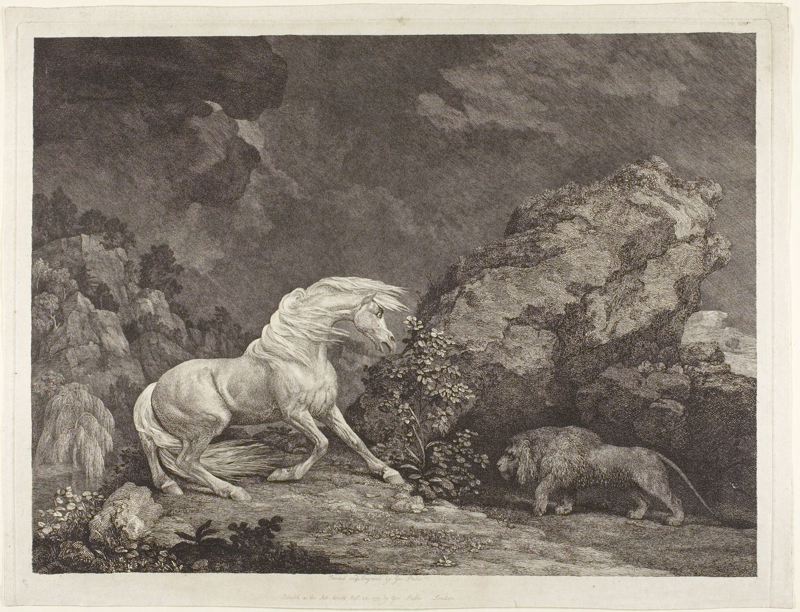
Back in early August 2011 I wrote a piece on using the “Yale Center for British Art.” For the first time ever, I finally understood why book and art historians talk about how enjoyable “working with the object” is. There’s something exhilarating about being in close proximity with the cultural documents we study–whatever the medium. This term, I dropped by the Art Institute of Chicago to conduct research. The institution’s collection presents phenomenal opportunities for visual studies scholars (Art History, English, or otherwise) of the eighteenth- and nineteenth-centuries to engage in direct object study. While this post will be followed by a sequel this spring–when I’ll be looking at some paintings in the collection for a seminar on the interior in art–this autumn’s primary course research falls on animals. Since the Art Institute has a wonderful impression of George Stubbs’s “Horse Frightened by a Lion” (fig. 1),

I found myself in the Art Institute’s Prints and Drawings Department. In what follows, I’ll describe how to best access the Prints and Drawings Department at the Art Institute, what information to assemble beforehand to use this resource effectively, and describe how the Art Institute structures visiting scholars’ interaction with their prints and drawings collection. From there, I’ll close with some remarks on what I got out of visiting the Art Institute for my own research this first time and by sharing some advice based on what I’ve gleaned from direct object study. In the end, what I hope you get from reading this blog post is an impetus visit Chicago and the Institute and, for some readers, a new way to think about how to approach visual art objects in your research.
Getting There: What’s the best part about the Art Institute of Chicago? Its central location in the Midwest. With Southwest Airlines’s third-largest hub positioned at Chicago-Midway and with United Airlines’s headquarters at Chicago-O’Hare International, getting to Chicago is easy given the number of inexpensive non-stop flights between these two airlines’ route networks. Both airports are directly linked to the Art Institute by the CTA “L” line (the paradigmatic Chicagoan mode of public transportation). What this all means is that one can catch a direct flight that leaves for Chicago early in the morning, arrive for the only appointments that the Prints and Drawings Department offers in the afternoon, spend about three and a half hours viewing artworks, and then still have time for dinner downtown before heading back to the airport for an evening flight home. Traveling to the Art Institute can be incredibly cost efficient.
Amassing Information Beforehand: In my experience doing direct object research it’s best to have a primary object of interest in mind, and then subsequently stage other objects in a given collection next to it to create meaningful avenues of comparison to bounce ideas off. I knew I wanted to look at this particular Stubbs work, and knew it was in the collection. So in building my trip I spent some time researching what other prints were in the Institute’s collection that matched up to a project on “horse art” (I chose two: Eugène Delacroix’s Cheval Sauvage and Albrecht Dürer’s The Small Horse, but you can view up to ten works on a single visit). Upon selecting the prints to look at, I used Zotero to sketch my preliminary ideas on why I was looking at what, and to make note of the accession numbers which match the object with their location in museum storage (these typically take the form of the year the work was acquired, followed by another number—for location purposes). I returned to these numbers when I emailed the Prints and Drawings Department to make an appointment, since this is the data the curatorial staff will use to pull the art you want to look at (as opposed to title/artist).
Arriving at The Art Institute & The Experience of Viewing: Upon arrival, you’ll want to check in at the front desk, as opposed to purchasing a ticket to view the museum exhibitions. A fellow from Prints and Drawings will escort you to the department. You’ll first receive a brief introduction to working with objects, after which you’ll enter the study room. Here, the works you and your colleagues of the day are set to study will already be put up on easels around the room’s periphery. There are tables in the center of the room were you can leave your laptop and/or pad of paper and pencil while you look closely at your chosen selections. In my experience, at this point, I grabbed my magnifying glass and was off to the races. While I was used to having the works I’ve looked at presented right in front of me, I ended up appreciating the time it took to walk back and forth—from the art to my laptop on the center table—between taking notes, since it forced me to meditate a bit more on the ideas the objects were generating for me. It was a different structure of interaction, but I liked it.
Conclusion: Even with the fabulous facsimiles and reproductions we’re privy to as 21st-century emerging scholars, I still always end up finding things in person I don’t see under any other circumstances. In this case, it was the sense of facture in terms of the organization of the print according to diagonals that lead the viewer’s eye in certain ways across the pictorial surface. But, in the end, what can I say? As much as I love to read theory, there’s just something about reveling in objects that moves me in a way that nothing quite else does–even when it comes to reproducible media, like prints. So while I recognize that most of the NASSRgrads readership has engaged in some form of direct object study in England, or elsewhere on the continent, I’d encourage everyone—who hasn’t, already—to visit some visual art objects. Indeed, one might even be surprised by what’s accessible at your own institution’s library special collections and university art museum (I was astonished at how many Blake holdings there are at Deering Library here in Evanston, for instance). In the end, seeing prints that weren’t on show at the Art Institute was a valuable experience for me—and I can’t wait to do the same with some nineteenth-century paintings in the spring.
And (last): looking forward to seeing many of you and hearing your papers in Tempe next month!
Getting to the Good Parts: Chapbooks and Blue Books

 One of my favorite things about Broadview Press’s 2006 edition of Zofloya (1806), by Charlotte Dacre, is the inclusion of a chapbook version of the original text in the appendix.[i] Dacre’s novel, which occupies 216 pages in this edition, has been condensed into a 19-page document that speeds through the tale, sidestepping scenes of excessive emotion, dialogue, and prolonged action and cutting right to the barebones plot. A scene early on in the novel, in which the main character’s father is mortally wounded by his wife’s lover, the count, reads:
“Draw, monster, devil, and incendiary!” exclaimed the frantic husband, at the same time snatching his stiletto from his bosom.
“I have no sword,” cooly returned the count; “but I have, like yourself, a stiletto, that shall be at your service.”
The Marchese heard no more: he struck and struck again with desperate fury at the body of his antagonist; but his aim was rendered unsure by his thirst for vengeance, by the raging and uncontrouled passions of his soul. The count, calm, and self-collected, parried with hellish dexterity his indiscriminate attempts; but receiving, at length, the point of his adversary’s stiletto in his shoulder, he suffered an impulse of rage to nerve his hand; and, retreating for an instant, then furiously advanced, and plunged his dagger to the hilt in the breast of the unfortunate Loredani. (50)
In the chapbook, this same scene simply reads:
“Draw monster and defend yourself!” exclaimed the husband, snatching his stiletto from his bosom.
“I have no sword,” said the Count; “but I have a stiletto.” The Marchese struck at him with great fury. The indignant Count plunged his dagger into the breast of the unfortunate Leonardo. (280)
It sounds almost like an outline or as if recorded from memory. The chapbook, called The Demon of Venice: An Original Romance, By a Lady (1810), like most chapbooks, has been blatantly plagiarized from Dacre’s original, though Adriana Craciun speculates in her footnote to the Broadview introduction that there is a slim chance that Dacre could actually be the author (31). Regardless, the “borrowing” of plot details as the norm does not seem to bother either reader or author, and Alison Milbank claims that changing the names avoids any direct legal ramification for the often-anonymous authors.[ii] Milbank explains the difference between chapbooks and blue books (named, of course, for their blue covers): chapbooks are prominent in the seventeenth and eighteenth centuries and had begun to die out in the early nineteenth century, whereas blue books—Gothic in nature and featuring a more sophisticated illustration style—were prevalent in the early nineteenth century and dealt closely with booksellers (perhaps even those carrying the original novels upon which they were based). Though I have only seen reference to The Demon of Venice as a chapbook, I suspect that it qualifies more as a blue book for these reasons. While books and even library membership were expensive, blue books “provided racy, entertaining and cheap reading for the literate poor,” and like many other more accessible forms of entertainment, such as theater, helped to perpetuate and continue the Gothic legacy among both the well-educated upper classes and the lower classes hoping occupy their minds for relatively cheap (Milbank). Milbank describes two lengths of these small books or pamphlets: “sixpence for 36 pages, and a shilling for 72 pages,” though some were even shorter.
I am just beginning to enter the world of chapbooks and blue books, hoping that this may offer insight into many Gothic novels that have not survived through to modern publishing and digitalization. Even Ann Radcliffe’s monstrous tome The Mysteries of Udolpho has been squeezed into under a hundred pages and re-titled as The Veiled Picture. I’m also interested in these types of abbreviations and how they change the stories themselves as well as the reading experience. I like to think of them as similar to today’s comic books or the series of Great Illustrated Classics with which many of us grew up (the ones with a picture on every other page. You know the ones!). They provide a different type of access to great stories. As Milbank points out, even our most revered literary figures, such as Percy Shelley, had a fondness for blue books, particularly in his youth.
Finding these texts today, however, is not easy. One of my goals for this post is to share with you a recent discovery that’s trying to make such texts as they were intended: accessible again. Literary Mushrooms, a spinoff project of Zittaw Press, is in the process of reprinting and re-illustrating fifteen Gothic chapbooks. They have just set up a great project page here, in order to gather funding for this project, which supports the 50’s-style comic illustrations, printing, and hand-stitching costs. Both Zittaw and Literary Mushrooms are dedicated in revitalizing an interest in these forgotten texts and to combine both nineteenth and twentieth-century elements to create a new (truly Gothic?) reading experience. I’ve just ordered a slew of copies of The Bloody Hand for the Gothic Reading Group that I run, distributing cheap thrills to the (poor) grad student masses, and we are anxious, amidst our regular studies of lengthy volumes, to discuss the difference in shifting from plot-driven novels to plot-only chapbooks, full (I might add) of exclamation points!
[i] Dacre, Charlotte. Zofloya. Ed. Adriana Craciun. Peterborough, Ontario: Broadview Press, 2006.
[ii] Milbank, Alison. “Gothic Satires, Histories, and Chap-Books.” Gothic Fiction: Rare Printed Works from the Sadleir-Black Collection of Gothic Fiction at the Alderman Library, University of Virginia. Marlborough, Wiltshire, UK: Adam Mathew Publications, 2003. http://www.ampltd.co.uk/digital_guides/gothic_fiction/AlisonMilbank3.aspx.
On Work-Life Balance
 I forgot about September like good food forgets about butter. Oh, it was there. Wouldn’t have been good otherwise. I just didn’t notice how delightful it was until it’s gone. Now I’m craving late summer warmth and autumnal beginning-of-the-school-year hopefulness and its over, carried away by Rocky Mountain snowcaps and rapidly diminishing morning sunlight.
Suddenly all my friends and students have the sniffles. I’m baking pumpkin muffins, drinking echinacea tea, and writing wrapped in a huge cable-knit sweater. I’m writing a chapter-like thing! And I’m beginning to realize that this is what you do when you are ABD: you bemoan the loss of time even as you court it, love it, snuggle up to it. What was once about work-life balance becomes about carving out time to write, every day, all the time. To knit a dissertation in great loops and tiny pearls before the season for your topic runs out. Golden, delicious, ephemeral season.
I received an email from a PhD friend the other day, the gorgeous and talented Myra. “What I would really like to be doing,” she says, “is holing up in my ivory tower spinning my little web. But alas, the web is sadly lacking in filaments these days.” This is followed by a truth, which is universally recognized: “I feel walloped by scheduling newness.” The adjustment into responsibility-laden school-year zone, with TAships and grant applications and office hours and organizing conference plans for next summer already. My dayplanner is like Whack-a-mole, just filled with lists and charts and little empty boxes waiting to be checked off. Walloping responsibilities.
I don’t have any advice, or plans for future improvement, or life-altering conclusions to make from all of this. Do you, gentle blog-reader, have some advice for me? I can only to say that these feelings—my feelings, our feelings, if you feel similarly—are corroborated, understood, empathized with. At least by my Myra. And that’s enough for me.