"Researching in Archives" – The NGSC Roundtable at NASSR 2013

Want to go on a funded research trip to study a collection that is crucial for your project? Want to know how senior scholars find funding, manage their time, and use a new collection to fortify their work-in-progress? Attend this year’s NGSC professionalization roundtable and learn how.
Conducting research in an archive away from your home institution can lend truly original ideas and evidence to your writing projects. It can also add important lines to your CV and prove that you have research skills that are important for the job market.
When: Friday, August 9, 11:30am – 1pm (Note: this is a brown-bag lunch session. Bring your lunch with you!)
Where: Conference Auditorium
We invited five distinguished speakers to give us advice on how to select an archive to travel to, get paid to do research there, and make the most of what we discover. Following short presentations we will open the floor for a lengthy Q&A session and conversation. Bring your lunches and your questions — we hope to have a lively discussion.
Speakers:

  • Andrew Burkett (Union College)
  • Jill Heydt-Stevenson (CU-Boulder, NGSC faculty advisor)
  • Michelle Levy (Simon Fraser U)
  • Devoney Looser (Arizona State U)
  • Dan White (U of Toronto)

Specifically, our panelists will help us learn:

  • how to write a winning application for funding for the trip,
  • where major collections for our field are held,
  • what you need to prepare before you arrive,
  • how to use the archive as a place of discovery, and
  • what to do with all the notes and photos we gather.

See you all there!

The First-Year Ph.D. Experience: Time Management

Introduction: This post marks the second of a series with perspectives on the first year of pursuing grad studies at the doctoral level. The first looked at language requirements, with my spring German reading exam serving as an example (which was–in fact–passed!). As promised prior, this next piece engages with the crucial issue of time management. It’ll be followed by a final blog in the series on theory and methods.
Broadly, something that I struggled with as a master’s student, and admittedly still struggle with at the Ph.D.-level (hence making myself write this during a particularly strong summer lull in productivity), is how to manage my time so as to consistently produce successful and (just as important) tangible results. For me, as I’m sure the case is for most, my time always seems impossibly short and the tasks before me infinitely many. As a solution, at the start of last fall, I committed myself to mapping out long- and short-term goals in concrete ways using material means that made them constantly visible to me on a day-to-day basis. In what follows, I outline these methods. Namely, there’s two technologies of time management at play: the dry erase board and my pocket notebook. When I did my best work this year, looking back, I relied on these things without exception.
Dry erase boards & the Moleskine Notebook: Keys to my first year: While my master’s program went well enough, essentially I had one central goal in mind: to be accepted to a Ph.D. program. Then, it was somewhat easy to conceptualize how I went about my work according to the priorities of finishing a fifty page thesis, completing application materials, and working on NGSC blog posts in between preparing a couple conference presentations. However, once I began gearing up for the demands of a five-year doctoral program in the summer, I quickly recognized matters would be considerably more difficult when the hurdles are both more complex and spaced out. In order to meet the new challenges that were ahead I decided early before the term started to attempt to change how I pursue my work, looking to take a much more organized, disciplined, and thoughtful approach than I had before. I found the basis for this in Donald Hall’s really great book The Academic Self: An Owner’s Manual, which stresses the importance of careful, but flexible, planning. Consequently, when I got to Evanston and it was time to hit the bookstore, I purchased two large dry erase boards and one dry erase calendar. I put them up around my apartment in places where I would see them constantly. I also picked up my first Moleskine notebook (on one Kurtis Hessel’s good advice, which became one of many over the course of the year). The first board would have the long-term goals for a five year plan, on the second the year’s objectives in monthly columns, and on the calendar and notebook (which I always tried to have with me, for constant accountability) how these goals would take shape on a week-by-week/day-by-day basis.
Long-Term Ambitions, Short-Term Goals, & Task Lists: On one of the large boards I took care to mark down all of the major milestones of my academic program: language exams, the second-year qualifying paper, third-year comps, and dissertation prospectus to follow. I also added a handful of other ambitions I’d like to fulfill, having to do with objectives like publications and fellowships for which I’d like to apply. Like most incoming graduate students, I felt initially intimidated by the list. But, breaking the larger objectives into tasks on a five-year timeline (while knowing the diss. phase may take longer) made things seem more manageable. For the first-year, beyond coursework, I decided to focus on completing both language requirements, have my qualifying paper selected from my seminar papers written in my first three terms, and (later) to apply for a museum curatorial fellowship. At the start of every month I would transpose the Year-Based Goals onto the calendar and at the end of each day I would write down what I wanted to complete on the day following in my Moleskine. I realized, for instance, that I needed to complete about a chapter per day (or 5/week) from my German For Reading Knowledge textbook in order to utilize German reading language resources for my winter/spring term research to feel prepared to take the exam in May. Yet, as the year progressed, I realized I needed to be much more adaptable on the second shorter-term tier of things, since contingencies came up that in many cases delayed (and in some even thwarted) what I wanted to get done when. The key, however, was that crossing off tasks on multiple lists made my development and progress more gratifying and tangible in ways I hadn’t felt before.
Conclusion: At the end of this year I’m convinced that I owe a great deal of my growth, which I felt came at a quicker pace than before, to thinking about–and managing–my time more conscientiously. This is not to say I followed my own system perfectly. In the winter term, for instance, it became more difficult to sustain the necessary effort and I became less committed to noting the next day’s tasks. As a result, things slipped significantly and I worked into deadlines more than I would have wanted. Moreover, I should have realized to a greater extent than I did initially that, even with great planning, flexibility is key and keeping a “negatively capable” eye towards productive uncertanties and new possibilities one can’t plan for is important. I hope to improve upon all of this in subsequent years. Ultimately though, I felt that ideas gleaned from my first-year in this regard multiplied the number of moments in each day  “Satan couldn’t find” and where I could be most productive. Of course, though, while I’ve been pleased with my own experiments this year, I’m of the mindset that a dialogue on how we think about time and structure our lives and work is better. So, I’d very much like for this piece to be a cause for conversation where other ideas on time management might be circulated.
 

Save the Date: "Emerging Connections," A Graduate Professionalization Workshop. June 12, 2014, Tokyo, Japan

This is a guest post from our colleague Danielle Barkley, a PhD student at McGill University, working on fiction from the intersection of the Romantic and Victorian periods.
Contact email for the “Emerging Connections” workshop at NASSR 2014: nassrgrad2014@outlook.com.
* * * * *

Leading up to the  NASSR supernumerary conference “Romantic Connections,” graduate students working in the field of Romanticism are invited to attend “Emerging Connections,” a skills and professionalization workshop to be held Thursday, June 12, 2014, at the University of Tokyo.
This one day event is intended to give graduate students a chance to network with other students from around the world, and hear from guest speakers about a range of topics concerning the current state of the field and how best to navigate it as an emerging scholar.
Topics covered will likely include publishing, conference-going, job applications, and interviewing; we welcome graduate students at any stage of their degrees. We also hope to arrange some cultural events and tours of Tokyo. We are committed to keeping this event affordable and accessible to graduate students; detailed cost information will be available in the fall.
A limited number of rooms will be available in university accommodation for students attending this event and the following “Romantic Connections” conference (which runs from 13-15 June). There is also reasonably-priced private accommodation in the area ($50-$100 per night). Registration for this event will open this autumn along with the main conference. For more information, see the “Travel” section of the Romantic Connections website (http://www.romanticconnections2014.org/travel.html). Early registration is advised.
More details, including a list of speakers, will be available in the coming months, but to give us a sense of what kind of numbers we might expect, we’d love to hear from anyone who is interested in this event. Please email emergingconnections@romanticconnections2014.org if you would be interested in attending, and feel welcome to also suggest any topics you would like to see addressed.
Sincerely,
Danielle

NASSR 2013 Course Design Competition

A reminder of the upcoming deadline for the NASSR 2013 Course Design Competition.  The Committee welcomes entries of all sorts as well as an initial inquiries. Entries are due by July 5.  See details below.

*****

Course Design Contest at NASSR 2013

Sponsored by NASSR and Romantic Circles

We are excited to announce the first annual NASSR Course Design Contest, which will take place at NASSR 2013 in Boston, August 8th-11th.  The contest was devised in the hopes of celebrating recent pedagogical innovation, inspiring creative new approaches, and creating an additional forum for conversations about Romantic pedagogy—both its boons and challenges.  We hope it will likewise complement and extend the conference’s open session on pedagogy, Teaching Romanticism Now:  What Matters Most?, sure to be a conference highlight.

Submissions might include a course that rethinks the period; a part of a course that addresses a specific author, theory, or literary problem; a special project, assignment, or a particular pedagogical technique.  We encourage the use of multimedia resources and digital techniques and courses designed to use multi-modal digital platforms for learning and communication, but they are by no means required.  Courses and projects should be recent—within the past two years—or projected to be taught in 2013-14.

After submitting a small packet of material, three finalists will be chosen to give a short presentation of their courses and pedagogies at a special panel during the conference.  The winner will receive a $250 award, recognition at the NASSR banquet, and their materials will be published on the Romantic Circles Pedagogies website.  The deciding board will be formed by members of NASSR in the US, UK and beyond, Romantic Circles, and the NASSR Graduate Caucus.

TO SUBMIT:

Please send a document of between 3-5 pages to Kate Singer, Assistant Professor of English, Mount Holyoke College and Romantic Circles Pedagogies Editor (ksinger@mtholyoke.edu) by July 5, 2013.

Initial queries and questions are welcomed.

Potential materials might include but are not limited to:

– A cover letter and explanation of the submission, including an argument as to the course or project’s pedagogical innovations and benefits

– Syllabus or parts of a syllabus

– Assignment sheets

– Multimedia or digital materials

How Iain Banks Helps Me Teach Romanticism


In the past week, dozens of tributes to Scottish writer Iain Banks, have appeared online— hundreds, if you count the smaller, no less poignant, expressions of grief and thanks via social media. Banks died of cancer on June 9th, two months after releasing a statement to his readers announcing his illness and the devastating news of his short life expectancy. Publishing consistently since the early 80s, he leaves behind a significant body of work, including both general fiction and science fiction under the name Iain M. Banks. Though we were “prepared,” the loss hits his fans hard and sooner than expected. Here is my tribute to this Great writer, one that I feel both unqualified and strongly compelled to write. Banks is certainly not a Romantic writer, so it may seem strange for me to write about him here. I discovered his novels only within the past few years, and I’ve still only read a handful of them. Yet, these works have made a lasting impression on me and, more to the point of this post, on my classroom, often paired with Romantic texts.
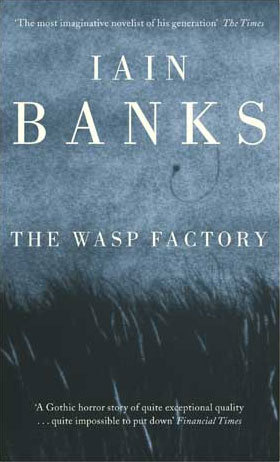

                  

Mary Shelley’s Frankenstein has been analyzed and interpreted in many different contexts, providing endless possible readings and uses. For some students, the possibilities are exciting, but, for others, they are also overwhelming. Frankenstein is one of the most teachable Romantic novels for the college classroom, but it can be difficult to convince students not accustomed to reading nineteenth-century texts (or not used to reading much in general) to have the patience to tread through unfamiliar prose styles in order to appreciate the novel’s worth. I think I can assume that many of us have taught this novel and had this experience at some point. There are many strategies to prepare students for the foreignness of earlier texts, but one that I frequently use is to pair a Romantic novel with a more contemporary novel. Twice, I have taught Frankenstein with Iain Banks’s The Wasp Factory (1984) in my freshman literature and composition classroom, a combination that exposes students to two types of literature: both qualify as Gothic, but we see it from two very different time periods and styles. After a week or so of feeling their way through Frankenstein, keeping characters straight and starting to construct understandings of settings and major themes, students develop a tenuous relationship with the text. Then I introduce them to a character named Frank.

“I represent a crime…” (10).

The Wasp Factory tells the story of this disturbed, sixteen-year-old, first-person narrator and his daily routines as he recounts his experiments and murders (that’s right, murders) on his family’s isolated Scottish land. His father, himself a reclusive mad scientist of sorts, has been seminal in Frank’s unstable (my students use the word “insane”) character. Frank, a god in his domain, spends his time fabricating and performing private rituals involving small animals and insects, creatures whose lives and deaths Frank orchestrates in order to tell the future or reinforce his surveillance and control over his island. The crowning glory of these devises is, of course, the wasp factory, a machine constructed from a giant clock face that holds twelve possible deaths for the wasp Frank releases into it. The death chosen by the wasp holds a wealth of information for our narrator. Frank is a powerless character desperate for power, abandoned by his mother and brother. Sound familiar? Frank, despite his age, has killed three times, and the twist ending blows my students’ minds.

“My dead sentries, those extensions of me which came under my power through the simple but ultimate surrender of death, sensed nothing to harm me or the island” (19).

Following up Frankenstein with The Wasp Factory solidifies students’ understandings of both novels by comparing and contrasting. Both texts are inherently about the construction of monstrosity on different levels, as well as human agency in matters of life and death. The creature and Frank are both considered to be monstrous outsiders for their behavior and appearances, but both have also been “created” by their father figures, practically devoid of any female influence. They are not unlike Victor in this sense, as well. They generate power through manipulation of their limited resources with conventionally inacceptable (again, “insane”), behaviors. All three construct their own forms of justice and morality based on adversity, environment, self-delusion, and a striving for power. The students compare and contrast these elements with little prompting from me as Frank and his world accentuate the choices and characteristics of Victor Frankenstein and his creation, not to mention the common themes of nature, science, motherhood, destruction, revenge, madness, etc.

“The factory said something about fire” (23).

The Wasp Factory is not a Romantic text, and that is what makes it so useful in this context: accessible and entertaining, it acts as a stepping stone between the students’ own interests and experiences and those of the early nineteenth century. Students have told me that The Wasp Factory is “the first book I’ve read that has actually made me think.” Another student became so fascinated with the spatial descriptions of Frank’s island that he went out and found a map of the book online, then did the same for Frankenstein. Banks’s novel is incredibly visual, and students want to visualize other texts just as clearly. They squirm at the more graphic, gruesome parts in the novel, but they can’t stop talking about them. The book complicates their own assumptions regarding characters as likable/unlikable and right/wrong and what those judgments are based on. They find Frank frightening and (again) “insane,” yet develop such an affection for him, one that they find themselves extending to the Creature and even to Victor. Writing about both texts together, they explore the complexity of character motives. They learned that liking a character does not mean that they can trust him, and that brings them even closer to that character.

“The wasp factory is beautiful and deadly and perfect” (154).

The strangeness of Banks’s novel, set in a familiar time and told with accessible and beautiful language, opens up a door to welcome other types of strangeness into the classroom, even a strangeness going back almost 200 years. A monster and his creations are always in good company. Iain Banks, thank you for your monsters and your creations. They will continue to teach us so much, not least to enjoy brilliant and important literature.            

Banks, Iain. The Wasp Factory. 25th Anniversary Edition. London: Abacus, 2009.

                                                                                               

Digital Humanities: My Introduction 1.3

This post is part of a three-part series charting my introduction to the digital humanities. My entrance largely follows from attending a seminar that meets twice a quarter on Saturday mornings entitled, “Demystifying the Digital Humanities” (#dmdh). Paige Morgan and Sarah Kremen-Hicks organize the seminar and it is sponsored through the University of Washington’s Simpson Center for the Humanities.
As the spring term ends for the 2012-2013 school year, I want to conclude this series of posts with some reflections on introducing the digital humanities into my pedagogical practice.

Digital Humanities or Multimodal Composition Class?

The course I designed in March differs greatly from the class I ended with this week. My assignment was English 111. As the course catalog describes it, 111 teaches the “study and practice of good writing; topics derived from reading and discussing stories, poems, essays, and plays.” While the catalog says nothing about the digital humanities, so long as we accomplished the departmental outcomes, my assumption was that a digital humanities (DH) component would only provide us with new tools for thinking through literature and writing.
It was an innocent assumption.
The main issue was scope. For my theme I chose “precarity,” which Judith Butler describes as that “politically induced condition” wherein select groups of people are especially vulnerable to “injury, violence, and death.”[i] Because there are so many “precarious characters” in Wordsworth and Coleridge’s Lyrical Ballads, I used this collection for my primary literary text. In addition to investigating precarity, with the Ballads students could also explore multiple genres and how the re-arrangement of poems alters the reading experience. Third, I wanted to use a digital humanities approach. By a DH approach I mean that I would encourage digital humanities values with regards to writing (e.g. collaboration, affirming failure), using digital tools, and learning transferable skills.
By the second half of the course it was clear that the students were confused about the concept, unhappy with the text, and struggling to understand the purpose of the values, tools, and skills. During the second half of the course, I lost hope for my big collaboration project and I dropped the emphasis on the Ballads, focusing instead on rhetorical analyses of blogs and news sites addressing issues of precarious peoples and working conditions, which was especially timely after the recent tragedy in Bangladesh.
Without the literature component, students began to feel more comfortable with the tools and concept, which led to greater motivation and better papers. On the downside, these students signed up for a literature class, which I basically eliminated. The triad of concept, literature, and method should work. But I found that if all three areas are of equal difficulty you may risk blocking success in any of them.
The “transferable skills” were perhaps the most successful part of the course. It is not the case that my classes didn’t teach transferable skills prior to my digital humanities emphasis. But as Brian Croxall has emphasized, we can teach more of them. As far as the digital humanist is concerned, more “skills” is tantamount to learning how to use more tools, which I translated (perhaps erroneously) as more media. So this term, all of my students built websites and blogs.
From building blogs and websites students learned firsthand how medium shapes what we can write, how “writing” might necessarily include design and management, and rather than give a tutorial on how to build these sites, I showed students how they could use Google to search for help on their own. The transferable skills were twofold: build an online platform to host your work (which alters what you can present and how), and learn where and how to find answers to your building questions (and rather than “good” sources, I stressed more of them). While initially these sites were less than satisfactory, by the end of the class students began to realize the potential and implications of the medium, which prompted several of them to re-build their sites during revision phases, taking more time with the organization of pages, images, background colors, and hyperlinks, and then explaining why these changes were important.
The websites and blogs showed signs of success with regards to “building skills,” but these platforms might belong less to the digital humanities and more to “multimodal scholarship.” As the organizers of the Demystifying the Digital Humanities seminar stressed during the April 14th session, digital humanists use their tools to “produce” scholarship, while multimodal scholarship means using tools to “display and disseminate” traditional research. These differences are a bit blurry for me still, but the blurriness might be accounted for by the fact that some of us are “trickster figures” occupying multiple regions on the plane of digital scholarship, as Alan Liu explains in the most recent PMLA (410).[ii]
But Liu adds greater clarity to these distinctions when he explains how a digital humanities project uses “algorithmic methods to play with texts experimentally, generatively, or ‘deformatively’ to discover alternative ways of meaning” (414). The algorithms may be out of reach for English 111 (and me!), but by using Google Sites, Blogger, and Ngram many students were cracking the digital ice and playing. In other words, these basic multimodal tools might be a useful first step towards transferring to a more involved and complicated DH project.
For such a class to be really successful it will require much more planning. For the fall, I am refining what I have rather than adding more tools to the mix. Until I do some serious text mining of my own, it might be safer to design a “writing with digital media” course. But now that Pandora’s (tool) box is open, I don’t see it closing in the future.
 
After attending the Demystifying the Digital Humanities seminars and writing these posts, I wonder if my introduction has actually led me to media studies instead. My suspicion is that I will touch both areas, because it is ultimately the task or problem that will determine the approach. However, and I believe Liu also demonstrates this point, the digital humanities as a method might prove to be a problem or task generator. With these tools we will become like Darwin returning from the Galapagos with all those varieties of finches sitting on his desk, asking what all these birds have to do with one another. Perhaps the moral should be: the more materials the bigger the questions.


[i] Butler, Judith. “Performativity, Precarity, and Sexual Politics.” AIBR. Revista de Antropología Iberoamericana 4.3 (2009): 1-13. Print.
[ii] Liu, Alan. “The Meaning of the Digital Humanities.” PMLA 128.2 (2013): 409-423. Print.

Archival Research at the Bibliothèque Nationale de France

2780793238_998cdcb399 — This post is dedicated to the very, very sweet student who I met on the escalator who helped me tremendously at the library. Without Ed’s very patient and good-humored help finding my desk and reserving materials I could not have had such a productive day at the BNF. Thank you, Ed! You’re the best! —
I am in Europe on a summer research trip for my dissertation and have primarily been working at the British Library. It now feels like a breeze to find via the tube, order materials to read, and take notes all day in one of the reading rooms. My comfort with the British Library emboldened me. I felt sure, as I strode toward the Bibliothèque Nationale de France (BNF) from the metro, that I would be able to find the lockers, get my reader’s pass, order my list of materials, and read all day, sans aucune problème, from 930am to 8pm. After all, the instructions online for registering as a reader seemed very straightforward, even in French. Silly, silly me.
It turns out that getting settled to do archival research in the BNF (the François-Mitterrand building — the newer and main branch) is extremely difficult. Most of the process felt designed to swallow new BNF researchers, and their precious research time, whole. Donc, le voilà, a how-to post for archival research at the BNF. It is, after all, a magnificent collection of archival resources and provided me with valuable research material that I have been unable to find elsewhere.
[Note: In this post, I tried to cover the basics of how to start your research here. Please add to this post any other advice or helpful anecdotes you have about navigating or working in the BNF.]

Step 1: Prepare These Materials Ahead of Time and Print Them to Bring With You

  • A printed, signed, and dated letter, on letterhead, from a professor at your institution who is your superior. The letter must state that you are a doctoral-level researcher and that you kindly request access to read archival material at the BNF. Your adviser or chair will know what this letter needs to say. Provide the rough dates that you will be there. Also provide a sentence that describes the subject you’ll be researching in very broad terms. Don’t leave home without this. If you do, email professors you have worked with in your department who might have a digital signature and letterhead on file – perhaps they can help you while you’re already abroad.
  • A printed bibliography of the materials you wish to order and read in order of priority. Be sure that this list is downloaded from the BNF website catalog and contains the catalog numbers for each item. This does not have to be a complete list — of course you are going to find things while researching that you didn’t at first know you would find. However, you do need to present the list to show your interviewer that the materials you wish to read are (a) available at that library location (there are several others), and (b) only available in the downstairs library archive (“Rez-du-jardin”) and not, say, available in the upper parts of the library (“Haute-du-jardin”) that are accessible to the general public at all times. Having this organized bibliography printed with catalog numbers saved me a lot of time!
    Note: for making this list, it may help to create your own account (“espace personel”) on the BNF website and save your bibliography there for easy retrieval. This is what I did.
  • Your passport for identification.
  • Money to pay for your reader’s fee. Unlike the British Library, the BNF is not free to use. You can either pay for a 3-day reader’s fee (around 8 euros) or an annual reader’s fee (around 40 euros).

Step 2: Pack for the Day and Head to the BNF

6171794154_235913081b
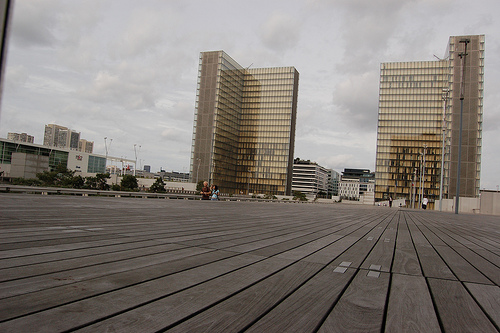
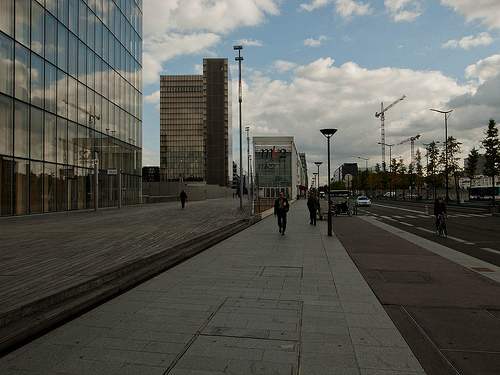
Getting to the BNF is not too difficult. You can find it via the metro by taking Lignes 6 (Quai de la gare), 14 et RER C (Bibliothèque François-Mitterrand). There’s a stop called “Bibliothèque François-Mitterrand,” so as long as you look for that, you’re all set. Once you arrive above ground and leave the metro, follow the signs to the library. When you get close, you will find yourself walking on a high wooden platform toward a very modern building. It looks as if it is next to a movie theater. For this summer, you will have to access the library through the West entrance (“le hall Ouest”) due to construction. If you get turned around — this is easy to do especially with all the construction — don’t be afraid to ask pedestrians with laptop bags marching toward the building in the distance.
Here are the directions on the main website: Addresses et transports.
Don’t forget to bring with you:

  • Your laptop charger cord and a French plug adapter
  • A snack and maybe a small water bottle (more on this below – I know it sounds wrong to bring this to an archive)
  • Any reference books you will need, such as an English-French dictionary, to help your research. There is NO wifi access in the research rooms to obtain these reference materials online. There are some tables that have ethernet cables that you can plug directly into your laptop, but these tables fill up quickly.
  • Some warm clothes in case the temperatures in the Rez-du-jardin are cold. (It was pleasant while I was there and felt warmer than the British Library.)

Step 3: Obtain an Interview for Access to Research Rez-du-jardin.

If you enter by the “hall Ouest” there is a welcome (“acceuil”) desk just across from the metal detector you must walk through and across from the small gift shop. Go there and tell the gentleman that you would like to interview for a reader’s pass for Rez-du-jardin research. He may ask you a question or two – explain that you are a graduate or doctoral student and that you are doing research for your dissertation or degree. The person I talked to was extremely friendly. He walked me behind his desk to a small office with two library employees. Here, an employee will conduct your interview.
My interviewer was lovely. I told her immediately that I spoke some French and could understand French well and she told me that she spoke a little English if I needed her to clarify something in English. She was clear and patient and I completed my interview almost entirely in French. I gave her my letter and my bibliography and explained briefly what I was researching and that I am a doctoral student writing my dissertation on romantic literature. She asked for a few pieces of information: my mailing address, my passport, and my phone number and email address. She then took my photo and made me a BNF reader’s card. *Do not lose your BNF reader card — it provides your way in AND your way out of the library and you cannot reserve or read materials at the library without it.*
That concludes the easy part – from here on, things were more difficult. She then gave me a set of maps and an oral list of instructions that were very confusing. I followed her as best I could. It will help if you take notes when your interviewer gives you your set of instructions for how to proceed. The instructions you’ll receive will be something like the procedures I’m telling you in this blog post. (Note: Please double check and don’t follow these instructions blindly — this library loves procedures and they may change rules between my visit and yours.)

Step 4: Pay Your Reader’s Fee.

To do this, walk back out of the interview office area and head to one of the tellers (à “la caisse”) to your left. Pay your fee and they will print you an entrance ticket – save this ticket in a safe spot.

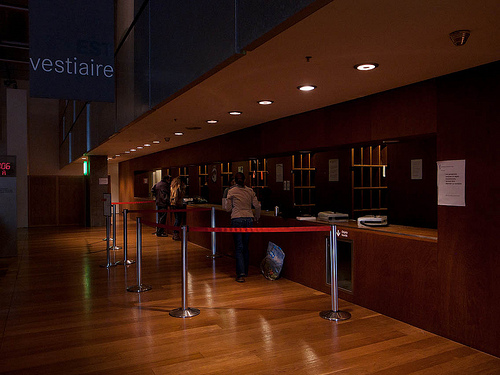
Step 5: Head to the “Vestiaire” to Check Your Coat and Bags.

Vestiaire
Vestiaire

This step is mandatory. There is no locker option (as there is at the British Library), to the best of my knowledge.
Here, you will give them your coat and bag to keep for the day. Take out everything you will want with you for the day, including laptop and charger, wallet, snacks(!) and a small water bottle, pencil and paper, and clothing. These items must ALL fit in the clear case they give you that looks like a transparent plastic laptop case. Hold on to your vestiaire ticket as you will need it to retrieve your belongings at the end of the day. There is no additional fee for this service.
Vestiaire location: It is on the same floor on which you entered, interviewed, and paid, at the other end of the hall on your right if you’re walking away from the tellers.
Note on food and drink: Though you cannot eat or drink in the archives while working, you will notice that many researchers bring snacks and drinks with them and keep them in their cases. I was shocked (SHOCKED!!) that this was allowed but everyone seemed to do it. Just be sure to take food/drink out of the clear box ONLY when you are in one of the designated eating/drinking areas. Otherwise, food and drink must remain in the box. (I am terribly afraid of getting in trouble with the BNF librarians.)

Step 6: Descend into the Reading Rooms Rez-du-jardin

This is more complicated than it sounds, as the turnstiles you must pass through require your reader’s card as well as completing your seat selection online as well as your book reservations online before they admit you. Here is what I learned on my journey into the depths — and this is where Ed, the student to whom this post is dedicated, came to my rescue!

6171264675_2fce562b84
Vestiaire is on the right and your first set of turnstiles are on the left in front of the firs set of giant metallic doors. Turnstiles only operate with your card.

  1. Use your reader’s card (“la carte”) to go through the turnstiles next to the vestiaire. You must hold the card on the sensor, like you would do with an Oyster card at the tube, and it will read your card and tell you when you gain access. When you do, the turnstile will enable you to walk through it and then through a gigantic set of double metallic doors.
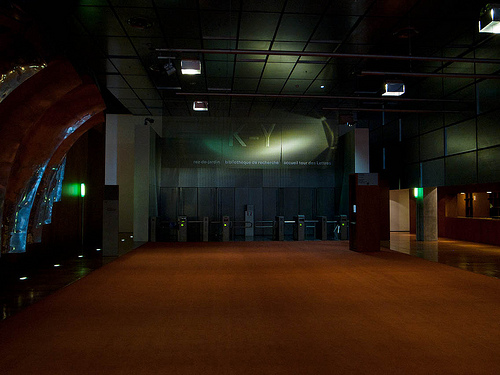
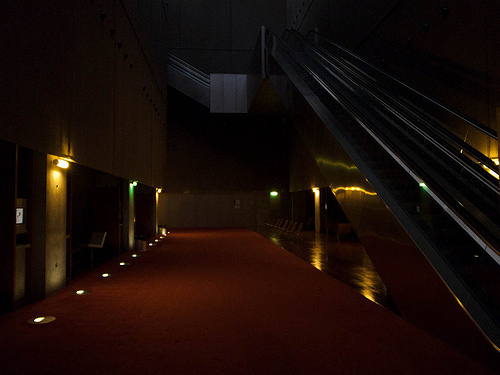
  2. You’ll proceed down an escalator in a metallic hallway with a red carpet. You will feel as though you are in a bank vault, casino vault, or a spacecraft.
  3. When you get to the bottom of the escalator, you will find another set of turnstiles to walk through by swiping your card. There’s a catch: if you have not registered yet, declared your seat online, and reserved your materials on a library computer, this turnstile will not admit you. Don’t panic! So then . . .
  4. Find the computer to the right of the turnstile and pull out your bibliography with the BNF catalog numbers. (Here’s another link to the BNF catalogs.) Put your card into the indented reader’s slot at the computer — the machine will read your card and pull up your account. You will need to select a reading table seat, or “votre place.” Pick a table letter where you will be working for the day — my interviewer at the BNF recommended section “L” because there is lots of space there and it is comfortable. Once you select your table letter, the machine will assign you a desk number (you can change this later if you like). Then, enter the catalog number for each item on your bibliography list, one at a time, and reserve them. Be sure to hit “confirmez” after each reservation or it will not be complete. Your maximum is 10 items. When complete, log out at that computer station.
  5. Wait a full minute after you log out before trying to turnstile again. After a minute, your card will be updated and you will be able to swipe it on the turnstile, pass through the turnstile, and proceed through this set of giant metallic doors into the Rez-du-jardin.
  6. High-five yourself. You’re almost done.

Step 7: Find Your “Place” (your desk).

Rez-du-jardin reading rooms and desks

This is the desk you chose and section that you selected on the computer. It will be a letter with a seat number. Your interviewer should have given you a map of the archives Rez-du-jardin to help you locate your section letter.
Here is a link to this map online – it might be a good idea to print and bring with you, in addition to your bibliography and other printed materials for your interview.
Drop your plastic case there at your desk and then proceed *with your reader’s card* to the nearest information counter. Check in, give the librarian your card, and make sure that your online requests are being processed. You will need to wait a little bit – it won’t take long. When your items are ready to pick up, the light at your desk will turn from red to green.

I was advised that I had time to grab a cup of coffee while waiting for my request to be filled. And this is where things temporarily went awry because I did not know this very, very important piece of information:
If you leave the Rez-du-jardin the way that you came in, and go back through the turnstile with your card, you are telling the computer that you are leaving forever (whether or not you actually are) and it CANCELS all of your reservations for the day. Any books that were waiting for you at the desk by your seat Rez-du-jardin go back to their shelves immediately. Doh! Gah! Quelle dommage!
There are two pieces of information that would have prevented this frustrating error that I made.

  1. Yes, there is a way to leave the Rez-du-jardin temporarily without canceling your reservations. (See the next step, below)
  2. I didn’t actually have to leave the Rez-du-jardin to find coffee. There are cafes located on this level of the library.

Thus, Step 8: How to Temporarily Leave the Rez-du-jardin (and return later the same day) and How to Permanently Leave the Archives Rez-du-jardin for the Day

Leaving temporarily: If you want to leave the Rez-du-jardin archives temporarily just to run upstairs and grab something out of your bag or to take a lunch break outside the library, you must check out at one of the computers by the turnstile and indicated with your digital account that you are leaving temporarily. Note again that if you fail to do this and you swipe your card at the turnstile and walk through it will CANCEL all of your material reservations for the day and think that you are leaving permanently for the day.
Leaving for the day: If you want to leave the Rez-du-jardins for the rest of the day, go ahead and walk out the way you walked in by swiping your card on the turnstile and heading back up the escalator in the metallic hallway. You will need to find your vestiaire ticket to reclaim your coat and bags upstairs (you cannot leave them overnight).
 

dark and metallic escalators and hallways
dark and metallic escalators and hallways – the hallway has more light than this but is definitely not cheerful

 
See Leon’s flickr photostream of the BNF for more images.

Digital Humanities: My Introduction 1.2

This post is part two of a three-part series charting my introduction to the digital humanities. My entrance largely follows from attending a seminar that meets twice a quarter on Saturday mornings entitled, “Demystifying the Digital Humanities” (#dmdh). Paige Morgan and Sarah Kremen-Hicks organize the seminar and it is sponsored through the University of Washington’s Simpson Center for the Humanities.
The first post in this series attempted to define the digital humanities by considering some of its values. Today I want to make two points regarding what a digital humanist is and does. First, a digital humanist is not the same thing as a scholar. While the same person may occupy both roles, these roles nevertheless perform distinct tasks. Second, the digital humanist is distinguished by the tool set, and those tools are primarily for the purposes of visualization. So let’s explore these two points in greater detail, and I’ll conclude by looking at one of the many tools you can use in your own introduction to the digital humanities.


Tools, Tools, Tools!

On the last day of our Demystifying the Digital Humanities seminar (May 4, 2013), the organizers drew our attention to something surprising with regards to digital humanities scholarship: it may not be scholarship, at all. Many of those coming to the digital humanities already know how to conduct research, build and organize an archive, and employ “critical thinking” in order to arrive at some conclusions. The final step is often a presentation of these conclusions in the form of a written essay or a book.
Rather than adding data and conclusions in the scholar’s process, the digital humanist multiplies the perspectives and the media. The digital humanist uses tools in order to view and present collected data in the form of a diagram, graph, word cloud, map, tree, or timeline (or whatever you invent). Because a visual image allows us to see the “same” object or data set in a different way, the tool increases the scholar’s range of conclusions. So the scholar must demonstrate significance, but it is the tool that functions as a “bridge” for the sake of achieving that end.
Given the literary scholar’s tendency toward close reading, certainly an abstract diagram of the work(s) will lead to a less insightful reading. But here we are operating as if the tool provides a conclusion, which is the wrong assumption. The tool does not provide conclusions. The tool only allows us to see more at once.
My close reading of a romantic poem might be the most accurate, interesting, or revealing, but if I can see the same information in relation to more texts, across spatial and temporal fields, my tools will make conclusions regarding historical time periods outside my area of specialization. Wrong again! The map or graph only demonstrates correlations, intersections, and divergences. It is then up to the scholar to investigate those areas.
As the historian Mills Kelly says in his contribution to Debates in the Digital Humanities, “instead of an answer, a graph…is a doorway that leads to a room filled with questions, each of which must be answered by the historian [or literary scholar] before he or she knows something worth knowing.”[i] In this sense, the diagram functions like a treasure map that makes the X’s more explicit. And while that map will tell a scholar where to dig, it cannot tell us why the artifacts matter, what they mean, or how they are useful.

If the burden of the conclusion falls on the scholar, the digital humanist has aesthetic and logistic responsibilities. The digital humanist might ask questions like, “What kind of visualization most effectively represents my data?” It will also be important to consider financial issues like cost and maintenance. Often times, visualization software is free. But when depending on others for your tools, there are risks like the issue of ongoing support. If I use an online tool made by a company that suddenly “disappears,” I may have to go shopping. And let’s not forget the attachment people feel for an accustomed piece of equipment. Whatever tool one chooses, the old rule applies: backup your files. If you lose a tool you have only lost the medium through which you represent your information. Lose your information, and—well…

But everything we do comes with risks. To balance your decision as to whether or not you want to use these tools, I suggest having some fun with them first. An easy and fast way to see the benefits yourself is through IBM’s Many Eyes, a website devoted to free visualization software. The disadvantage is that Many Eyes’ visualizations must remain online; on the other hand, the site is so easy to use that you can test the water within minutes.
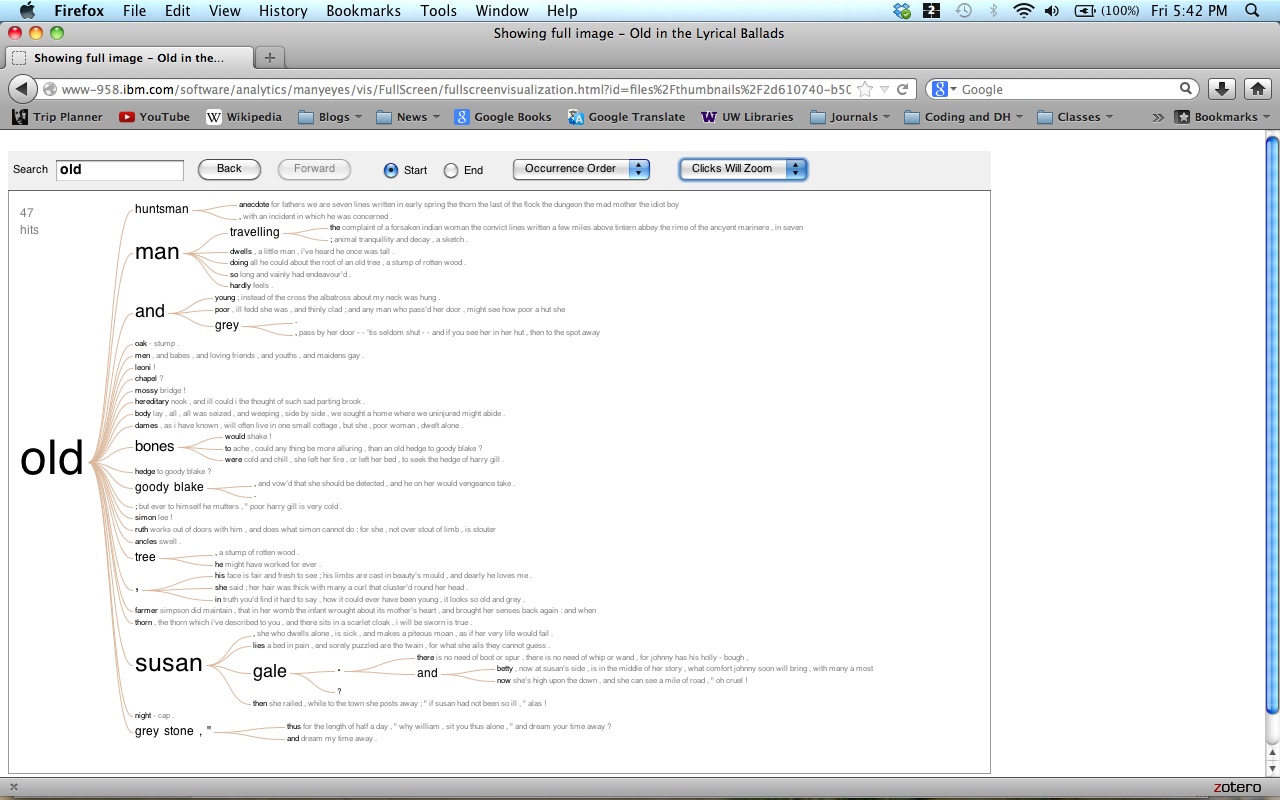
Below is a screenshot of a word tree I made from the Lyrical Ballads. In order to generate the tree, first I use the browser in the “data sets” to find the Ballads, which someone had already uploaded. Then I click the “visualize” button and select the first diagram option, “word tree.” From here I can enter any word from the Ballads that I want to explore. The 1800 edition begins with an “old grey stone,” so I enter “old,” which catches 47 hits. A diagram appears illustrating all the instances of “old” and how it connects to the words around it. Now imagine doing this with hundreds or thousands of texts. Many Eyes won’t tell you what all those connections mean; rather, it allows you to see them in the first place.
OLD in LB 2013-05-10 at 5.42.16 PM
For a closer look at this image, click here.
Rather than “new,” the word that best describes the advantage of digital tools is “more.” A Concordance to the Poems of William Wordsworth does something very similar to my word tree above because the book also supplies all the instances of “old” in Wordsworth’s poetry. But with digital tools, I could add the concordances to Virgil, Spenser, and Milton, as well as those writing manuals, law documents, and political pamphlets. Then all of these texts can be incorporated into the same visualization. In a way, these possibilities make me less nervous about the future of scholarship. Now I can see more ways of lengthening the narratives I was already generating, and find more to explore.
Beyond aiding our own scholarship, the visualization helps communicate what we do as scholars to a broader audience. The thing to remember is that the tool is not a justification in itself and it does not make one’s role as a scholar more relevant. But with these tools we can better demonstrate the power of the media we study to others using a medium held in common across discipline lines. Equally important, by working with these tools, we are in a better position to illustrate the necessity of the scholarship that actually makes these images meaningful.


The Demystifying the Digital Humanities seminar ended last week, but I hope that Paige and Sarah are able to continue these valuable workshops in one form or another in the years to come. For my final post in this series, I will discuss how I have attempted to incorporate the digital humanities into the course I am teaching this term, some of my success, as well as my failures.


[i] “Visualizing Millions of Words.” Debates in the Digital Humanities. Ed. Matthew K. Gold. Minnesota: U of Minnesota P, 2012. 402-03. Print.

Alt-Ac-Attack: Thoughts on Preparing for the Job Market

The job market is not great right now. We all know it. We don’t always want to think about it. And, since several years pass between the first year of grad school and the last year, it’s very easy to avoid thinking about it: just put your nose to the dissertation grindstone until that last frantic year when you have to look up from your work and look around. The market can change a lot in five, six, seven years as well: when I left undergrad in 2006, it wasn’t horrible. Now… it is, and it seems like grad programs are realizing this and making moves to address it. We are just starting to really assess this issue in my own department, and we’re trying to do this in two related ways: focus on preparations for the academic job market earlier in a student’s career AND accentuate other options that we’re not often taught to consider: alternative academic careers, in other words. In this post, I’d like to describe some of the issues and possible positive practices we discussed in a recent meeting among grad students in my department. I’d also really like to start a dialogue about what other departments are doing to help their graduates prepare for a more positive future after all their hard work.
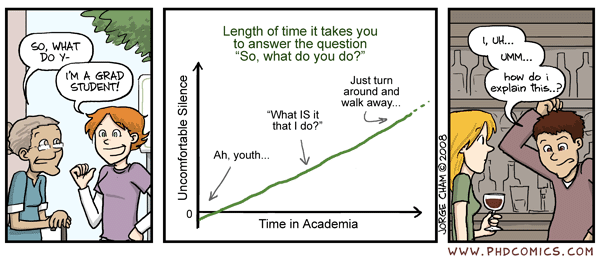
Alt-ac jobs unjustly get a bad rap: they’re spoken of with low tones, shaken heads, shrugged shoulders. We’re so focused on getting that increasingly unrealistic tenure-track professorship that anything else seems like some kind of failure. And it really, really shouldn’t. Jobs are hard to get in many professions, but variations using the same skill sets don’t seem to be looked down upon as much as they currently are in academia. So, one of the first problems to be fixed is this negative attitude towards jobs that require exactly the types of abilities at which we excel, jobs that would provide financial stability, health care, productivity, and a lot of genuine happiness. Concerns that interfere with considering these options early might include support from the department, committee expectations, discussions (or silences) amongst fellow grad students about such subjects, as well as simple confusion about how to market skills we already have or even how to find alternative career options. All these problems are fixable. My department has taken a first step by putting a recently-hired faculty member in charge to act as a go-to person to help students on an individual basis as they approach graduation as well as to hold various workshops and meetings related to academic and alt-ac job concerns. Overall, we’ve discussed some New School-Year’s Resolutions as we round out the end of our current semester:

Start early. As I said, it’s really easy (and, let’s face it, enjoyable!) to get wrapped up in your research and to forget about where it might lead you after graduation. I, myself, am incredibly guilty of this. Just starting to poke around at what jobs are available from time to time can create awareness (without panic) and can also give you a sense of the timeline for applying to various positions. Start making the most of what you’re doing right now. Have faculty come observe your teaching in preparation for letters of recommendation. Get involved with committees in which you may already have an interest. Use summers to explore short-term alt-ac jobs that might require editing, grant-writing, teaching, etc.  

Know what we have. We have so many skills that would make us fantastic professors. But they’d also make us lots of other fantastic kinds of professionals. We can speak in public and plan lessons and manage groups of people and think on our feet and make information interesting and read large amounts and synthesize and simplify and summarize and analyze and explain and entertain and proofread and edit and a hundred other things. But we don’t always translate what we do into these broader skills. Some of the future workshops we’ve discussed focus on this kind of translation: how to recognize our skills, how to use our writing skills for different types of writing, how to change a C.V. into a résumé, etc.

Speak and listen. Half the problem with both the impending trauma of the job market and the search for alt-ac jobs is that we don’t talk enough about them. We don’t talk about what we think about putting our skills to use in different ways, and we don’t discuss what those different ways might be. What we’ve done, just by having a meeting to discuss the new faculty position and what we’d like it to cover, is to allow ourselves to talk and to listen to one another. This is huge. What’s more, we’re hoping to be able to speak and listen to those outside our current student and faculty population by contacting alumni who have pursued various career options with our same educations. We’ve begun to bring in speakers who can help us think about aspects of professional development and alt-ac careers. We’re planning mock interviews and job talks amongst ourselves, as well as more informal discussions about other aspects of applications.

The job market is a sensitive subject for practically everyone right now, particularly for academics who have invested so much time and energy into a very specific career path. Yet, it’s also a concern near and dear to our hearts as we watch friends and colleagues struggle and prepare for struggles of our own. I am incredibly pleased and proud to be part of these steps to create a space for such an important conversation.  

But, I know we are certainly not alone. I’d really like to open up this discussion to my fellow blog-readers: what steps have your departments taken to think about the job market and alt-ac careers? What have you found useful or frustrating in regards to the leap from graduate student to job seeker? What have you found really helpful in this process?

Helpful resources:

http://mediacommons.futureofthebook.org/alt-ac/

http://chronicle.com/blogs/profhacker/the-alt-ac-track-negotiating-your-alternative-academic-appointment-2/26539

http://www.higheredjobs.com/

http://academicjobs.wikia.com/wiki/Academic_Jobs_Wiki

A Romanticist’s Journal of a Tour to Cleveland; Or, notes from ASECS 2013

The 44th Annual Meeting for American Society for Eighteenth Century Studies was held in Cleveland three weeks ago so my apologies that this isn’t coming to you in the full blush of the liveblog moment. But my brain is still sprouting with new names, books to read, perspectives on the state of the field, and connections (however fanciful) between my coursework papers and panelists’ insights. And I may not be the only one who recollects April 4-7 with a blush or two: some acronyms just leave you with no choice. Having never attended ASECS before, I can’t speak for the surely lengthy history of great jokes in this regard, but I can tell you that this year, we were on top of things. I like to think the Romanticists in attendance navigated this innuendo especially well. Telling the Romanticists apart from Eighteenth Centuryists, isn’t so easy; or at least I found myself taking a a few searching looks in the restroom mirror of the Renaissance Marriott Hotel: Where does an Eighteenth Centuryist end and a Romanticist begin?* Who am I, really? (And what am I doing in a Renaissance hotel?)
My conference bookends, the first and last panels I attended, were my favorites. We** listened to our first after a harried drive from Chicago, arriving in time to find parking only in the bowels of the giant casino next door, and seating at the front of the Garfield Room—on the floor. If you haven’t tried it, it’s a good experience: not only are you appreciating some very sharp minds, you get to appreciate them from the vantage of a Kindergarten student, crossed-legged on the carpet. ASECS was wonderfully democratic this way. Latecomers got the floor, whether they were fledgling grad students there to be sponges, tenured professors, or professors a giddy month or two or twenty shy of tenure (spirited conversations were had, especially, with the latter). But plenty of generous seat-offering took place as well (fellow-feeling in full swing here!).
So this panel, a roundtable, was titled “Aesthetics and Individuation: Frances Ferguson’s Work in Eighteenth Century Studies,” and the panelists, none of them officially Ferguson’s students, spoke about their indebtedness to her thinking and the incredible influence she has had on the fields of Eighteenth Century and Romantic studies. From her game-changing article “Rape and the Rise of the Novel,” on Richardson’s Clarissa (1987) to her book “Solitude and the Sublime: Romanticism and the Aesthetics of Individuation” (1992), Ferguson has been a force, and other strong voices have met Ferguson with forceful questions and concerns of their own. On this panel, John Bender, Blakey Vermeule, Helen Thompson and Nancy Yousef. Here are some of their thoughts, in condensed Shelley-acorn form:
Bender: Romantic marriage is where function and phantasm meet; realism’s reality is gothic; ecstatic interpenetration.
Vermeule: Ferguson advocates a way to be a self that doesn’t need to mean atomism; what does it mean to want to make an impact in one’s career? pertinent
and, one Hilary Rodham gave the valedictorian speech to Ferguson’s graduating class of 1969 at Wellesley College: “More than social reconstruction we need human reconstruction,” Rodham said.
Thompson: modes of doing and non-doing, what counts as rape? the departure of the volitional; external contents of persons; form as the situated production of inner-ness; Sci Fi and physiological formalism.
Yousef: What relations can be used under the word form? Form preoccupies the room of emotional thinking; Ferguson reminds us that historical materialism and formalism co-exist and cannot cancel each other out.
Finally, my last panel of the weekend: “Close Reading Today,” held in the George Bush room (did not specify Jr. or Sr.)
Sandra Macpherson delivered a paper titled “Close Hearing” and posed some brilliant questions: How do we read the sonic properties of objects? How do we talk about sound as matter without turning it into meaning? I’m still thinking about the independence of sounds in verse being other than, or not necessarily, onomatopoeic. I’m very partial to Jane Campion’s “Bright Star,” and Macpherson ended her talk with a clip from the opening of the film. A shot so close that at first you can’t tell what’s happening (a ragged thread being led by a needle in and out of a piece of cloth) but the whole time there is the music, a human symphony singing no words in particular.
Stephanie Insley Hershinow’s “Up Close and Personal” talk began with the question: “Does reading make persons or impersonality?” She went on to consider how close reading has been said to fail and why it is nonetheless a mistake to discount the details: “Close reading is to notice something new, even in a text that has been extensively critiqued.”
Matthew Wickman’s paper, “Reading for the Middle Distance: Moretti and the Picturesque,” made a juicy counterpoint to Hershinow’s. How do we read the images of distant-reading (the bubble trees, line graphs, word clouds etc.)? Numbers: do we really know they mean? Counting, Wickman argued, is a figurative exercise, and if we do not know what numbers are, we don’t know who we are—we don’t know what a ‘whole’ is.
The post-panel discussion ended where I wished it had begun: a man asked a question (or rather, stated at length with no question mark in sight), saying new critical formalism had had its day. Macpherson sung out, “Oh it’s back, baby!”
And with that, back we went to Chicago, heads humming with good things to tangle with and sound out in the months ahead.
*Radiohead’s “Where I end and you begin” is an excellent song for a road trip back to the long (and longer and longer) eighteenth century.
**”We” refers to Samuel Rowe (a second year PhD at the University of Chicago), Allison Turner (a first year PhD at the U of C) and to your blogger, Lauren Schachter (also a first year PhD at U of C). We attended as observers, wisely choosing to do this on our break between Winter and Spring quarters instead of writing our papers.