Young Poets. Young Scholars.

When I was a junior in college, I studied abroad in England for a semester, and as part of my Modern British Poetry class, I took a literary pilgrimage to Wentworth Place, Keats’s home in Hampstead. This trip was genuinely transformative for me, as it fueled a fantasy that I was John Keats’s lover in another life (hey, we all have our literary crushes). And more importantly it began my creative and scholarly work on the poet. As I wandered room to room, swooning over the handwritten manuscript of “Ode to a Nightingale” in the corridor and tearing up at the death mask encased in the library, I hadn’t a thought of my future with the poet.  But this week I received an acceptance to the first ever Keats Foundation conference at the Hampstead house.  And I began to reflect back on my 20-year-old self and how she would laugh to know that she would return to Wentworth Place as a career Keatsian almost a decade later.

Over the last month, I have been thinking a lot about how identity gets organized, both my own as I am beginning to define myself as a young scholar and that of the poets I study.  This all came about as I prepared proposals for the Keats and His Circle conference in Hampstead and NASSR 2014.  For each of these, I am looking to begin some foundational dissertation work that looks at identity organization in the Cockney School.

Journalist, poet, and radical Leigh Hunt attempts to organize the second generation of Romantic poets in his creative works and his weekly newspaper The Examiner. Though he never writes an overt manifesto and never claims the emergent artists of Romanticism’s second generation as “his” school, I believe he constructs a clear political and artistic mission for himself and his friends. In The Examiner on December 1, 1816, Leigh Hunt published the “Young Poets” article, which announced a new school of poetry led by Percy Shelley, John Hamilton Reynolds, and John Keats (with a nod to Lord Byron). As he writes here and elsewhere, this new school was not innovative so much as restorative, returning the focus of modern poetry to “true” nature and more genuine understandings of “human nature.”

Hunt organizes their poetic identity both as an extension of and reaction to the first generation (esp. after the publication of Wordsworth’s Excursion, lambasted by Byron, Hunt, and Hazlitt as the mark of Wordsworth’s establishment allegiance). He says the new poets are continuing the cultural work begun with the linguistic and political experiments of Lyrical Ballads, a project he believes the now conservative first generation has abandoned. As he defines the cultural work to be done by his school of artists and political reformers, he touts the revolutionary power of loose versification and conversational language (he maintains that the language of conversation is the language of “true nature” and “nativeness”), but he also touts cheerfulness and sociality, as opposed to the Wordsworthian egotistical sublime–poetic insight emerging through solitude. Hunt and crew value brotherly love, charity, and a mutual support of fellow beings. And they uphold these virtues in contrast to the modern vices of extreme individualism, commercial interests, and exploitation of the disenfranchised.

As applied to this circle, the term “Cockney School” in itself demonstrates the ways in which identity gets imposed upon a person or group. Famously, “Z,” a semi-anonymous critic for the Edinburgh Review, printed a series of vicious essays on this group of liberal (and often dissenting) intellectuals from the London suburbs, titled “On the Cockney School of Poetry.”  According to Z, the school was headed by Leigh Hunt, and included such figures as Keats, Webb, Haydon, and Hazlitt.  His reviews frequently digressed from the work of this school, using ad hominem attacks to belittle the men with their shortcomings in class–all with the intent to discredit this second generation of Romantic artists because of their politics.  Intriguingly, pieces of this class prejudice against Cockneys precedes the era, and the stereotype can be seen today in the classic appropriation of Liza Doolittle style Cockney accents in parodies of the English.  A particular favorite of mine in the last year has been Fred Armisen’s portrayal of Queen Elizabeth II as a sort of Cockney thug on Saturday Night Live.

Nevertheless, the Hunt circle appropriated the qualities of this pejorative stereotype and other labels applied to them, reading into these intended delimitations a revolutionary power for greater liberty. Z complained of their inferior education, their limited knowledge of Greek and Latin, but for Cockneys like Hunt, Keats, and Reynolds translations and retellings proved more democratic, opening new worlds of knowledge and opportunity for people of middle and working class backgrounds. Chapman’s Homer introduces Keats to new peaks, new oceans, new planets, horizons previously inaccessible. Z complained of their vulgarity and obscenity, but Hunt, Keats, and Shelley celebrated sensual overflow and freedom of expression.  Their poems portray this liberty literally by catalogues of sensory images and metaphorically by unconventional representations of love (sympathetic idolaters, demon lovers, love triangles, etc.).

In a trend I find problematic, Keats scholars of the twentieth- and early twenty-first centuries perpetuate a prejudice against Keats’s supposed Cockney roots, often undervaluing the politically engaged young Keats of 1816-1817.  Moreover, they divorce his later work from Hunt’s influence (rightly so, perhaps, as Keats distanced himself from Hunt for numerous personal and professional reasons). As a young scholar just beginning my work on Keats’s Cockney roots, I don’t know yet to what extent I agree that Keats’s work transcends his Cockney identity.  Though his 1820 volume may demonstrate sophistication well beyond the wrenched rhymes or weak adverbial descriptors of Huntian style, his thematic concerns remain deeply Cockneyfied.  Romances like Isabella; Or the Pot of Basil and Lamia betray his continued resistance against a modern capitalist economy that exploits both human and nonhuman resources.  And even his great ode sequence, which ostensibly celebrates a pure aestheticism, carries the taint of political agenda and historicity.  The nightingale disappears, the poet awakes. He returns to a historical reality of the Six Acts, the Corn Law Protests, Peterloo, disenfranchisement, disease, and personal loss. To say the least, his 1820 volume shows a conflicted relationship with the Hunt school (perhaps a topic for another post).

Armisen’s Queen from SNL 2013

I feel immensely fortunate to have the opportunity to explore London and its suburbs again, as a slightly more seasoned romanticist, Keatsian, and anglophile. And while I will not adopt a phony Cockney accent for the duration of my visit, I will expand upon my original pilgrimage, exploring the sites that were key to the school’s development.  On the list thus far, other than Hampstead Heath, of course: Edmonton, Enfield, Guy’s Hospital, and the Vale of Health.  I will keep you apprised of my plans for exploration as well as archival research as the reality of this trip continues to set in.
Welcome New Co-Chairs

The NASSR Graduate Student Caucus (NGSC) is pleased to announce the election of 3 new Co-Chairs:
Laura Kremmel (Lehigh U)
Jacob Leveton (Northwestern U)
Teresa Pershing (West Virginia U)
Laura, Jacob, and Teresa are excited to begin collaborating to support graduate students studying romanticism by developing our online community and resources as well as organizing events at the annual NASSR conference. Please join me in thanking them, in advance, for their work and time.
Best holiday wishes!
Kirstyn Leuner, outgoing Chair
Jill Heydt-Stevenson, NGSC Faculty Mentor

What I Learned About Truth in Pursuit of Reality

In response to Deven’s post regarding her journey toward archaeology via the pursuit of reality, I wanted to use the resonance I felt in her story as a jumping off point for my own post about the nature of reality. While I am compelled by approaches to understanding defined by logic and reason, I find myself sometimes working against both in my role as an artist. I make work in a system that allows for the full creation of possibility and ideas – a world that ascribes to sets and grouping but also readily casts them off in order to make great leaps and bounds of the imagination. Contemporary artists, unfettered by traditional labels that have served much of western art history (though still enriched by that history), move about from media to media, always seeking the best solution to visual questions. Art of the mind is valued as well as art of the hand, and at that juncture, pragmatic fixes need not be applied. As a printmaker interested in geology and compelled by the scientific method, I was searching for artistic solutions that had practical, empirical answers.  I wanted to find the place where art and science met. Perhaps after one too many philosophy papers, I decided to close the book on abstract ideas and go out into the field.
Much of my work deals with narrative and the quest for the truth in that space. Truth, for me, was about getting to the heart of what really happened on a cold day in December that has long since passed and can now only be accessed through memories. I have no observable data or evidence. The reality of each moment is a driving concern, and if I can create output of those moments, perhaps they will be easier to analyze and interpret. The prints that I create deal with specific times and places, and I can correlate that nicely with rocks in the field that I learned about through geological field exploration. For instance, pick a memory from your childhood, say, around fourth grade. Were there other people there?
What kind of day was it?
Can you recall what you were wearing?
In the epochs of the history of this earth, that blink in your existence could be akin to a river flooding in the Late Cretaceous. Perhaps some plant matter is trapped in with the sediments rushing over the banks, a picture of that day in the memory of the earth, now lithified. Literally, set in stone.
People will remember things differently, and focus on separate parts of events. Humans get details wrong and let their emotions dictate how they feel about certain memories. The earth, however, could only ever tell you the truth.  It records events as they happen, and if you wanted to find out the story – “the reality” – all you need to know is how to read the rocks.
 

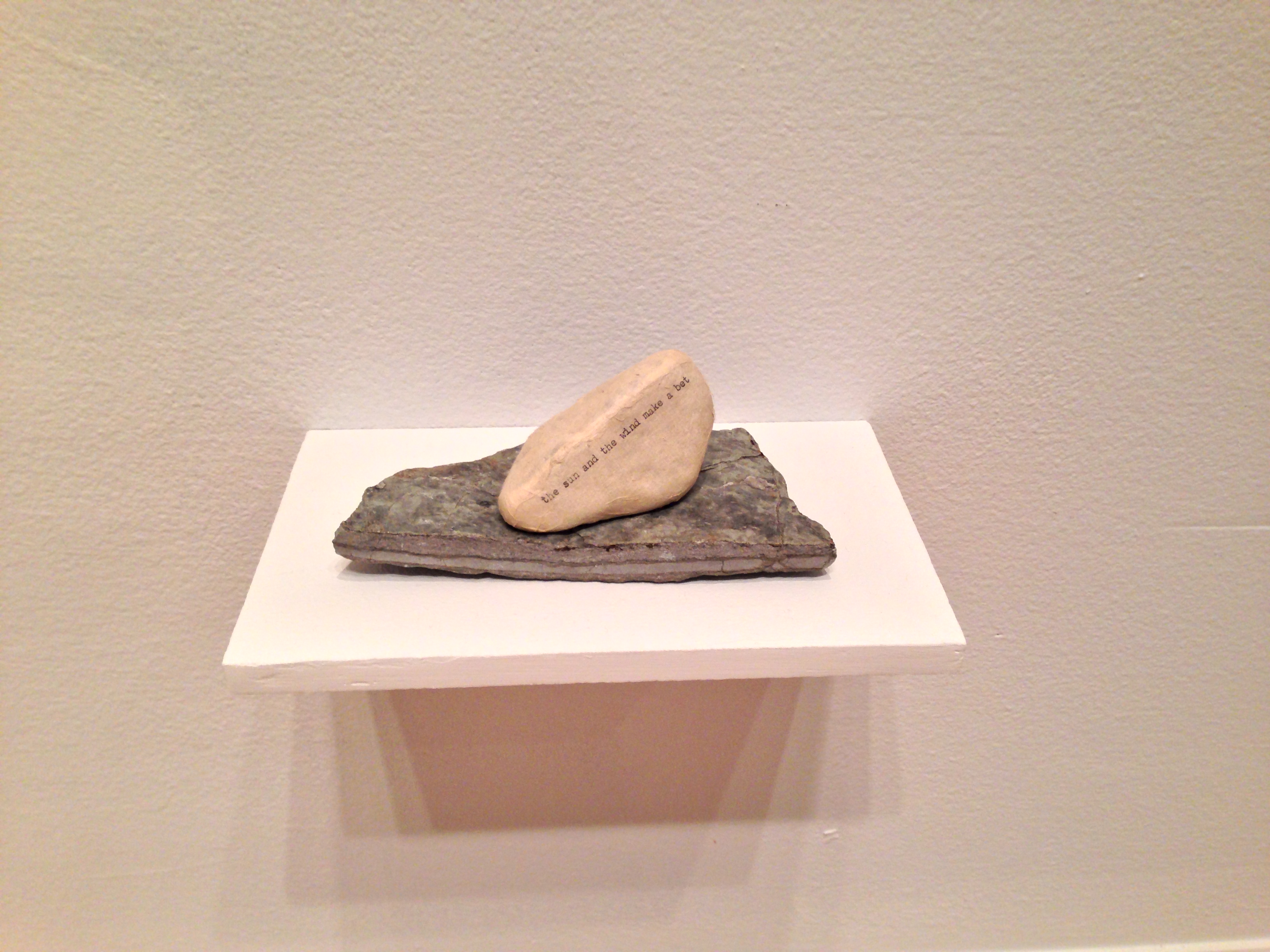
Nicole Geary, Wonders of the Rocks, detail, Exhibited 2013. Granites, Gypsum, Limestones, Prints. Dimensions Variable.

 
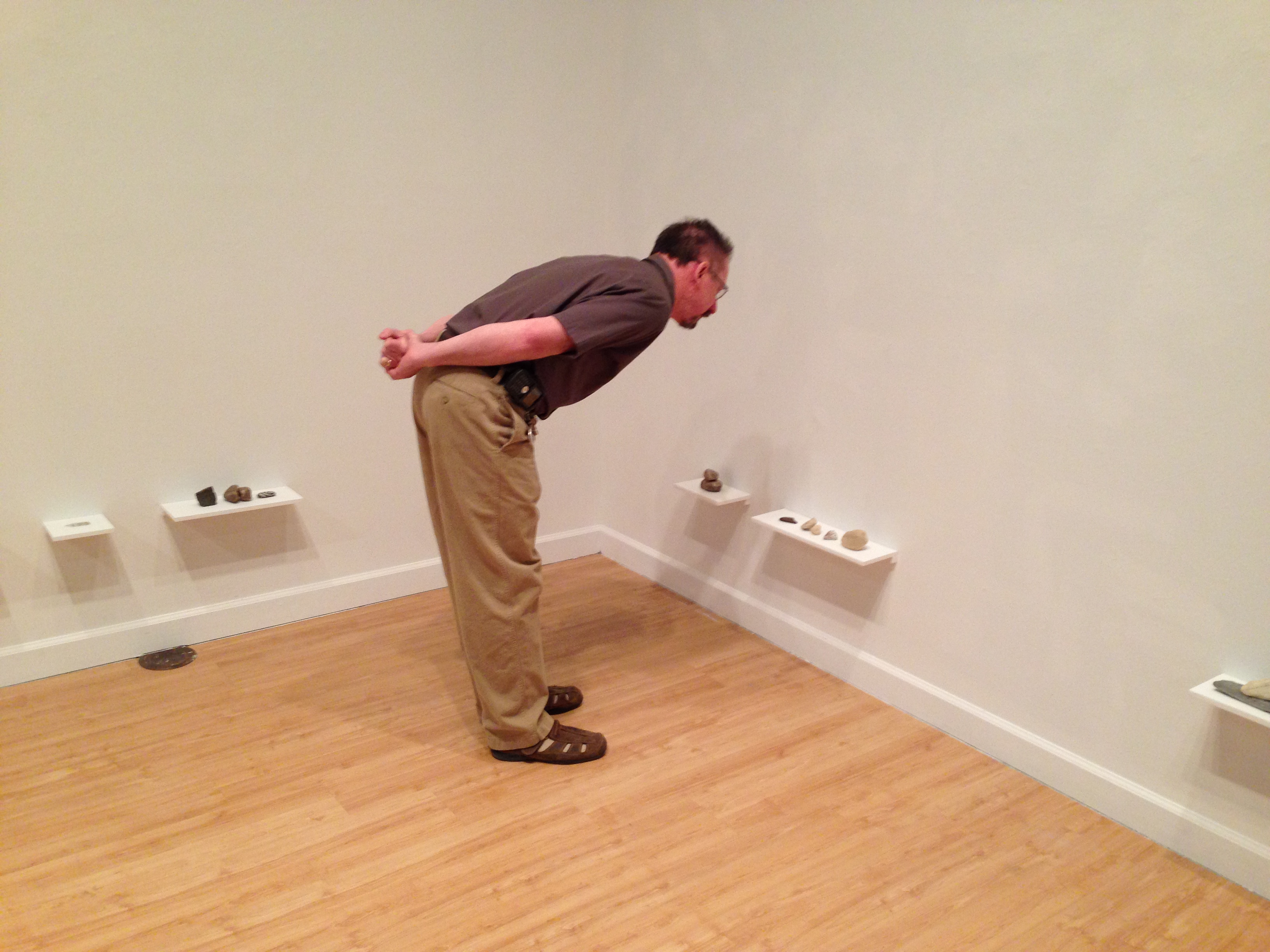
Going forward with this proposition, in late 2012 I set about making an installation titled Wonders of the Rocks: Passages I – IV. It is a collection of various hand-collected granites, gypsum, shale and limestones, placed onto shelves of varying widths. Each shelf contains a set of rocks meant to signify some narrative or implied story amongst the grouping. Some of the rocks used in the piece were covered with my own interpretation, or memory, of that rock so that you could no longer see its real story underneath. The piece is hung low on the wall and arranged in a linear format, meant to be “read,” as one literally reads rocks in the field, looking ever downward. I wanted the viewer to come to this piece and kneel down or bend over as one does when searching for samples. If the meaning of some small passage was lost to the passerby who did not fully engage with the piece, to me this is symbolic of the geologist who loses sight of the details and fumbles even the smallest of notes. A misinterpreted strike and dip of strata could change how one reads a formation entirely, much the same with small intonations in the translation of a foreign text.
Nicole Geary, Wonders of the Rocks, Passages I-IV, Exhibited 2013. Granites, Gypsum, Limestones, Prints. Dimensions Variable.

 
I am still working on the idea here between what is meant by the signs and signified, but now I am incorporating cues from language. Maps still play a role to me as guides in making meaning for geological work, but the idea that these rocks can transcend that and become a new language interested me. I’d attempted to construct a meaning, a language, and a truth from reality – actual pieces of the geological record of the earth. I specifically thought of the work One and Three Chairs, executed by Joseph Kosuth in 1965. He gives us an artifact, documentation, and an explanation, but wherein lies the truth?  At one point, a member of my committee had to tell me, “You need to let go of this idea of the truth.”  I had become stubbornly attached to the idea that each rock was telling me a true story. It is okay to walk away from a set of rocks and misunderstand them, as their language is multifunctional, in a constant state of change (literally from sedimentary to metamorphic to igneous), and open to vast interpretation. There is no one set of passages that can equal one meaning, much the same in language.
 
But the question persisted: What do we hold the most important? The thing or the idea of the thing?
Joseph Kosuth, One and Three Chairs, 1965. MOMA.
Joseph Kosuth, One and Three Chairs, 1965. Wood Folding Chair, Mounted Photograph of a Chair, and Mounted Photographic Enlargement of the Dictionary Definition of “Chair,” Chair: 32.38 x 14.88 x 20.88 in. (82.00 x 37.80 x 53.00 cm.), Photographic Panel: 36.00 x 24.13 in. (91.50 x 61.10 cm.), Text Panel: 24.00 x 24.13 in. (61.00 x 61.30 cm.), Museum of Modern Art, New York, URL Link to Artwork

 
Along the way I began to think of reality and truth as the same. I could hold a rock physically in my hand, inspect it under a microscope, classify it, and make a very good estimation about how it was formed. Touching a rock was, to me, like picking up a page from the history book of the world. Each rock was a true statement, and if I collected enough of them, I would start to have an alphabet from which to begin a new language.
If these minerals and rocks are important to me as signs, so is what is signified. When I look back at Kosuth’s Chairs, I am reminded of a print that brings this entire endeavor back around again for me. Blue Print, 1992, by Abigail Lane is one of a series of inked chairs that has a felted inkpad in the seat. The placement of the chair so near the wall, the print of the bodily mark hung nearby, almost as evidence but more as connection, calls forth the Kosuth as an artistic antecedent. The print in this artwork acts on several levels: as a record of an action, as a tie-in to the sculpture, and as an image for visual consumption. There is a language beginning to take shape in the print, which is made directly from the body. Almost like a trace fossil found near an outcrop, you can safely guess that one came from the other.
Abigail Lane, Blue Print, 1992.  http://abigaillane.co.uk/
Abigail Lane, Blue Print, 1992.
http://abigaillane.co.uk/

 
I wanted to tell the story of place and of memory with 100% accuracy, but here’s the rub – even in geology you cannot do that. You can make very educated statements and qualified guesses, but there will always be some unknown factor. In the sciences, they warn of “observational bias” tainting your results, but in the art world, observational bias is the most important thing you’ve got.

Applying to Graduate School: On Writing the Statement of Purpose

Since it’s nearing the end of November, and application deadlines for our intrepid readers applying to graduate programs are fast approaching, I thought circulating an outline of my thoughts on writing a successful statement of purpose might prove a helpful addition to the blog. Any academic with even a modicum of compassion for the aspiring graduate student recognizes that the process of generating a statement of purpose is a tremendously stressful and anxiety-producing challenge. How does one even begin to go about imagining and persuasively describing one’s past, present, and future academic selves in what frequently amounts to fewer than two pages of text? However, what I hope this post accomplishes is to make concrete and believable the idea that the act of crafting the statement of purpose is, actually, a tremendous opportunity–and even something to be enjoyed. You get the chance to envision who you want to become in grad school (the greatest process of self-actualization I’ve ever experienced), the intellectual communities in which you wish to take part, and what your ideas might conceptually offer to others asking similar questions and working in disparate fields and areas.
The following should be helpful for anyone applying to any humanities M.A. or Ph.D. program. I begin with some general points, followed by a paragraph by paragraph breakdown of one way of structuring the statement. However, it is also important to realize there is no set formula or template for such a document. These are merely the strategies that worked for me. Accordingly, I invite further comment, conversation, and advice from others on how they’ve gone—or are currently going through—the process.
General Points: As I was made aware when I applied to Ph.D. programs in the fall of 2011, the statement of purpose represents far and away the most crucial aspect of any graduate school application portfolio. In general, those that are successful accomplish three aims: (1) it clearly and precisely frames how you envision your work, (2) compellingly articulates what constitutes your intervention in the discipline, and (3) does so in a way that can both read very quickly for admissions committees working through hundreds of applications, and reward additional readings, in turn revealing the potential depth of your scholarship.
The most important point to stress, though, about writing a statement of purpose is that one must keep in mind that the majority of professors (if not all) who sit on your admissions committee will not be in your field. Consequently, you need to think broadly. The statement of purpose comprises a great space to consider how your work might contribute to moving other scholars to think differently about their research and methods across a larger spectrum of major fields, areas of specialization, and interests.
Introductory Paragraph: Contains Everything Your Admissions Committee Needs to Know About You—at a high level of generality. It should read well, even if skimmed.
– Initial sentence should declare the nature of your work as concisely as possible (i.e. “I work at the interstices of Art History and English Literature”).
– Will declare your major area which, for the purpose of this document, should correspond to a field recognized by the MLA, CAA, etc. (i.e. eighteenth- and nineteenth-century European art, British literature of the long nineteenth-century, European Romanticism, etc.).
– Describe 3-4 concepts that are salient to your research, but connect with trends driving the discipline beyond the period you study (in my case, for instance, these were interdisciplinarity, critical theory, image and text, and ecocriticism).
– Needs a sentence formally declaring your intention to apply for the M.A./Ph.D.
– Another sentence announces the program to which you are applying, the department in which it is housed, and the institution you wish to join—and why they all both complement you, specifically, as an applicant, and how you might, in turn, benefit and enrich those communities.
Paragraph Explaining Your Area of Specialization [Including a Gesture Towards a Dissertation Idea]
– Topic sentences frames your project: ex. “I would like to concentrate my efforts on the English Romantic visual artist and poet William Blake.
– Discuss the theoretical framework you wish to develop—this gives the admissions committee a good idea of how you position yourself.
– Demonstrate why your specialized research is of general relevance to the discipline (as opposed to just scholars in your field/area).
Paragraph Pointing to Tertiary Areas of Interest
– Not necessarily required, but I think it’s helpful to show that you have other interests you’d like to develop and explore, given the strengths of the program, department, and university to which you’re applying.
Paragraph Addressing the Faculty With Whom You’re Interested in Working
– Declare who you would like your adviser to be. You should be familiar with their publications, and these should be connected with your project in either subject or theoretical approach (ideally, both).
– Discuss other professors in the department whose work interests you, particularly as they might help you to build on your areas of tertiary interest.
– I believe it is also beneficial to be aware of one professor outside your intended program/department whose publications are related to your own work, and highlight their potential role in the projects you want to develop. With the increased emphasis on interdisciplinarity across the humanities, this move should help to make your application stand out.
Paragraph on How Your Background Has Prepared You [Essentially gives a narrative to your CV]
– Brief discussion (2-3 sentences at most) about how you came into the discipline, described in the most professional–as opposed to sentimentally autobiographical–terms possible (for example, “reading ‘x’ texts in ‘y’ course in my first semester of college led me to begin asking ‘z’ questions. Consequently, my work now orbits around a consideration of how the phenomenon of culture operates through its texts/art/etc.”). In this way, you’re not merely saying “I am interested in…” but are actively demonstrating that you have a strong sense of how intellectual projects are catalyzed and develop.
– Address the research you have completed under the direction of your most current adviser (i.e. the B.A. or M.A. thesis, or other substantive project). Again, this should be related to topics of interest in the discipline, more broadly.
– Describe your past academic service engagements. This will communicate to the admissions committee that you do not merely aim to benefit, individually, during your years as an M.A. or Ph.D. student, but are committed to contributing to the intellectual community in the department and institution, generally.
Paragraph Addressing the Relation of the University’s Resources and its Geographic Location to Your Plan of Development in the Program
– With Northwestern, for me, it was the graduate interdisciplinary cluster initiative that offered me a group of graduate students and faculty both from and outside my department working on critical theory from varying vantage points. Yet, almost all universities offer fabulous and unique opportunities to develop your work and ideas in myriad ways. Seek them out and incorporate this knowledge into the logic of your statement of purpose.
– Think also about the institutional holdings at the university that relate to, and might drive, your research there. Some questions to ask of yourself, for example. Work on visual culture? What specifically is in the collection at not only the university art museum, but also in the library’s special collections, as well? What else is in close geographic proximity to the university? Work on the history of the book and are applying to any program in the greater Chicago area? What might the Newberry Library have for you, etc.? Keep it brief, but naming specifics in these regards is helpful and shows the admissions committee that your process of professionalization is well underway, and will yield immediate benefits for the institution and the broader surrounding community.
(Short) Concluding Paragraph
– In 3-4 sentences, briefly re-articulate what you feel should be emphasized about your specific interests, why the program is a good fit for you, and what you will bring to the academic culture in the department and institution.
And you’re there! As a final note, it is also important to keep in mind that the statement of purpose is just that–an imagining of what you might do and become, and not a document that defines a set trajectory you’ll follow once you matriculate. All professors realize that your goals and ambitions will change, and that this is—in the majority of cases—a very good thing.
In any event, good luck to all the NASSRgrads on the graduate school market this year! In bocca al lupo!
 

Digitization and Humanities: Navigating e-Text and Using Social Media as a Scholarly Database

My name is Sydney Lines, and as a member of the 19th Century Colloquium at Arizona State University, I’ve been given the honor of offering up this month’s blog post. I am a bit of a non-traditional member at the moment. I joined the Colloquium while I was completing my MA (English Literature) at ASU. Since graduating in spring 2013 and deciding to take a year off before applying to doctoral programs, the Colloquium has graciously allowed my continued participation and still offers support and mentorship in preparation for my looming doctoral applications and requisites. (Many thanks!)

slines
Follow my research at https://asu.academia.edu/SydneyLines

My research interests include science and Romanticism, women writers, travel writing, the supernatural, and the gothic sublime. It is only very recently that I would also include the digital humanities in that list. In an effort to consider just one of the many varied possibilities the digital humanities offer, and to demonstrate its use as a potential tool for scholars, this post will detail my own experience using digital texts and social media as an organizational database for my research.
I am often met with combined levels of reservation and intrigue when I mention that I have turned social media into a digital humanities project that acts as a scholarly database. Admittedly, my foray into this sphere was largely experimental, and I had no real expectation about results or functionality. What I found is that it creates an alternative organization system that is represented visually and offers another mode of piecing my research together. It is also, in my case, publicized in a social media network where some non-scholars are interacting with my research and finding interest in areas they may not have considered prior to engaging with my Tumblr blog. In detailing my methodology, I hope to provide a glimpse of how a digital humanities project can operate and hopefully provide another resource for scholars who wish to organize their research in similar formats.
slines2
One of Blake’s illustrations of Gray’s “Descent of Odin.”

Originally, I was interested in supernatural women in Romantic texts from a folkloric perspective. Somewhere along the way, I came across some obscure references to Old Norse mythology in British texts and was delighted to find supernatural female figures[1]. Out of mere curiosity, I decided to look further. I wanted to see if women writers were using the same mythological figures, if they were portrayed in similar ways, and if there was a potential area of research within this space. Searches through the university library revealed that there has not been much scholarship at all in this field, and the majority of what I now refer to as “Norse Romantic” texts, have had little critical attention[2]. This newly discovered movement in Romanticism offered the benefit of being a niche space I could bring to light while conversely offering the challenge of trying to synthesize the scattered scholarship, the forgotten texts, and the historical references. But how was I going to pull all of this into one coherently organized system?
Thanks to digitization projects like Google Books, HathiTrust, and the increase in digital scholarly databases, I could do preliminary research without having to incur travel expenses and devote time and energy to a potential project I was not yet sure existed. I started with Adriana Cracun’s Women Romantic Era Writers (UC-Riverside) and the collection of British Women Romantic Poets (UC-Davis). I located the first woman writer in the databases and literally began by using the “Ctrl+F” command throughout her listed works, typing in some of the same words I found in other identified Norse Romantic texts that designated a Nordic association. I am still surprised at how much I was able to find with this simple technique. I noticed a few identifiable trends and started keeping a folder of all the works I located. I amassed quite a bit of information and was struggling to find a good organizational system that allowed me to access it from multiple locations.
The answer came in the form of social media.
A screenshot of my "Norse Romanticism" research Tumblr blog.
A screenshot of my “Norse Romanticism” research Tumblr blog.

And thus came the creation of http://norseromanticism.tumblr.com/. It acts as my own interdisciplinary database of artwork, literature, scholarship, and historical documents I encounter in my research and gives me the opportunity to post a multitude of media and text types—whether curated from other places on the web or self-created. Every submission template also comes with a “source” box, so my bibliographic information stays attached to each post.
Every post on the Tumblr page is added by me, and it is completely tailored to my research interests, following a set of guidelines I designed for my own specific use. My Tumblr is public, so everyone on the web can access it, and anyone with a Tumblr account can share or interact with any of the posts. If you prefer a private database that is seen strictly by you or a few others with whom you choose to share it, Tumblr allows a password-protected account.
One of the most useful features I’ve found is the tagging system. I have developed my own series of tags that help me categorize the posts in ways that will help me continue to access them for future use. For instance, if I want to look solely at artwork or artists, I will go to my “Tags” page, click the “art” tag, and Tumblr will populate all of my posts with that tag. I can use this similar function with any other tag. If I want to see only works by William Blake, I can click the “William Blake” tag or if I want to see only travel writing, I can click the “travel” tag and so on.
A screenshot of posts returned by clicking the "art" tag.
A screenshot of posts returned by clicking the “art” tag.

By using these tags, I can more quickly navigate the categories and begin answering questions like: How are the Norse figures and/or the Scandinavian North depicted in art? In literature? In travel writing? In women’s writing? What are the similarities and differences I see between each group? Is there an underlying theme that connects them all? Etc.
Though my MA thesis is completed, I continue to update the account with new information I find as I hope to create a larger project out of the research. The Tumblr account has assisted me largely in terms of identifying patterns more easily, allowing space for imagery, and offering quickly populated, categorized information without having to go through the process of paying for or creating my own personal database with the added benefit of simultaneously creating an interactive digital humanities project in its own right.


[1] See Thomas Gray’s “Fatal Sisters. An Ode” or “The Descent of Odin,” both illustrated by William Blake.
[2] Robert Rix and Margaret Clunies-Ross are two current scholars; Rix proposed the “Nordic Exchanges” panel at NASSR 2013.

Romantic Geologies and Post-Organic Forms

I’d like to begin by thanking the NGSC for welcoming me to this year’s blogging roster. It is a pleasure and privilege to write alongside these intriguing and diverse graduate scholars, and I’m looking forward to reading the material our collective will produce this year.
The blog posts we’ve seen already have been so compelling, both intellectually and personally, that I would like to continue the conversation by engaging with the fundamental questions previous posts have posed. “Fundamental” seems to be a key word for us, as we think about how the foundations of our scholarly temperaments act as cornerstones for our intellectual flights. As Nicole and Deven’s posts illustrate, we can describe this layered relation of the personal to the scholarly by drawing on material metaphors of sedimentation, accretion, and metamorphosis.
Deven and Nicole’s descriptions of their scholarly uses of archaeology and geology—as accretive fields that can inform their work with the material aspects of literary texts—come at a fortuitous time, for me at least. I have been thinking about how aspects of literary form can be captured through scientific metaphors, and their posts have sparked my interest in thinking about how geology and Romantic poetic form intersect.
Geology is a fascinating area within the Romantic sciences, partly due to the period’s uncertainty about whether “rocks and stones and trees” formed an organic continuum. This problem of unclear organicity dated back at least to Buffon’s 1749 proposal that mountains were formed when “all the shell-fish were raised from the bottom of the sea, and transported over the earth.” During the height of British Romanticism, the problem of distinguishing between organic and inorganic forms was compounded by the discoveries of giant fossils of extinct lizards between sedimented layers of rock. In 1809, the natural scientist Georges Cuvier, who had already examined the fossil of a giant sloth and coined the term mastodon, classified these reptilian fossils as the Mosasaurus and the Ptero-Dactyle, leading the charge for the study of dinosaurs, which was to reach a high point in the discovery of the iguanodon in the 1820s. As a geologist as well as an early paleontologist, Cuvier was faced with the challenge of defining sedimented organic forms as both crucial to, and distinguished from, non-living terrestrial matter.
This instability of Romantic geology shook the foundations of the period’s poetry. Though we might usually think of huge and ancient organic forms first emerging “to rise and on the surface die” in Tennyson’s 1830 poem “The Kraken” (l. 15), Romantic literature abounds with buried dinosaurs and geological eruptions. Keats’s Endymion witnesses skeletons “Of beast, behemoth, and leviathan [and] Of nameless monster” on the ocean floor (III, 134-36), while in Cain, Byron challenges the usual Biblical chronology by referring to the “Mighty Pre-Adamites who walk’d the earth / Of which ours is the wreck” (II.ii, 359-60). Likewise, in Prometheus Unbound, Shelley describes at length the “monstrous works and uncouth skeletons” and “anatomies of unknown winged things” that lie buried in the deep (IV. 299, 303). Moreover, geology could help describe the poetic process: we see this best in Byron’s celebrated metaphorical account of his own creative tendencies, with his passions building up internally and finally erupting volcanically into verse. (Meanwhile, in Don Juan, he jokingly writes, “I hate to hunt down a tired metaphor: / So let the often used volcano go. / Poor thing! How frequently, by me and others, / It hath been stirred up till its smoke quite smothers” [XIII.36]). At the same time, though he doesn’t acknowledge it, Romantic geology poses a problem for Coleridge’s definition of literary organic form, which considers the growth of the text from its inception to its adult shape—not its later stages of death, decay, and post-organic potential re-use.
Today, Romantic geology, with its imagery of defunct and sedimented layers of organicity, has profound implications for how we think about poetic form—particularly the forms of Romantic poetry. Geology is a key metaphor for many Romantic critics: David Simpson, for instance, writes that “a great deal of Wordsworth’s poetry is best approached as if it were a core sample of an especially contorted geological substrate. One works with a rough prediction of how the layers ought to relate one to another, but there are continual local deviations and surprises.” Moreover, in recent New Formalist arguments, the sedimentation of dead organic matter can be a crucial motif for thinking abstractly about the life-cycle of a literary form or genre. Recently, I read a very compelling essay, Group Phi’s “Doing Genre” (in New Formalisms and Literary Theory, eds. Theile and Tredennick, 2013), which takes geology, plasticity, and recycling as its governing metaphors. In this text, Group Phi proposes that “genre” is a “sedimented and metamorphic historical category that is received by readers,” and that “form” is the “the reader’s activity of adopting/adapting that category for further use”—more simply, that a genre is like a sedimentary rock, with accretions of its use built up over time, while form is like the wind, shaping the rock and depositing new layers of use upon it. Further developing this intriguing metaphor of geological sedimentation, Group Phi then discusses at length how genres can be “recycled” and “repurposed”—to my mind, invoking a layer of crude oil, the result of decayed organic matter, that is buried within the sedimented structure, drawn out, made plastic, “refocused, repurposed” and reshaped, and then recycled for future use. This is no doubt a metaphor of literary form characteristic of our own time, reflecting our concerns about the ethics of geotechnical excavation, and particularly the problem of violently appropriating formerly organic structures, now metamorphosed into inorganic matter (oil). Group Phi’s invocation of recycling, mid-way through the essay, is perhaps one way of “greening” their potentially problematic metaphor of the generic sedimentation of post-organic (literary) forms.
But the Romantics themselves may have something to say about these contemporary geological forms, and here I’m thinking of Shelley in particular. In Alastor, or the Spirit of Solitude, Shelley writes about the hero’s journey as he pursues “Nature’s most secret steps” to where the “bitumen lakes / On black bare pointed islets ever beat / With sluggish surge” (85-86). What Shelley means by “bitumen lakes” has long posed a problem for critics, who have variously identified them with the Dead Sea, with the lake of fire in Paradise Lost, or with molten lava-flows in general; the most obvious precedent for Shelley’s 1815 use of the term is Southey’s reference to the “bitumen-lake” in Thalaba the Destroyer (1801). To me, the image of bitumen lakes in Alastor points within Romanticism to the era’s own problem of uncertain organicity (compounding the animal imagery of decayed dinosaurs, “bitumen” introduces a layer of vegetable matter in its etymological relationship to “pitch”). Yet for today’s readers, Alastor‘s bitumen lakes gain much in the translation: “bitumen” is the correct scientific term to describe the heavy crude oil now being excavated—in part, through hydrofracking—from the vast tar/oil sands of Alberta. Anticipating one of the great environmental controversies of our time, Shelley’s prescient use of the geological term can perhaps cast light on the deep Romantic substrates of current forms of representation of the tar/oil sands project.
In short, building on Group Phi’s model, we might look more closely at how the geological realities that underlie our contemporary metaphors of form and representation are built upon a deeper layer of Romantic uses. The mixed organicism of geological sediment has rich potential for talking about poetic language. Recalling Shelley’s account of continually dying metaphors in A Defence of Poetry, Ralph Waldo Emerson writes that “language is fossil poetry”; we too might look to the strata of literature’s organic forms in our own search for deeper meanings within Romanticism.
 

Memoirs and Confessions of a Second-Year Ph.D. Student

Here are the facts as I know them: 1. There are never enough hours in a day; 2. I have students who still think I don’t know that changing their font from Times to Courier adds at least a page to their essays; 3. The long 19th century is such a joy to study.
I didn’t always know these facts. When I was an undergraduate English major, using Courier in every paper I wrote about books that I only partially read, I was aimless. I took classes in order to get my degree, I earned A’s, and I didn’t minor in anything. You could say that I wasn’t the most pragmatic person on the planet. At the time, I wasn’t fully focused on school or my future; my older brother had left for Israel instead of attending law school as he had originally planned, and I struggled, trying to understand his decision. Later, as I pondered what I might do after my B.A., I was torn between graduate school and law school. A Romanticism seminar in the fall of my senior year tipped the scales.
One of the first books that we read was Frankenstein, the first assigned book of my undergraduate career that I read cover to cover. What sold me on Mary Shelley’s work wasn’t the fact that she wrote in response to a ghost story competition—instead, it was an anecdote shared by my professor. He told us how he had inscribed the creature’s words: “I will be with you on your wedding night” in a card at his friend’s wedding. How clever, I thought. I, too, wanted to be that witty, literary friend at weddings, but I realized that I should not and could not quote a book that I had not read. It was the first time that I fell in love with a canonical work.
We read a lot of other interesting works in class, and– in case you’re wondering–I did actually read them in their entirety. However, it was the last assigned work of the semester that changed my life. But Jane Austen’s Pride and Prejudice didn’t grab my attention right away. So, to make it more animated, I began reading it aloud to my cats with different voices. Soon, I was invested in the characters. And then I brought my interpretation of the novel to class: I said there was an erotic attachment between Darcy and Bingley. My classmates reacted with violent disagreement. They took it personally—that is, they were uncomfortable with any reading of a famously heteronormative text that involved queer desire. In all honesty, their disagreement delighted me. It motivated me. It led me to attend office hours and read literary theory for the first time. I read Eve Kosofsky Sedgwick, Freud, Lauren Berlant, and Michael Warner. I wrote multiple drafts of my end-of-semester paper. And I realized that—just as my brother had done something unconventional that he loved—I loved writing about literature that I had actually read and thought about in unconventional ways; I needed to read for intellectual engagement, not just for pleasure or for finishing an assignment.
I didn’t know it then, but I had stumbled upon the subject I am most passionate about, the deconstruction of heterosexist interpretations of texts. You could say that Pride and Prejudice was my patient zero. As a MA student, I continued working with Austen; the next text that I plunged into was Persuasion, and then it was Emma. In my M.A. thesis, I argued that the heteronormative relationships depicted in Austen’s three novels are built and premised upon queer desire.
As a Ph.D. student who will enter into her final semester of coursework in January, I am actively compiling my exam lists and just as actively kicking myself for not actually reading for my first three years of college. The list of works that I’ve read, while growing, is woefully underdeveloped, and I see my exam lists as an opportunity to atone for my undergraduate sins.  Even though I’ve been exposed to theory and a variety of tropes and texts, I remain interested in looking at texts—especially famous heteronormative love stories—and analyzing the ways in which desire functions. My dissertation will be a transatlantic study of desire and will further the ideas that I’ve been so passionate about since that seminar on Romanticism in my senior year of college.
PS. In case you’re curious–I have read Memoirs and Confessions of a Justified Sinner and therefore feel okay about using parts of Hogg’s title.
 

Towards a Tangible Romanticism; or, One Student’s Search for the “Real”

I have a confession to make: I’m not getting a Ph.D. in English because I’m interested in literature. An avid reader since childhood, books were something I enjoyed, but not necessarily found interesting enough to study. Sure, Pride and Prejudice was a great read, but I’d never thought it more than that. My early thinking went like this: “Fiction is entertaining, but it’s not real. What’s the value in studying something that isn’t real? If it isn’t real, what’s there to study?” This line of thought must abhor many of you, but I confess that I struggled (and still struggle) to convince myself that studying literature was a worthwhile, productive endeavor. It didn’t help that I went to a college where most students viewed education as a means to a well-paying job—a degree worthwhile for the job at Goldman it could score you. I was certainly influenced by this environment, and haven’t entirely discarded its thinking. I was, for better or worse, interested in the real, the tangible.
My quest to study something “real” (quite literally) led me to declare a major in Archeology, a field where I got to touch things and feel their realness. Literature was about ideas, archeology was about objects. A poem didn’t have the same tangible meaning for me that, say, a clay pot did. The pot was created for a purpose: to hold liquid, cook food, decorate a home. I liked that I could touch the artifacts I studied; they had real meanings behind them, not the “imaginary” meanings that people superimposed over novels and poems. You could find an object’s meaning within its material form—it had been shaped a certain way for a reason.
Yet a few months later, I found myself missing literature. I started to crave the “humanness” of books from which artifacts, although made by humans, felt detached. I started taking more English classes, mainly for fun, when an idea struck me: what if books could be read, not as abstractions upon which readers inserted meaning, but as objects? This watershed moment transformed the way I thought about literature, and led me to switch my major. I stumbled across a new kind of reading that I want to call an “archeological hermeneutics.”
How this works: I read a book as a material object, not only significant because it’s the product of a distinct cultural moment, but because it has a relationship to all other objects of the same type. In archeology, we think about a decorated Tlingit mask as it exists alongside hundreds of undecorated masks. The mask is both an independent object with a unique history, and a type working within a tradition of objects. Likewise, books are interesting, as opposed to entertaining, when I can read even the smallest moment in a text as related to the book’s position in its unique cultural moment, and as a product within a history of moments. So, when Keats writes Hyperion in unrhymed heroic verse, it’s significant on a local level—revising the verse form after the critical failure of Endymion—but also engages within a tradition of verse that hearkens to Chaucer, Spenser, Milton, Pope, and others. Books are both local and transhistorical artifacts.
In archeology, material constraints dictate what kind of objects people create. The indigenous peoples of the Great Basin make baskets out of yucca, a material which obviously constrains their shapes and colors. Applying this to my studies in Romanticism, the material conditions of a book’s creation, publication, and dissemination are important to my understanding of its content. As I’ve learned in my current course on Romantic Drama with Jeffrey Cox, the material conditions of Regency theatre culture—there were only 2 theatres in London allowed to perform spoken drama—led to the development of musical forms like melodrama, pantomime, and other forms of Jane Moody’s “illegitimate theatre.” And then there are the constraints of publication: Why does Equiano choose to publish by subscription, and why does he include a list of subscribers on the first page of his Narrative? Does it affect our reading of the narrative that follows? These are the questions, inspired by Romanticism’s material conditions, that I find worth discussing. To me, they are real, almost tangible.
Yes, there are benefits to reading books as closed systems. It’s useful to understand how a text functions within itself, how it teaches the reader to read. But often with this approach, the meaning I find within texts is one I’ve placed there myself. Nietzsche (and Paul Youngquist, from whom I first heard it paraphrased) explained it thus: “If someone hides something behind a bush, looks for it in the same place and then finds it there, his seeking and finding is nothing much to boast about.” In my burgeoning career as a Romantic scholar, I want to discover truths that emanate from texts without having to place them there myself.
Perhaps I ought to rephrase my opening statement: I’m not getting a Ph.D. in English because I’m interested in literature; I’m getting a Ph.D. in English because I’m interested in literature’s interaction with the material world and the truth that emerges from it.


Inaugural Post to the Artist in E-Residency Position

Something From Home Nicole Geary intaglio, collagraph, chine collé 11" x 14"
Something From Home, Exhibited 2013. Intaglio, Collagraph, Chine Collé, 11.00 x 14.00 in. (27.94 x 35.56 cm.

 
I first want to thank the NASSR Grad Caucus Board for such a warm welcome to this blog and, also, to the NASSR community. I am thrilled about the many ways in which my role as an active artist can contribute to conversations about, and in response to, issues in Romanticism, illuminating both historical frameworks and existing political or ideological currents. I’ve been provided such energetic feedback to all of my initial questions that I now feel I am ready to tackle an initial post. To do so, I’ll introduce myself more thoroughly. I recently graduated with a Master of Fine Arts in Printmaking from the University of South Dakota and I am currently living and working in San Antonio, Texas. I teach printmaking, make prints and sculpture, and also involve a good deal of geological and art-historical research in my practice.
To more fully explain my work, I need to talk about where I’m from and what I’ve studied. I’m going to take some latitude to go into a little selected personal history and write at some length about what drives me to make work.
I grew up in North-Central Florida for most of my life, born and raised in a swampy and green part of the state that informed most of my understanding about nature and animals. The idea of mountains, snow, desert, or indeed of other spaces, is foreign to me. I am captivated by the idea of travel while at the same time am imbued with a sense of desire for “home.” In many ways, the work that I make is about exploring the feeling of longing for two places. As a young art student, Jean Baudrillard’s “The Precession of Simulacra” always resonated with me, perhaps because I grew up in Florida, and he most briskly takes Disney down to a mere order of infantile fantasies. [It should be noted that Baudrillard is referencing the Disney Land in Los Angeles, but I hold that the same is true for its own iteration in Orlando, again the simulation of itself.] I believe Baudrillard’s writing on simulacra also held sway with me. I felt that a place could hold a fantasy, a wonder, significance – and be in reality nothing more than a swampland.
By the time I reached graduate school, I’d found that my attention to land and the impression that certain areas had upon me were developing into a research-based artistic practice focused on maps and geology. I was interested in understanding more thoroughly, on a scientific and rational basis, why land was so important to me. I specifically wanted to take emotion out of the equation. It was my point of conjecture that my feelings of homesickness, anger, pain, or regret were, to put it logically, contaminating my results. In an attempt to dissolve those feelings into a solution of metaphor, charts and graphs balanced sensitive marks. It was tricky at first, because old anger and severe homesickness didn’t want to be dealt with. I looked for ways in which I could talk around these feelings without being too blatant. The more I read about maps, the more I realized that signs and signifiers wouldn’t work for me anymore. Replacing emotion with a symbol was too simple an answer; the reality of emotion goes deeper and is felt more thoroughly than any pocket-size road atlas could contain. To go forward and really grapple with emotion I must nod to the oft-referenced Jorge Luis Borges fable and say , “the map is not the territory.”
Geology seemed to have all of the answers. As a printmaker, I work in layers and stages naturally, and the process of observation and investigation is something of a peek into history. I had been slowly growing more aware that to know what my work was about in the present, I needed to know where it came from. I desired to be able to read the strata of my own history. Geologists can do a wonderful thing: they can walk out into the world and, using careful observation, tell you what kind of environment used to exist there thousands or millions of years before. They see the world as it is now and as it was then, peeling back the layers of time before them like the blankets on a press bed to slowly reveal the surprise beneath. Geologists and printmakers both work in strata.
My prints are often akin to a journal page or even a field note, a place for working out internal thoughts or recording events: poetry of inner questioning and curiosity. Formally I tend to be drawn to the work of artists that utilize their own handwriting or found items into prints or drawings, like the pages of a well-loved diary or sketchbook. To me, this is part of the process of knowing. Scientific diagrams are beautiful and clean, as they are meant to be effective teaching tools. What tends to be forgotten is the disarray that went into the collection of data to get to that well-prepared and perfect outcome. I’ve become more interested in the mess that came before.
I welcome any comments in response to this evolution and to these thoughts as I’ve outlined them. As this is my first post, I’d like to share more as I go along, diving into more diverse realms of pedagogy, practice, and specific areas of research.
 

Never Have I Ever Read

Photo courtesy of: http://www.victorianweb.org/painting/millais/drawings/50b.jpg
The Eve of St. Agnes Millais (1863) http://www.victorianweb.org/painting/millais/drawings/50b.jpg

At the beginning of summer, my husband, our two basset hounds, the cat and I moved into a little white rental house with a backyard. And once we had unpacked all our books, installed a makeshift closet in the back room (in the whole house, we have one tiny little 2×3 feet closet in the bedroom), and felt sufficiently settled to have company, we threw a housewarming party.
Naturally, ninety-percent of our guests were English grad students, and, as we were sitting around the fire-pit in our new backyard, someone suggested we play a literary version of the party classic “Never Have I Ever.” In the original game, the players take turns admitting to something they have never done (never have I ever been skiing–a sad truth!), and each person who has done the event loses a point until only one person is left with points, or something of the sort. In our version, we shamefully admitted works we had never read, and the other players were to put down a finger of the full ten with which they started. Of course, we awarded a slight handicap of negative five points to the only three non-bookish types (my husband the mathematician, a former history major, and a physicist) to make the game somewhat fair.
We were never quite clear on the goal of the game, since in our circle there seemed more pride in “losing” the game than surviving to the end with fingers still raised. In fact, one of our friends “lost” twice by the time we called the game. And we were all envious. But we went round and round, enjoying ourselves immensely.

“Never have I ever read Moby Dick.”
“Never have I ever read Huck Finn.”
“Never have I ever read Beloved.”

I have been studying for comprehensive exams for the past five months, and while I have read a significant number of the works on my lists in past graduate seminars, I feel like the whole process is a long game of “Never have I ever read…”
At the University of Kansas, where I am in my third year of doctoral studies, you compose three lists with your committee–two of which are time period lists (your area and an adjacent time period) and the third is a list of your own choosing (often an author, literary theory, a genre, etc). As a Romanticist with a fairly extensive background in Victorianism, I have chosen my period lists to form the full nineteenth century in British literature, and my final list is geared toward the Leigh Hunt Circle as I prepare for a dissertation focusing on Keats, the Cockney School, and how this context shaped his conception of “work.”
After reading criticism and biographies for the last two months as I try to whittle away at the dissertation list, I have switched to fiction for a much needed breather. I find it heartening to zip through a couple of novels in a week, when I have been slogging through nonfiction for what seems like a lifetime (and I will say I have read several “lifetimes” in that list, and highest praise must go to Nicholas Roe’s 2012 Keats biography. I have added it to the ever-growing list of books I wish I had written). In anticipation of the Halloween season, I scheduled myself several gothic novels in a row. And last week, I read Wuthering Heights for the first time.
Perhaps I just permanently altered your opinion of my clout as a nineteenth-century scholar. Well, so be it. I certainly admit the sad fact with a touch of shame. But now I have checked it off my list of never-have-I-ever-reads, and I have moved on to the next novel that somehow fell through the gaps in my long tenure as a literature student.
I feel this game “Never Have I Ever Read” haunts literature scholars. It certainly helps us flesh out syllabi–how else will we force ourselves to finally pick up Dombey and Son if we do not assign our students (and ourselves!) to read it?–and the game even fuels our research, it seems.
Three weeks ago, I had the pleasure of traveling to Portland and presenting on a Romanticism panel at the Rocky Mountain MLA. This conference has become a tradition for a couple colleagues and me, who would likely never travel and present together otherwise since our areas are so diverse. I presented on the connection between architectural structures and female bodies in Keats’s romances. I looked at the way in which the lived experience of female bodies, specifically in rape narratives, becomes abstracted into a symbol (the first step of which is the equation of the female body to the house or palace that protects her–i.e. Madeline is endangered because her house is penetrated in “The Eve of St. Agnes”). This cultural phenomenon is allegorical in so far as the female body comes to represent social bodies (structures) in various forms through literature and even political propaganda. The specific and material become crystallized into a generic trope that can be circulated, translated, and exchanged, depending upon the terms of its use, its ability to anger, inspire, manipulate.
In the Q&A portion of the panel, another presenter asked if I had read Cymbeline. I shook my head and shyly admitted I had not. Despite taking two courses in Shakespeare and Renaissance drama, never had I ever read, seen, or even heard a plot summary of the play. Nor is the classic John Middleton Murry volume Keats and Shakespeare listed among my secondary texts for comprehensive exams.
Nevertheless, I did my research that evening in my hotel room, and discovered much speculation on the play’s influence in Keats’s portrayal of Madeline’s boudoir. Indeed, Charles Cowden Clarke wrote, “I saw [Keats’s] eyes fill with tears, and his voice faltered,” as the poet read aloud from the play in summer 1816 (qtd. on page 56 of Walter Jackson Bate’s biography of Keats). In addition to speculation on the scenery, importantly, Imogen has been reading the story of Tereus and Philomela before falling asleep. According to Greek mythology, Tereus rapes Philomela and cuts out her tongue so that she cannot report the assault. Jove later transforms Philomela into a nightingale, and her song becomes an echo of sexual violence throughout literature, including T.S. Eliot’s “The Fire Sermon” in The Wasteland (a piece I have read many times since first crossing it off my never-have-I-ever list in high school).
Scholars speculate on what the literary greats have read (or not read) as an everyday practice. My fellow-scholar who asked if I had read Cymbeline was presenting truly stellar archival research that sought to uncover whether Keats had read various seventeenth-century ballads on nightingales. She lamented that we do not know to what volumes he had access while staying with Benjamin Bailey at Oxford in the summer of 1817. And as she had not yet read Roe’s recent Keats biography, she did not know the conflict between Bailey and Keats’s London friends, and why Charles Brown and other early biographers would not have contacted him to inquire about Keats’s reading that summer. Even in their lifetimes, Keats and Leigh Hunt gained the label “Cockney” as a class slur partially due to the fact that they never had ever read mythology in the original Greek, and instead got their knowledge of the classics through translations.
Next up on my reading schedule is Northanger Abbey, and I will be reading it for the first time. This will be my last novel for a while, and, as I want to preserve my reputation with you at least beyond my first blog post, I will not admit the Romantic poetry I will be reading next week–for the first time.