Interview: Dr. Judith Page and Dr. Elise Smith

Dr. Judith Page and Dr. Elise Smith’s article, “Writing a Book Together,” featured in The Chronicle of Higher Education, documents their experience working on Women, Literature, and the Domesticated Landscape: England’s Disciples of Flora, 1780-1870 across the disciplines and across several states. Page and Smith explain that from the beginning, they had two objectives: To bring together the disciplines of art history and English, and to find a topic that would yoke their “mutual love of gardening.” These two goals resulted in their brilliant argument, that “gardens provided women with a new language and authority to negotiate between domestic space and the larger world,” while it simultaneously “offered expanded possibilities that re-centered domesticity outward” (2).
Page and Smith’s friendship is partially rooted in gardening. In fact, one of Page’s first memories of their friendship is planting her first vegetable garden with Smith and her children. “Our children were also friends,” Page says. “They grew up together and thought of her as a second mother, so it made sense for us to want to do a book together.” In this way, Page and Smith’s book is more than a well-researched, fascinating study of women and gardens; it is a carefully constructed document between friends.

INTERVIEWER

How did you initially meet?

PAGE

We met each other as faculty members at a small liberal arts college, Millsaps College, where Elise still teaches. I taught for a long time until I moved to the University of Florida. I loved the kind of collaborations that can occur at a liberal arts college because you really are very connected to people in other departments […] We became good friends and realized that we shared a lot of interests. At first, we actually team taught together. […] We taught a couple classes on images of women in art and literature. We went from very early images through the twentieth century and mostly focused on European art.

SMITH

It was a big change for the two of us because although we already had a lot of teaching experience, at that point, it was always just us in our own classes, me, as an art historian, and her, as a literary historian. […] Thinking about women was the baseline for what brought us together from our various fields. Those courses were such fun to teach. I think it was marvelous for the students to have a way to see alternative perspectives, not just in what they read, but in seeing us with our different viewpoints there in the classroom. That really helped later when we came up with this idea of writing a book together. It was an important foundation for us in terms of thinking collaboratively.

INTERVIEWER

How was this project similar to or different from your other collaborative processes?

PAGE

I would say that the project is different from the collaborative project of teaching together because when you teach a course together, you have to sit down and shape the course and perhaps make changes as you go along. When you’re writing a book together, you really have to read the work, collaborate, change it, revise for each other, and we found that process worked really well. People joked with us and said, “You’re such close friends. Are you still friends after writing a book together?”

INTERVIEWER

How did you come up with your idea?

PAGE

I think it moved from that very early amorphous images of women to something that was much more specifically grounded in the garden and what we might be able to do with that […] I don’t remember what actually sparked the initial idea except our love for the garden and our interest in writing a feminist piece on the garden and our interest in women artists and writers, so it all just came together. […] This was after I had left Millsaps. I’ve been at the University of Florida for 13 years. We both had finished book projects. I had finished my book on Romanticism and Judaism and she had finished a book on the Victorian painter, Evelyn De Morgan, which was her first piece of work in the 19th century.

SMITH

One of the advantages of us not living in the same town anymore is that we’ve got a lot of emails that relate to the project. One dates back to August, 2003. I had written Judy an email at 1:16 in the morning. I started by saying that I had been trying to get to sleep and just wasn’t able to because my mind was full of thoughts about this book that we had begun to think about. Initially, we had been thinking very broadly and loosely about something relating to gardens and landscape issues in the 19th century.
In this middle of the night email that I sent to Judy, I was sort of moaning about this article that I was working on about Gainsborough […] and I said what was really getting me a lot more excited was the thought of working with her on 19th century women gardeners or rather women and gardens, since some of the women might not necessarily be gardeners themselves […] She responded that same night at 2:51 AM, which is kind of bizarre. And she said, “This is so strange because I’m sleepless in Gainesville and decided to get up with hot milk, dry cereal, and a computer check. I love the idea of focusing on women and gardens although we might find that pushing back in the 19th century could be interesting too.”
The time framing of the book—that may have been one of the hardest things for us to figure out, because, of course, there was only a certain amount that we could do. But, any time we got ourselves a tentative beginning and ending date, one of us would kind of stretch an elbow out and say “Oh, but you know, if we just go ten years further or ten years earlier, I could include such and such.” It really was not until late in the writing process that we finally settled on the framing device that we had.  I think it was, in part, some of the frustration that both of us felt at having to leave out some of the later 19th century stuff that got us going on our second project that we’re working on now.

INTERVIEWER

Can you tell us more about working between the disciplines? Within “Writing a Book Together,” you touch upon the clash of verb tenses and working together to achieve a seamless writing voice–a “we” rather than an “I”.  What were some of your other struggles or victories? How did you approach them?

PAGE

We found it a very congenial process and almost always took each other’s criticism and felt that it was right. We’re coming from different disciplines. Elise is a trained art historian. I’m trained, of course, in English. […] There really were some funny moments in sharing our work where we would see different conventions that would guide us. For instance, in my previous books that were not collaborations with Elise, I had illustrations, and some of the illustrations were what she might consider to be decorative. In other words, I did not engage the illustration in the text. Elise’s ground rule was if you have an illustration in the book, you have to engage with it in the text. Of all the 75+, or however many it turned out, nothing was just gratuitous. We talked about each one of them. There was a purpose for having them. That is something that I really had not thought about before. When I wrote my book about Wordsworth and women, I had illustrative illustrations […] and I didn’t necessarily engage them. […] Some of the pictures of the home places I did talk about, but I didn’t have such a strict guideline that I was working with. I liked it. It makes a lot of sense and it’s a good way to justify the illustrations to your publisher.

SMITH

I was also particularly concerned about being sure that we incorporated images in all of the chapters, not just in the chapters that I was working on, and that we incorporated them in what I thought was a substantive rather than a relatively cursory or merely illustrative way. I wanted significant analysis as much as possible to be done with all of the images, rather than just having them there as an illustration on the page.

PAGE

There was that issue, and another one, which I also think is a disciplinary difference that we had. I’ll give you an example: I am the primary author of the chapter on Dorothy Wordsworth. That chapter had even more in it when I first shared it with Elise that was very speculative about Dorothy Wordsworth and her relationship to her brother. Elise wanted evidence. […] On what grounds are you making this statement? What can you point to? What evidence is there? I took it out when it was purely speculative and I didn’t really have the evidence. I worked according to that and I think it was good for me. It certainly made our writing more compatible because she is devoted to really careful scholarship and all of her evidence and references are very precise. It was a good discipline for me to have that because I think that we, as literature scholars, perhaps tend to have more flights of fancy and things that we can’t absolutely justify [with hard evidence], but that we still think we’re right.

INTERVIEWER

Can you tell us more about your collaborative process?

PAGE

We were collaborating from the very beginning. As soon as we would write a chapter, we would share the chapter. We agreed from the outset that each of us would write four chapters. The book has eight chapters, plus an introduction and a conclusion. One of us drafted the introduction—I did—and one of us drafted the conclusion. Then, we each revised them, so they were all truly collaborative.
I also think that our voice is pretty close. […] Maybe someone who analyzed the chapters with some kind of technological program could tell there are certain ticks or ways of writing that are distinctive, but I think we’re actually quite close in our writing styles and I think that it made for a greater harmony in terms of the voice.

SMITH

We assigned ourselves key chapters to draft up and then we would send that draft to the other person. I’d send my draft to Judy and would get all kinds of responses from her and vice versa. Often, something that I might have been working on, for example, related to images, I realized didn’t really fit in my chapter anymore but could easily fit into one of Judy’s chapters as additional visual material […] or a literary passage could really fit well into one of my chapters, so that worked well in the later stages of drafting.

PAGE

We were also both committed to the “we”. We were committed to writing the book together, so it was something that we accepted. I know at one point, Elise said, “I feel really funny using the word “we” in the chapter on Dorothy Wordsworth. It’s so clearly your chapter. You’re the Wordsworth scholar.” There were moments like that where we both chuckled a little, but even the chapters […] where one obviously wrote more of that chapter than the other, at the end of our process, we ended up taking some things out of one chapter and putting it in another with no regard for who wrote the chapter originally. I would say our process, if I had to have a metaphor for what it was like, was like making a quilt. We got the parts, we thought of the chapters, and then we pieced things together in them, so it’s quilt making, if you think of quilt making as an organic process.

INTERVIEWER

In your book, you mention collected specimens, exotic flowers, and how “the microscope suggested a hidden life rich with possibility and meaning” (58-9). If we consider female botanists collectors, can we compare them to famous male botanist and collector, James Banks? Could they be following his example, set in 1771, when he returned from Captain James Cook’s first voyage to South America with samples in tow?

PAGE

Some of the women that we wrote about, for example, Agnes Ibbetson, who is a very accomplished botanist, did have an interesting system of categorizing and collecting in that sense, but we didn’t find this grand design of women as collectors in the sense of Banks or some of those great collectors and adventurers. […] It’s almost a kind of gendered distinction. Male adventurers have a strong desire to conquer and collect and to bring it all back as a part of the empire and put it on display in Kew and other gardens in Britain.
We found less of that in women writers and artists. We found more of an interest in teaching that a lot of this knowledge goes into an educational function […] That educational interest that is very strong, so that you find women who have great knowledge of different parts of the botanical world. That knowledge takes the form of dialogues between mothers and children and various kinds of scenes of instruction in books, so that the botanical knowledge is often put toward that kind of advancement of intellect.
That said, I just read Elizabeth Gilbert’s novel, The Signature of All Things, which was published a couple of months ago. The main character is a woman botanist who has an amazing collection of moss and becomes an incredible expert. I was fascinated by the portrayal of this character not just because she was a collector and wanted to get to the heart of it, but because of what she saw when she studied the moss really closely under the microscope. Gilbert’s character demonstrated this notion that we see in Chapter Two, this discovery of this interior world, an amazing world that was represented when you could actually see into the life of this species, this plant. I think there was this sense of wonder in the world. A lot of women botanists write about wonder, often putting it in a religious perspective too.

INTERVIEWER

Interesting! You discuss the garden as a liminal space of education and exploration, especially for girls before they become women. Did the garden have the same erotic connotations as other well known liminal spaces of education and exploration, such as boarding schools?

PAGE

We do indeed focus on the garden as a place of exploration and education, a place where women and girls can extend their sense of themselves. […] The garden for both men and women always has this erotic charge. It makes me think about the Garden of Eden and all of those kinds of metaphors that go with that. The book is not comprehensive and we didn’t talk a lot about that, but if I had added another chapter, […] I would’ve loved to talk about writers in that context—one of them is Austen. I did a paper for the Cambridge Companion to Pride and Prejudice that just came out last year on the landscapes and estates and gardens. One of the things I talk about there is not the garden narrowly defined as a garden per se, but certainly the outdoor space and the outdoor world in Austen’s novels is a place of freedom. It’s a place where many of the really important scenes and activities take place and discussions between characters that are highly charged and couldn’t take place in the drawing room. They take place out of doors.
Think about the moment in Emma, at the end of the book, where Emma is described as hurrying into the shrubbery. She’s overcome in that moment. She’s recognized that, “I’ve loved Mr. Knightley all along—Harriet can’t have him because I love him!” And she’s pacing the garden, the shrubbery. In that moment, Mr. Knightley appears. That moment can only take place out of doors. It’s highly erotic, and Austen handles it so beautifully.

SMITH

I think that you can particularly see erotic fears perhaps most prominently and ironically in children’s literature–this fear of the children escaping past the wall and the kind of punishment, the literal and metaphorical fall, that these children might have if they climb up on top of the wall. And, of course, the idea of the fall takes on so much resonance symbolically. That could be read as sexual metaphor. I have not made that explicit in the chapter that I wrote, but I think it’s a really neat way of thinking further about that work.

PAGE

We describe this in the beginning of the book that we use the term garden very fully and loosely and we take in botanical writings, landscape, and a whole range of ways that people can engage with the natural environment in the book.

INTERVIEWER

Can you tell us more about your next project?

PAGE

We decided that we loved writing this book together so much that we’re going to write one more book together. […] If critical books could have a sequel, I suppose it’s a sequel. […] What we found looking at the later 19th century is that if in this earlier period, we talked about the way that so many women writers and artists negotiate their relationship between the public and private, in the newer project, one of the things we talk about is an increasing professionalization of the way that women writers and artists talk about the garden, the garden as a potential profession. If women were amateur gardeners in the 19th century, and many of them did move into professional garden writing […] at the end of the 19th century, you have women thinking of themselves as professional writers, professional gardeners, and that there’s a kind of conjunction between women and the garden and women who worked in the city, New Women, if you will. The whole notion of the New Woman fits into this.
Some of the figures, for instance, that I’m interested in, begin to write important gardening histories. They see themselves as historians of what has taken place in the garden not only over the last century, but going back for many centuries. […] There are examples of women who have university educations and see themselves as historians of the garden. We’re going to look at some of those writers.

SMITH

Mostly, I’m working on the time between the very tail end of the 19th century through World War I. That’s where most of my stuff is leading right now. […] I’ve drafted a chapter on garden memoirs written by women who were gardeners themselves and were really thinking about how to create a space for themselves outside of the city. The city/country dichotomy is very important because many of these women travelled back and forth between their country retreat and the city. In fact, I’ll be giving a talk at the 19th Century Studies Association in Chicago in March, which is a conference centered on the city in the 19th century. I’ll be talking about these women in the country and the way in which they contrasted what they valued about their lives in the country, in their gardens, as opposed to what they saw as really problematic about the city, the noise, the dirt, and also the city as standing for some of the violence that they associated with the war torn years.
One of these garden memoirists wrote in defining this contrast between the city and the country, “Asphalt or turf? Pose or repose?” She was referring to the idea of the pose, the sort of artifice of the poseur life in London, as opposed to being able to let that all go when one is rooted in the countryside. That was a lot of fun for me to write. I hadn’t heard of a lot of the women before, but very few other people now have heard of them either. As an art historian, I’m finding myself pulled into text based writing and text based image making, because there is very little imagery involved as I dig into these memoirs and write about them. My other chapter, so far, is about an artist from the Bloomsbury group who knew Virginia Woolf. Her name is Dora Carrington. She was working in the 1910s and ‘20s before she committed suicide. She did a lot of paintings of the land around the three homes that she lived in. One was her childhood home and two were houses that she lived in with the Bloomsbury writer Lytton Strachey. I argue that these landscapes that she painted are really a way of attempting to make a psychological home base for herself because of the way she felt increasingly removed from friends and lovers, and even the actual homes themselves, which she didn’t own. […] She was afraid of being a hanger-on with Lytton Strachey. […] My next chapter will be on children’s stories and illustrations centered around Frances Hodgson Burnett’s Secret Garden, but I will also look into other children’s books written by women that deal with children in the garden in some way, which will be an extension from the chapter that I wrote about children’s literature in the last book. I’m not sure what my fourth chapter will be. That is sort of giving you an indication of how Judy and I are feeling our way into what we might want to write about.

 PAGE

I’m very interested in figures like Beatrix Potter and Vita Sackville-West, women who saw themselves in terms of a kind of mission that they had to revitalize the English landscape. Beatrix Potter is an example of someone who is best known as a children’s author. She wrote the Peter Rabbit books that we all grew up on. However, after she wrote the Peter Rabbit books and settled in the Lake District, she became a conservationist and someone who dedicated her life to the restoration of the countryside. […] Sackville-West wrote books where the garden features very importantly, but she also developed and designed with her husband and then worked in one of the most important gardens of the 20th century, Sissinghurst, which is still regarded as one of the great gardens in England. I’ll be looking at what the relationship between her life as an actual gardener and what she wrote about her gardening life. In this project, we’re also going to be very interested in looking at the effect of the First World War, but we’re going to take it through the Second World War and the effect of the war on the sense of the landscape, the place of the garden in the landscape, and women’s relationship to it in particular. One of the things that developed during the First World War is the Women’s Land Army, and women increasingly took the place of men as workers on the land as men were drafted into the army. Many of those women became committed to those skills and to that life, even after the war. Looking at those kinds of changes in how women contributed to the land and the landscape during the war years is something that we’re going to be very interested in.

INTERVIEWER

Do you have any advice for scholars interested in collaborative work?

PAGE

I would say that productive collaborations arise from shared interests and passions, and when each contributor brings a different knowledge or disciplinary perspective to the mix. Once you get going on the collaboration, think of it like other relationships that always require give and take—and compromise.

SMITH

I think my main advice would be that you have to give up turf possession. That’s a good metaphor to use when we’re talking about gardening. You have to give up the sense of, “Oh, I’m an art historian, and thus what I write has to be situated in art history.” I learned long ago by coming to Millsaps and being the only art historian here for many years, to give up turf ownership of any particular period in art history because I teach from ancient all the way up to contemporary. […] Now, by working with Judy collaboratively, I’ve had to broaden out beyond being just an art historian to being a thinker about the world, open to all kinds of questions, and then following those questions to whatever kind of evidence might come to bear on those questions. I think about texts as well as images. That advice is important advice for any scholar in whatever field, whatever they’re doing – go where the questions lead you.


Rethinking Romantic Textualities with Media Archeology

In my first post for this blog, I wrote about how my background in archeology influences my perception of texts as physical objects, and how I’d like to move towards an “archeological hermeneutics” that takes into account a text’s material conditions as contributing to its contents and their significance. Moving forward, I’d like to complicate our understanding of text-as-object by introducing what I’ve so far learned in my “Media Archeology” seminar taught by Lori Emerson. It came as a surprise to my family and friends that I enrolled in this course, because I tend to take classes that focus on the study of 18th and 19th century literatures. Although I won’t be reading any texts “in my period” for this class, I’ve found it has in fact supplied me with a variety of alternative methodologies for my Romantic-era research.
Although those who work in the field tend to resist a concrete definition, Jussi Parikka calls media archeology “a way to investigate the new media cultures through insights from past new media, often with an emphasis on the forgotten, the quirky, the non-obvious apparatuses, practices and inventions” (Parikka loc 189). We’re encouraged to take apart machines in order to understand how they operate, and in turn expose the conditions and limits of our technologically mediated world. Relying on Foucault’s Discipline and Punish, among other texts, media archeologists expose structures of power embedded within the hardware of modern technology, revealing the ways in which media exert control over communication and provide the limits of what can be said and thought.
I find this way of thinking about the structures and limitations imposed by media particularly useful for the study of 18th and 19th century texts. Instead of thinking about how printing and publication practices give rise to individual texts, as I have in the past, I’ve started to consider texts from the inside out: what do books tell us about the cultural conditions and constraints imposed by the media in which they were (and are) written, manufactured, and consumed? Like the ASU Colloquium’s post, I wonder what three volume novels, for example, might tell us about communal reading practices and circulation of texts and, importantly, our modern reading practices in comparison. I’d hypothesize that circulating texts and libraries would contribute to communities of readers in which reading was, perhaps, a shared experience. In contrast, modern reading tends to be solitary experience which involves owning texts (especially when the library has only one copy of the book you need).
I’ve also found media archeology’s rethinking of linear time and notions of progress particularly useful and interesting. Collapsing “human time” allows us to bring together seemingly unrelated technologies for comparison and analysis. I’m thinking here of the Amazon Kindle and 18th century circulating libraries, which both create spaces for communal reading. In contrast to the private reading practices I described above, I think the Kindle – and specifically the “popular highlight” feature – presents an opportunity for readers to become aware of their participation in collective readerships. When you click on a pre-underlined sentence, it shows how many other people have also highlighted it. While at first I found this feature annoying – perhaps evidence of the private relationship I tend to have with books – I’ve begun to enjoy the way it makes me aware that I’m one of many readers who’s enjoying this particular text. Furthermore, I wonder if my newfound sense of collective readership would also give me a better understanding of Romantic-era reading practices that were likewise characterized by shared texts and mutual engagement. The ASU Colloquium posed an important question about whether we should attempt to read texts as their original readers would have; since many of us no longer have access to the original 3 volume novels and their circulating libraries, maybe we can gain insight into these texts and reading practices from the vantage point of our own collaborative technologies.
To close this post, I want to introduce one more concept from my media archeology reading that I’ve also found particularly applicable to the study of Romanticism: glitch aesthetics. Typically understood as accidents and hick ups within games, videos, and other digital media, glitch artists exploit them in order to “draw out some of [that technology’s] essential properties; properties which either weren’t reckoned with by its makers or were purposefully hidden” (McCormack 15). Again, media archeologists are concerned with exposing the power structures embedded in technologies, this time by giving us a peek of what lies beneath. While looking at glitch art, I couldn’t help but think of an experience I’d had in the British Library reading Keats’s manuscripts. I remember finding an additional verse to “Isabella: Or, the Pot of Basil” in George Keats’s notebook in what I think was Keats’s hand etched nearly invisible on the opposite page. Of course, this mysterious stanza threw a wrench in the carefully constructed argument I’d planned, and I had no idea what to make of it. Now that I look back on it, I’d like to think of that stanza as a textual glitch – it’s possible that Keats never intended for it to be read. Perhaps it had even been erased from the page. For me, this “glitch” reveals the textual instability of the poem and disrupts the sense of solidity and permanence with which I’ve come to regard Keats’s oeuvre.
I still have much to learn about media archeology and its methodologies (which I’ve certainly oversimplified), but I think this field could lead our work in Romanticism in new and exciting directions.
 

The Romantic Poets' Travel-Guide to Italy

“Thy rare gold ring of verse (the poet praised) / Linking our England to his Italy!” Thus concludes Robert Browning’s masterwork The Ring and the Book (1868-69), a poem whose composition celebrates the longstanding artistic relationship between the two nations in the nineteenth century.
English literature is full of Italian journeys. There are honeymooners, though their marriages tend not to fare well (Dorothea and Casaubon; Gwendolen and Grandcourt; George Eliot’s own Venetian wedding-night debacle). There are ill-fated convalescents (Keats; Elizabeth Barrett Browning; Milly Thrale; Ralph Touchett). There are traveloguing or scholarly visitors (Sydney Owenson; John Ruskin; Byron in his late Childe Harold phase). There are also exiles (Byron and the Shelleys). And—finally—there are Italians émigrés in England (the Rossettis).
In this post, I recommend some enjoyable and Romantically-informed travels in Italy—and invite you to contribute adventures of your own in the comments section!
Rome
Like the Romantics, you may find yourself exploring thousands of years of history with the help of a guidebook – perhaps Italy, written by Sydney Owenson (Lady Morgan) in 1821. You might also consult Byron’s always entertaining prose. He wrote in 1817, “I am delighted with Rome—as I would be with a bandbox, that is, it is a fine thing to see, finer than Greece; but I have not been here long enough to affect it as a residence. [I have been] about the city, and in the city: all for which—vide Guide-book.”
But, apparently unsatisfied with the “Guide-book” in question, Byron developed his own vision of Rome in the fourth Canto of Childe Harold’s Pilgrimage, where he writes (with characteristic grandeur):
Rome—Rome imperial, bows her to the storm,
In the same dust and blackness, and we pass
The skeleton of her Titanic form,
Wrecks of another world, whose ashes still are warm. (IV. 46)
and
Oh Rome! my country! city of the soul!
The orphans of the heart must turn to thee,
Lone mother of dead empires! and control
In their shut breasts their petty misery. (IV. 78)
Rome admired Byron back, and it comes as no surprise that the poet is omnipresent in the city. In the Villa Borghese, for instance, look for the Byron statue at the entrance to the park. This is a copy of the famous Thorvaldsen bust of the poet, for which he posed in Rome in 1817 (the original statue, refused by Westminster Abbey, is at Trinity College, Cambridge).
Even classical sites like the Colosseum can be seen anew through a Byronic lens. The poet devotes six stanzas to the gladiatorial games that took place in that “enormous skeleton” in Childe Harold, Canto IV, and finishes with this epic misquotation of the Venerable Bede:
“While stands the Coliseum, Rome shall stand;
When falls the Coliseum, Rome shall fall;
And when Rome falls—the World.” (145)
Nearby, Trajan’s Column, now separated from the Colosseum and the Roman Forum by a Mussolini-era expressway, also gets the sublime Byronic treatment: “Whose arch or pillar meets me in the face, / Titus or Trajan’s? No—’tis that of Time…” (Childe Harold IV. 110).
Byron began writing Canto IV—the Italian leg of his peripatetic long poem—in 1817, at his Roman residence, Piazza di Spagna 66, which is located at the bottom of the famous Spanish Steps. The building now seems to be a dentist’s office—suitably befitting its red-tooth-powder-obsessed former resident.
Considerably more important, however, is Piazza di Spagna 26, a pink building across the square and directly next to the steps. This is now the Keats-Shelley House. Keats died here in 1821, and the building has since been converted into a museum celebrating the life and works of the second-generation Romantic poets, especially Keats.

Keats-Shelley House from the Spanish Steps

The poet’s modest rooms, on the second floor, are particularly moving: on the wall is a brass plaque that commemorates his death, and the bedroom has been restored to its historical condition, including the original fireplace and period furniture. The museum displays many of Keats’s belongings and letters, and even his death-mask.
The Keats-Shelley House also boasts an excellent collection of over eight thousand volumes related to Romanticism, including many early editions, as well as plentiful (and sometimes disturbing) paraphernalia associated with the English poets. There are many well-preserved original letters in Mary Shelley’s hand. Look out for locks of hair belonging to Milton and the Brownings, and scraps from Byron’s red bed-curtains (dating to the night terrors he experienced during his marriage). Perhaps most uncanny is Byron’s wax mask, which he wore during the Carnival at Venice. You can even take a virtual tour of the Salone (the central room) without the cost of airfare to Rome.
Shelley’s impassioned response to Keats’s death in “Adonais” (1821) leads us to our final Romantic site in Rome. “Go thou to Rome,” Shelley urges, to see the “slope of green access / Where, like an infant’s smile, over the dead / A light of laughing flowers along the grass is spread” (433, 439-41)—that is, to the Protestant Cemetery, where not only Keats, but also Shelley’s son William (and ultimately Shelley himself) were buried. Other notable Romantics there include Keats’s friend Joseph Severn, and Shelley and Byron’s friend Edward Trelawny. Keats’s grave famously features only the inscription “Here Lies One Whose Name Was Writ in Water.” The map of the cemetery is available here.
Florence
Florence is known for its unparalleled art galleries, which were celebrated even in the time of the Romantics. Indeed, Byron’s letters attest to how little the collections have changed in two centuries:
“At Florence I remained but a day, having a hurry for Rome, to which I am thus far advanced. However, I went to the two galleries, from which one returns drunk with beauty. The Venus [dei Medici] is more for admiration than love; but there are sculpture and painting, which for the first time at all gave me an idea of what people mean by their cant, and what Mr. Braham calls “entusimusy” [enthusiasm] about those two most artificial of the arts. What struck me most were, the mistress of Raphael, a portrait; the mistress of Titian, a portrait; a Venus of Titian in the Medici gallery—the Venus; Canova’s Venus also in the other gallery: Titian’s mistress is also in the other gallery (that is, in the Pitti Palace gallery); the Parcae of Michael Angelo, a picture; and the Antinous—the Alexander—and one or two not very decent groups in marble; the Genius of Death, a sleeping figure, etc., etc.”
The Venus” (Byron’s eyebrows clearly raised) likely refers to the celebrated and controversial “Venus of Urbino,” which is still displayed in the Uffizi Gallery. The other portrait of “Titian’s mistress,” which the poet saw in the Pitti Palace (the former residence of the Medici family), has a particularly interesting history. Usually titled “La Bella,” this painting of an unknown woman (probably the same model used for the “Venus of Urbino”) was taken to France in 1800 during Napoleon’s conquest of Florence. (Napoleon briefly occupied the Pitti Palace itself, and his opulent bathrooms, which are still accessible to visitors, would likely have provided Byron with considerable entertainment). The painting was returned to Florence fifteen years later—only two years before the poet visited the Pitti Palace in 1817. When I visited the gallery in 2011, “La Bella” had just undergone an in-depth restoration, the details of which were explained in an extensive exhibit.
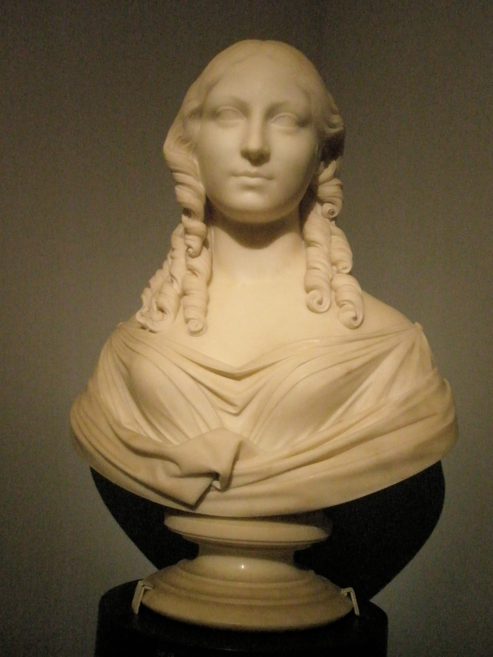
Today, the Pitti Palace also features Lorenzo Bartolini’s bust of Byron, for which the poet posed some years after his sitting with Thorvaldsen:
Bartolini's bust of Byron
Bartolini’s bust of Byron

Byron’s mistress, Teresa Guiccioli, offers an amusing account of the sculptor’s encounter with the poet:
“Bartolini, the sculptor, wrote to Lord Byron to ask permission to come to Pisa and carve a bust of him. Lord Byron liked very much to be surrounded by portraits of his friends and those whom he loved—but he was loath to pose himself. When he did , it was always to please friends. Thorwaldsen had sculptured his head and shoulders for Hobhouse, but Lord Byron did not even have a plaster cast. ‘It’s all very well,’ he said, ‘getting painted’ […] But to pose for a bust in marble struck him as vanity and pretentiousness, as wanting to obtrude oneself on posterity rather than leaving a private memento. […] When pressed, he replied that he would sit, provided it was not for himself, and that Bartolini would commit himself to doing a bust of Countess Guiccioli at the same time.
When [Bartolini] set eyes on Lord Byron, he announced that he could never do justice to such an original, since Lord Byron’s handsome appearance and his expression seemed to him to exceed the power of art. He was quite right […] His beauty was wellnigh superhuman in its manifestation, and Bartolini was far from being the man to overcome the difficulty.
Lord Byron himself […] was unfavorably impressed; and when the marble was destined for Murray, he wrote to him: ‘The bust does not turn out a good one, though it may be like for aught I know, as it exactly resembles a superannuated Jesuit.’ Then again: ‘I assure you Bartolini’s is dreadful.’ He also added that if it were like him, he could not be long for this world, for the bust made him look seventy.”
I leave Bartolini’s likeness to your judgment, though the partner bust of the Countess Guiccioli (normally held at the Istituzione Biblioteca Classense in Ravenna) strikes me as being quite serene and beautiful. And a reading of Browning’s “The Statue and the Bust” would not be amiss when visiting the Pitti Palace.
Bartolini's bust of Teresa Guiccioli
Bartolini’s bust of Teresa Guiccioli

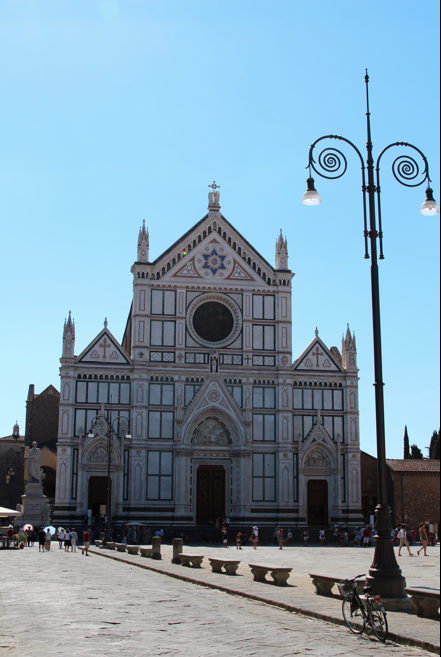
Next, though not the grandest cathedral in Florence, the Basilica di Santa Croce is a fascinating historical site, and it too gets the Childe Harold treatment:
In Santa Croce’s holy precincts lie
Ashes which make it holier, dust which is
Even in itself an immortality,
Though there were nothing save the past, and this,
The particle of those sublimities
Which have relaps’d to chaos:—here repose
Angelo’s, Alfieri’s bones, and his,
The starry Galileo, with his woes;
Here Machiavelli’s earth, return’d to whence it rose.
These are four minds, which, like the elements,
Might furnish forth creation: —Italy! (IV. 54-55)
Santa Croce
Santa Croce

Though Harold was rhapsodically transported by the four great monuments within Santa Croce, Byron himself was less impressed: “The church of ‘Santa Croce’ contains much illustrious nothing. The tombs of Machiavelli, Michael Angelo, Galileo Galilei, and Alfieri, make it the Westminster Abbey of Italy. I did not admire any of these tombs—beyond their contents. That of Alfieri is heavy, and all of them seem to me overloaded. What is necessary but a bust and a name? and perhaps a date?” But in spite of Byron’s derision, Donatello’s frescoes are worth seeing, and more recent additions include a statue by Henry Moore and a monument to Florence Nightingale on the cathedral grounds.

Moving forward through the nineteenth century, a literary tour of Florence would be incomplete without a visit to Casa Guidi, where the Brownings lived from 1847 to Elizabeth Barrett Browning’s death in 1861. Casa Guidi is located on the piano nobile (second floor) at Piazza San Felice 8. Now owned by Eton College, the home has been restored as a museum. Look out for the Brownings’ personal collection of flea-market-acquired Renaissance art.

And, in true Browning spirit, when you visit one of Florence’s many street markets, bring along your copy of the Old Yellow Book, which Robert Browning bought at a Florentine market in 1860. The poet ultimately used the book’s voluminous correspondence about a 1698 murder case to develop his best-selling poem, The Ring and the Book.
La Spezia and the Bay of the Poets
A lovely day-trip from Florence will take you to the province of La Spezia in Liguria, located next to the Tuscan border. The area is most famous for the Cinque Terre, a collection of five tiny coastal villages now designated a UNESCO World Heritage Site, which are linked by a train and hiking trails. The stretch between La Spezia proper and Lerici, one of the many small towns in the area, has been renamed the Golfo dei Poeti (the Bay of the Poets) after the Shelleys and Byron, who lived in the area. The Shelleys’ home on the beach of San Terenzo, Casa Magni, now renamed the Villa Shelley, is accessible by coastal road. The villa is actually available for private rental, though the damage deposit alone might prove too much for a graduate student’s stipend… There is also a monument to Shelley in nearby Viareggio, where Shelley was cremated.

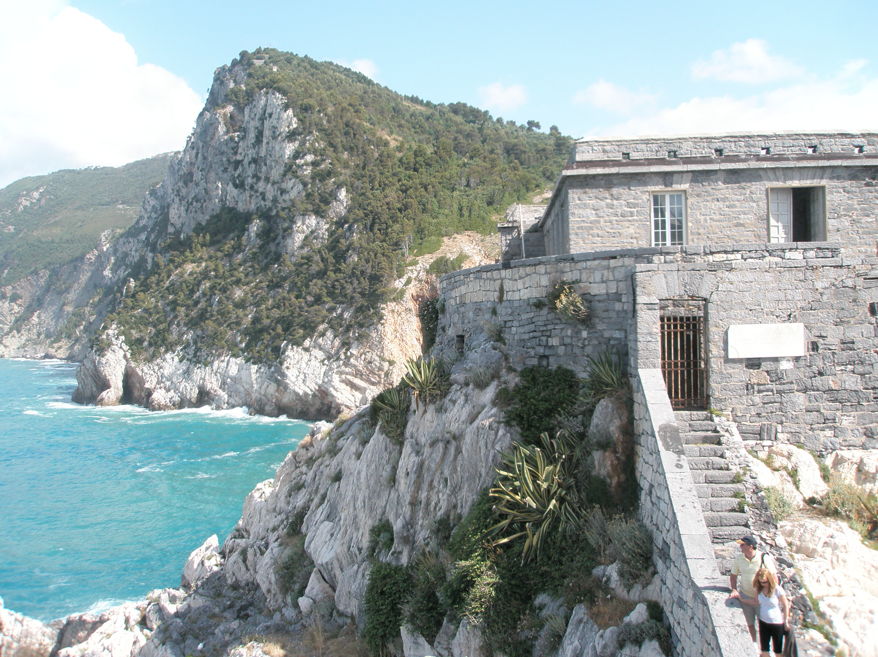
The Byron Grotto is just behind this promontory

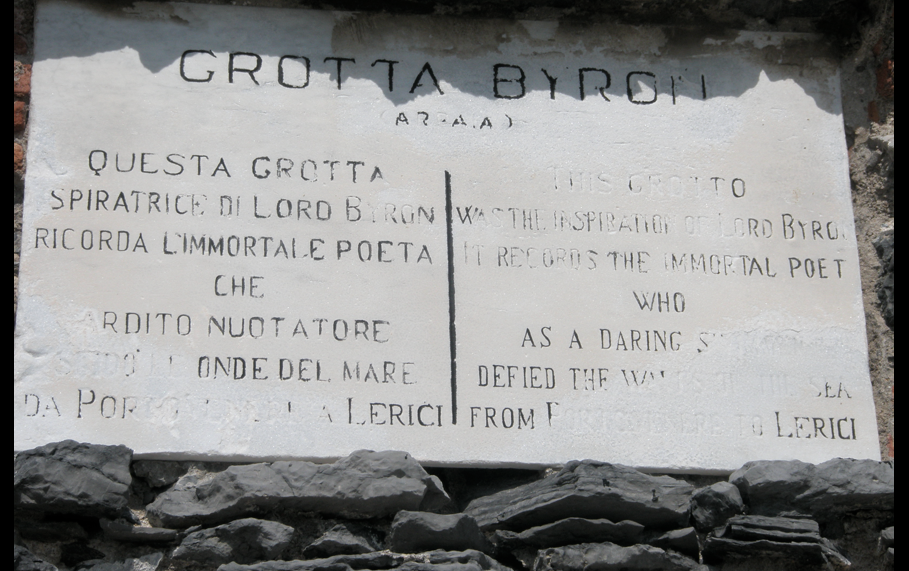
Portovenere, another UNESCO-protected village on the Ligurian coast, pays considerable homage to Byron. Most important is the Byron Grotto, which commemorates the “Immortal Poet, who as a Daring Swimmer Defied the Waters of the Sea” by swimming from Portovenere to the Shelleys’ home at Lerici.
Byron Grotto in Portovenere

The grotto isn’t a particularly appealing swimming-hole, as it’s filled with sharp rocks (perhaps of interest to Romantic geologists!), but there is a staircase that will take you near the water’s edge. Local shops and pizzerias are also named in memory of Byron. And be sure to sample some of the locally made pesto (the town holds a Feast of the Basil every year).
Venice
To set the tone for your final stop, begin by reading Byron’s letters and journals from 1817-1818. A sample: “I am just come out from an hour’s swim in the Adriatic; and I write to you with a black-eyed Venetian girl before me, reading Boccaccio…” Poetically, his first attempt at ottava rima, Beppo, is absolutely required reading for a Venetian stay.
There are a few key literary stops. First is the Palazzo Mocenigo, which Byron rented from the Mocenigo family in 1818. The palace has been turned into a museum of textiles, and much of the décor on the piano nobile dates back to the eighteenth century.  The palazzo’s library holds extensive collections of early editions, including literary works by Byron and the Gambas (Teresa Guiccioli’s family of origin).
The view from the Palazzo Mocenigo in San Stae. The building on the right is the Palazzo

But be warned: there are several Mocenigo palaces in Venice. This museum is in the San Stae district. When I visited in 2011, museum staff told me that Byron lived on the piano nobile of that building; unfortunately, subsequent searches suggest that the poet lived in another Mocenigo palace in the San Marco district, which I can confirm is closed to the public. But you can see the San Marco Mocenigo palace from a #1 vaporetto ride on the Grand Canal, and admire the balcony from which Margarita Cogni took her impassioned dive during a domestic squabble with the poet.
More rewarding for the poetically-inclined is the Brownings’ palazzo, Ca’Rezzonico, which is located on the Grand Canal and has its own water-taxi stop. Bought by Pen Browning, the poets’ son, and his heiress wife, this was Robert Browning’s last residence. Like the Palazzo Mocenigo, Ca’Rezzonico has also been converted into a museum dedicated to eighteenth-century Venice. It boasts a recreated apothecary’s shop on one of the upper floors, and a traditional enclosed gondola, “Just like a coffin clapt in a canoe” (Beppo ll. 150-51), in the main entrance. (And, as Shelley’s heroic couplets in “Julian and Maddalo” make clear, “gondola” really did rhyme with “way” in the nineteenth century). Browning’s rooms are on the ground floor; when I visited, they were closed for repairs. The museum café is lovely, though, and you can sit on the terrace overlooking the canal.
Located in the city centre, St Mark’s Square, is the Palazzo Ducale (Doge’s Palace), the historical residence of the democratically-elected rulers of Venice, and its annexed prison. Notably for Romanticists, the Doge’s Palace features the so-called Bridge of Sighs, a name fancifully coined by Byron to commemorate the sighs of the prisoners as they caught a final glimpse of the lagoon before being taken to their cells. As usual, Childe Harold says it best:
I stood in Venice on the Bridge of Sighs,
A palace and a prison on each hand;
I saw from out the wave her structures rise
As from the stroke of the enchanter’s wand:
A thousand years their cloudy wings expand
Around me, and a dying Glory smiles
O’er the far times, when many a subject land
Look’d to the wingèd Lion’s marble piles,
Where Venice sate in state, throned on her hundred isles! (IV.1)
The prisoners' last view from the Bridge of Sighs
The prisoners’ last view from the Bridge of Sighs

And, for eighteenth-century aficionados, the Doge’s Palace offers a splendid tour focused on Casanova’s imprisonment and dramatic flight from the allegedly “unescapable” prison.
My final suggestion, for those looking to emulate Casanova’s escape from Venice’s main tourist hub, is a short boat-journey to the Lido, the final stop on the #1 vaporetto line. Here, you can revisit the initial setting of Shelley’s conversation poem “Julian and Maddalo,” which was based on a series of philosophical debates he had with Byron in Venice in 1818. The “bank of land which breaks the flow / Of Adria towards Venice” was a favourite riding-place for the poets: “This ride was my delight.—I love all waste / And solitary places” (ll. 2, 14-15). And, looking West from the Lido at sundown, you can try to find the Maniac’s dwelling:
A building on an island; such a one
As age to age might add, for uses vile,
A windowless, deformed and dreary pile;
And on the top an open tower, where hung
A bell, which in the radiance swayed and swung… (99-103)
One final word of caution: take care not to travel to the Lido in a “heavy squall,” lest you, like Byron, return to an unexpected dressing-down: “Ah! Dog of the Virgin, is this a time to go to the Lido?”
Happy travels—and may you, like the poets, be creatively inspired by Italy—the “Mother of Arts, once our guardian, and still our guide” (Childe Harold IV. 47).
(All photos belong to Arden Hegele)

Humanities questions as inspired by Sherlock Holmes, Reading, and Undeath

Greetings from the Valley of the Sun and happy 2014! The Colloquium extends its warmish wishes to everyone, especially those who were (and are again) in the path of the Polar Vortex. We hope you are all doing okay in what sounds like very challenging weather. Our weather here is mild, in fact it is too mild, uncannily mild. So, while the West Coast might not be suffering the chill I’d be willing to bet this summer will be destructively hot and dry for us, especially the southwestern states, unfortunately.
Off the (depressing) topic of weather, I hope to bring some of the discussion the colloquium had this past week to you all. At our meeting we examined a few book chapters. Specifically, Chapter 13, “The Age of the Novel,” from The History of British Publishing by John Feather. And also the Interlude Chapter, “Necromanticism and Romantic Authorship,” from Necromanticism: Traveling to Meet the Dead by Paul Westover. And also we had a brief digression on Sherlock Holmes (as you do) which is where we will start.

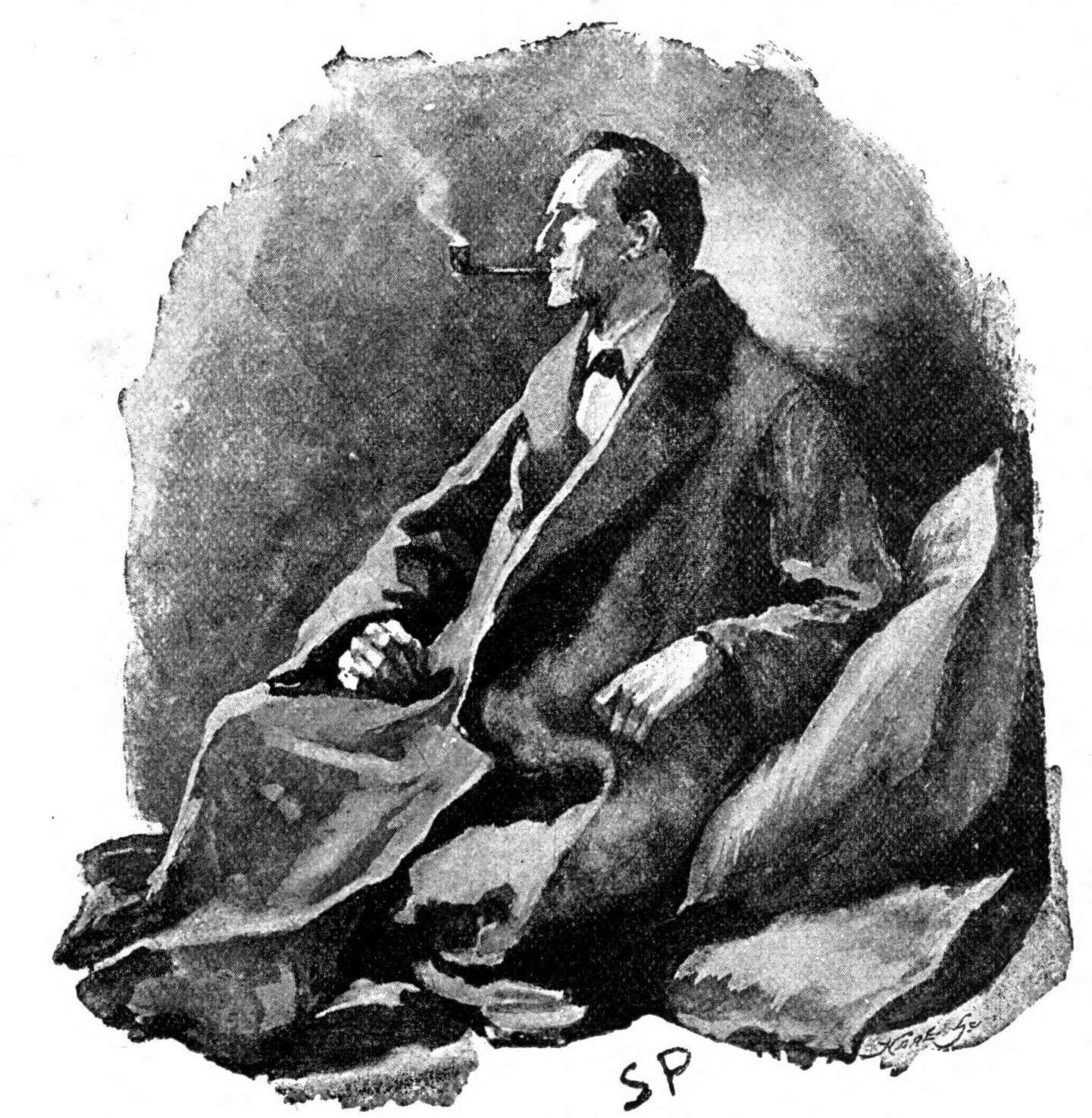
“The Pipe Was Still Between His Lips.”

Perhaps unsurprisingly most of the colloquium is fan of Sir Arthur Conan Doyle’s character, and the various current iterations such as Elementary and Sherlock. And some of us have seen the PBS documentary “How Sherlock Changed the World” [http://www.pbs.org/program/sherlock-changed-world/]. This documentary, which is trying to channel some of the popular enthusiasm into historical knowledge, roughly claims that Doyle’s character impacted forensic science more than any actual forensic scientist. The argument demonstrates innovations from the stories and then discusses the way Sherlock Holmes inspired people to become forensic scientists in the latter half of the 20th century (and these people use knowledge they derived from or that was inspired by Holmes).
You all will have to watch the documentary yourself, but we were not especially impressed. Perhaps the error that was the gravest was that the documentary never talks to literary historians or any cultural historians.  Mainly they use current forensic scientists with a smattering of evidence from the stories. The one speaker that was related in some way to the literature was a writer of popular fiction who had also written a few novels using the Sherlock Holmes character. None of us thought that these people were ‘bad’ speakers per se, but were somewhat miffed that a documentary that focused on the influences of literary character on history did not talk with researchers who dedicate their time and energy to understanding that relationship. More than anything this method seemed to be merely a data point in the larger question of the role of the humanities in the public sphere. PBS, one would guess, is no doubt a largely sympathetic audience when it comes to the humanities. But, at least in this case, the humanities researchers were largely left out of a discussion on humanities; a troubling situation to say the least.
One of the other problems was the surprisingly graphic nature of the documentary, where they used actual crime scene photographs. The one that we found the most disturbing was of Marilyn Reese Sheppard. She was bludgeoned to death on July 4th of 1954. The documentary used a photo of her, uncensored with all the physical manifestations of violence, the gore, visible in stark black and white. But, the show did go to the effort of censoring her exposed nipple. (As an aside, someone else might have edited the photo before, then the show used it, but it still seems an odd choice). Whatever the case maybe, the use of these photos definitely raised questions of violence and bodies: what bodies can and cannot be displayed doing or being and how violence is received by the larger audience.
As you can see this innocuous documentary raised some perplexing conundrums for us: how we portray violence to bodies and whether the humanities needs to try and be more aggressive with its public face.
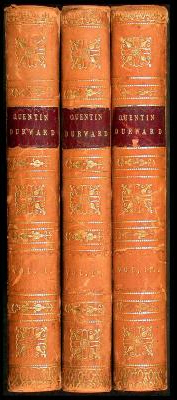
Three Volume Set of ‘Quentin Durward’

Eventually, though, we turned to the articles which dominated the majority of our meeting. We started with John Feather’s work, which provoked a question about research: how we (scholars) read and whether that should or should not be like the way the text was read (or at least as close as possible). According to Feather novels in the romantic period, especially post Waverly by Scott, were published in the popular ‘Triple-Decker’ format (Feather 144), for a variety of reasons, but mainly because it meant that the publisher got to sell the novel three times (Feather 147); arguably it also made it better for the lending libraries because three people could be reading the ‘same’ book at one time. But, especially as graduate students, we do not typically read works like Waverly in three volumes over a period of months; we have maybe a week (or two) to devour the book while also reading one or two other books (plus a variety of other work and research). This is not to say that the system needs to change, but we were wondering what it means for us as researchers and the arguments that we make that we do not read the novels in the same way that they were historically. This discrepancy increases in the Victorian period with serialization: many readers read chapters from magazines while presumably fewer read the novels as one unified whole (due to the cost of the unified novels). We were unsure whether this mattered at all: does reading one way or another dramatically influence one’s reception of a novel? Especially considering the periods people had time to discuss the developing plot with each other, after a household had finished the first volume of a work and how that might change their perception. Should we strive to read as the people did, so that our claims are more ‘accurate’ or is accuracy merely a facade because meaning does not change that much between varieties of reading?
There was one statement that generated a great deal of discussion. At the very end of the chapter, Feather claims that “there was a brief period in the middle of the nineteenth century when literary merit and popular success coincided” (Feather 152). Most of us agreed that this statement did not seem to fit well with the rest of the chapter and that the statement was worrisome. For example, the conversation drifted over to the idea of the Romantic Canon, i.e. the big six of Blake, Coleridge, Wordsworth, Byron, Shelley, and Keats. For a long time those six (and sometimes only really five) have been the writers of ‘literary merit’ at the exclusion of other sexes, races, classes, forms, genres, and so on. Thus, we thought that the particular statement was obscuring a few other important discussions. But the idea of ‘literary merit’ also drew out another question: what are English Scholars? Are we art critics? Are we cultural historians? Are we theoreticians and philosophers? Are we all things or none? There were good arguments for all positions, well except ‘none’ no one argued for that, nevertheless we debated for a bit. I apologize for all the questions, and especially our lack of concrete answers, but we pondered that particular idea for a while with no particular conclusion.
“Wordsworth on Helvellyn” by Haydon

At that point it seemed wise to switch over to Paul Westover’s chapter before we lost our entire weekend to the previous question(s). Westover argues that even if an author is living, especially the Romantic authors, because of their literary success they become ‘dead’ (Westover 93). Somehow the author becomes both dead and alive, which is obvious in the various descriptions that Westover cites. For example, people would visit William Wordsworth but ultimately be surprised because the being they encountered did not match up with their vision thus they would exclude the material body from their vision and description,  and so as Westover states “Wordsworth had become an artifact and a ghost in his own house” (Westover 95). In part this un-dead-ness appears to result from the disconnect between the image of the author in the reader’s head and the material reality of the author. Perhaps most interesting to us was the focus on the author. Everyone is aware, of course, that the Author died a couple of decades ago and that we do not talk about them. But, Westover’s book is in part about authors and their existence.  Humor aside it certainly does not seem like a poor trend for literary scholars to also incorporate the author into their analysis but obviously the author cannot be overriding because texts live apart (as Westover and others show) from their creators.
That did lead to one concern: are we as scholars also victims idolizers of authors? And if so, might that impact our ability to be clear-eyed when making arguments? Or, phrased another way with a greater focus on undeath: if you could resurrect an author and speak with them would you / should you? While a few names were thrown out for ‘yes’ to resurrection (like Mary Shelley) and ‘no’ (like Edgar Allan Poe), we decided that the literary scholar’s enthusiasm for certain authors was probably a good feature because it allows us to keep going even when we encounter research dead-ends and conundrums.  Although, being on guard against over idolization of course is never a bad idea.
Anyway, these are a few of the items that we discussed. If there is anything you would like to add in the comments, please do! Otherwise, good luck with your work in 2014 and we look forward to many exciting discussions as inspired by this graduate caucus!
Kent Linthicum

Quarterly Editor's Note: Collaboration & The Rush of New Insights

From one of the colder sites of the “Polar Vortex 2014,” I write to wish everyone within the orbit of romanticism (and beyond) a very happy, healthy, and successful New Year. The concluding months of 2013 brought with it the installation of a highly engaged and innovative new cadre of writers, with established authors Aaron Ottinger and newly elected NGSC Co-chair Laura Kremmel continuing to publish on the blog, making the autumn season an incredibly exciting one. There were no fewer than sixteen pieces generated in the better part of the last three months of the year. Writers explored a range of topics from the formation of scholarly collectivities, the importance of self-reflexivity regarding the possibilities and limits of reading practices, to new imaginings of cross-disciplinary approaches to romantic literature. An immediate and special congratulations goes out, as well, to blogger Renee Harris, who was selected to present new work at the Keats Foundation Conference, “Keats and His Circle,” at the Hampstead House this spring.
In my first editor’s note, posted in October, I made the proposition that this blog comprises a space where the “rush of new insights” might be most immediately felt (especially with respect to the sharing of concepts driving work-in-progress). This was most certainly the case across the autumn’s trajectory. In what follows, I highlight what I found to be some of the more interesting and important new threads of inquiry that appeared in the last few months. I’ll also make some suggestions regarding what is to be expected going forward, into 2014.
Deven Parker’s introductory piece “Towards a Tangible Romanticism” holds out the promise of very important work to come. In it, Deven outlines a new resolutely materialist approach to the interpretation of Romantic culture based on what she critically terms  “an archaeological hermeneutics.” Taking a disciplinary point of origin in Deven’s initial undergraduate training in archaeology at Penn, the proposed method pivots, as Deven puts it, on the notion that a book retains “a relation to all other objects of the same type” with strata of meaning retaining the potential to be excavated on the basis of things like choice of verse. This comes in comparative relation to other literary texts, but with a vocabulary that significantly breaks from well-worn tropes and idioms in literary studies, with the result that books come into view as simultaneously “local and transhistorical artifacts.” At its core, Deven’s method—as it seems to me—offers myriad illuminating directions for shifts in focus and understandings of relations that comprise the materiality and conditions through which the texts and objects we study are generated, received, used, and redeployed.
Arden Hegele’s November blog publication—“Romantic Geologies and Post-Organic Forms”—represents some of the very best new thinking I’ve encountered as of late. Her ability to collegially engage with, and synthesize, work by the caucus graduate authors was as enlightening as it was inspiring. By highlighting the “fundamental” as a core concept connecting the blogging being undertaken by other caucus members, Arden brings out the ways in which our group is returning to the cornerstone issues upon which Romantic studies is constructed—and it is this thread that I hope other authors will continue to draw out over the next year. Arden directs our attention to vexing questions so often taken for granted: what represent the fundamental principles with which we define the scope and body of materials we study? What are the methods we use to pursue this, and what are the temporal and theoretical limits and possibilities for Romantic studies, with respect to the nineteenth-century and beyond? Arden’s pointing to geology was crucial in this regard—and her luminous turn to look at the ways the “instability of Romantic geology shook the foundations of the period’s poetry” generates a vital potentiality of thought. Just as well, I was grateful for Arden’s bringing genre into our continuing conversation on the blog—in a reading of Group Phi, whose writing on the topic as both “sedimented” and “metamorphic” Arden nicely highlights. I was especially compelled by the way Arden amplified the importance of Phi’s theorization, arguing that thinking about genre in geological terms endows the interpretive act with a particular urgency given the politics of our own contemporary moment. It’s connected, as Arden so memorably contends, with “the ethics of geotechnical excavation, and particularly the problem of violently appropriating formerly organic structures, now metamorphosed into inorganic matter (oil).”
More recently, Nicole Geary and myself, in conversation with Arden, took this thinking as a point of departure for considering how the field of geology represents a rich zone for thinking through our own respective practices—artistic, literary, and art-historical. This led to the first collectively written post on the blog, with the broader purpose of exploring the relation between romanticism and contemporary visual culture. Ultimately, it is my wish that multiple authors collaborate in the new NGSC “Dialogues” series to produce one jointly-written post per quarter.
Further, on the collaborative front, we saw three illuminating posts by different authors belonging to the Arizona State University 19th-C Colloquium. In their first piece, Kent Linthicum spoke to not only how their scholarly collective was formed, but also to the logic defining its practices, which hinges upon an ever-present “focus on professionalization.” It struck me that this is precisely what the caucus community is doing as well, and am convinced of the importance of getting clearer on precisely what professionalism and the process of becoming professional means within the context of our field. Also, on the point of collaboration, and interdisciplinary on another axis, Jennifer Leeds published her recent interview with the political scientist and author of Jane Austen, Game Theorist Michael Chwe in December. Jennifer and Professor Chwe’s discussion proves absolutely exemplary for locating the ways in which texts produced by a figure on which many of us work can represent a field through which we might re-think a range of issues at the nexus of different disciplinary frameworks, practices, and values. This, of course, is to say nothing of the brilliance with which Jennifer approached the interview, bringing into play her own crucial investments with respect to gender and the challenging of heteronormativity on the basis of the pervasive configuring force of homo-social and –sexual relations in the nineteenth-century novel. Jennifer’s including these concepts in the interview yielded highly productive results, which I found thrilling.
In short, I am pleased that the state of the Romantic studies blog(e)sphere is very strong entering 2014—and I enthusiastically look forward to reading the critical mass of writing that will appear in this forum in the coming months.

NGSC E-Roundtable: Romanticism & Geology

Introduction: This piece comprises the first of a series of interdisciplinary dialogues that will appear quarterly on the NGSC Blog. The initial iteration finds NGSC contributing writers Arden Hegele, Jacob Leveton, and artist in residence Nicole Geary engaging with geology as a factor in the production both of Romantic poetry and contemporary sculpture. Towards this end, they collectively looked at a range of geologically oriented literary texts (Felicia Hemans’s “The Rock of Cader Idris,” Charlotte Smith’s “Beachy Head,” and Percy Shelley’s “Mont Blanc”), works by the visual artists Robert Smithson and Blane de St. Croix, and literary, art-historical, and ecological criticism. Arden, Jacob, and Nicole then posed a series of questions for, and responded to, one another in a discussion that pivots upon a set of shared aesthetic problems and conceptual issues linking current critical and contemporary creative practices.

Roundtable:
Arden: On the subject of the nonhuman voice in Nature, in “Mont Blanc,” Shelley writes that the mountain’s “voice” is “not understood / By all, but which the wise, and great, and good / Interpret, or make felt, or deeply feel” (80-83). How do you see Shelley’s mountain’s form in relation to poetic form, or, how might you relate the challenge of geological interpretation to the interpretation of Romantic literature?
Jacob: This is a great question with which to lead off, and I think provides an effective frame to derive some important points regarding the relation between Shelley’s poetry and politics. Of course, the lines to which you’ve directed my attention drive toward some of the liberatory aspects of Shelley’s poetic project at the time. The poet addresses Mont Blanc and posits that,“Thou hast a voice, great mountain, to repeal / Large codes of fraud and woe; not understood by all, but which the wise, and great, and good / interpret, or make felt, or deeply feel” (80-83). The lines advance the point that Mont Blanc as a nonhuman geological form retains a voice to speak. That voice is comprehended by the “wise, and great, and good” who experience the mountain’s affective force at a high level of intensity (to “deeply feel”). Such a knowing-subject, indeed the Shelleyan poet, interprets the mountain’s geological form and communicates it in a way that effectively manifests itself as a field of social-critical potentiality. What I mean by this is that the poetic engagement with Mont Blanc, that itself generates the poem’s form, is geared to be mobilized in challenging and overturning social inequities. The poetic form that Shelley’s “Mont Blanc” makes available is one that takes geological interpretation as a point of departure for the purpose of social critique, and so relates to broader issues regarding interpretations of Romantic literature informed by historical-materialist theoretical investments, and the field of poetry and politics, more generally.
Nicole: Jacob, “Mont Blanc” seems to be written with a lonely and inhuman aura, one that puts nature out of the grasp of humankind. Do you agree that, as Heringman writes, it helped “mobilize the analogy between geological and political revolution” (13-14)?
Jacob: Your question is a wonderful one, as well–and, actually, while I’d agree that “Mont Blanc” is written with a profoundly inhuman aura I’m convinced it’s one that encodes a form of revelry in the nonhuman other. Ever since my first time working with that particular text, I’ve found it to offer a particularly energetic intellectual jouissance in its impellation that the reader recognize a significant interconnectivity with the natural environment. In this regard, the natural environment can be seen as deeply other and simultaneously co-constitutive of a self that is connected with all other sentient and non-sentient beings. This is why I found Heringman’s remarks so persuasive, with respect to how the “Romantic recognition of the earth’s unpredictability and difference from human interests” ultimately “permits progressive analogies to human agency” (13). One valuable concept the movement to posthumanism gives us (though one which the field of late eighteenth-century cultural production makes possible, by way of writers like Rousseau, Joseph Ritson, Erasmus Darwin, and others) is that the world in which we find ourselves is comprised of a rich myriad of human and nonhuman life and that to understand what it is to be human it is at once necessary to understand what it is to be human in relation to nonhuman life, the natural environment, and non-sentient matter. Geologically, it is the non-sentience of the mountainscape that Shelley’s poem engages with the utmost force, and its that difference between the human poet and nonhuman natural/geological phenomena that drives the poem. This is what I believe that poet is getting at when crafting the image of “The everlasting universe of things” which “Flows through the mind, and rolls its rapid waves” (1-2). The poetic metaphor is taken from the Arve as the river that cuts through the ravine where the poet is positioned, with geological processes here comprising the primary factor of Shelley’s poetic production. Nonhuman geological and human subjectivities are differentiated, yet come together within the poem’s form as a zone of human/nonhuman environmental contact. They’re connected as Shelley’s poem draws out a vector of signification that links the Arve as an example of a formative geological agent that continually carves the mountainscape, the poet’s consciousness in writing, and the reader’s subjectivity in reading. These notions advance Heringman’s argument quite well. If geological formations like Mont Blanc make visible the way in which the earth is in a continual state of transformation–and it’s a given that species do best when they are adaptable to change and humans constitute one species position within a broader web of nonhuman life–then it follows that a commitment to progressive thought and engagement proves integral to the absorption of geology in Shelley’s poem.
Nicole: What I really fell for in “Beachy Head” was the long stretch of meandering we did through what felt like a mix of memory and storytelling. It’s as though we are briefly on the ground at this place, then suddenly no longer conforming to space and time. I find that it’s deceptive at first. Can you talk about how you find the form of this poem lends itself to the underlying story?
Arden: “Beachy Head” is such a rich poem, generically as well as geologically. Although it’s clearly working in the Romantic tradition in its description of sublime natural landscapes, it also looks back to an older genre — the loco-descriptive poem — which characterized eighteenth-century works like James Thomson’s The Seasons (1726-1730). In the loco-descriptive poem, the speaker’s point of view moves fluidly between spaces through the act of looking, and the poem describes the different landscapes in view; importantly (and in contrast with most Romantic poetry), the energy carrying the poem isn’t so much the developing emotional charge, but rather the speaker’s changing observational position within a landscape. This active eye prompting topographical transitions is much of what we get in Smith’s 1807 poem, especially in lines like these: “let us turn / To where a more attractive study courts / The wanderer of the hills” (447-49). Here, Smith signals how her speaker’s eye carries “us” between geographical sites and their relation to her memories.
But, as you suggest, Nicole, Smith’s work is compelling because the landscapes in question prompt temporary flights away from the locations that she describes — including Beachy Head itself — as the speaker contemplates their relation to her emotional state. These jumps away from the landscape into recollected emotion is what feels most Romantic about the poem. For example, Smith’s denunciation of happiness is one of the work’s most poignant moments: “Ah! who is happy? Happiness! a word / That like false fire, from marsh effluvia born” (258-59). To me, this is an intriguing moment for the poem’s physical environment, since the simile associates happiness with a paranormal feature (a will-o’-the-wisp), in contrast to the many concrete landscapes of the poem — Beachy Head itself, the stone quarry, the cottages, the cave in the rock, and so on. But the ignis fatuus also helps to reveal the poem’s ongoing mechanism for the speaker’s nostalgic leaps: here and elsewhere, the ground gives direct rise to the emotions that the speaker experiences. (As a side note, “false fire, from marsh effluvia born” also invokes the miasmatic theory of disease popular during the period, which maintained that toxic gases would arise from the ground and spread contagion – a rather chilling way of describing “happiness”).
The historical and biographical contexts of “Beachy Head” are also quite interesting with respect to the poem’s treatment of time and space, especially in a scientific context. While writing was a source of necessary income for Smith (she was the only earner for her ten children), she took pleasure and relief in scientific practices like botany, and it seems to me that her somewhat loco-descriptive survey of the landscape of Beachy Head alludes to her personal practices of dispassionate scientific observation. An early reviewer of the posthumous poem remarked that

“It appears also as if the wounded feelings of Charlotte Smith had found relief and consolation […] in the accurate observation not only of the beautiful effect produced by the endless diversity of natural objects[,] but also in a careful study of their scientific arrangement, and their more minute variations.” (Monthly Review, 1807)

In keeping with what this reviewer notices, one of the poem’s main projects seems to be to classify different types of rock — the “chalk […] sepulchre” of the cliffs (723), the “stupendous summit” of Beachy Head itself (1), the “castellated mansion” (514), the “stone quarries” (471), and even the sedimented sea-shells, fossils, and “enormous bones” beneath the sea (422). But the poem also moves beyond classification by relating natural forms to poetic lyricism: for example, Smith describes “one ancient tree, whose wreathed roots / Form’d a rude couch,” where “love-songs and scatter’d rhymes” were “sometimes found” (581-84). At the poem’s conclusion, the rock of Beachy Head itself inspires verse, as “these mournful lines, memorials of his sufferings” are “Chisel’d within” (738-39); indeed, Smith’s own lines appear to have emerged from the physical rock. Moreover, supporting its thematic transitions between spaces and even outside of time, “Beachy Head” isn’t confined to a single verse form — the two sets of inset songs (in variable quintains and sestets) break up the sedimented quality we get with the long passages of blank verse. So the meandering quality that you notice between the poem’s specific geographies and abstract memories also applies to the fluctuating relationship between the verse forms, between the various locations and historical moments the poem describes, and, perhaps most importantly, between the relationship of scientific and poetic practices, which Smith ultimately tries to reconcile.
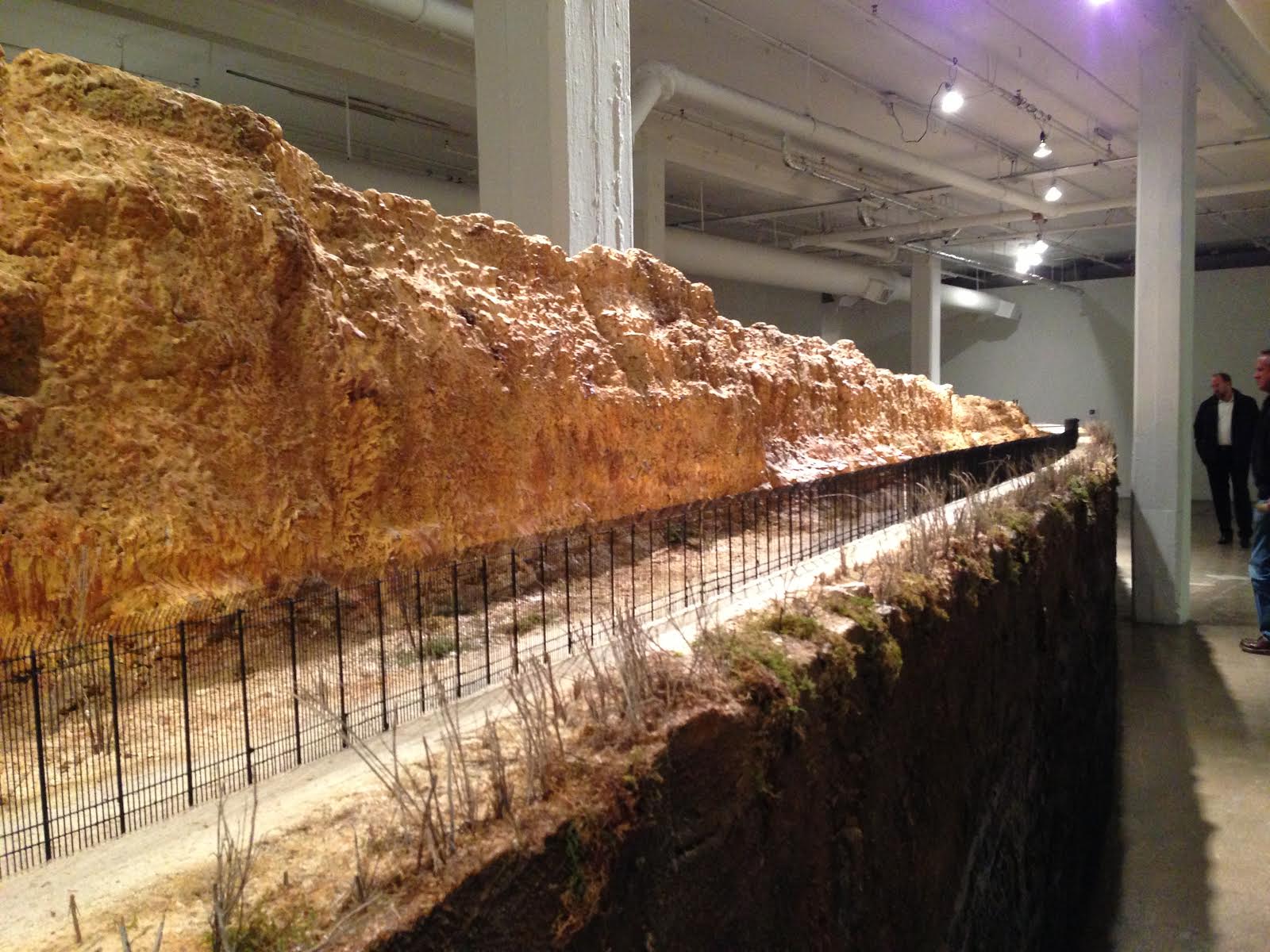
Jacob: Arden, I was particularly struck by the wonderful resonance between your suggestion that we read Charlotte Smith’s “Beachy Head” and Nicole’s decision that we look at Blane de St. Croix’s Broken Landscape III (Fig. 1), since both works utilize geology as a means to think through the concept of national boundaries. In what ways might the ideas you find in Broken Landscape III  intersect Smith’s poem? Just as well, how might de St. Croix’s strategies as a visual artist diverge from those of Smith as a poet?

Blane de St. Croix, Broken Landscape III, 2012. Wood, plywood, foam, plastic, paint, branches, dirt, and other natural materials, 80.00 x 2.50 x 7.00 ft. (24.38 x 0.76 x 2.13 m.), as viewed at the Blue Star Contemporary Art Museum, San Antonio, TX. Photograph by Nicole Geary
Fig. 1. Blane de St. Croix, Broken Landscape III, 2013. Wood, plywood, foam, plastic, paint, branches, dirt, and other natural materials, 80.00 x 2.50 x 7.00 ft. (24.38 x 0.76 x 2.13 m.), as viewed at the Blue Star Contemporary Art Museum, San Antonio, TX. Photograph by Nicole Geary

Arden: I’m so glad that you drew my attention to the political similarities between Charlotte Smith and Blane de St. Croix’s works. Both artworks are connected in their different ways to the question of politically-charged national borders. Smith’s perspective can certainly cast new light on de St. Croix’s contemporary art, and I see at least two ways in which the pieces can work together in productive dialogue. First, their portrayals of their respective borders share certain formal similarities, in spite of the very different natures of the artworks. Second, the works diverge in the mechanisms by which they represent the borders as liminal spaces: while de St. Croix is invested in showing how the deep strata of the Mexico-US border’s geological formation acts as a barrier between the nations, Smith finds that the France-England border’s geology reveals similarity underlying the nations’ apparently radical differences.
Both artists engage with the idea of sedimentation as a formal tool for political commentary. In “Beachy Head,” Smith regularly draws the reader’s attention to Beachy Head’s distinctive white cliffs, the tallest in Britain, whose layers of chalk point to a long-standing geological history of increasing division from the opposite coast by means of marine erosion over millennia. For Smith, the continual geological breakdown between the two nations, through this process of erosion, is a provocative metaphor for their political relationship. In its allusions to the Norman Conquest, the battle of Beachy Head of 1690 (which the English lost), and the tensions between the nations during the French Revolution and the Napoleonic Wars, the “scroll voluminous” of “Beachy Head” offers a versified representation of this erosion (122). Presented in chronological order, each incident of conflict with France gives way to the next until the reader reaches sea-level and England’s triumph: “But let not modern Gallia form from hence / Presumptuous hopes” against England, the “Imperial mistress of the obedient sea” (146-47, 154). In the political ramifications of its eroding structure, “Beachy Head” has much in common with Broken Landscape III, which is also interested in the sedimentation of a politically-charged international border. For de St. Croix, however, the formalism of sediment is not figured through erosion, but rather through accretion. Discourses about the border have, over time, accumulated in layers, just as layers of rock have accreted in the border’s geological history. De St. Croix’s representation of the border as a human-scale sedimented wall explores how its underlying discourses have built up to create an insurmountable barrier in the present (unlike the real border, de St. Croix’s installation actually prevents the viewer’s ability to walk across it).
At the same time, though, the two works differ considerably in the function of their sedimentation. As Lily Gurton-Wachter argues, Smith resists the idea that France and England were “natural enemies” (a term used pejoratively to describe their strained relationship at the turn of the nineteenth century), and instead finds a common ground for them in their shared geological past. The poet contemplates whether the bottom of the sea, cast up in cliff form at Beachy Head, serves as the area of continuity between the nations: “Does Nature then / Mimic, in wanton mood, fantastic shapes / Of bivalves, and inwreathed volutes, that cling / To the dark sea-rock of the wat’ry world?” (383-86). While at one point Smith calls Romantic geology “but conjecture” (398), the general implication of the poem is that geology can help to locate a literal, deep-seated common ground between the opposed nations. De St. Croix, on the other hand, finds only political difference in the geology underlying the border. The human imposition of international boundaries on the surface of the earth is so metaphysically weighty that it actually carries downwards physically into its subterranean strata, in spite of the fact that each nation’s side is effectively the same in material and appearance.
Arden: Nicole, I’m interested in your thoughts on the materiality of landscape as a source for art. In Robert Smithson’s film about “Spiral Jetty,” the artist says that “the earth’s history seems at times like a story recorded in a book, each page of which is torn into small pieces. Many of the pages and some of the pieces of each page are missing.” How do you see geologically-inspired works of art — especially an “entropic” project like Smithson’s, or Blane de St Croix’s meticulous topography — engaging with the materiality of literary texts? And, how does your study of Romanticism help you to understand this material relationship?
Nicole: It’s especially remarkable when you come upon stacked strata in the field and see rocks lined up like books on a shelf. This metaphor instantaneously becomes ingrained within you as you run your finger down the stack, looking for the book (rock) you want to pull out. In the history of the earth, pages, sometimes whole volumes go missing. We suffer those convulsions and catastrophes, and the earth rebuilds itself from the pieces. Spiral Jetty is made from rocks, water, mud, evaporites, and time (Fig. 2).
Robert Smithson, Spiral Jetty, 1970. Mud, precipitated salt crystals, rocks, and water, 1,500.00 x 15.00 ft. (457.20 x 4.57 m.), Great Salt Lake, UT
Fig. 2. Robert Smithson, Spiral Jetty, 1970. Mud, precipitated salt crystals, rocks, and water, 1,500.00 x 15.00 ft. (457.20 x 4.57 m.), Great Salt Lake, UT

But not just that, it is a place. Spiral Jetty is difficult to reach, sometimes not able to be seen due to changes in the level of the Great Salt Lake. In reading romantic-period texts, I’m reminded of the overwhelming sense of the sublime that artists felt for certain places. Certain topographies, either remote or only able to be accessed by memory (as so wonderfully illustrated in “Beachy Head”) hold a history that engages and sometimes mystifies. So, too, does the Broken Landscape series by de St. Croix as it not only shows the surface, or present tense, but it digs into the depths of what came before our tense border anxieties. Broken Landscape III looks directly at ontological constructs upon the landscape that never existed before human-made activity, but doesn’t negate the rock record.
What I find fascinating is that this rock record is always around us, ever complex yet at our disposal to read. There is some comfort in the idea that we can make sense of the word, quite literally, by translating it like an ancient tome. I think that through Romanticism, I’m actually able to understand more about the emotional weight I give to rocks themselves. By reading through the Scottish Enlightenment and the geological revolution, I understood that what I was going through artistically was my own new science: a way of naming and identifying my emotions without feeling them – calling them the Other.
Jacob: This year, I’ve become increasingly influenced by Rebecca Beddell’s The Anatomy of Nature: Geology and American Landscape Painting, 1825-1865 in terms of the way in which, as Beddell explains, the division of labor between artists and scientists is essentially a discursive construction. Namely, here, I’m interested in how reading Bedell’s art-historical analysis might relate to, or gave you a space to imagine, your own work, perhaps in a different way than you had prior. In this regard, I’m drawn especially to the preface to her book, where Bedell suggests that in the nineteenth-century: “American landscape painters and geologists then stood on common ground. We now tend to consign art and science to different epistemologies, regarding them as distinctive pursuits, with completely different methodologies, directed towards completely different ends” while in the nineteenth-century art and science proved an interconnected spectrum of pursuits “in both popular perception and practice” (xi). What I’m wondering is how you consider about your own work within this trajectory. I’m thinking mainly of your 2011 Secondary Sediment series of prints that I think so powerfully evokes the relation between personal memory and geological space, and especially the play of text and image in “IX” (Fig. 3).
Fig. 3. Nicole Geary, "IX" from the Secondary Sediments series, 2011. Drypoint, type, and chine collé, 8.00 x 10.00 in. (20.32 x 25.40 cm.), Courtesy of the Artist
Fig. 3. Nicole Geary, “IX” from the Secondary Sediments series, 2011. Drypoint, type, and chine collé, 8.00 x 10.00 in. (20.32 x 25.40 cm.), Courtesy of the Artist

Nicole: Jacob, this is such a great question, because I specifically thought about this, too, when I was reading Beddell’s introduction. It seems a social construct based on educational or vocational pursuits has rendered art and science separate pursuits in our recent history, but the idea of a more common acquisition of knowledge and shared respect for these fields was in vogue during the age of Manifest Destiny. A different resurgence in this kind of thinking is afoot, with places like Science Gallery (https://dublin.sciencegallery.com/), the resurrection of LACMA Art + Technology Lab (http://lacma.org/Lab), and the CERN Artist’s Residency (http://arts.web.cern.ch/collide), to name only a few art and science collaborations.

To answer your question, my work does straddle both realms. It’s a mix of personal memoir related to the land it was experienced in. I find that the economic aspects of landscape cannot be separated from their role as passive backdrop to this “American dream” sedative. To deal with one part of the land or the space I live in requires me to seriously investigate all parts – it’s an element of knowing the land that I think a poem like “Beachy Head” deals with in a wonderful way.

The idea that we should mine the earth for its riches, or fight wars for those resources, the same principles that as a youth I could feel patriotic about, are now the ideas that I question in my work. What is worth exploiting (property, resources, and lives) and at what cost for the betterment of humankind? Who can really own land? In “A Place on the Glacial Till,” Thomas Fairchild Sherman writes a personal, historical, and geological history. A story of the animals and plants of his native Oberlin, Ohio, he writes of a place that is clearly familiar and dear to him when he says that: “Our homes are but tents on the landscape of time, and we but visitors to a world whose age exceeds our own 100 million times. We own only what the spirit creates.”

At what cost does the land stop becoming land?  I think Solnit shares a fine example of this in her essay (see “Elements of a New Landscape,” 57). The work “El Cerrito Solo” by Lewis deSoto was initiated by a friend’s remark that it was “too bad the mountain wasn’t there anymore.” Essentially, a small hill had been sourced for it’s material until it was no longer there – a story that’s full of what I think of as the ripping out of a page from one of the volumes in the rock record of the earth. Almost painfully, the artist says, “you could be in the landscape while driving on the freeway.” This reminds me of living in South Dakota and driving on pink-hued roads, colored this way because of the quarrying of local Sioux quartzite, the words of this story echoing in my thoughts. How many “little mountains” disappeared from the landscape to make these roads? At the intersection of art and geology, I read of a similar story that took place in Belize of the unfortunate destruction of a 2,000+ year-old Mayan temple, locally named Noh Mul, or Big Hill. A local contractor was quarrying the site for its limestone to create roadfill, but now embedded archaeological artifacts are totally lost and broken cultural relics have become part of the landscape.  Ultimately, the “otherness” of Nature is no longer a separate entity conceptually at bay but is a real, interactive part of our lives. I believe art can help us transform the way we think about landscape and its effect on us.

(Link: http://hyperallergic.com/71065/ancient-mayan-temple-destroyed-in-belize/)

(Link: http://edition.channel5belize.com/archives/85391)

I think the time is right to invest in people. One of the biggest problems that I see with contemporary Western culture (as this is what I can speak to), is a lack of focus on local histories and real science, and an art world that seems fixated on the cult of celebrity, or too quickly moves on from one fad to another. I think the reason I became a printmaker was that somewhere at the core of my being, I enjoy the slow work and old-fashioned ethos of making something from an antiquated technology. It’s possible that I set myself up to be interested in history specifically because of that, but a lot of the work I drift toward or care about is art about the sciences and questioning the role of the author, or the authoritative voice. By this I mean searching for authentic stories of people so that they not be forgotten by history due to their gender, race, or sexuality. I look for things to have meaning and depth beyond their surface. Rocks and big outcrops, with their stony gazes, seem to have a lifetime of stories to tell, even if their faces are unyielding. I have to agree with Shelley on this point, where he ascribes a voice to Mont Blanc–in the lines to which Arden first drew our attention. What I read in this passage is the work of the artist and the geologist. To make the voice of the mountain known, through study and familiarity, through knowledge and wisdom, and to transmit that feeling through the power of metaphor, and of unity with the landscape. Who can say which job belongs to whom?
 
Works Consulted:
Poetry
Felicia Hemans, “The Rock of Cader Idris” (1822)
Percy Shelley, “Mont Blanc” (1817)
Charlotte Smith, “Beachy Head” (1807)
Art
Blane de St Croix, “Broken Landscape III” (2013)
Robert Smithson, “Spiral Jetty” (1970)
Criticism
Bedell, Rebecca. The Anatomy of Nature: Geology and American Landscape Painting, 1825-1875. Princeton: Princeton University Press, 2001.
Gurton-Wachter, Lily. “’An Enemy, I suppose, that Nature has made’: Charlotte Smith and the natural enemy.” European Romantic Review 20, 2 (2009): 197-205.
Heringman, Noah. Romantic Rocks, Aesthetic Geology. Ithaca: Cornell University Press, 2004.
Solnit, Rebecca. “Elements of a New Landscape.” As Eve Said to the Serpent: On Landscape, Gender, and Art. Athens: University of Georgia Press, 2001.
 

"I have a new leaf to turn over:" A Romanticist's Resolutions for 2014

I think we can all agree that Keats’s Endymion (1818) was a critical and commercial failure. As Renee discusses in her post, Tory reviewers lambasted the poem because of Keats’s affiliation with outspoken radical Leigh Hunt. Although the poem’s most notorious critic, John Gibson Lockhart, notes its metrical deviations from the traditional heroic couplet form, he spends more time attacking Keats personally: “He is only a boy of pretty abilities, which he has done every thing in his power to spoil.” It’s no wonder, then, that Keats’s letters written in the months that followed show a recurring preoccupation with self-improvement, or “turning over a new leaf.” In a short letter to Richard Woodhouse (friend and editor) dated December 18, 1818, he writes “Look here, Woodhouse – I have a new leaf to turn over: I must work; I must read; I must write.” He’d repeat the phrase again that April in a letter to his sister, complaining that he had “written nothing and almost read nothing – but I must turn over a new leaf.”
Due to my unfortunate tendency to self-identify with whomever I’m reading (“OMG, Keats, I know EXACTLY what it’s like to have your work rejected and then mooch off your friends because you have no money. WE ARE THE SAME PERSON.”), Keats’s desire to “turn over a new leaf” resonates as I prepare for a new semester of graduate school in the new year. While our situations are slightly different – constructive criticism of a seminar paper not quite as devastating as the complete and utter failure of a published book  – his mantra for self-improvement sounds eerily like that of a graduate student: “I must work; I must read; I must write.” In the spirit of turning over a new leaf, and hopefully transforming that Endymion-esque seminar paper into a Lamia, I present to you my academic resolutions for 2014. I should note that many of these will be obvious to the more seasoned scholars among you, but for all of you newer grads out there, I hope you’ll find my mistakes instructive.
Resolution #1: I will develop arguments from texts instead of making texts conform to my arguments. 
This one seems easy in theory, but it’s something I’ve been struggling with throughout the semester. I’ll read one text – Endymion, let’s say – and then a bunch of criticism, and its reviews, letters, etc. Then, I’ll develop an idea about how Keats’s later poems revisit the same genre and politics as Endymion, but ultimately rewrite them. Except, I’ll form this connection even before I’ve read the later poems, just because it sounds so smart and will make such a good paper. Then, I’ll set about writing the paper and finally get around to reading Lamia, Isabella, The Eve of St. Agnes, and other poems (1820), and only then will I realize that the texts interact in completely different ways than I had originally thought. Of course, there’s not enough time to completely rewrite my paper, so I stick with the argument, praying that the reader doesn’t realize I made this crucial error.
So, simply put, I resolve to stop doing this faulty method of research. I’m going to let myself be confused by texts, and stop trying to develop beautiful, complex arguments before I’ve had time to fully read and think about them. If a brilliant idea pops into my head before I’ve done this, I’ll write it down, set it aside, and consider it later. As a wise professor once told me, “Always start with close reading. If you leave it till the end, it will always most certainly change your argument.”
Resolution #2: I will accept that I am, first and foremost, a student.
A wise man (Michael Gamer) once told a group of English majors, “graduate students are full of themselves.” I hate to say it, but I’m living proof of this. I started graduate school last August under the impression that I was a Romanticist. In my undergrad days I was merely an “aspiring Romanticist,” but starting a Ph.D. program gave me the right to crown myself with the full title. Once I was accepted, I thought that I had made the transition from student to scholar, and deceived myself into believing that I knew more about my field than I actually do. Thankfully, the enormous ego that Michael prophesied was soon deflated when I realized a few weeks into class that, in fact, I know very, very little about the period in which I claim to specialize. Of course, this realization was accompanied was a decreased sense of self-worth, doubt about whether I was in the right line of work, and a frantic conversation with my advisor in which I dramatically exclaimed, “I KNOW NOTHING!” “That’s ok,” he assured me, “you’re a student, and you’re not supposed to. Frankly, you’d be surprised how many people in the field don’t know much either.” So, for 2014, I resolve to remind myself that I’m not a scholar yet; I’m a student. I will accept the limits of my knowledge while doing my best to expand them.
Resolution #3: I will overcome writing anxiety.
This problem plagues many of us, and it’s one of my biggest areas for improvement in the new year. Sometimes, the sheer size of what I need to write, the nearness of the deadline, and difficulty of the subject matter create a Kafka-esque paralysis in which no writing is accomplished. I can tell I’m experiencing this when I go to extra lengths to avoid starting a paper, whether it’s extra research, extensive outlining, or a meticulously organized Spotify playlist entitled “Writing.” As many of us know, talking about writing and thinking about writing is not actually writing. The only way to overcome this problem is simply to write more. At the advice of many of my peers, I plan to write everyday, especially while I conduct research. There were simply too many times this year when I was tempted to end my seminar papers in the way that Milton ended “The Passion” (1620): “This Subject the Author finding to be above the years he had when he wrote it, and nothing satisfied with what was begun, left it unfinished.” I’m pretty sure only Milton could pull off that one.
Resolution #3.5: I will write my blog posts on time. 
This probably should’ve been number one. Thank you, Jake and fellow NASSR grads, for your patience.
Happy 2014!


Books Are Good. Ebooks Are Good. Both are Better: Avoiding the Word “Versus” in the Future of Libraries

We bookish types are worried about our books. Articles, conferences, discussions, podcasts and references in all the social media about the future of libraries and of reading have become common and seemingly endless. Physical books versus internet sources, libraries versus digital texts, bookstores versus ebook orders, even letters versus emails. It seems that, when we talk about the increasing popularity of the digital humanities, the word “versus” inevitably comes into use, despite our best intentions. But, should it, and why? That’s one of the many questions that came up throughout a one-day conference at The College of Physicians of Philadelphia on December 6th in celebration the astounding 225th anniversary of its library. The conference was titled, “Emerging Roles for Historical Medical Libraries: Value in the Digital Age,” and was comprised of five speakers from different perspectives, all dealing with historical medical libraries in some capacity and highlighting what they considered to be the values and stakes of this “versus” debate. Below, I’ve gathered some of the points made during each scholar’s talk, points that I found relevant for anyone invested in libraries and research. For more detail about the conference program, visit the library website.
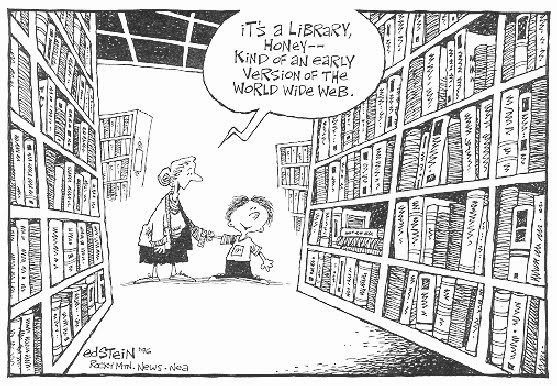
Jacalyn Duffin on the archive as treasure hunt:

Dr. Duffin presented her experiences with texts that had been reprinted through several editions across many libraries as she stumbled across other texts and historical figures through library exploration: she spoke to archivists and librarians, poked around shelves, and paid close attention to marginalia and illustrations. Sounds like the typical book-loving-researcher’s story: reassuring to hear and gratifying with which to agree. She also discussed the cost of knowledge, however: how does digitization affect cost, and is this effect positive or negative? Editions of the books she was researching went from expensive, to print on demand, to digitized on ECCO (though only for a university audience). Despite these changes, she reiterated that space and place are still incredibly important in understanding the book and its contexts. Duffin ended by posing a familiar question, with a haunting response: “Why libraries? Maybe we won’t know why we need them until they’re gone.”

Jeffrey Reznick on methods of assessing libraries from a national perspective:

Dr. Reznick brought the perspective of the National Library of Medicine and discussed methods of assessing libraries as well as his own experiences as a reader. Much of his talk referenced other books and sources on the topic, showing a myriad of different perspectives. Some of the many I found myself furiously copying into my notes include: IndexCat, Library 2020, and Circulating Now.

Nancy Cervetti on the library as place of creative power:

Dr. Cervetti brought perhaps the strongest literary perspective to the conversation, providing a list of exciting texts about literary depictions of archives and written materials, peppering her talk with quotes from Foucault and Derrida. She herself had begun as a scholar of literature who, through archival digging, started leaning towards history of medicine, particularly related to Weir Mitchell (who famously invented the “rest cure”). As Duffin did, Cervetti stressed the importance of being present in the archive in order to interact with librarians and to make discoveries through exploration, creating a multidimensional understanding of a subject rather than simply gathering information.

Mary Fissell on books as records of readers and readership:

Dr. Fissell shared her experiences using the College of Physicians Library collections in order to trace the readership of books through marginalia, looking at the book as an artifact that has its own subtext hidden in individual detail. Her work with recipe books showed readers interacting with the text and using it to keep track of experiences. She reiterated previously-made points about respecting and valuing the physical book for its differences among editions and the information its size, texture, and material can bring to our understanding of it. At the same time, she could not have pursued her project without the aid of digital archives and resources. The digital can help us use the archive and vice versa. They should be seen as tools to aid each other.

Simon Chaplin on rebuilding the library:

Dr. Chaplin is the head of the Wellcome Library in London, a “free library for the incurably curious,” its strength in the medical humanities. The Wellcome is in the process of remodeling its library and museum space, and Chaplin discussed the techniques of the library to boost its readership to match its museum patronage. The library will intertwine the library with the museum, making it easier for visitors to stumble upon (a key phrase throughout the conference) and make discovers by whim, according to a thematic organization. This new design speaks to a re-prioritization of the library to include more things. Accessibility and applicability will make it a place visitors want to explore. “Libraries don’t have to die!” he claims. They simply need to be willing to change and help people recognize what they already do so well: to “create questions where none existed previously.”

While all five speakers lauded the advantages and the joys of archival research, celebrating the place, space, contacts, and objects of books, some of the questions posed by the audience spoke to the dangers of denying the practicalities and the benefits of digitization in favor of over-romanticizing the rare book archive. I have heard sessions at conferences and by visiting speakers, either in vague praise of ever-changing technological advances in the humanities or full of anxious or romanticized defense of libraries: however, it seems both more useful and more difficult to discuss how these two archival methods complement each other. When questions arose pleading the necessity of digitization and online research, the speakers were very eager to admit that, of course, they never could have done their research without preliminary or follow-up investigation.
Yet, why does this feel like a concession? We’re worried about our books and their disappearance. Yes, libraries are in danger, for many reasons that I will not go into here, but perhaps it’s time to ease back from the admirable and protective tributes to libraries and focus on the strengths and weaknesses of the two types of research as they work together. This topic would be extremely complicated and (perhaps) contentious but would perhaps also help us to cement an inseparable relationship between the two and to achieve a vocabulary for talking about that bond that can support libraries better than a spirited defense. We don’t need libraries or online archives. What we need is both.

Dr. Brandy Schillace has also covered this event on her excellent blog, The Daily Dose!

Interview: Dr. Michael Chwe

Emma Woodhouse reflects upon notions of truth and strategy, stating, “Seldom, very seldom does complete truth belong to any human disclosure; seldom can it happen that something is not a little disguised, or a little mistaken.” Famous for being the only one of Jane Austen’s heroines who “no one but [herself] will much like,” Emma reveals a dangerous fact that we all know instinctively: the complete truth rarely exists without some sort of agenda.
But, sometimes, an interpretation of Austen’s agenda is inspired by complete coincidence. Dr. Michael Chwe explains that finding the children’s book Flossie and the Fox at a garage sale was the beginning of his project, titled Jane Austen, Game Theorist.  Much has been said about our Austen in the past several years—we’ve asked questions about her sexuality, questions regarding her censored letters, and questions about her publication history, but we’ve never considered her a game theorist until now.
Chwe’s book Jane Austen, Game Theorist supports Emma’s assertion, and argues that “Jane Austen systematically explored the core ideas of game theory in her six novels, roughly two hundred years ago” (1). Chwe looks at how Austen’s characters negotiate the main principles of game theory: choice (a character does something because they want to do that action), strategic thinking (a character does something based upon how they think others will perceive and respond to it), and preferences (a character does something because they prefer it over another option). The result is an interesting, interdisciplinary analysis of Jane Austen and her work.

INTERVIEWER

You mention in the preface of your book that this project started when you found Flossie and the Fox at a garage sale for your children. You used this experience and paired it with all the years you spent teaching and reading folktales and Austen to create Jane Austen, Game Theorist. Can you tell us more about how you came up with your idea and how it changed over time?

CHWE

The original title of the book was called Folk Game Theory, which revolved around the idea of people who use game theory who are not traditional game theorists. The examples were folk tales, and I actually had a whole chapter on Rogers and Hammerstein’s Oklahoma, the musical. But, most of it was Austen.  Seventy, eighty percent was Austen. So, one of the [manuscript] reviewers said, “You should just say that this is about Austen.” It was a good choice. The original idea was to say that this book is many instances of people who are developing game theory, not necessarily in a theoretical way, but through narratives […] In my teaching, I use examples from movies and other things to show students, so I’m always on the lookout for more examples […] I got interested in Austen after I saw the movie Clueless. Then, I started watching Austen movies. And then, I started reading her books. That’s how the whole Austen thing came about.

INTERVIEWER

That’s incredible. So, Clueless was your gateway into Austen.

CHWE

It was indeed. Yeah, I never read Austen in college or in high school […] In college, I never took a literature class, so I didn’t read Austen until I was like forty. I’m glad because if I had read Austen in my twenties, I wouldn’t have understood a lot of it, to be honest.

 INTERVIEWER

Was Emma the first of Austen’s novels that you read?

 CHWE

I originally thought the book [Jane Austen, Game Theorist] would talk about Emma as just one case because it is so clear that Emma is about manipulation and meddling […] I thought I’d focus this book on Emma, but then I wanted to read the other books and see what I could say about them […] I think that if Austen had written twenty or thirty books, I wouldn’t have been able to read all of her books, but because she only had six, I thought I’d just go ahead and do it.

INTERVIEWER

Do you have a favorite Austen novel?

CHWE

No, I really like them all.  Pride and Prejudice is a little shallow to me in the sense that most of her characters are fully formed at the start. To me, Mansfield Park is better because it’s about the development of a human being. People change more. Persuasion, I also like a lot. So, those are my favorites, but, of course, I like them all.

INTERVIEWER

In terms of your book, what was the publication process like?

CHWE

I was lucky in that I had already published a book with Princeton […] back in 2001.  So when the time came around to think about writing a book again, I sent it to Princeton. I also sent it to Oxford University Press. Neither place had problems with the idea being a little bit non-standard, but it was hard to find reviewers on the literature side […] Everyone talks about how important it is to do interdisciplinary work, but it is harder in a sense because people have a harder time judging it.

 INTERVIEWER

What do you make of EverJane, the online role-playing game based upon Jane Austen novels? Have you played it? What might it say in terms of your argument?

CHWE

I haven’t played it, but I think that it’s a great idea and that it has potential. I saw the Kickstarter page. I think, potentially, it is a great way for people to get into Austen and I think Austen’s world view is very much about the decisions you make to get ahead and how important a single decision can be. I think that Austen’s literary worlds are worlds where […] you think about yourself in terms of decisions. Other people’s worlds might think in terms of visuals or characters or history, but when you think about Austen’s worlds, it’s about […] what would you do? What would you think about? What connections would you make?

INTERVIEWER

What I’m wondering right now is do you see EverJane as a physical representation of your argument? Or, I guess, a virtual representation?

CHWE

I haven’t worked with the game, but maybe. I’m not sure how they structured the game […] I think because Austen emphasizes decision making so much, maybe her novels are most suited for this kind of thing…For example, if I made a game out of Virginia Woolf’s To The Lighthouse, I’m not sure what that game would look like.  So, some novels don’t necessarily lend themselves, but I think Austen’s do.

INTERVIEWER

I understand your argument as an interpretation of Austen, herself, as a game theorist, as well as the notion that she portrays her female characters as game theorists—that is, Austen extends her own strategic thinking to her characters, which is demonstrated through their culminated marriages. How might readers navigate your argument if we don’t view Austen’s novels as strictly heteronormative? How might Austen’s game theory change?

CHWE

I don’t see Austen’s novels as all that heteronormative. There’s a whole thing with Henry Tilney […] [and] gender roles. There’s the discussion with Catherine Morland and Henry Tilney, where he says that women have so much talent that they don’t need to use more than half…I think its representative of the questions: Are women better at strategic thinking than men? What are the social determinants of that?
When Henry Tilney buys the muslin for his sister, that’s like him being in drag or being gay or bisexual…But back to marriage—I’d say that you can think of [game theory] more in terms of social advancement. I think that Austen is trying to be general and is saying: this is how you can understand human behavior […] Marriage is just one of those possible objectives, so [game theory] doesn’t hinge on the idea that marriage is the final goal. For example, in Northanger Abbey, if you think of Henry Tilney as not as stereotypically masculine as other characters, maybe he could have been in touch with his feminine side. He’s one of the better strategic actors in the novels. He doesn’t make huge mistakes like Mr. Darcy does. I think Henry Tilney, more than any other male character, explicitly says things about strategic thinking. He talks to Catherine Morland and says,  “When you think about other people’s motivations, you think about them in terms of what you yourself would do, as opposed to what a person of their age or their status would do.” That’s a very clear explication of the problem of strategic thinking. We always tend to think of people in terms of ourselves. We’re not necessarily good at putting ourselves in the mindset of others. Henry Tilney says that. He has a definite feminine side. He’s not as stereotypically masculine as some of the other male heroes […] I don’t think [Austen] takes heterosexuality as necessarily as a given.

INTERVIEWER

So, the game theory wouldn’t necessarily change at all, even if marriage wasn’t the end goal.

CHWE

No, not at all.   Austen thinks getting married is important to their world, but she doesn’t necessarily see [marriage] as a sacred life goal. Her interest is more about the process. She’s not interested in what happens to people once they’re married […] She’s interested in how people get to that goal.

INTERVIEWER

You argue that Austen, herself, was a game theorist. How might considering Austen’s own strategic thinking complicate traditional ways of viewing her work as domestic narratives?

CHWE

I’ve never myself been concerned with the critique that just because she talks about five or six people […] that somehow her work is not significant. All game theorists and a lot of social scientists realize that you can explore interactions amongst a handful of people. Those can have applications to a very large group of events. When I teach game theory, the most interesting parables are those between two people and then you generalize them. A parable or story about people deciding whether to cooperate or fight each other over painting a fence […] can be a parable for international relations or war. The very fact that Austen doesn’t talk about historical things or a huge world event has nothing to do with whether her ideas are applicable or generalizable. Any social scientist would say that.  There’s no reason to think that just because it’s a domestic narrative that the insights there may not apply to lots of other things. I think that we shouldn’t think necessarily of a narrative or novel in terms of its subject matter but in terms of its vision for how people interact with each other. Those insights can apply to many different cases.
It’s like slave folktales. Slave folk tales are tales about animals, but they’re not about animal behavior. They’re used to talk about uprisings or strategic techniques that slaves can use against their masters […] They tell narratives about rabbits and foxes—it’s obvious that these slave folk tales are about, in terms of their subject matter, animals. But what’s relevant about these specific strategies is that they express techniques that these animals use against each other.

INTERVIEWER

Interesting! How does game theory apply to scholars in Romanticism? How might game theory be used to enhance literary criticism, appreciation, or cultural study?

CHWE

I think that the obvious thing is to use game theory to illustrate aspects of novels. Game theory might come from a situation like a prisoner’s dilemma—these are situations where people can gain if they all cooperate, but no individual person wants to cooperate–so [scholars in romanticism] might say, “In this novel, I’ve found an example of a prisoner’s dilemma and this is how they solved it.” You could do that. With Austen, I did something a little bit different, which is to say that we’re not using game theory to understand her work, but rather, we’re trying to understand her as a game theorist herself. This won’t be the case for every single author. Some authors may be more interested in emotions or social context or irrationality or self-perception or delusion […] If you’re aware of how people in the social sciences try to make explanations for things, you can maybe use them to understand how certain authors seem to be expressing theories of human behavior. It might be another way of analyzing their work.
For example, since I was working with game theory, I was really monomaniacally thinking in terms of choices and in terms of purposeful action […] so I was really sensitive to those issues. […] People who are interested in psychology or how we constitute the self can also take that to literature. Some people have taken that to Austen.
It can’t hurt to be aware of certain [social science] ideas and where they come from […] If you’re sensitive to these things, then you might find another avenue for reading other people’s work and understanding their objectives […] In Austen’s time, there wasn’t anything called social science or a systematic discipline for understanding human behavior. If you were interested in human behavior and wanted to analyze it, probably, you ended up going to the novel. That’s what you did back then. If we think of understanding human behavior, we shouldn’t think of this as a specialized thing—it’s something that we all do. It’s not surprising that if you’re a novelist or a writer and thus you have to think about human behavior, part of you develops some sort of theory about it.

Literature Through Participation: Confessions of a Table-top RPG Player

74672_10151453820128413_712331389_nI am 5’ 6.” I am 120 pounds. I have a scar on my left arm. I have silver hair. I am an Amazonian warrior with a halberd. My name is Trish-la.
Obviously this is not actually what I look like or who I am. My name is Deanna Stover. I have never held a halberd, let alone been any sort of warrior (although my hair is beginning to turn silver. Thank you graduate school applications). No, I play Dungeons and Dragons. What I’ve just described are the basic stats of the first character I ever developed and played. It was 2000, I was 10 years old, and I stumbled into the game because a friend’s mom ran a game for the neighborhood kids.
First of all, let me make this clear: I am no expert about D&D. I can, however, give everyone a brief background of what the game is: D&D is a table-top role playing game (RPG). It is also a game that inspired a lot of controversy and negative reactions in the 1980s. People claimed that it promoted witchcraft (how 15th- and 16th-century!) and devil-worship. Role playing games still have a negative connotation associated with them; you should see the reactions people have when they find out I play Dungeons and Dragons. There’s also very little understanding about what D&D actually is. Typically people believe it is a video game (and there are those around), but a table-top RPG is different.
A Dungeon Master (DM) develops a basic story line and the “party” (typically around four to six players in my experience) influences the way that story will work out through their own decisions, interactions with other characters, and the luck of the dice. The dice involved are not just your average 6-sided dice; the die we use most is 20-sided. D&D is very hard to understand without playing. However, as I will explain, these games may spark a particular interest in those of us who love literature.
Flash forward to 2012. I didn’t remember playing my first campaign, let alone the dusty binder where I kept my character sheet (this helps you keep track of your stats, your skills, your weapons, and any other information you may need during the game) and my accumulation of die. I didn’t remember any of this until a few friends once again introduced me to D&D. However, I fell in love all over again. In the past year, I’ve participated in three campaigns, and I am a walk-in character in a fourth. I have literally laughed and cried my way through these adventures.
photoSo, what does this have to do with literature? Well, not only is Dungeons and Dragons inspired by literature and mythology, it involves the creation of new narratives every session. In that dusty binder from my first foray into D&D, I have these instructions: “The players are like characters in a book that you, the players, are writing with the [DM].” Playing as an adult, I am ever more aware of the truth behind this statement.
Admittedly, the literature that inspired D&D is typically associated with the 1960s and 1970s, something that may be foreign to those of us who are interested in the 19th-century, but the connection between D&D and all literature students is still a vibrant one. I am not a creative writer, I am definitely not an actress, and I never even played video games as a child, but the attraction to this game is still strong. The communal storytelling is what makes it so appealing and, honestly, there are some elements of each campaign that reference Romantic and Victorian literature; the campaign I’m currently in has some Swiss Family Robinson-esque elements tied in. But for me the most entertaining part of D&D is feeling like I am a part of a Choose Your Own Adventure novel every time I step into the room.
Perhaps you can see this post as a recruitment for D&D or even RPGs in general, and on some level I suppose it is, but what I am really trying to point out is that, even while I spend most of my life now nose-deep in 19th-century literature and papers I have to grade, D&D is what keeps reminding me what is so magical about words. I have watched the DM create a world all his own (albeit influenced by D&D lore, Roman and Greek mythology, and even modern video games), and I have participated in its creation. In the end, D&D is just five people sitting in a room for six hours every week speaking to each other, spinning a story and interacting through words alone, but only there can I become a warrior woman or even a half-dragon. Through our simple words and a few rolls of a die, a whole new world is born—it is literature through participation.