Advice: Five Scholars on Comprehensive Exams

Constructing comprehensive exam lists is no easy feat. A friend of mine compares the process to building a personalized obstacle course and then having to master it; after all, the texts that appear on your exams are texts that you have personally chosen. Another friend compares constructing exam lists to building a wish list; here are all the books and articles that I wish I had time to read (or re-read) earlier in my career. Whether you view exam lists as friends or foes, one thing remains certain: you must be aware of yourself as a scholar.
Several weeks ago, I read Renee Harris’ thoughtful how-to on running the comprehensive exams gauntlet. Harris’ article offered the very comforting reminder that even while we construct (and take) these personalized exams, we are never alone in the process. Beyond our supportive departments, committees, and mentors, there are always other people going through similar neuroses, struggles, and victories. And, consequently, there is a vast group of established scholars who have already gone through them.
In an effort to extend this conversation of how to approach such a daunting task, I’ve asked five established scholars across North America about their experiences taking and preparing for exams. What did they wish that they had known? What were they glad that they already knew? Below are their words of wisdom:

Dr. Brandy Schillace, Case Western Reserve University

I was standing in the stairwell, waiting to be called up to the defense. It’s hard to capture the tumult of emotion and anxiety… I felt I had dueling octopi in my stomach. I was terrified I’d say the wrong thing, or nothing at all in a fit of brain freeze. Then I remembered something. I’m Anglican, and coming from my studies of theology, I suddenly remembered the early charge that disciples ‘not worry’ about what they would say in advance. When the time came to speak, speak they would.
In that moment before defense, we are  ‘disciples’ of English studies and about to stand trial. But remember–we are also masters. We know our subject better than anyone, and possibly even as well as some on our committee. They are not judges; they are peers. We are not going to prove we belong; we are going to show we’ve belonged all the time.
I breathed a sigh of relief as I climbed the stairs… And I entered the room as a colleague. That’s what you are–colleagues in the making. Don’t be paralyzed by the exam. Don’t be cocky, either, but just remember: this is our job, it’s what we do. When the time comes to defend, defend you shall.
(Though I confess, praying never hurts)

Dr. Anne Stiles, Saint Louis University

1. Study several contiguous time periods. When I took my exams, I decided to focus on the Victorian period and the 18th century, but skipped the Romantic era. I definitely regretted it afterwards, especially since many jobs in my field are geared toward the “long nineteenth century.” If you’re studying two different time periods separated by a decade or more, remember that the meat in the middle of the sandwich is important, too!
2. Always carry around a book with you in case you have a few spare minutes for reading (while waiting in lines, for ex.).
3. Remember to read secondary criticism on the primary works you read, even if you’re not required to do so. This secondary criticism can help you tie together and better understand the works on your list, so you have more to say about them.

Dr. Richard Menke, University of Georgia

One of the questions I’m asked most frequently by students approaching their comps is whether they should “focus on breadth or on depth” in their preparation and in their exam answers themselves. My answer may sound glib and unhelpful, but it’s really intended to be neither of these: “Both.” What I mean is that they should be ready to frame their deep, specific answers in terms of a broad sense of genre, history, context, ideology (and so forth). But they should also make sure that when they find themselves articulating their broad understanding of the field, they offer a sense of how they could add details to flesh out and add nuance to their responses.
This dual focus can help students offer successful exam responses that set up useful follow-up questions, since examiners will often pick up on these suggestions in an oral exam, for instance. But I’m convinced that it can also do something more. Rarely in our careers do any of us have the chance (or the obligation) to read extensively and promiscuously across our fields, as we are asked to do for our exams. So preparation for the comprehensive exams represents a chance to charge your intellectual batteries in a special way, to gather some of the knowledge, the theories, and the hunches that can help propel years of thought. As students are studying for their exams, they should work from specific texts and problems, to patterns that link them into networks of relationship, to larger themes and ideas. They should see their own knowledge and understanding in relation to the shape of their field, and should be ready to articulate the significance of their ideas by discussing their connections to these wider intellectual contexts. After all, that’s just what they’ll need to do in their own scholarship, as they present their deep research and argue for the breadth of its intellectual significance.

Dr. Anne Mellor, UCLA

The only suggestion I have is to know everything that is in my anthology, Mellor and Matlak, BRITISH LITERATURE 1780-1830. That will familiarize you both with the canonical and the newly-added-to-the-canon texts, as well as their historical contexts.

Dr. David Sigler, University of Idaho

The exam year is the best experience you’ll ever have in this profession, and probably in your life. If the listmaking and reading and examining feel traumatic to you or even merely stressful, be comforted to know that this is the least traumatic phase of your whole long career to follow, and that the memory of its pleasures will compensate you during the decades of anxiety to come. Just by doing all that reading all day every day for about ten months, and reading super-carefully so as to file away all of the details, you really do become an expert in the field and begin making connections, text to text, that spark a million ideas. Everything begins to relate to everything else, like you’re Coleridge or something. I read for months with a kitten, Eloise, often aloud—and when I see Eloise today, ten years later, we both know that we read a whole lot of stuff, very intensively, together. It’s solidarity and belonging one is building, then. Reading for the exams was, no doubt, the best intellectual experience I’ve ever had.
Making the lists is like making a mixtape, and thus when they’re poorly constructed one’s deficiencies are exposed. Mixtapes were a technology of the late twentieth century. I worry sometimes that scholars of the most recent generation are at a considerable disadvantage in the list-making, having never made anything but playlists. You want to show that you appreciate some delightful neglected corners of your field and also aren’t afraid of the greatest hits. Everything should be selected to demonstrate one’s immaculate and capacious taste. I had all kinds of Joanna Southcott on there, and Mary Prince, and The Writings of the Luddites, and the Marquis de Sade, and some early Felicia Hemans from before she sold out (The Domestic Affections). I went with The Last Man instead of Frankenstein like it was no big deal. I know that none of those are obscure at all, but it felt that way to me at the time because my frame of reference was expanding so quickly. One covers a lot of ground and gets smarter. The experience was exhilarating for me, and it always is. My point is that mine was a really great Romanticism list, and I’m not sure anyone else really appreciated it properly. My advice, if you’re doing it now, would be to use an earlier, shorter version of The Prelude, as early and short as possible, because that’s a lot of time-spots to remember for ten months. Don’t put Night Thoughts or Political Justice on there, either—seriously just read them after your exams, or during your exam year on your own time if you must. You don’t want to be pressed on those hundreds of details. Finally, don’t argue with the DGS when s/he insists that you include Manfred on your list—it’s simply so delightful that you should definitely include it, even if you’ve already got Don Juan and Beppo on there—it’s not a burden to include it, I promise, and the arguing just makes you seem timid and unimaginative. I know you know that already.
 

Jane Austen and Romantic Mortification

Perhaps surprisingly for its canonical status as a tale of romantic love, Pride and Prejudice (1813) is governed by many distinctly unromantic states of negative affect. Distress, embarrassment, depression, shame, and disbelief are all integral to Austen’s portrayals of character. But one emotional state stands out as being distinctively Austenian: mortification. Elizabeth Bennet is “most cruelly mortified” by her father; Kitty experiences “mortification” at the Forsters’ preferment of Lydia; Darcy feels “incredulity and mortification” at Elizabeth’s initial rejection, and later, “trouble and mortification” as he searches for the renegade Bennet sister in London; and even Miss Bingley “was very deeply mortified by Darcy’s marriage.” Most famously, at the scene of the Netherfield ball, Elizabeth’s “mortification” accrues with each outrageous Bennet performance, and she even enters into “dances of mortification” with Mr. Collins. The Austen reader might well ask, what is this state of mortification, and why is it such a key term for describing Austen’s characters?
As a synonym for silent humiliation, “mortification” has a particularly Romantic shade. The term had been used in Shakespeare’s plays, and by Swift in his “Drapier’s Letters,” but it appears considerably more frequently in the prose fiction of the early nineteenth century. Walter Scott’s Rob Roy (1817) features its narrator, Frank Obaldistone, claiming that he is “Not mortified, certainly not mortified”; Amelia Opie’s short story “Mrs Arlington: Or All is Not Gold that Glitters” (1818) describes one character as “humbled, offended, mortified, and self-condemned”; and other works by Maria Edgeworth, Charlotte Smith, and Clara Reeve all feature mortification as a key term for describing the emotional plights of society heroines.  But “mortification” seems to be an especially potent term for Austen. In Northanger Abbey and Persuasion, published together in 1817, the term appears at least 8 times, and Austen typically modifies it to increase its severity: Catherine Morland experiences “deep mortification” and “severe mortification” at a ball with Henry Tilney, while Anne Elliot, shocked by Captain Wentworth’s sudden appearance, “fully submitted, in silent, deep mortification” to his comment that her person is altered beyond recognition. As with Elizabeth and Darcy, both Anne and Catherine must experience mortification, and especially public mortification, as a key stage in their trajectory to marital bliss.
Where did Romantic-era mortification come from? Austen’s repeated uses of the term are fascinating, since “mortification” occurs much more often in non-literary Romantic fields.  Rather, the term could refer to a religious practice of personal deprivation in the interest of spiritual self-improvement: as Ezekiel Hopkins wrote in 1807, “THE GREAT DUTY OF MORTIFICATION” required personal penance, since “without mortification, no [after]life is to be expected.” And, as A Daily Exercise and Devotions, for the Young Ladies and Gentlemen (1816) suggested, “The constant exercise of mortification is another fruit of penance” and the young lady or gentleman in question might “draw” “vast fruit” from the spiritual exercises of personal deprivation, or even the “voluntary toleration of bodily pain or discomfort” (as the OED would have it).
More intriguing, though, was Romantic mortification’s medical sense, as the word for the necrosis of bodily tissue — that is, as gangrene. The vast majority of references to mortification during the early nineteenth century appeared indeed in this pathological sense. “Mortification” is a central heading in John Hunter’s seminal work on battlefield surgery, A Treatise on the Blood, Inflammation, and Gunshot Wounds (1794), and the term appears with great regularity in medical textbooks in the early 1800s. One particularly clear definition appears in Sir Robert Carswell’s Pathological Anatomy: Illustrations of the Elementary Forms of Disease (1838):

The term mortification is generally employed in this country to express the state which has been induced in a part of the body by the complete and permanent extinction of its vital properties. On the Continent, however, the term gangrene is employed to signify the same state, whilst in England it is more commonly used to denote the incipient stage of mortification … The extinction of the powers of life, the complete cessation of the circulation, and an entire want of sensibility, characterize the second or last stage of mortification, which is called sphacelus

But what could the horrifying condition of gangrenous mortification have to do with Mr Darcy’s embarrassment? One place to look for an answer is in the medical notes of John Keats, literature’s best representative of Romantic medicine. In his Anatomical and Physiological Note Book (published 1934), Keats discusses the connections between aneurism and mortification, and — in a cautionary tale for graduate students — mentions how “Those who have been addicted to Study from Keeping up a continued determination of Blood to the Brain have often the Vessels of that part ossified,” making the scholarly brain “subject to mortification” even among “the Young.” As Keats noted elsewhere, mortification could also take place among those who “lead a life of Intemperance.” Thus, since one of the main ambitions of Pride and Prejudice is to temper the unrestrained outbursts of the romantic leads, it makes a strange sort of sense that their intemperance of character — their respective pride and prejudice — leads to mortifying social punishment.
Although he does not use the term “mortification” in his poetry (to my knowledge!), Keats, who himself experienced “occasional ridicule, & some mortification” as a result of his “Pride and conceit […] amongst mere Medical students” (in the words of his friend Henry Stephens), is perhaps the touchstone for Romantic embarrassment. As Christopher Ricks’s 1974 book, Keats and Embarrassment, discusses, “a particular strength of Keats is the implication that the youthful, the luxuriant, the immature, can be, not just excusable errors, but vantagepoints” (12). Austen, too, uses moments of mortification to give insight and perspective, and the embarrassment her characters feel is not the result of “excusable error,” but of betrayal by their biology (their desires, or, more often, their desires thwarted by their foolish relatives). Thus, it seems no coincidence that Mary Ann O’Farrell’s discussion of “Austen’s Blush” (1994), another important work on Romantic embarrassment, touches on the biological underpinnings of socially coded desire. The blush, which Austen associates explicitly with mortification (Catherine, for instance, displays a “blush of mortification”), is for O’Farrell a marker of the body’s involuntary expression beyond the socially regulated codes of signals: “Austen necessarily invokes that about the body which is most inimical to manners, what makes manners most vulnerable to disruption” (127).  Thus, in my view, the affect of shameful mortification in Austen’s novels arises from the tension between the socially appropriate suppression of desire (analogous with religious mortification), and desire’s rebellious expression in the outer tissue of the organism (similar to medical mortification).
Austen’s union of the two external mortifications in producing her characters’ affect of humiliation established a convention that extended later into the century, and an interesting point of comparison is Anne Brontë’s novel, The Tenant of Wildfell Hall (1848), which uses mortification as a key plot-point. Helen Huntingdon mortifies her would-be suitor, Mr Hargrave: “I cut short his appeal, and repulsed him so determinately […] that he withdrew, astonished, mortified, and discomforted, and, a few days later, I heard he had departed for London.” Helen’s power to mortify figuratively seems also to result (indirectly) in the death of her abusive husband, Arthur Huntingdon, whose alcoholism has led to actual mortification. In his last days, Arthur experiences “freedom from pain” and “deadness to all sensation where the suffering was most acute”; Helen writes, “My worst fears are realized — mortification has commenced.” In contrast to the extremely painful affect of mortification experienced by Austen’s characters, Arthur Huntingdon’s mortification passes from the first stage, gangrene, into the painless, fatal stage of sphacelus. His death releases Helen from her personal mortification at his hands, and leaves her free to marry Gilbert Markham. As in Austen’s novels, mortification is a developmental stage through which characters must pass to reach their marital goals; but unlike Austen’s mortification, Brontë literalizes the experience into its medical form, offering a much grislier model of character shaping.
But even marriage could not keep the advances of mortification entirely at bay. Elizabeth’s vigilance in “shield[ing]” Darcy from her humiliating relatives culminates in her permitting him to speak only to “those of her family with whom he might converse without mortification.” Et in Austen ego — even at the satisfying end of an Austen novel, then, is the encroachment of gangrenous necrosis.
 

After the Exams … Writing and Defending the Prospectus

Reading and preparing for the comprehensive exams feels like the most daunting task we undertake as doctoral students, but what happens after we take the exams? What happens after we spend months, sometimes a year, on edge, full stress, constantly questioning if we are doing enough, reading enough, are we ready enough to pass our exams? And then—we do. We pass; we hear the congratulatory statements from our committee members and our peers. But what happens next?

“Noon – Rest from Work (after Millet)” (1890) by Van Gogh

All I wanted to do when I finished the comprehensive exams was breathe. Breathe air that wasn’t tainted by the constant nervousness or questions of whether or not I was prepared enough. I wanted to sit down, change my email signature to PhD Candidate in English and move on to the dissertation. But at Arizona State University, our exam process is three-part and the oral comprehensives is only part two. The exams start with a written exam, once you pass the written with committee approval, you move on to the traditional oral comprehensive exams. The last and final portion of the three-part exam process is the prospectus defense. Before we receive the final stamp of candidacy and ABD, we have to defend our dissertation prospectus in a two-hour colloquy.
Writing the prospectus after the high of passing the comprehensive exams was incredibly difficult for me. I wanted to celebrate and enjoy the success of having completed the most difficult and daunting task that I had faced as a PhD student. And I tried, but the nagging feeling that I wasn’t quite done yet kept me from being able to fully let go of the stress and anxiety. I still had one more step.
The dissertation prospectus by definition is a daunting document to write. This one paper is supposed to set up the next two years of research and writing. In one document, I am supposed to outline my dissertation argument and chapters, provide a literature review of my specific area of study, and prove that my dissertation will contribute to my field, all while proving that I am capable of completing the task in a specified amount of time. The other difficulty that I encountered with the prospectus is that the specific expectations for content, style and format were ambiguous. Everyone that I talked to that had completed the full exam process had different expectations for what the prospectus should do. Is it 10-15 pages? 15-20 pages? 25-30 pages? Should it be an informal discussion of my project ideas or a formal paper that easily can transition into an introduction? What portion of the project should be a review of the literature and scholarship? How long should each of the chapter descriptions be? Should the chapter descriptions be abstract length or should they be more detailed? These questions and hundreds more plagued my prospectus writing process. I let the questions and the uncertainties halt my ability to move forward and complete the document. I met with my committee members multiple times, but it never fully helped to clear up what exactly it was that I was supposed to do.
Hand Prospectus
“Hand Prospectus” (2014) by Kaitlin Gowan Southerly

One day, about two months after my comprehensive exam when I was so overwhelmed and ready to give up on my idea for my dissertation, I went in to talk to my good friend in the program, Kent, and it turned into me venting about my inability to just write this document. I frustratingly opened up about my struggle to overcome the block and anxiety associated with the document itself. I ended up sitting in Kent’s office for about an hour and we mapped out my project together. I bounced my ideas off of him (something we regularly all do together in our 19th Century Colloquium) and it finally hit me. I just needed to talk about my project out loud; I needed to share my ideas and get them out of my head. I needed to make my project something real rather than an idea or figment of my imagination. And once I did this, once I talked with my friends and shared my ideas and had an intelligent conversation about my project—I wrote my prospectus. Literally, over the next three days I wrote my prospectus. I frantically emailed my committee, miraculously found a date that everyone could meet, and two and a half weeks later, I walked out of a two-hour colloquy ABD.
Okay, I know that this story and process is unique to me, but here is the best advice that I received and learned throughout the prospectus process. Maybe some of it can help you…

  1. Breathe after your comprehensives. Take a specified amount of time to celebrate and relax and enjoy life without worrying about what comes next. I didn’t do this and immediately after the comps, all I could think about was what I still had to do and that really took away from my ability to celebrate the incredible accomplishment that passing comprehensive exams is.
  2. Don’t be afraid to tell your committee that you are struggling. As soon as I opened up about my writer’s block, my committee was incredibly helpful and understanding and supported me.
  3. Instead of worrying about what specific format the prospectus should follow, just write your ideas for your project down. As soon as you get your ideas down, the rest will come. And don’t worry, your chair (who will go over your document first before you send it out to the rest of your committee) will let you know exactly what he or she is looking for once you send the first draft. The most important aspect of this document is your project, your ideas, and your argument, so focus on that.
  4. Don’t worry that you don’t have all of the details figured out yet. Your committee expects your project to change as you begin to write, so it doesn’t have to be perfect now.
  5. And the absolute best advice I can give: SHARE. Share your ideas with your peers, with friends and family. Share with anyone who will listen. Share with the old man sitting next to you at the bar while you attempt to drink away the writer’s block. The more you talk about your project and ideas for chapters, the easier it becomes to write them down, even if you are sharing with someone who knows nothing about your area of study. When you share your ideas, you get excited about them. Harness that excitement and writing becomes easy.

The last thing to say is as cliché as it sounds, remember that you love this. You are putting yourself through a PhD program because you are passionate about what you study. I don’t think we could make it through programs like ours without a crazy amount of passion for what we study. But sometimes we lose that and forget how excited we are about these texts when we get stuck in the rut of jumping through the necessary hoops—especially when the hoops appear to be rings of fire. When I remembered that I loved what I was studying and was excited about what I had to say, I discovered that I was completely capable of writing the prospectus and finishing that last step of my exams. And I did. And if I can do it, you can do it too. And then you can hurry up and change your email signature from PhD Student to PhD Candidate.
Kaitlin Gowan Southerly
PhD CANDIDATE in Literature
19th Century Colloquium
Arizona State University

Rethinking Romantic Media: Print Alternatives

While my research has thus far focused on Romantic print media, my recent foray into the world of media archeology has led me to search for alternative media that print obscures. In Gramaphone, Film, Typewriter, Friedrich Kittler confronts “the historian’s writing monopoly” (6) by arguing that print cannot adequately take into account oral and visual culture. Writing merely stores the “facts of its authorization” (7), while “whatever else was going on dropped through the filter of letters and ideograms” (6). Kittler points to photography and film as storage media that put an end to the monopoly of print by recording the images and noise that print filters out. And yet, for scholars like ourselves interested in the period that preceded these inventions, how do we uncover the alternative media that print obscures? In order to answer this question, I turn to two examples of performance-based media that much recent work has attempted to reconstruct: lecture and drama.
Reconstructing the Romantic lecture
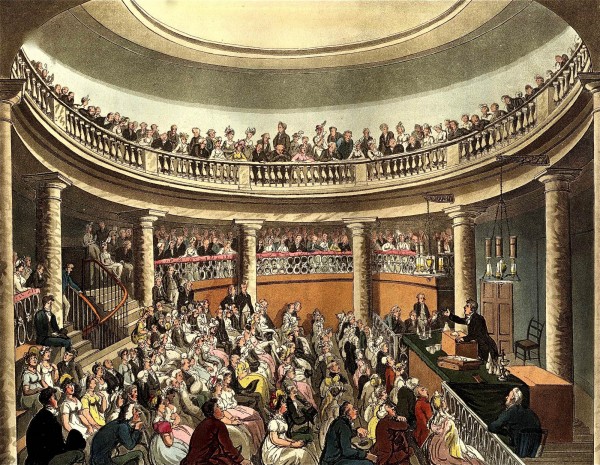
On February 28, 2014, the University of Colorado at Boulder hosted “Orating Romanticism,” a series of speakers that included Dr. Sarah Zimmerman of Fordham University, Dr. Sean Franzel of the University of Missouri, and CU Boulder’s own Kurtis Hessel. While each speaker focused on a particular lecturer or series of lectures, all spoke about the challenges they face when attempting to reconstruct a medium that is inherently performative and ephemeral. Dr. Zimmerman explained that Romantic lectures were critical oral arguments shaped by participating auditors as much as speakers themselves. For example, when giving a series of lectures on Shakespeare’s characters at the Royal Institution, Coleridge frequently deviated from his notes and occasionally strayed so far from the advertised topic that auditors complained in their reviews. Other lecturers changed their topics according to the audience’s immediate responses, collapsing the time between composition and reception that characterizes print. Working with such a medium proves challenging, explained Zimmerman, because the lecture’s “authoritative text,” if such a thing exists, “lies at the midpoint that marks the exchange between performer and audience.” As an inherently performative media dependent on time, place, and audience, the Romantic lecture cannot be adequately expressed in print.

Surrey Institution, London, 1810. Thomas Rowlandson and Augustus Charles Pugin. (Wikipedia)

Facing this challenge in his work on Coleridge’s, Hazlitt’s, and Humphry Davy’s respective lectures, Kurtis Hessel explained that in order to reconstruct these events we’re forced to cobble together “texts” from various sources, including the speaker’s notes, advertisements, reviews, and writings of those who attended. And yet, cautioned Hessel, these sources are often unreliable indicators of what actually took place. Just because a lecture was advertised, for example, does not mean it was actually held. If ticket sales failed to reach certain quotas, the event was canceled. In addition, while some lecturers like Hazlitt published write-ups of their lectures following the event, the printed version does not necessarily provide an accurate account of the lecture itself. Although it’s tempting to treat lectures in the same way we treat texts, Hessel struggles against this inclination in his work. Rather than relying on an available text, he explained, we’re forced to construct one. While print continues to dominate our understanding of Romantic-era oral media, we should seek out as many diverse sources as possible in order to reconstruct these moments. The lecture itself exists somewhere in between.
Reconstructing drama and pantomime
Drama is a similarly performative medium that presents methodological challenges when reconstructing it in print. With the exception of closet dramas and other plays that were not intended for the stage, the majority of popular stage productions were written with performance in mind. Although we have scripts, stage directions, and other textual remnants of these works, it’s difficult to imagine what occurred at individual performances. In Coleridge’s highly successful drama Remorse (1813), for example, we know that audiences were enthralled by a spectacular incantation scene in which an altar goes up in flames to reveal a painting of the protagonist’s assassination. Yet no surviving versions of the text give any indication of how this effect was achieved. Instead, our best guess comes from a write-up in The Examiner that describes “the altar flaming in the distance, the solemn invocation, the pealing music of the mystic song,” that together produced “a combination so awful, as nearly to over-power reality, and make one half believe the enchantment which delighted our senses.” Though lacking in specifics, this description depicts the scene better than the play’s stage directions, which simply read “The incense on the altar takes fire suddenly, and an illuminated picture of Alvar’s assassination is discovered.” In cases where stage spectacle played an important role in a production, paratextual materials are often better approximations of performance than the text itself.
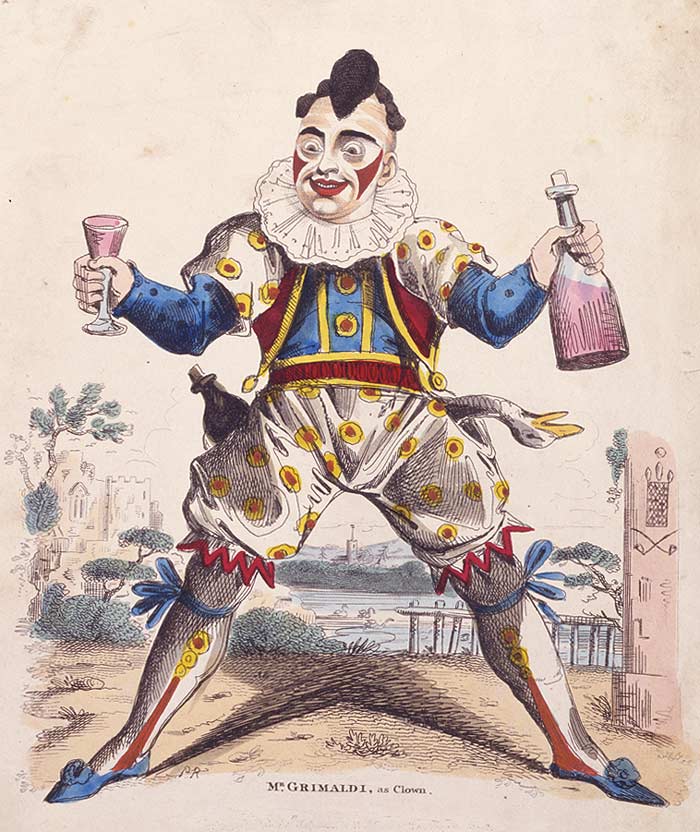
These materials become even more important in the reconstruction of eighteenth- and nineteenth-century pantomime, a form characterized by on-stage action rather than dialogue. When trying to reconstruct the text of Harlequin and Humpo (1812) for The Broadview Anthology of Romantic Drama, Jeffrey Cox and Michael Gamer used manuscripts with short descriptions of scenes alongside audience programs and other detailed information, but it’s impossible to arrive at an “ideal text” when a performance has no words. In places where the manuscript had little detail, they looked for descriptions in newspaper reviews. One review reveals that an Indian boy performed impressive contortions and acrobatics for a good portion of Scene V, a sequence that isn’t mentioned in the manuscript and seems have been a last minute addition to the show. It’s the piecing together of these sources that gives us the closest possible approximation of the work.
Joseph Grimaldi as "Clown," an archetypal pantomime character. c.1810. Wikipedia.

Joseph Grimaldi as “Clown,” an archetypal character in pantomime, c. 1810. (Wikipedia)

Destabilizing print
Despite my desire to uncover alternatives to print media, to deconstruct Kittler’s “writing monopoly,” it’s obvious that print is all that remains of Romantic performance culture. And yet, in our efforts to cobble together “texts” of these lectures and plays, it becomes harder to uphold traditional notions of textual stability. Especially in instances where there are multiple versions with significant differences, books are characterized by variation, difference, and inconsistency rather than grand solidity and authority. While publishers tend to smooth over these ruptures in “definitive editions” of canonical texts, reconstructions of forms like lecture and drama refuse to lull the reader into a fall sense of continuity. The search for Romantic print alternatives, though perhaps futile, may lead us to a more nuanced understanding of the different forces at play within printed texts.


Use Value and Literary Work: Poetic Identity in 19th Century Britain

I am a few days from submitting a full draft of my Ph.D. comprehensive exam rationales. These short written explanations/defenses of my lists are intended to help my committee see how I chose my texts, how I conceptualize the time periods, and what kinds of questions to pose in my oral exam next month.  No pressure, right?  I am not required as of yet to make groundbreaking strides in our field.  (I have four months until the dissertation proposal is due.)  For now, I am to demonstrate a confident knowledge of the area and its current critical debates.

And I must say, despite all odds: I am really enjoying this process.  I mean REALLY enjoying it.


Months upon months ago, I began designing my lists according to major themes in Romanticism and Victorianism.  I borrowed this approach from an old Victorian lit syllabus that divided our readings into the major debates of the period.  Luckily, the Victorian epoch already has names for many of these debates– we get “the woman question” and “the condition of England.” I started there and tried to work backward to see similar debates in Romanticism.  Not impossible, but I eventually abandoned these categories, finding many texts too difficult to compartmentalize.  Within and across the lists, I found too much resistance to these neat categories.

The porous boundaries between literary movements or cultural epochs are a consistent point of debate in literary studies. (This acknowledgment heads the disclaimer we sign upon entering grad school, right? “We all know this fact, but you, grad student, are responsible for challenging these textual boundaries in intelligent and original ways for the next six years”). The long-nineteenth century in British literature itself must expand at both ends to encompass a least a decade in each direction to make adequate sense in the ways we critics currently construct the period. And this is not a phenomenon reserved for the afterlife of each movement alone, but rather the writers and theorists of the Romantic and Victorian movements look backward and forward in attempts to situate themselves and their literature within a cultural narrative that shapes and is shaped by their work. Indeed, what I find definitive of the nineteenth century, a point of connection that unites the various authors and genres represented in my comprehensive exam lists, is a desire for clear situation within and beyond an epoch.

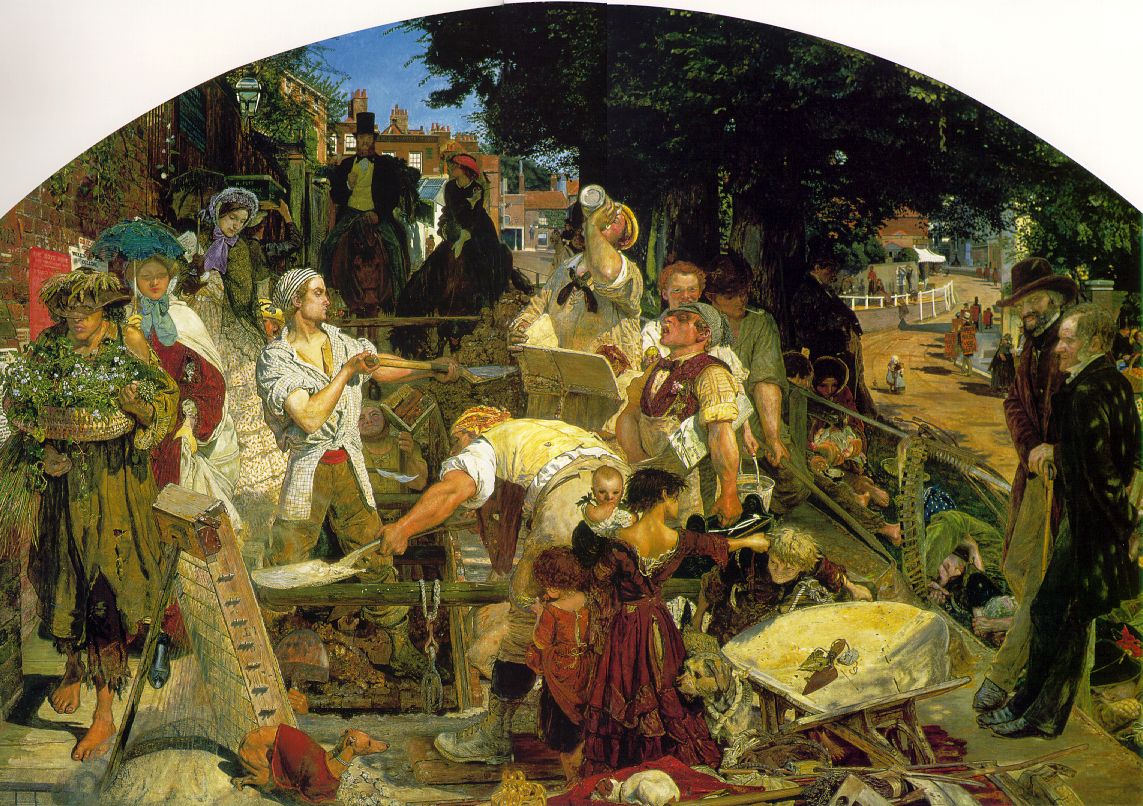
The writers we study desire a lasting cultural influence. They seek to shape and correct, to play a significant role in cultural formation and the national story. I argue that this desire to influence and make a mark is a symptom of economic insecurity. With an emphasis on practicality and pragmatism (the use-value of work) as the bourgeois class rises to influence across the Romantic and Victorian epochs, the “word’s worth,” if you will, of a man or woman of letters seems to require its own proof. This need to defend and define one’s usefulness in society and to posterity (on top of the need to prove one’s self within a chosen vocation, as with Keats, Hunt, DeQuincey and numerous women writers like Mary Robinson) creates a significant identity crisis that gets translated across the century into various points of cultural and historical contention.

"Work" by Ford Maddox Brown, 1865
“Work” by Ford Maddox Brown, 1865

John Guillory writes a compelling history of “use value,” how it was invented and how it comes to odds against aesthetic value in the early nineteenth century. I came to Guillory through Mary Poovey’s brilliant 2008 book Genres of the Credit Economy. Hers is a book you read and pine over, jealous you hadn’t written it first.  Of course the list of books I wish I had written has grown well beyond anything I could reasonably produce in a long academic career; nonetheless, I continue to drool and dream. Teasing out what Poovey calls a “double-discourse of value,” Guillory argues that aesthetic value depended on the emergence of “use value” as an economic concept in the late eighteenth century.  Looking to Adam Smith’s Theory of Moral Sentiments and Wealth of Nations, Guillory states that use value was invented to discursively clarify the relationship between production and consumption. It seems the people—literary writers and theorists?—were uncomfortable with the affective motivation behind ascribing a product value. Under the increased pressure for utility and practicality, valuing a work of art because of the pleasure it brings seemed a tenable (at best) justification for the time and effort expended in producing and consuming it. Therefore, the discourse substituted in use value which seems to marry production and consumption and get rid of the warm, fuzzy emotional value of art.

At the same time, Literature with a capital “L” cannot become so useful as to be absorbed into other types of writing like economic, scientific, or political writing (here’s the heart of Poovey’s book– how the distinctions arose between the genres).  So here’s the rub—aesthetics branches off from economic discourse for the first time, reiterating that not all written products are works of art. But what’s more, the products that appear like works of art may not be.  Thus Literary writers define what is “fine art” and distinguish between types of imaginative production based upon their adherence to the definition (namely, a work should not call attention to itself as a commodity, so rule out popular works and works of “immediate utility”).

But does this dismissal of “immediate utility” give leeway enough for my argument that poets and novelists in the nineteenth century feel the need to prove their utility?  I say, absolutely yes.  In my own adaptation of this cultural narrative, this is the crux of poetic identity in crisis. Suddenly (or not so suddenly, really, but now of sudden we have the language to explain this phenomenon) literature’s worth can no longer be taken as indisputable fact.  Suddenly, artists must defend the cultural relevance of the work.  What work does Literary work perform? Ironically, Wordsworth’s Prelude (esp. the 1805 version) justifies his seemingly self-indulgent aesthetic exercise in tracing the development of the poetic genius as performing the cultural work of a natural philosopher or historian, as he uses himself as the case study of a mind in development during upheaval of the French Revolution. Similarly, guarding his work against accusations of sensationalism or shock value, DeQuincey justifies his Confessions as being a comprehensive (scientific?) study of the effects of opium consumption, adding the potential educational benefits his mistakes may provide for the reader.

Perhaps more interestingly, Victorians like Thomas Carlyle and Matthew Arnold seek to define a use value for the aesthetic products more obviously abstracted from immediate utility than Wordsworth’s or DeQuincey’s.  Here we have a sense of immediate cultural crisis—the moral fabric of society is degrading as the class boundaries seem to be dissolving, gender roles (especially in the literary marketplace) seem to be in flux, science is questioning what it means to be human (and to be particular kinds of humans, etc). Carlyle and Arnold foresee anarchy, and they don’t seem too extreme with these concerns.  Radical individualism, as Carlyle terms it “democracy,” erases the need for leaders to model correct behavior.  And what will we do without models?  How can we possibly be moral without seeing what morality is?  How can we be cultured if everything and everyone is valued equally?  Carlyle’s answer: heroes and hero worship.  And significantly, his heroes always have a poetic sensibility, that is when his heroes are not poets themselves. Likewise, Arnold famously writes that culture is the answer to anarchy. To read and see all the best that has been known and created–this will civilize and make moral the British populace in flux.


I can see these economic questions of “work” and “value” at the root of my original categories, the major crises of the nineteenth century in British culture.  I feel as though this framework lends itself to a discussion of so many topics in recent scholarship: mental science, gendered work (domestic novels vs. fin de siècle adventure novels; sensibility and sentimentalism; etc.), professionalization of bourgeois occupations, dissenting culture, the widening franchise, the bard’s role in nation-making and historical record, scientific advancement and religious doubt, etc.
All this to say, I am arguing a relationship between economic and social (class) change as the root of writers’ identities. I see the common thread between nineteenth century writers as their struggle to negotiate aesthetic vocations within a market and within a society that seeks a use value for all products (read utilitarianism, read Victorian work ethic, read rise of bourgeois values). Meanwhile every fiber of their beings wants to privilege fine art above products with an immediate utility. Fine art is for posterity, it is lasting and transcendent. Okay so “every fiber” is a gross overstatement, and my actual narrative challenges this art for art’s sake assumption. Ultimately, there is a real anxiety about whether literary work performs a cultural service, and these writers vie for recognition of their worth both personally and occupationally, both in the moment and in literary history.

CAA 2014: A Romanticist’s Report (Part One)

Last month I was fortunate enough to attend the College Art Association conference in Chicago. Each year CAA brings together professionals in fields of the visual arts across numerous institutional (and non-institutional) vantage points, from art historians to creative practitioners working in different artistic and performance media, to theorists, curators, and other museum professionals. For me, the conference is exciting precisely because it exists as a contact zone for myriad directions of thought involved in both the production and study of visual culture—past, present, and future. I emerged from the experience wholly energized. In what follows I begin to recap my days at CAA, which were many since my professors canceled graduate seminars that would’ve met during the conference (score!). Last, this will be a post in two parts—with the second to follow shortly.
Unbecoming Animals
I have to say that the first panel I attended was my favorite. Not only was this because the robust supporter of NGSC-based endeavors Ron Broglio gave a great talk. Rather, this was a wonderful panel because it included Ron—as a scholar of romanticism and animal studies theorist—and three contemporary artists exploring engagements with nonhuman-human animal relations across their respective practices. The session was the result of a collaborative effort between Irina Aristarkhova and Holly Hughes, professors of art history and performance art at the University of Michigan. In introducing the session, Aristarkhova observed that the purpose of the event was to look at how animals are “cared for in art,” and ask whether or not there is an “ethics” relative to artistic work concerned with nonhuman life.
Some highlights:
The artist Kathy High led off the panel. High discussed her new video project: Fleeing—The Fate of Escaped Animals.

  • The work explores the human fascination with the escape of animals domesticated and pressed into different forms of production, especially the meat industry and zoos.
  • High specifically addressed such a fascination in relation to “human desire for flight.” The result, for the artist, is that “escape is “conceptual escape,” a “rupture of categories.”
  • Such an artistic endeavor is a means for understanding what humans do to nonhuman animal subjects and, in turn, what that says about us.

Broglio brilliantly followed High’s exciting talk with an illuminating flight into theory.

  • Positing a notion of “Art Beyond Culture,” Broglio made a highly provocative argument. As I took the talk, in pursuing forms of making concerned with nonhuman subjects artists are arriving at a limit of production. Artists working in such a mode break with human-centered notions of culture as a boundary condition for art.
  • Whereas ideas of hospitality are traditionally reserved for humans, Broglio insisted we ask the question: “why can we not be hospitable” to nonhuman subjects?
  • The presentation used Jacques Derrida’s powerful admonition to broach the idea: “Let us say yes to who or what turns up.”
  • The result is what Broglio terms a “significant antinomy” when art becomes “hospitable enough to give itself over to nonhuman culture.”

Next was a presentation by the Brazil-based artist, academic, curator, and designer Hugo Fortes.

  • Fortes began by making the insightful point that, as an artist, he aims to include animals in artistic “praxis.” An engagement with animals, then, forms a constitutive component of Fortes’s commitments that become actualized through processes of art making. Very cool concepts.
  • Primarily discussed his new video work, Evolution in 3 Lessons (accessible, here: http://www.hugofortes.com/home/artist/video-and-photo). The piece, in the artist’s view, connects different places and stories. Though it fascinatingly pivoted on interspecies interactions.
  • Fortes’s stated intervention relative to art, animals, and ethics is to say that art shows how ethical relationships with animals are indicative of human interpersonal relations.

The last speaker on the panel was the photographer Lee Deigaard, who spoke on her project based on a series of photographs, “Unbidden.”

  • In her work, Deigaard aims to produce artworks that show animals as “the protagonists” of the landscapes they inhabit.
  • Deigaard, in a fascinating re-appropriation of apparatuses with respect to her artistic practice, uses the same infrared lenses in her production to create art about animals that hunters use to pursue them.
  • Conceptualizing her practice, moreover, Deigaard suggested that, in her photographic work, authorship becomes shared as the nonhuman gaze is returned. The result is that—theoretically—the viewer experiences a sense of awakening.
  • In the end, Deigaard is committed to art as a mode of witnessing. As she puts it, “to witness can be a moral act”—a “remembering without slippage.”

The Present Prospects for Social Art History
The second panel I attended was also wonderful, and I couldn’t help but think that the session would’ve been especially beneficial for those in our graduate corner of romantic studies. The social history of art is based on resolutely materialist modes of interpretation (i.e. the social, political, institutional, and class-based situations from which art is produced, and frequently struggles against). It was fascinating to see how art historians continue to position their own work and expand this methodological idiom. I was also stoked because I proposed a Twitter hashtag for the framework during this panel, which was actually taken up (#SocialArtHx).
Some highlights:
Hector Reyes (a Northwestern alumnus!) gave a wonderful talk to begin the panel on the relation between Jacques-Louis David and the figure of Marat.

  • Reyes’s rich intervention in doing the social history of art was to utilize what he calls micro- and macro-analyses as terms of engagement for interpreting art in view of broader social phenomena.
  • This allowed Reyes to oscillate between illuminating close readings of David’s work while constantly situating the material in relation to longer genealogies of socio-political issues (e.g. histories of display, rituals for royal funerals, the relation of the king’s body to the social, etc.).
  • What Reyes proposed that I found so compelling was that synchronic social-historical work is most effective when it is in conversation with a longer diachronic critical orientation. My take away was that the present is simultaneously determined by a past an artist like David draws upon in order to effect, or otherwise produce, a future.

Second, Elizabeth Mansfield—whose work has become increasingly influential on my own—looked to the trajectory of how social art history has unfolded as key to understanding the method’s prospects for the present. The point is that the social history of art itself has a history. Namely, Mansfield identified a number of phases over which the mode of doing art history developed:

  • The first was positivist, taking its methods from nineteenth-century sociology.
  • The second is critical, in the sense that practitioners of social art history incorporated into their methods how ideology operates and the ways in which they, themselves, become implicated within such a horizon of interpretation.
  • The third phase Mansfield sees is based on psychoanalysis, bringing an increased level of interpretive attention to ideas of subject formation.
  • Another key assertion was that visual culture studies and the social history of art should be considered complimentary.

Next Margaret MacNamidhe gave an exceptional talk on Picasso. It was really thrilling to see what contemporary social art history could lend to the interpretation of the artist’s work.

  • Interestingly, MacNamidhe’s argument pointed us to the social history of drawing techniques that formed Picasso’s methods.
  • MacNamidhe made the point that works from the artist’s “rose period” reflect Picasso’s “drawing from the wrist”—which itself has a longer social history in terms of institutionalized artistic training and reception of artworks by artists that mobilize the technique.

Fourth on the panel, Alan Wallach took as his originating question: “Can Bourdieu Save the Social History of Art?” I’m convinced that the talk was a critical one for scholars pursuing social history across different disciplines. For me, its corresponding implication was to consider how contemporary modes of continental philosophy might allow for new insights to be produced out of social art history.

  • Centrally, Wallach argued that Bourdieu’s conceptualization of capital was salient to methods of art interpretation now.
  • In Bourdieu’s work there’s an impetus to get clearer on the different forms of capital in circulation. In hearing Wallach speak on the subject, I realized that bringing such an impetus to bear on the interpretation of art has a great potential to allow different socio-economic factors to come into view.

Closing out the session was Joshua Shannon, who gave a talk proposing an important formalist re-orientation of social art history.

  • Namely, he proposed that a problem in the social history of art, today, is that what we’re doing is effectively cultural studies. As a result, we’re losing the disciplinary specificity we get as trained art historians. This attention to visual form, for Shannon, is what makes art history different from other humanities disciplines.
  • Consequently, the most effective present prospects for the social history of art—in Shannon’s view—hinge upon a move towards the practice of what Shannon calls “a social history of form.”
  • Shannon drew attention to the point that forms relate to long historical structures and also “belong to epistemes, organizations of things in the social sense.” This talk had me at the echo of Foucault, I admit.
  • At its core, the “social-formal history of art” Shannon’s advancing is hypothesized to show how trajectories of artistic production make specific contingencies visible.

And that gets us through five hours of CAA sessions. Next week, check back for “Part Two” where I’ll recap CAA panels on Symbolist Art, the “Global and Local” and “Art and Religion” in Eighteenth-Century Art!


An Analog Humanities? The Case for Material Technologies

As a scholarly product of my time, I am the first to admit the advantages of the digitization of the humanities: after all, that’s what gives me EEBO and ECCO, transhistorical word searches, our web-based community of fellow Romanticists, and even the ability to edit my dissertation chapter with my old friends, Copy and Paste…
These advantages are not to be scorned lightly, so it is with some trepidation that I pose the following question: what role can an “analog humanities” play in our digital landscape? When, how, and why does the materiality of the literary text give the contemporary scholar a new lens for interpretation? And how can we expand our definition of “technology” to include the technologies that have (silently) accompanied literary studies all along?
I have recently been investigating these questions by going back to the physical foundation of the book—the pre-verbal stage in a text’s life—as a member of the Pine Tree Scholars, a collective sponsored by the Pine Tree Foundation and hosted through Columbia’s Rare Book and Manuscript Library. This brand-new organization brings together students with an interest in the material culture of books, and introduces us to an exciting range of book-making practices in the New York City area.

The Works of Lord Byron (1816)

Our first excursion, to the New York Antiquarian Book Fair in April 2013, gave me an incredible glimpse into the world of rare books. The Fair’s many sellers hailed from around the world, and they displayed an almost overwhelming range of manuscripts, printed posters, antique maps, handwritten letters, and, of course, books. In some ways, what impressed me most were not just the first editions—there were some very beautiful Jane Austens—but also the more esoteric, non-paginated artefacts, like F. Scott Fitzgerald’s walking cane and a large and chilling collection of glass eyes. Following the Fair, we had lunch at the Grolier Club, New York’s club for book collectors, which also features a library of rare materials, fascinating exhibits based on members’ personal collections, and a very becoming portrait of the young Walter Scott. For me, this excursion was an unquestioned success: I scored an 1816 five-volume set of The Works of Lord Byron which I then read in preparation for my qualifying exam (probably to the poet’s ghostly dismay).
More recently, the Pine Tree Scholars have delved into more specific practices of book-making, especially where material production crosses into artistry. Last fall, we visited a letterpress studio—Woodside Press, in Brooklyn—which operates letterpresses, wood-block printing, and also a variety of antique print machines, including Linotype and Monotype systems from the late nineteenth century. To my great pleasure, just as we visited, the printers were working on a special commission to print Shelley’s “Ozymandias.” I was also excited to see that the arrangement of letters on the “keyboard” of the 1890s Linotype printing press followed Sherlock Holmes’s account of the most frequently-occurring letters in English, documented famously in “The Adventure of the Dancing Men” (etaoin shrdlu). At Woodside Press, I also learned the crucial difference between a “type” and a “font”: a “type” refers to a “typeface,” or a specific design of the letters of the alphabet, while a “font” is a mass noun that describes the necessary quantity of pieces of type required for printing a book manuscript. Woodside’s metal fonts included many familiar names—Garamond and Palatino, among others—but also a number of unusual typefaces, of which some were of the Press’s own design. And I was astonished to learn that one letterpress expert can distinguish between typefaces just by looking at their punctuation marks!
Handmade paper (Dieu Donné Papermill)

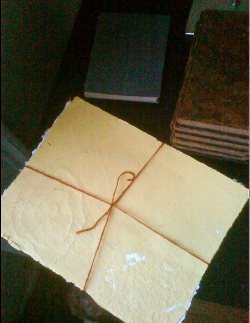
We next visited Dieu Donné Papermill in midtown Manhattan, where I produced several (very experimental) sheets of handmade paper. Dieu Donné is a workspace for artists, art therapists, and their clients, as well as members of the public interested in learning paper-making techniques. Here, paper-makers create their artworks by processing linen, cotton (including old blue jeans and medical gowns), hemp, wood pulp, abaca (used to make tea bags), or other natural fibers, in a watery solution; the cellulose within the fibrous mixture allows the sheet of paper to fuse together when the pulp is laid on a screen and the water drained or pressed away. I was very interested to learn that the artistic technique we were using—creating sheets of paper individually on screens—was still the dominant commercial way of making paper from cotton and rag fibers during the early Romantic period; the first continuous paper-making machine was invented in France in 1799 and introduced to England in 1803 and the United States in 1817, replacing the earlier practice of making sheets by hand. Now to determine whether my Works of Lord Byron is printed on handmade sheets…
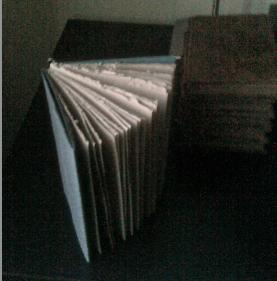
My latest foray into the material practices of book-making was a bookbinding session: the artist and bookbinder Susan Mills visited the Columbia Library and instructed us in the practices of sewing together the bindings of books. To me, this was an especially remarkable experience, since I was quickly and easily able to produce my own 96-page chapbook using extremely simple tools—in addition to sheets of paper, I needed only a paper-knife, an awl, a needle and thread, and a scrap of linen. During the Romantic period, book-binding would have been done by hand, by (usually) anonymous craftspeople, whose contributions are often only recorded in tiny holes in the pages near the book’s spine (where tiny drops of blood, from pricked fingers, decayed the paper more quickly). And readers would normally have cut the pages by hand; I note, with admiration for an anonymous previous reader, that my Byron‘s pages are cut perfectly cleanly. (Later addendum: they were probably “guillotined” by the printer.)

Hand-bound Chapbook
Hand-bound Chapbook

As I return to the question about the value of the “analog” humanities—that is, a deliberate return to the material technologies used in the production of literary texts—I think that experiencing the physical processes of making books, as I have been so lucky to do, can offer a unique and valuable pedagogy for the contemporary Romanticist. Having seen printing presses, paper-making, and book-binding in action, I have such an affective appreciation for the meticulous craftsmanship of my little 1816 Works of Lord Byron. The volumes’ ink is still vivid, the pages don’t crumble, and the tightly sewn bindings remain unbroken. The many type settings, ranging from the bold Gothic lettering of the title of Childe Harold’s Pilgrimage to the tiny typefaces, italicized passages, and Greek fonts in the glosses, testify to a material investment in the text that extends beyond the poet. From my “analog” adventures, I’ve learned that such small details as printing errors—like the notorious misprint in Austen’s Persuasion that “Lady Russell loved the mall”—are not just criteria for editorial footnotes; they are also reminders of the book-making process and the unseen but tremendous effort of Romantic-era craftspeople to support, in material fashion, what they saw as literary inspiration worth recording.

(All photos—and the textual materials depicted therein—belong to Arden Hegele)

Registration Open For Emerging Connections Graduate Event, June 12, 2014

Registration is now open for the Romantic Connections conference in Tokyo, and for the accompanying graduate workshop, Emerging Connections. If you are a graduate student at any level of study who will be attending the conference, please consider registering for this event: it will be a great way to connect with fellow grads prior to the start of the conference. The list of speakers will be available soon! The planned schedule of events for the day can be found at the conference website.

Running the Comprehensive Exams Gauntlet: A Hopeful How-To

I have spent the last nine months thinking about my Ph.D. comprehensive examinations, and, as of tomorrow, I am nine weeks away from THE day.  Yikes!  And since in my current stage of borderline freak out I can think of nothing else, I have decided to write a very practical how-to/how-not-to guide for comprehensive exam preparation.  Please learn from my colleagues’ and my experience and mistakes.  And PLEASE add your own suggestions in the comments below.  We grad students need each other’s support. I still have nine weeks, oh wise ones.  I welcome your advice and in return I give you mine.

A Young Girl Reading, or The Reader (French: La Liseuse)
A Young Girl Reading, or The Reader (French: La Liseuse), an 18th-century oil painting by Jean-Honoré Fragonard.

To begin, let me describe the two comprehensive exam models I know from my Masters and Ph.D. universities.  Both universities position these exams as the transition between coursework and the dissertation.  At each university, students are tested over a group of lists specific to their areas of study, including primary texts of all genres and critical texts.  At my Masters university the exams were written.  Students prepared for the exams for an average of one and a half to two semesters.  The exam itself required students to write three 20+ page papers in response to the questions written by their committee (I believe the students have 4-5 questions from which they choose three).  You had 48 hours in which to complete the essays.  This style requires very organized and diligent note-taking, and communication with your committee members about types of questions to expect.  From here, you can begin drafting potential arguments to use during the exam days.
At my current university, the exams are oral. Three hours in a conference room at the mercy of five committee members. I’m reassured by my committee that the three hour exam is not so foreboding, but for dramatic effect and to garner your sympathy, I present it as an academic gauntlet. Four committee members are (roughly) in your area of study, and one committee member is recruited from a different department to ensure fair treatment and assessment of the tester. See? A gauntlet.
Students are to master three lists of texts (each of which is approximately three syllabi-worth of material) that cover our time period, an adjacent time period, and a list of our choosing (often a dissertation list, an author list, a genre list, or a theory list).  We are given three semesters in which to do this, but most students take only two.  My lists cover the long nineteenth-century with a decided focus on poetry and critical prose (though I do include novels as well).  I have a Romanticism list, a Victorian list, and a dissertation list, titled “Keats and the Cockney School.”  These lists are self-created with the help of your committee.  They must be approved, and you must provide rationales for them in the form of a 25 page document.
I did not get off to the best start in my studies. (Shhh! Don’t tell my committee!).  But after consulting with friends who had run the gauntlet and lived to tell about it, I developed a reading schedule, a realistic outlook on the process, and even an appreciation for this phase in my academic career.
So here’s a taste of what I have learned over the last few months:
Continue reading “Running the Comprehensive Exams Gauntlet: A Hopeful How-To”

Why You Should Always Submit Proposals: My Surprising Experience at my First Conference

Meadowbrook Hall, Oakland University by Wm. Chris Rowland, II

As a second year graduate student this past fall, I found myself headed to the International Conference of Romanticism at Oakland University with few goals other than to make it through my panel without throwing up, and to not look like an idiot in front of my peers. The fact that I was even in the conference was a surprise, after all I had only submitted my paper proposal just inside the deadline that summer at the encouragement of my fellow Romanticists at Arizona State. “I don’t know if I’m even ready to submit to a conference like this,” I wrote in an email responding to their reminder of the upcoming deadline. I might not have been, but with the encouragement of Kent and Kaitlin I submitted anyway, and not soon after the first surprise came—I had been accepted. Thankfully the two of them had been as well, so I figured I would have at least two people at my panel in September. As the date of the conference approached, we made the group decision to not attend the official banquet largely due to financial concerns, and believing that none of us had a chance at winning the competitive Lore Metzger Prize, which went to the best essay read by a graduate student at the conference.
Well reader, I won that prize. Instead of learning this news at the banquet where I could have stood up and been recognized for my paper “The Undead Presence: Exploring Boundaries of Life, Death and Sex in ‘Christabel,’ ‘The Skeleton Priest,’ and ‘The Aerial Chorus’” by my fellow Romantic scholars, I found out via text message from Jacob while I was at an Irish pub down the street. I was lucky enough to have Kaitlin and Kent by my side at that moment to congratulate me, but the initial shock of that moment has yet to wear off. I am so honored to have won such a prestigious award not only because I was a second-year graduate student and that it was my first Romantic conference and first out of state conference, but because I wrote about something I am truly passionate about. Talking about the importance of walking, talking corpses in Romantic literature seems risky, but it paid off.
“So halfway from her bed she rose, And on her elbow did recline to look at the Lady Geraldine.”

The lessons I learned from this experience are significant, and I believe, important to share. First, if you are lucky enough to find a community in your university that encourages and supports you, listen to them. They might know of potential you do not see in yourself. I would not have even tried to be at ICR if it wasn’t for the kind (but firm!) push from Kent and Kaitlin to submit a proposal, and I would not have won the award for best graduate paper without the edits and suggestions given to me by the ASU 19th Century Colloquium. Peer review is good, honest peer review with your best intentions in mind is fantastic—and absolutely integral to succeeding in the academic field. Secondly, always submit a proposal. Even if you think there is no chance in hell that you will be accepted to present at that conference, or be asked to write a chapter for that book, do it anyway. Not only is it excellent practice, but it will also force you to be more confident in your ideas and get your name out there. When you get accepted (because you undoubtedly will with all those submissions), have your work critiqued by people you trust and respect. They will tell you the truth, strengthen your argument, and you will be better for it. And finally, write about what you love. Zombies and vampires and all the variations inside and outside of those categories might be a laughable topic at first, but I truly believe that if I had gone to ICR with anything else than that, anything other than something I am passionate about to the point of insanity, I would not have won the Lore Metzger Prize. So take those risks, submit those proposals—the outcome could surprise you.
Oh, and always fork over the money and go to the banquet.
Emily Zarka