Last night I had the pleasure of attending a lecture by Dr. Catherine Belling (associate professor at Northwestern University’s Feinberg School of Medicine), an event launching the “Imagining Health Project” series by the IHR Medical Humanities Initiative at ASU. This series is meant to integrate art and the humanities with medicine driven by the philosophy “health is a basic human need” that encapsulates a variety of physical and mental components.
Belling’s talk, entitled “Imagining Disease–Horror and Health in Medicine,” was hosted by the Mayo Clinic in Scottsdale. While I have personally been to lectures taking place in art museums, cafes, and libraries, attending a humanities-driven event at a working medical treatment and research facility was definitely a novelty. Tackling the themes of uncertainty and fear at the center of medical care, Belling’s lecture focused on what she termed “a poetics of medicine” in which the humanities offers ways to approach healthcare in all of its facets. She named three terms implicit in this discussion: imagining (or imagination), disease, and horror. I found her definitions and conclusions regarding imagining and horror to be the most compelling, and I will briefly summarize her key points below while also noting my own reactions to the material, posing questions I still need answered (perhaps you dear reader, can help!). Continue reading “"Horror in Medicine" – a Response”
Fellow-Feeling, Cognitive Science, and Keats
I’ve lately been dabbling in cognitive cultural studies in efforts to understand the physiological registry of emotions and how the second generation Romantics theorized the phenomenon as embodied or immersive reading. I thought for this post, I would give a little background on how I got to this area of study and why scholars have linked it to eighteenth and nineteenth century British thinkers and Romantic poets, in particular. I limit this post to Gabrielle Starr’s work, as her book Feeling Beauty focuses on the cognitive processes involved in aesthetic experience, and I am particularly interested in the aesthetic experience of reading poetry. Continue reading “Fellow-Feeling, Cognitive Science, and Keats”
Poem: Winter Song
I’ve been thinking about the concept of wildness in the context of winter, and the idea of delirium seemed worth exploring to me. I had the skating episode of Wordsworth’s Prelude (Book I ll. 452-489) in mind, and especially the passage that begins with the wonderful line, “When we had given our bodies to the wind” (479).
Winter Song
Now, in the delirium of winter
I eat my breath
Warm and dribbling down thick scarves
And sip at wind
So thick it lies water-heavy in my mouth.
Meanwhile my vision, distracted,
Has lost the boundaries of sun, ice, snow,
All of them covered in wind
That drags them into each other.
But behind the wind
The cold slips in
Soft like snow,
Clearing out the heat
In brain and body.
The world is perfected –
Snowbanks sheared to stiff edges,
The blue lines of their shadows neat beside them,
The sunrise growing on trees,
The air;
And as the wind breaks on my cheekbones
I am sharpened to a blade
Against ice.
The Poet and the Vampyre: Caught in the "Byron Vortex"

I know the beginning of the semester (or really any time during the semester) is not the best time for a book recommendation. But, I think you’ll forgive me because this is a fun one and packed with your favorite “literary characters.” Andrew McConnell Stott’s The Poet and the Vampyre was released late in 2014 and is a biographical amble through the events great and small surrounding the fateful weekend in Diodati that produced the monsters we have come to love. Yet, it also self-consciously dances around that stormy night—one that we can all agree fascinates scholars but has been written about to (un)death—in favor of an in-depth look at the relationships amongst these young poets and poetesses that brought them together and split them apart, primarily focused on Byron’s influence (and curse) upon his young doctor, John Polidori. For years, I have been an apologist for Polidori and his novella, The Vampyre, both of which often get shoved to the side for being important but not necessary or enjoyable. Here is finally an attempt to bring Polidori to life, not just as the spiteful tag-along of more successful poets but as the sympathetic victim of other people’s celebrity. Continue reading “The Poet and the Vampyre: Caught in the "Byron Vortex"”
The Dream of Art in Batman
“Thou art a dreaming thing, / A fever of thyself” – Keats
https://www.youtube.com/watch?v=sQn-vulThcY
Jack Nicholson’s the Joker is the Romantic Visionary artist in extreme. His version of the apocalypse emerges from his diabolical imagination and his scheme to poison Gotham’s commercialized vanity. This is, to recall a quote I used in a previous post, the Romantic Vision on steroids: Continue reading “The Dream of Art in Batman”
The Year Without Summer; or, What Happened in 1816?
By Talia Vestri
With the rapid pace of today’s technologies, the news of any event happening anywhere in the world seems to travel at almost light speed to everywhere else. Whether through Twitter, Instagram, Facebook, or online journalism, the news of a missing jetliner in Southeast Asia or an earthquake in Japan can become common knowledge on the other side of the world almost instantaneously (unless, apparently, the event happens in Africa, but that’s an entirely different topic). Imagine, then, living in an era when the impact of a natural occurrence like a tsunami or hurricane would never be heard about for those who did not experience the phenomenon first hand—a time when news didn’t just travel more slowly, but sometimes didn’t travel at all. Continue reading “The Year Without Summer; or, What Happened in 1816?”
One Thought Fills Immensity
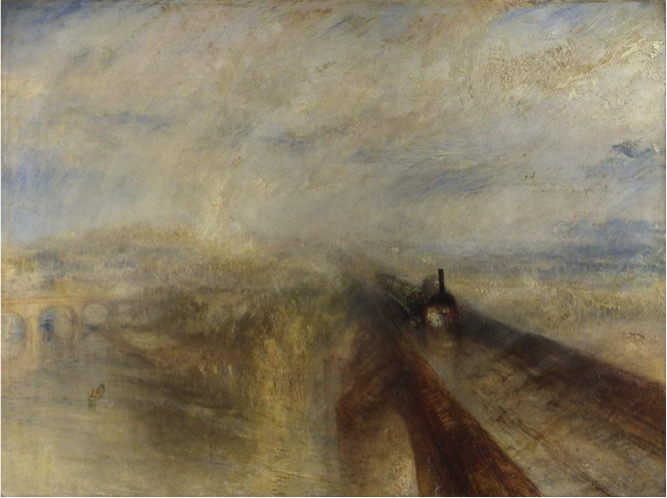
This experimental post responds to the question I’ve been posing for myself for some time: what should I post when preparing for my exams, and have little time for words in the form of a blog? My answer came by way of an assignment I set for myself as part of my contemporary art and ecology exam reading list. Watching the “Ecology” episode of Art21, I was struck by the sculptor Ursula von Rydingsvard’s recalling of a time in her life when words were at a premium. In response, she spoke of continuing to “drink of the world by visual means.” And so, in this post, I wish to simply leave you all with a series of objects that have moved me to thought in various ways while studying for my nineteenth-century and contemporary art exams. I welcome comments on what responses to the images readers of the blog might have. Continue reading “One Thought Fills Immensity”
Objective Reading
Reading is not one thing but many. Most of all, reading is not passive. “In reality,” writes Michel de Certeau in the opening of The Practice of Everyday Life, “the activity of reading has on the contrary all the characteristics of a silent production.” But what are we producing? And what does the scholarly practice of reading do to this production?
As graduate students we often expect ourselves somehow to swallow texts whole—to get them. We try mightily to read texts simultaneously in terms of their own coherence, elisions, and indeterminacies as textual systems, of their unconscious procedural expression of determinant historical conditions of possibility, of their own stated and unstated relations to their intellectual precursors, and in the light of their reception by scholars or later links in the canonical chain; we strive to keep in mind texts’ political ramifications, how their formal-generic elements engage with other morphologically-related texts, and their relative sympathy or antipathy to various major philosophical concerns or strands of ideological critique; we read texts to find out whether we can instrumentalize our readings for the purposes of conference papers, dissertation chapters, or course syllabi—and maybe to determine whether we like them. More often than not, while reading I am also planning on passing along certain passages to colleagues or photocopying them for friends outside of the academy; wondering whether I could get a pirated PDF instead of waiting the several days for Interlibrary Loan or maybe shelling out the cash for a nice sixties paperback copy of my own, speculating about the biography of the author or the business-end realities of the academic press in question, and so on. Continue reading “Objective Reading”
Graphic Learning: Examples of Well-Researched Comics
It seems pointless to argue that graphic novels have an important place in literature at this point. Personally, I took two classes during my undergraduate career that incorporated such texts (including Satrapi’s Persepolis and Bechdel’s Fun Home), but more often than not this is a rare occurrence and something I did not encounter in my graduate coursework. Graphic novels often do not get the attention they deserve, in part because many deem them déclassé due to their graphic nature and/or subject material, but also because they are hard to teach. While graphic novels can be analyzed through literary theory (and should be), the format itself, and most notably, the visual element of such narratives, are in a scholarly discipline all their own. One cannot teach, or even fully enjoy a graphic novel, without at least a bare minimum knowledge of art theory and visual composition. (Understanding Comics: The Invisible Art and Critical Approaches to Comics: Theories and Methods are good places to start.) But then again, neither of these things occupies some alien universe detached from what we as literary scholars already tackle. Continue reading “Graphic Learning: Examples of Well-Researched Comics”
Planning My First Brit Lit Survey
At my university, the opportunities to teach an upper-level course are present but few. After passing comprehensive exams, you can apply to teach a survey course corresponding to your area of specialty. The second-half of British literature is particularly hard to come by, and typically a PhD candidate gets to teach it once before graduating. This is my semester, and I am thrilled!
I have been teaching general education classes for six years. I can count the number of English majors I have taught on one hand. But now, I have two full classes of English majors or minors, who ask me questions like, “Percy Shelley? Any relation to Mary Shelley?” (Isn’t it crazy to remember a time when we didn’t know every intimate detail of the Shelleys’ marriage?).
I am two days in. And here’s what I can report so far: I love my job.
Continue reading “Planning My First Brit Lit Survey”