
One of the great advantages we have as scholars is the opportunity to form communities beyond our institutions — not just at annual conferences in remote locales, but also in ongoing conversations on the web. These online communities are fora for scholarly dialogue and informal queries, requests for crowdfunding special projects and historical sites, and repositories of archival material. Here’s a brief roundup of selected sites, listservs, and communities available to Romanticists (and if you know of more, please get in touch!).
Academic listservs:
(1) NASSR List — the list of the North American Society for the Study of Romanticism (subscription required). The list is frequented by many major scholars in the field, but also graduate students and junior faculty; this is a particularly excellent resource for answers to obscure and arcane historical questions, and for links to major awards and opportunities in the field. Continue reading “Romantic Web Communities”
NASSR 2015 Program & Pedagogy Contest
I’m delighted to announce that NASSR 2015 has released a program! Highlights of the August 13-16 conference in Winnipeg will include: tours of the archives of the Hudson’s Bay Company (the world’s oldest continuously-operating corporation) and the Canadian Museum for Human Rights; plenaries by Joel Faflak (Western) and Nancy Yousef (CUNY-Baruch); and an Aboriginal Rights Roundtable. Also of note — in addition to participating in many panels, the members of the NASSR Graduate Student Caucus will be hosting a professionalization panel and a pub night.
I also have an update about the NASSR Pedagogy Contest, sponsored by the NASSR Advisory Board, the NASSR 2015 Organizing Committee, and Romantic Circles. Please send in your syllabuses by June 5th to be considered for the Pedagogy award (which comes with a cash prize of $250). Here are the instructions:
TO SUBMIT:
Please send a document of between 3-5 pages to nassrpedagogycontest@gmail.com by June 5th. Please include a cover letter with identifying information, which should be left off all other documents. Initial queries and questions are welcomed.
Potential materials might include but are not limited to:
– A cover letter and explanation of the submission, including an argument as to the course or project’s pedagogical innovation and benefits
– Syllabus or parts of a syllabus
– Assignment sheets
– Multimedia or digital materials
Will the Real Mr. Darcy Please Stand Up?
By Talia Vestri
Jane Austen was in the news again last week—I know this, because when I log onto Google News, it offers tailored entries based on my previous web searches and sticks them right at the top of the feed. I honestly don’t know whether to be delighted or terribly disturbed by this fact. But artificial intelligence issues aside, I found this most recent bout of Austenmania to be quite a curious one.
It’s not a rare occasion these days that Miss Jane appears in the news, especially during this decade that celebrates “200 years since…” each of her famous tomes, published during the 1810s. Austen’s popularity endures: in 2013, Britain announced it will finally commemorate her in currency (Austen will appear on the 10-pound note, beginning in 2017) and last month she even got a musical in Chicago.
The most recent news cycle that got my attention (to be fair, it was hardly a sidebar item) highlights a new book that claims to make a striking and long sought-after discovery: the “true” identity of the real-life Mr. Fitzwilliam Darcy—and (sadly) it’s not Colin Firth. Continue reading “Will the Real Mr. Darcy Please Stand Up?”
Guest Post: Reading, or Ardor
By Andrew Welch
Rereading Keats’s Poems of 1817, I’m struck by how many pieces belong to the noble & distinguished tradition of poetry that frets about its own inadequacy. Keats begins “To My Brother George” in accordance:
Full many a dreary hour have I past,
My brain bewilder’d, and my mind o’ercast
With heaviness
What’s wrong, dear Keats?
I’ve thought
[…]
That I should never hear Apollo’s song
[…]
That still the murmur of the honey bee
Would never teach a rural song to me:
That the bright glance from beauty’s eyelids slanting
Would never make a lay of mine enchanting,
Or warm my breast with ardour to unfold
Some tale of love and arms in time of old.
Continue reading “Guest Post: Reading, or Ardor”
The Visionary Power of M.H. Abrams
I happened to be revisiting The Prelude this morning in preparation for a class when I came home to learn of the passing of M.H. Abrams. At the bottom of the obituary that I read, The Ithaca Voice pulled together memories of Abrams that were posted for his 100th birthday celebration a few years back. E.D. Hirsch wrote this:
“Here are 3 Abrams-isms lodged in my memory after many decades.
After a wayward 2 years at Cornell, including some disagreements with my sophomore English professor, I came to see you (around 1947/8) about an honors program you were starting. After a few minutes of chat, I confessed that I had just made a C in sophomore English. You said “You’re in. It takes a lot of talent to make a C in that course.”
My favorite scholarly Abrams-ism: good criticism requires “a keen eye for the obvious.”
My favorite airport-waiting-room Abrams-ism: I ask you: Have you read “A Sea of Thighs?” You replied without a pause: “No, I haven’t seen hide nor hair of that one.”
Bring Out Yer Dead: Why Edinburgh's "Public" Dissections are Important

Last month, word began to spread that Edinburgh University will be offering anatomy lessons. This does not sound all that unusual: it’s one of the oldest and most prestigious medical schools in the world, of course the study of anatomy should be at the forefront of the curriculum. What makes this exciting, however, is that the university is offering anatomy lessons using real cadavers, and the lessons will be open to the public. The first mention I saw of this boasted that this is the “First public anatomy lectures planned in the UK since Burke and Hare,” referring to the infamous 1828 case in which William Burke and William Hare delivered over a dozen bodies through the back door of Dr. Robert Knox’s dissection theater for use in teaching anatomy, bodies that were killed for that very purpose (and for the meager sum it paid). Continue reading “Bring Out Yer Dead: Why Edinburgh's "Public" Dissections are Important”
Guest Post: Ways for English Graduate Students to Scare Landlords with Terrible Fridge Magnet Poetry
By Katherine Magyarody-Sigal
A few days ago, I climbed the stairs to my apartment and encountered my landpeople, who let me know that they had been in to check on some electrical wiring. They are extremely nice and shy about coming into our space. Anyways, I made it up the final flight of stairs and dumped my bookbag onto the kitchen table. And I looked over. And I froze. And I hoped that in their journey across the apartment, they did not look at the kitchen table and did not see the cookie sheet there, on which I had composed the worst fridge-magnet poetry ever. Poetry…not even poetry…words that makes me seem delusional, lovelorn, possibly homicidal. It begins:
if nevermore
I mourn that kiss
my silent scream
will make him howl Continue reading “Guest Post: Ways for English Graduate Students to Scare Landlords with Terrible Fridge Magnet Poetry”
Proposing a Special Session for MLA
By Talia Vestri
Last week, I submitted a panel proposal for the next MLA convention in January 2016. (alternative title for this post: What was I thinking?!?)
I was motivated, in part, by an important realization about my own position on the academic career ladder:
There comes a time in every young scholar’s life when she must realize that she is no longer part of the junior graduate cohort. Suddenly there are an uncountable number of faces that you don’t recognize around the department, and conversations being held about seminars you didn’t even know were being offered. This signals only one thing: you’re now horrifyingly closer in position to that new assistant professor who just got hired than you are to the first-year doctoral students. You are more scholar than student, more faculty than freshman. (When did this happen, exactly?!)
Poem: When I consider the mind
Since beginning to write for this blog, I’ve been thinking back to a paper I once wrote on Keats’ “Ode to Psyche.” The poem is fascinating to me because of the way it describes the poet’s mind as a sort of bower in which Psyche may live. I’ve written a poem in response to this image, although I’m not so much interested in the poem itself (it’s not exactly Keats!) as in how it has allowed me to think more about the mind as a growing thing.
Continue reading “Poem: When I consider the mind”
Blake in Song: Interview with Composer Ben Scheer
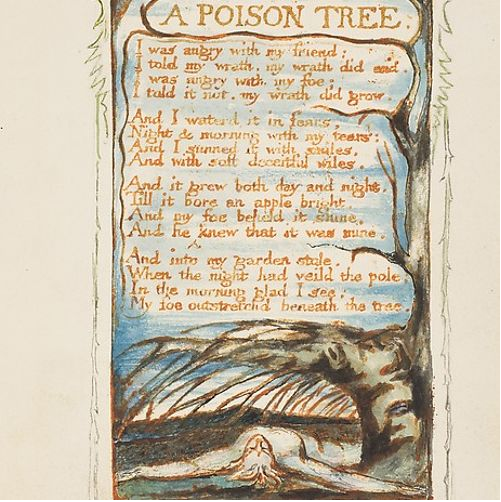
In this post, I have the very great pleasure of interviewing the contemporary composer Ben Scheer about his new artistic production. Ben, who studies composition and violin at the Eastman School of Music, has just written and released a new work for voice and piano based on William Blake’s poem “A Poison Tree,” from the Songs of Experience (1794). A recording of the piece, which features the soprano Rebecca Herlich and the pianist Forrest Moody, is available on Soundcloud here. Ben answers my questions about his contemporary setting of Blake’s poem after the jump.
 Continue reading “Blake in Song: Interview with Composer Ben Scheer”