On a recent visit to the Chazen Art Museum located on the University of Wisconsin-Madison campus I stumbled across a literal cabinet of curiosities. Sculptor Martha Glowacki’s mixed media sculpture titled “My Arcadia”, composed in 2000 [pictured below] is an eerie dark wood Victorian inspired cabinet of fifteen drawers and opening at the top that holds three plants preserved in smoky graphite. Viewers are welcomed to open each drawer, and when they do they might react on a scale of disgust to delight in seconds. Continue reading ““My Arcadia” and Romantic Creation in America’s Midwest”
Pride and Prejudice and Zombies roundtable
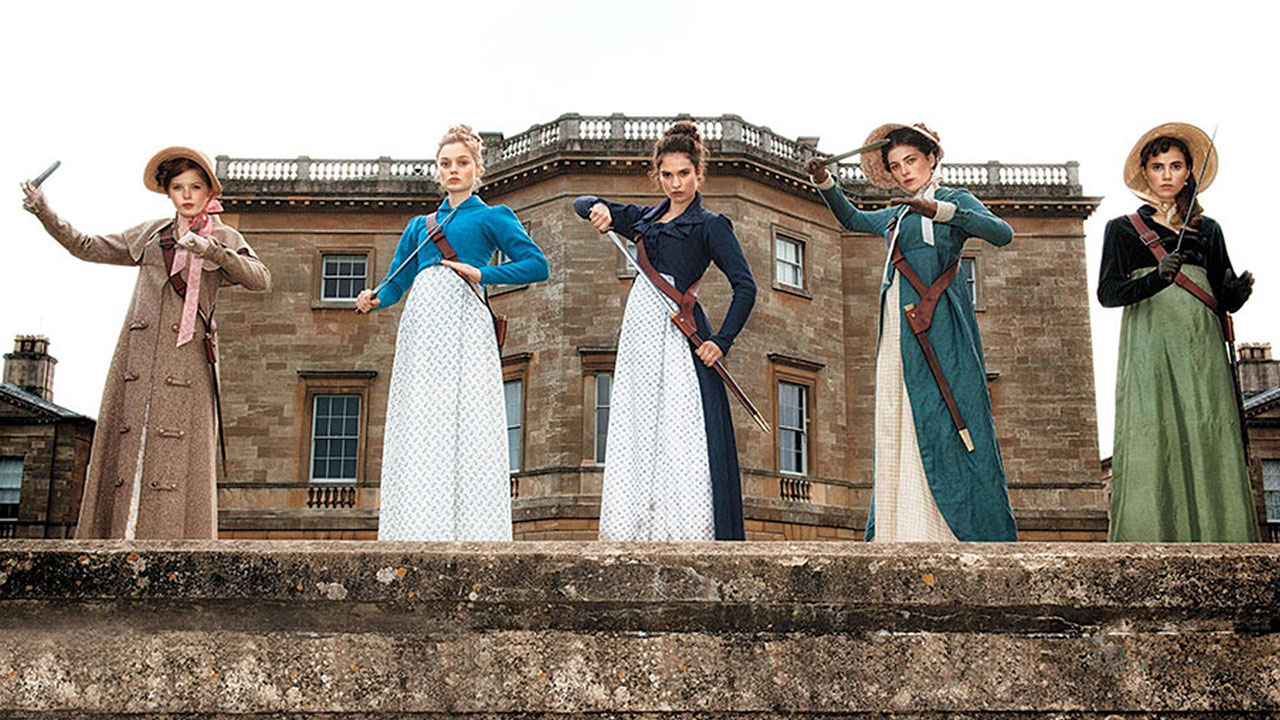
Are we at peak Jane Austen? Have Austen adaptations jumped the shark? What did Jane Austen know about corpse-lovers? Catherine Engh, Cailey Hall, and Caroline Winter discuss the recent film version of the Austen mashup Pride and Prejudice and Zombies.
Continue reading “Pride and Prejudice and Zombies roundtable”
From Perish to Publish: Writing with Papers and Scrivener
By Caroline Winter
I recently started writing my dissertation. Although it’s an exciting stage of my program, when I think of the daunting task ahead of me, I often think of Cowper’s “The Castaway.” We scholars are castaways ourselves, “wretches” writing and struggling alone, drowning in piles of papers and stacks of books.
One of the most daunting challenges so far has been figuring out the logistics of how to organize–and actually write–a research project of this scale. Since I imagine many of us are facing similar challenges organizing research and writing tasks, I’m outlining some strategies that I’ve found helpful so far.
Continue reading “From Perish to Publish: Writing with Papers and Scrivener”
Hacking Non-Romanticism Teaching Assignments
It’s almost March. The time of year (at least in my department) that we get our teaching assignments for the fall semester. Many of us greatly look forward to this, especially if it’s our first time teaching our own courses: there’s something intoxicating about finally getting to design your own class. The possibilities are endless.
Until you read the course description of the class you’ve been assigned.
Continue reading “Hacking Non-Romanticism Teaching Assignments”
David Hume in the Slough of Despond: Design from Theology to Aesthetics in Virginia Woolf's To the Lighthouse
After the children have gone to sleep, Mrs. Ramsay is relieved to find herself alone: “This self having shed its attachments was free for the strangest adventures.” Our outward appearances and expressions, “the things you know us by,” she intuits, cover over a “limitless,” “unfathomably deep” darkness (69). As she looks out the window, she feels herself extend out to meet the turning “stroke of the Lighthouse” as it shoots its beam of light across the water. She finds herself “losing personality” in that bright beam, “sitting and looking, sitting and looking… until she became the thing she looked at” (70). In this epiphanic state she suddenly mutters: “We are in the hands of the Lord.” This bit of maudlin theodicy intrudes upon her secular revelation, annoying her. She does not know where these words came from—this “insincerity slipping in among the truths.” Turning upon the problem, she asks, “How could any Lord have made this world?”
With her mind she had always seized the fact that there is no reason, order justice: but suffering, death, the poor. There was no treachery too base for the world to commit; she knew that. No happiness lasted; she knew that. (71)
At this moment Mr. Ramsay passes by, “chuckling at the thought that Hume, the philosopher, grown enormously fat,” had once, while walking through Nor Loch, found himself stuck in a bog. Juxtaposed on either side of a period, their thoughts seem incongruous. And yet it was Mr. Ramsay’s Hume who had carried Mrs. Ramsay’s intuition to its logical conclusion, dismantling attempts to derive a benevolent God from the observation of nature. The Ramsays are thinking two ends of the same thought.
Continue reading “David Hume in the Slough of Despond: Design from Theology to Aesthetics in Virginia Woolf's To the Lighthouse”
Ozy Ozy Everywhere, & Not a Man to Marvel

Every chance I get, I read Ozymandias. I should clarify, though, because that makes it sound like all I do is read the same poem over and over again (in the shower, in lines at Burger King, or mowing the lawn)—that’s just not the case at all. Fall Out 4 recently came out, and my lovely-lady-scientist wife bought it for me as an birthday present. In between the soul-crushing bouts of non-stop homework, I play it endlessly. That is, of course when I’m not busy reading graphic novels for a book club I participate in every two weeks, and when I’m not playing with my puppy Huckleberry, or talking to  friends over a weekly meeting I call “Coffee with Jammer” (I’m currently in talks with PBS about making it into a series) or when…you know, perhaps it’s better to be honest, and say whenever I stumble upon the poem, I take the time to read it. Continue reading “Ozy Ozy Everywhere, & Not a Man to Marvel”
Fangirl(s): Lord Byron edition
By Cailey Hall
I’ll seize any chance I can get to talk about Lord Byron’s fan letters – and with the somewhat flimsy excuse of the 224th anniversary of the publication of Cantos I &II of Childe Harold’s Pilgrimage just around the corner (March 20, to be exact), now seems like a perfect time. Lord Byron received fan letters? Of course he did!
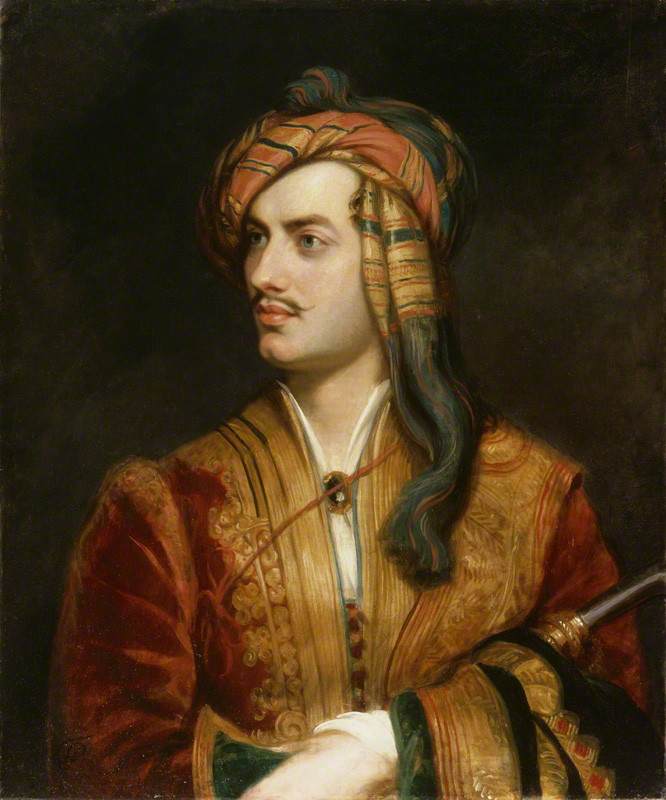 (1813 portrait of Byron in Albanian dress, by John Phillips)
Affect Theory Reading Log
This winter, I’ve been working to familiarize myself with the affective turn in Romantic studies. But the reading experience has been generally defamiliarizing; ideas about affects, emotions, feelings and passions are consistent, it seems, only in their inconsistency. In their introduction to Romanticism and the Emotions, Faflak and Sha usefully suggest that the difficulties that Romantic scholars encounter trying to theorize affect stem from the nature of the project, which is “to categorize what by definition at once sustains and eludes both thought and language.” The common ground that unites those that I’ve read on the topic is not so much a shared theory as a a shared belief that we can learn something about our contemporary interest in affect as a scientific object (neuroscience) and as a subject for the humanities by looking back to emotion’s (uneven and multilayered) emergence as a category of experience in the Enlightenment and Romantic periods.
In the place of a single book review, I’ll provide here a brief and by no means comprehensive survey of a few books on the topic that I’ve been spending some time with lately. The readings here ask unresolvable, but pressing, questions about the relation between feeling and knowing, bodies and texts, affect and agency, aesthetics and socio-political forces. The list is completely idiosyncratic: Thomas Pfau’s Romantic Moods is influential, but I haven’t read it and Romanticism and the Emotions from Cambridge UP is fresh and excellent but, as a collection of essays, is too daunting to summarize. I’d love to know what other people are reading on the topic—please feel free to add your recs in the comments section!
- Pinch, Adela. Strange Fits of Passion: Epistemologies of Emotion, Hume to Austen. Stanford, Calif: Stanford University Press, 1997.

Strange Fits of Passion asks what writings by Hume, William Wordsworth, Charlotte Smith, Ann Radcliffe and Jane Austen can teach us about the relationship between knowing and feeling. Recurring questions include: Where do emotions come from and how do they travel? Can we judge whether feelings are fit to their occasions? Are feelings our own (personal) or are they transpersonal (conventional)? The last question is the most central to the study; Pinch everywhere challenges the notion that emotions come from some irreducible core of the self. She does this by emphasizing the “vagrancy,” (10) or trans-individual status of emotions in Romantic literature. What interests me most about Pinch’s book is her idea that that language, and especially imaginative language and utterance, plays a key role in bridging the gap between affect (materiality, physiology) and emotion (psychology). In poems by Wordsworth and Smith, poetic figures are simultaneously produced by passion and productive of emotions that circulate as conventions.
Reading Hume, who did not theorize language, Pinch seeks to recover the role that representation plays in shaping sympathy. In Hume, “force” designates the mysterious motion of the mind that translates ideas into impressions (and vise-versa) and is thus crucial to “sympathy.” “Force” is an unsatisfying concept in Hume if only because it fails to explain how and why some ideas impress us more forcibly than others. Contrasting Hume’s representation of imaginary men of misfortune with his famous representation of his own despair at the end of Book I of the Treatise, Pinch suggests that sympathy may be most forceful where we attribute imaginary feelings onto indifferent objects. Readers have long found it difficult to sympathize with Hume’s melancholic outpourings and this may be because he represents them as his own, rather than as ours to imagine.
In attending to the conventional and virtual aspects of feeling, Pinch sidelines the common charge against the Romantics (especially central to eco-critical conversations) of egoism and anthropocentrism. Pinch’s open displacement of this issue sets her apart from the other books listed here, which are more explicitly concerned with the ethical and political stakes of formulations of ‘sympathy’ that emerged in the Enlightenment and Romantic periods. Strange Fits of Passion positively stands out, however, in its analysis of the ways that gender differences get entangled in writers’ rendering of emotion. I especially enjoyed reading Pinch’s on Wordsworth’s “Goody Blake and Harry Gill.” For Pinch, the poem identifies the “spontaneous overflow of powerful feelings” with an old woman’s passionate utterance. More surprisingly, it likens Harry’s violence towards Goody to the male poet’s desire to empathize with an experience of feminine suffering that will authenticate his verse. There’s a great anecdote here in which Joseph Cottle reads the Lyrical Ballads aloud to Hannah Moore. On the second reading of “Goody Blake,” Hannah Moore lifts up her hands, “in smiling horror” on hearing the curse “O, may he never more be warm!” Pinch writes, “Moore perhaps recognizes through her own playacting the power of a woman’s curse to engender poetic pleasure” (97).
-
Yousef, Nancy. Romantic Intimacy. Stanford, Calif.: Stanford University Press, 2013.
 Romantic Intimacy asks how the epistemic problem of other minds informs accounts of intimacy in writings that range from eighteenth century moral philosophy to contemporary recommendations for psychoanalytic practice. Yousef moves lucidly between moral philosophy, poetry, novels and contemporary theory as she carefully draws out the ethical implications of relational experience in Romantic texts. A central thesis is that writers like Wordsworth, Austen and Coleridge are skeptical of sentimental philosophy’s confident appeals to the authority of shared feelings yet untethered to notions of (re)cognition (in Kant and Levinas) that emphasize equality and reciprocity between persons. Yousef’s book encourages us to see in Romantic literature diverse accounts of relational experience that expand beyond the paradigms of Humean sympathy and Kantian respect.
Yousef shares with Adela Pinch an unprepossessing interest in the formal and aesthetic qualities of the texts she explores. But where Pinch tends to reify a dichotomy between private and shared emotion, Yousef is drawn to poems like “Frost at Midnight” that challenge that divide. In Coleridge’s poem, little Hartley’s breath—his passive and unimposing presence—provides the relational background that sustains Coleridge’s intimate lyrical outpouring of memories, fantasies and hopes. Yousef provides startling analogies between the “generative silence” Coleridge’s infant son provides in “Frost at Midnight” and contemporary experiments with silence in psychoanalytic practice and performance art.
An interest in affective asymmetries coheres the excellent chapters in Romantic Intimacy on Wordsworth, Austen and Coleridge. If “Frost at Midnight” configures a relational situation where one person is completely silent so that another can speak, Pride and Prejudice represents the erotic possibilities of a relation where one person is endowed with gift giving power so that another can learn to receive. Yousef points out that Elizabeth Bennet’s engagement with Darcy is read at turns as a capitulation to power and as an aspirational (Kantian) assertion of equality between rational beings. Attention to the role of gratitude in Elizabeth’s bilding offers a way out of this impasse. For Yousef, Elizabeth’s entanglement with Darcy demonstrates the transformative force of a self-abasing moral feeling that constitutes the subject “as an implication of appreciation for an other” (112). Pride and Prejudice thus represents the subject as the effect of gratitude, rather than the other way around.
3. Anonymous Life: Romanticism and Dispossession. Stanford, Calif: Stanford University Press, 2008.
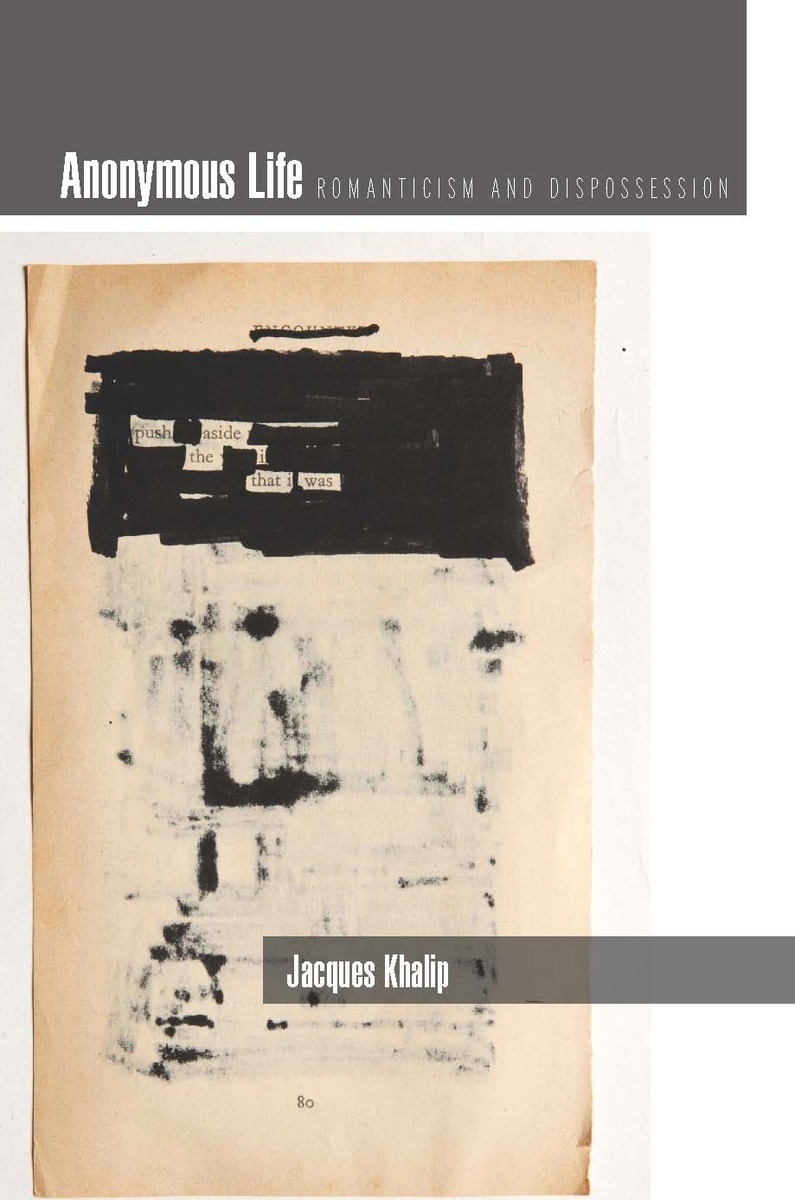
Anonymity and Dispossession theorizes Romantic subjectivity in the wake of the Enlightenment call for transparency and self-revelation. Jacques Khalip argues that second-generation romantics (Keats, Hazlitt, Shelley, Austen) saw Enlightenment models of personhood as deeply inauthentic and sought to re-conceive of the self as anonymous. To think about subjectivity as anonymous is to value experiences of trauma and privation over experiences of self-possession and confessional plentitude. As critical praxis, understanding subjectivity as dispossessed, or as being-without, involves attending to the virtuality of figuration (de Man and Derrida are important theoretical influences in the book) and to literary representations of anachronisms that evoke “an existence whose untapped power” is “always temporally unfinished and suspended, not knowing what it is, and what it will be” (7). Khalip wants us to see that Romantics thought of identity as “always an unmade and undone “thing”” (14) and, in so doing, shattered the relational channels of sympathetic exchange and mutual recognition. (see Yousef!)
Anonymity and Dispossession intersects with the concerns addressed in Pinch’s and Yousef’s book and Romantic affect theory more broadly in its treatment of “sympathy.” Khalip carefully draws out sympathy’s political dimensions, or its entanglement with the logic of financial speculation and accumulation. Khalip points out that the category of property underwrites formulations of sympathetic selfhood in Hume, Burke and Smith. All three of these philosophers acknowledge the virtual and potentially destabilizing aspects of sympathy (see Pinch!) only to keep the self as imaginary possession intact. Shelley then amplifies the destabilizing features of sympathy present in Hume, Burke and Smith in order to re-conceive of sympathy as a “dissimulating” process that tears apart the “apparently fluid causality of consciousness” (117) and thus allows for a challenging ethical experience: “Sympathy…is an obligation to otherness that cannot be properly defined, but to which the subject remains critically open” (132). This is sympathy in the wake of any illusions about the linkage between affect and cognition, impressions and ideas, meanings and texts. It is a sympathy that refuses to understand the relationship between the self and the other in terms of mimesis.
Chapter four asks what the book’s broad themes of a skeptical and uncertain selfhood look like in the hands of women writers. The unifying mood is not of sympathy but of melancholy. Khalip argues that for Wollstonecraft, Shelley and Austen, melancholy entails a withdrawal from the public sphere that is sometimes strategic, sometimes compulsory. One surprising suggestion is that by refusing the demands of self-presentation, female writers display a “powerfully anonymous mobility in the world.” Wollstonecraft’s Letters Written During a Short Residence in Sweden, Norway, and Denmark and Austen’s Persuasion are well chosen and illustrative of the point. If the delicate being taught only to please of the Vindication is cognitively and emotionally stunted by a discourse of femininity that “spuriously regulate[s] the visibility of the female self,” then the Wollstonecraft fashioned in the letters is more like Austen’s melancholy heroine who cultivates a skepticism that “disarticulates personal fulfillment from self-presentation and self-assertion” (135). Khalip’s book leaves us with challenging questions about agency—if we can’t define ourselves, then how do we know how to act in the world? Romanticism and Dispossession encourages us stop thinking of ourselves as willful actors and to take up an obligation to perpetually reorient ourselves in relation to a fundamentally unknowable world.
The Romantic Reply to the that Terrible Question: Valuing the Humanities
One option out of a wide array of graduate seminars to choose for this current Spring semester ranging from the theory heavy to the literature heavy, and usual contenders (i.e. my much beloved courses on Modernism and the 18th c. novel) stood out among the rest in sheer ambiguity: the public humanities. The seminar is an interdisciplinary course that includes graduate students from various departments. Continue reading “The Romantic Reply to the that Terrible Question: Valuing the Humanities”
Finding "Romance of the Forest" in a Scrap of Toilet Paper
Like many who have read Ann Radcliffe’s Romance of the Forest, I began the novel with the knowledge—one could even say the predisposition—that I would find in it the moments that Jane Austen parodies in Northanger Abbey. In Northanger, Catherine Morland finds a scrap of paper that she is certain will prove to be the last testament of General Tilney’s late wife—only to find that the memento is actually a laundry bill. This scene is one of many in which Austen communicates how Catherine’s excessive engagement with gothic novels has prejudiced her ability to interpret her immediate surroundings and experiences. I’ve read Northanger a handful of times and have always been a big fan, so I approached Radcliffe’s work anxiously, waiting for her heroine, Adeline, to find some damning piece of paper, which would fulfill my own expectations of gothic horror conventions.
Sure enough, a little over 100 pages in, Adeline stumbles upon the manuscript of a man who had years before been captured and killed in the abbey where she and her guardians, the La Mottes, are hiding from the French authorities. The “MS” horrifies yet captivates her, and for the next few chapters, she continually rushes back and forth between the room where she keeps the manuscript and the other rooms of the abbey, where she finds herself having to fight against the Marquis de Montalt’s sexual and marital advances. Her attention is torn between the written fragment of the past—much of which has been obscured by the erosion of ink on the page—and the immediate dangers of her present.
Did it fulfill my desires for cliché yet disturbing gothic goodness? Absolutely. But when I got to that part of the novel, I didn’t think of Northanger Abbey. Instead, a completely unexpected picture flashed through my mind:

Continue reading “Finding "Romance of the Forest" in a Scrap of Toilet Paper”