Use Value and Literary Work: Poetic Identity in 19th Century Britain

I am a few days from submitting a full draft of my Ph.D. comprehensive exam rationales. These short written explanations/defenses of my lists are intended to help my committee see how I chose my texts, how I conceptualize the time periods, and what kinds of questions to pose in my oral exam next month.  No pressure, right?  I am not required as of yet to make groundbreaking strides in our field.  (I have four months until the dissertation proposal is due.)  For now, I am to demonstrate a confident knowledge of the area and its current critical debates.

And I must say, despite all odds: I am really enjoying this process.  I mean REALLY enjoying it.


Months upon months ago, I began designing my lists according to major themes in Romanticism and Victorianism.  I borrowed this approach from an old Victorian lit syllabus that divided our readings into the major debates of the period.  Luckily, the Victorian epoch already has names for many of these debates– we get “the woman question” and “the condition of England.” I started there and tried to work backward to see similar debates in Romanticism.  Not impossible, but I eventually abandoned these categories, finding many texts too difficult to compartmentalize.  Within and across the lists, I found too much resistance to these neat categories.

The porous boundaries between literary movements or cultural epochs are a consistent point of debate in literary studies. (This acknowledgment heads the disclaimer we sign upon entering grad school, right? “We all know this fact, but you, grad student, are responsible for challenging these textual boundaries in intelligent and original ways for the next six years”). The long-nineteenth century in British literature itself must expand at both ends to encompass a least a decade in each direction to make adequate sense in the ways we critics currently construct the period. And this is not a phenomenon reserved for the afterlife of each movement alone, but rather the writers and theorists of the Romantic and Victorian movements look backward and forward in attempts to situate themselves and their literature within a cultural narrative that shapes and is shaped by their work. Indeed, what I find definitive of the nineteenth century, a point of connection that unites the various authors and genres represented in my comprehensive exam lists, is a desire for clear situation within and beyond an epoch.

The writers we study desire a lasting cultural influence. They seek to shape and correct, to play a significant role in cultural formation and the national story. I argue that this desire to influence and make a mark is a symptom of economic insecurity. With an emphasis on practicality and pragmatism (the use-value of work) as the bourgeois class rises to influence across the Romantic and Victorian epochs, the “word’s worth,” if you will, of a man or woman of letters seems to require its own proof. This need to defend and define one’s usefulness in society and to posterity (on top of the need to prove one’s self within a chosen vocation, as with Keats, Hunt, DeQuincey and numerous women writers like Mary Robinson) creates a significant identity crisis that gets translated across the century into various points of cultural and historical contention.
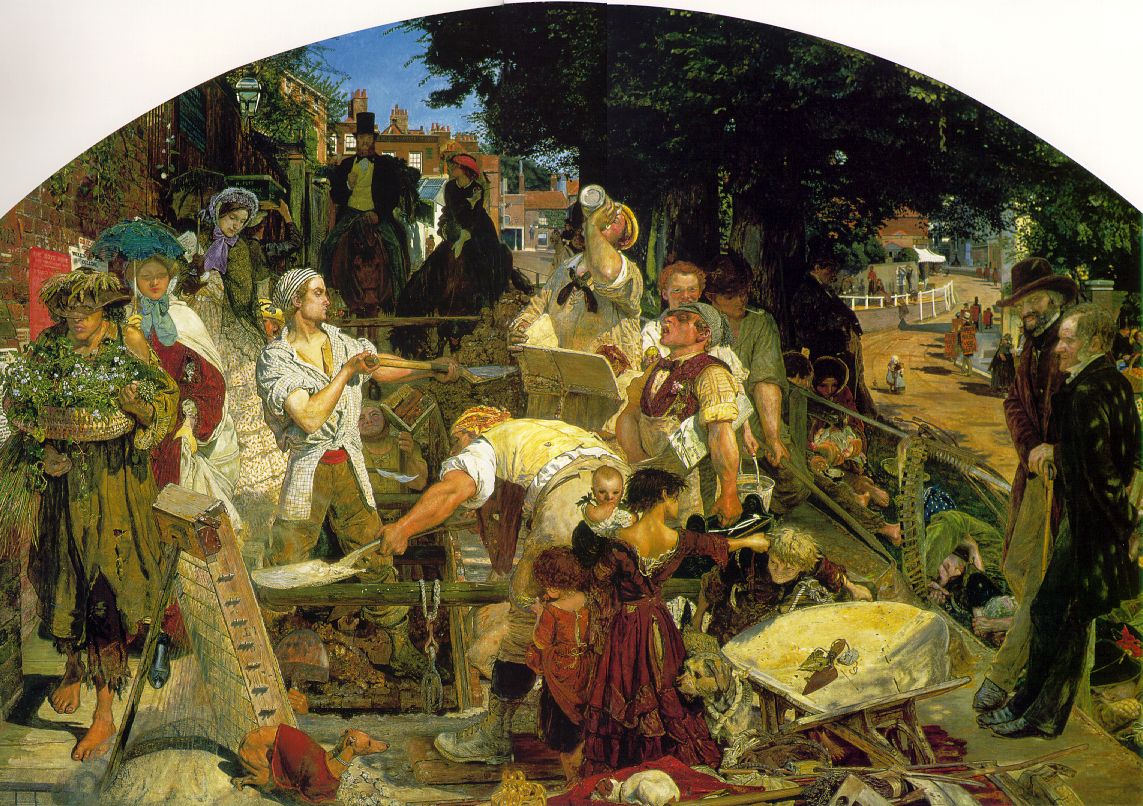
"Work" by Ford Maddox Brown, 1865
“Work” by Ford Maddox Brown, 1865

John Guillory writes a compelling history of “use value,” how it was invented and how it comes to odds against aesthetic value in the early nineteenth century. I came to Guillory through Mary Poovey’s brilliant 2008 book Genres of the Credit Economy. Hers is a book you read and pine over, jealous you hadn’t written it first.  Of course the list of books I wish I had written has grown well beyond anything I could reasonably produce in a long academic career; nonetheless, I continue to drool and dream. Teasing out what Poovey calls a “double-discourse of value,” Guillory argues that aesthetic value depended on the emergence of “use value” as an economic concept in the late eighteenth century.  Looking to Adam Smith’s Theory of Moral Sentiments and Wealth of Nations, Guillory states that use value was invented to discursively clarify the relationship between production and consumption. It seems the people—literary writers and theorists?—were uncomfortable with the affective motivation behind ascribing a product value. Under the increased pressure for utility and practicality, valuing a work of art because of the pleasure it brings seemed a tenable (at best) justification for the time and effort expended in producing and consuming it. Therefore, the discourse substituted in use value which seems to marry production and consumption and get rid of the warm, fuzzy emotional value of art.

At the same time, Literature with a capital “L” cannot become so useful as to be absorbed into other types of writing like economic, scientific, or political writing (here’s the heart of Poovey’s book– how the distinctions arose between the genres).  So here’s the rub—aesthetics branches off from economic discourse for the first time, reiterating that not all written products are works of art. But what’s more, the products that appear like works of art may not be.  Thus Literary writers define what is “fine art” and distinguish between types of imaginative production based upon their adherence to the definition (namely, a work should not call attention to itself as a commodity, so rule out popular works and works of “immediate utility”).

But does this dismissal of “immediate utility” give leeway enough for my argument that poets and novelists in the nineteenth century feel the need to prove their utility?  I say, absolutely yes.  In my own adaptation of this cultural narrative, this is the crux of poetic identity in crisis. Suddenly (or not so suddenly, really, but now of sudden we have the language to explain this phenomenon) literature’s worth can no longer be taken as indisputable fact.  Suddenly, artists must defend the cultural relevance of the work.  What work does Literary work perform? Ironically, Wordsworth’s Prelude (esp. the 1805 version) justifies his seemingly self-indulgent aesthetic exercise in tracing the development of the poetic genius as performing the cultural work of a natural philosopher or historian, as he uses himself as the case study of a mind in development during upheaval of the French Revolution. Similarly, guarding his work against accusations of sensationalism or shock value, DeQuincey justifies his Confessions as being a comprehensive (scientific?) study of the effects of opium consumption, adding the potential educational benefits his mistakes may provide for the reader.

Perhaps more interestingly, Victorians like Thomas Carlyle and Matthew Arnold seek to define a use value for the aesthetic products more obviously abstracted from immediate utility than Wordsworth’s or DeQuincey’s.  Here we have a sense of immediate cultural crisis—the moral fabric of society is degrading as the class boundaries seem to be dissolving, gender roles (especially in the literary marketplace) seem to be in flux, science is questioning what it means to be human (and to be particular kinds of humans, etc). Carlyle and Arnold foresee anarchy, and they don’t seem too extreme with these concerns.  Radical individualism, as Carlyle terms it “democracy,” erases the need for leaders to model correct behavior.  And what will we do without models?  How can we possibly be moral without seeing what morality is?  How can we be cultured if everything and everyone is valued equally?  Carlyle’s answer: heroes and hero worship.  And significantly, his heroes always have a poetic sensibility, that is when his heroes are not poets themselves. Likewise, Arnold famously writes that culture is the answer to anarchy. To read and see all the best that has been known and created–this will civilize and make moral the British populace in flux.


I can see these economic questions of “work” and “value” at the root of my original categories, the major crises of the nineteenth century in British culture.  I feel as though this framework lends itself to a discussion of so many topics in recent scholarship: mental science, gendered work (domestic novels vs. fin de siècle adventure novels; sensibility and sentimentalism; etc.), professionalization of bourgeois occupations, dissenting culture, the widening franchise, the bard’s role in nation-making and historical record, scientific advancement and religious doubt, etc.
All this to say, I am arguing a relationship between economic and social (class) change as the root of writers’ identities. I see the common thread between nineteenth century writers as their struggle to negotiate aesthetic vocations within a market and within a society that seeks a use value for all products (read utilitarianism, read Victorian work ethic, read rise of bourgeois values). Meanwhile every fiber of their beings wants to privilege fine art above products with an immediate utility. Fine art is for posterity, it is lasting and transcendent. Okay so “every fiber” is a gross overstatement, and my actual narrative challenges this art for art’s sake assumption. Ultimately, there is a real anxiety about whether literary work performs a cultural service, and these writers vie for recognition of their worth both personally and occupationally, both in the moment and in literary history.

Registration Open For Emerging Connections Graduate Event, June 12, 2014

Registration is now open for the Romantic Connections conference in Tokyo, and for the accompanying graduate workshop, Emerging Connections. If you are a graduate student at any level of study who will be attending the conference, please consider registering for this event: it will be a great way to connect with fellow grads prior to the start of the conference. The list of speakers will be available soon! The planned schedule of events for the day can be found at the conference website.

Rethinking Romantic Textualities with Media Archeology

In my first post for this blog, I wrote about how my background in archeology influences my perception of texts as physical objects, and how I’d like to move towards an “archeological hermeneutics” that takes into account a text’s material conditions as contributing to its contents and their significance. Moving forward, I’d like to complicate our understanding of text-as-object by introducing what I’ve so far learned in my “Media Archeology” seminar taught by Lori Emerson. It came as a surprise to my family and friends that I enrolled in this course, because I tend to take classes that focus on the study of 18th and 19th century literatures. Although I won’t be reading any texts “in my period” for this class, I’ve found it has in fact supplied me with a variety of alternative methodologies for my Romantic-era research.
Although those who work in the field tend to resist a concrete definition, Jussi Parikka calls media archeology “a way to investigate the new media cultures through insights from past new media, often with an emphasis on the forgotten, the quirky, the non-obvious apparatuses, practices and inventions” (Parikka loc 189). We’re encouraged to take apart machines in order to understand how they operate, and in turn expose the conditions and limits of our technologically mediated world. Relying on Foucault’s Discipline and Punish, among other texts, media archeologists expose structures of power embedded within the hardware of modern technology, revealing the ways in which media exert control over communication and provide the limits of what can be said and thought.
I find this way of thinking about the structures and limitations imposed by media particularly useful for the study of 18th and 19th century texts. Instead of thinking about how printing and publication practices give rise to individual texts, as I have in the past, I’ve started to consider texts from the inside out: what do books tell us about the cultural conditions and constraints imposed by the media in which they were (and are) written, manufactured, and consumed? Like the ASU Colloquium’s post, I wonder what three volume novels, for example, might tell us about communal reading practices and circulation of texts and, importantly, our modern reading practices in comparison. I’d hypothesize that circulating texts and libraries would contribute to communities of readers in which reading was, perhaps, a shared experience. In contrast, modern reading tends to be solitary experience which involves owning texts (especially when the library has only one copy of the book you need).
I’ve also found media archeology’s rethinking of linear time and notions of progress particularly useful and interesting. Collapsing “human time” allows us to bring together seemingly unrelated technologies for comparison and analysis. I’m thinking here of the Amazon Kindle and 18th century circulating libraries, which both create spaces for communal reading. In contrast to the private reading practices I described above, I think the Kindle – and specifically the “popular highlight” feature – presents an opportunity for readers to become aware of their participation in collective readerships. When you click on a pre-underlined sentence, it shows how many other people have also highlighted it. While at first I found this feature annoying – perhaps evidence of the private relationship I tend to have with books – I’ve begun to enjoy the way it makes me aware that I’m one of many readers who’s enjoying this particular text. Furthermore, I wonder if my newfound sense of collective readership would also give me a better understanding of Romantic-era reading practices that were likewise characterized by shared texts and mutual engagement. The ASU Colloquium posed an important question about whether we should attempt to read texts as their original readers would have; since many of us no longer have access to the original 3 volume novels and their circulating libraries, maybe we can gain insight into these texts and reading practices from the vantage point of our own collaborative technologies.
To close this post, I want to introduce one more concept from my media archeology reading that I’ve also found particularly applicable to the study of Romanticism: glitch aesthetics. Typically understood as accidents and hick ups within games, videos, and other digital media, glitch artists exploit them in order to “draw out some of [that technology’s] essential properties; properties which either weren’t reckoned with by its makers or were purposefully hidden” (McCormack 15). Again, media archeologists are concerned with exposing the power structures embedded in technologies, this time by giving us a peek of what lies beneath. While looking at glitch art, I couldn’t help but think of an experience I’d had in the British Library reading Keats’s manuscripts. I remember finding an additional verse to “Isabella: Or, the Pot of Basil” in George Keats’s notebook in what I think was Keats’s hand etched nearly invisible on the opposite page. Of course, this mysterious stanza threw a wrench in the carefully constructed argument I’d planned, and I had no idea what to make of it. Now that I look back on it, I’d like to think of that stanza as a textual glitch – it’s possible that Keats never intended for it to be read. Perhaps it had even been erased from the page. For me, this “glitch” reveals the textual instability of the poem and disrupts the sense of solidity and permanence with which I’ve come to regard Keats’s oeuvre.
I still have much to learn about media archeology and its methodologies (which I’ve certainly oversimplified), but I think this field could lead our work in Romanticism in new and exciting directions.
 

"I have a new leaf to turn over:" A Romanticist's Resolutions for 2014

I think we can all agree that Keats’s Endymion (1818) was a critical and commercial failure. As Renee discusses in her post, Tory reviewers lambasted the poem because of Keats’s affiliation with outspoken radical Leigh Hunt. Although the poem’s most notorious critic, John Gibson Lockhart, notes its metrical deviations from the traditional heroic couplet form, he spends more time attacking Keats personally: “He is only a boy of pretty abilities, which he has done every thing in his power to spoil.” It’s no wonder, then, that Keats’s letters written in the months that followed show a recurring preoccupation with self-improvement, or “turning over a new leaf.” In a short letter to Richard Woodhouse (friend and editor) dated December 18, 1818, he writes “Look here, Woodhouse – I have a new leaf to turn over: I must work; I must read; I must write.” He’d repeat the phrase again that April in a letter to his sister, complaining that he had “written nothing and almost read nothing – but I must turn over a new leaf.”
Due to my unfortunate tendency to self-identify with whomever I’m reading (“OMG, Keats, I know EXACTLY what it’s like to have your work rejected and then mooch off your friends because you have no money. WE ARE THE SAME PERSON.”), Keats’s desire to “turn over a new leaf” resonates as I prepare for a new semester of graduate school in the new year. While our situations are slightly different – constructive criticism of a seminar paper not quite as devastating as the complete and utter failure of a published book  – his mantra for self-improvement sounds eerily like that of a graduate student: “I must work; I must read; I must write.” In the spirit of turning over a new leaf, and hopefully transforming that Endymion-esque seminar paper into a Lamia, I present to you my academic resolutions for 2014. I should note that many of these will be obvious to the more seasoned scholars among you, but for all of you newer grads out there, I hope you’ll find my mistakes instructive.
Resolution #1: I will develop arguments from texts instead of making texts conform to my arguments. 
This one seems easy in theory, but it’s something I’ve been struggling with throughout the semester. I’ll read one text – Endymion, let’s say – and then a bunch of criticism, and its reviews, letters, etc. Then, I’ll develop an idea about how Keats’s later poems revisit the same genre and politics as Endymion, but ultimately rewrite them. Except, I’ll form this connection even before I’ve read the later poems, just because it sounds so smart and will make such a good paper. Then, I’ll set about writing the paper and finally get around to reading Lamia, Isabella, The Eve of St. Agnes, and other poems (1820), and only then will I realize that the texts interact in completely different ways than I had originally thought. Of course, there’s not enough time to completely rewrite my paper, so I stick with the argument, praying that the reader doesn’t realize I made this crucial error.
So, simply put, I resolve to stop doing this faulty method of research. I’m going to let myself be confused by texts, and stop trying to develop beautiful, complex arguments before I’ve had time to fully read and think about them. If a brilliant idea pops into my head before I’ve done this, I’ll write it down, set it aside, and consider it later. As a wise professor once told me, “Always start with close reading. If you leave it till the end, it will always most certainly change your argument.”
Resolution #2: I will accept that I am, first and foremost, a student.
A wise man (Michael Gamer) once told a group of English majors, “graduate students are full of themselves.” I hate to say it, but I’m living proof of this. I started graduate school last August under the impression that I was a Romanticist. In my undergrad days I was merely an “aspiring Romanticist,” but starting a Ph.D. program gave me the right to crown myself with the full title. Once I was accepted, I thought that I had made the transition from student to scholar, and deceived myself into believing that I knew more about my field than I actually do. Thankfully, the enormous ego that Michael prophesied was soon deflated when I realized a few weeks into class that, in fact, I know very, very little about the period in which I claim to specialize. Of course, this realization was accompanied was a decreased sense of self-worth, doubt about whether I was in the right line of work, and a frantic conversation with my advisor in which I dramatically exclaimed, “I KNOW NOTHING!” “That’s ok,” he assured me, “you’re a student, and you’re not supposed to. Frankly, you’d be surprised how many people in the field don’t know much either.” So, for 2014, I resolve to remind myself that I’m not a scholar yet; I’m a student. I will accept the limits of my knowledge while doing my best to expand them.
Resolution #3: I will overcome writing anxiety.
This problem plagues many of us, and it’s one of my biggest areas for improvement in the new year. Sometimes, the sheer size of what I need to write, the nearness of the deadline, and difficulty of the subject matter create a Kafka-esque paralysis in which no writing is accomplished. I can tell I’m experiencing this when I go to extra lengths to avoid starting a paper, whether it’s extra research, extensive outlining, or a meticulously organized Spotify playlist entitled “Writing.” As many of us know, talking about writing and thinking about writing is not actually writing. The only way to overcome this problem is simply to write more. At the advice of many of my peers, I plan to write everyday, especially while I conduct research. There were simply too many times this year when I was tempted to end my seminar papers in the way that Milton ended “The Passion” (1620): “This Subject the Author finding to be above the years he had when he wrote it, and nothing satisfied with what was begun, left it unfinished.” I’m pretty sure only Milton could pull off that one.
Resolution #3.5: I will write my blog posts on time. 
This probably should’ve been number one. Thank you, Jake and fellow NASSR grads, for your patience.
Happy 2014!


Never Have I Ever Read

Photo courtesy of: http://www.victorianweb.org/painting/millais/drawings/50b.jpg
The Eve of St. Agnes Millais (1863) http://www.victorianweb.org/painting/millais/drawings/50b.jpg

At the beginning of summer, my husband, our two basset hounds, the cat and I moved into a little white rental house with a backyard. And once we had unpacked all our books, installed a makeshift closet in the back room (in the whole house, we have one tiny little 2×3 feet closet in the bedroom), and felt sufficiently settled to have company, we threw a housewarming party.
Naturally, ninety-percent of our guests were English grad students, and, as we were sitting around the fire-pit in our new backyard, someone suggested we play a literary version of the party classic “Never Have I Ever.” In the original game, the players take turns admitting to something they have never done (never have I ever been skiing–a sad truth!), and each person who has done the event loses a point until only one person is left with points, or something of the sort. In our version, we shamefully admitted works we had never read, and the other players were to put down a finger of the full ten with which they started. Of course, we awarded a slight handicap of negative five points to the only three non-bookish types (my husband the mathematician, a former history major, and a physicist) to make the game somewhat fair.
We were never quite clear on the goal of the game, since in our circle there seemed more pride in “losing” the game than surviving to the end with fingers still raised. In fact, one of our friends “lost” twice by the time we called the game. And we were all envious. But we went round and round, enjoying ourselves immensely.

“Never have I ever read Moby Dick.”
“Never have I ever read Huck Finn.”
“Never have I ever read Beloved.”

I have been studying for comprehensive exams for the past five months, and while I have read a significant number of the works on my lists in past graduate seminars, I feel like the whole process is a long game of “Never have I ever read…”
At the University of Kansas, where I am in my third year of doctoral studies, you compose three lists with your committee–two of which are time period lists (your area and an adjacent time period) and the third is a list of your own choosing (often an author, literary theory, a genre, etc). As a Romanticist with a fairly extensive background in Victorianism, I have chosen my period lists to form the full nineteenth century in British literature, and my final list is geared toward the Leigh Hunt Circle as I prepare for a dissertation focusing on Keats, the Cockney School, and how this context shaped his conception of “work.”
After reading criticism and biographies for the last two months as I try to whittle away at the dissertation list, I have switched to fiction for a much needed breather. I find it heartening to zip through a couple of novels in a week, when I have been slogging through nonfiction for what seems like a lifetime (and I will say I have read several “lifetimes” in that list, and highest praise must go to Nicholas Roe’s 2012 Keats biography. I have added it to the ever-growing list of books I wish I had written). In anticipation of the Halloween season, I scheduled myself several gothic novels in a row. And last week, I read Wuthering Heights for the first time.
Perhaps I just permanently altered your opinion of my clout as a nineteenth-century scholar. Well, so be it. I certainly admit the sad fact with a touch of shame. But now I have checked it off my list of never-have-I-ever-reads, and I have moved on to the next novel that somehow fell through the gaps in my long tenure as a literature student.
I feel this game “Never Have I Ever Read” haunts literature scholars. It certainly helps us flesh out syllabi–how else will we force ourselves to finally pick up Dombey and Son if we do not assign our students (and ourselves!) to read it?–and the game even fuels our research, it seems.
Three weeks ago, I had the pleasure of traveling to Portland and presenting on a Romanticism panel at the Rocky Mountain MLA. This conference has become a tradition for a couple colleagues and me, who would likely never travel and present together otherwise since our areas are so diverse. I presented on the connection between architectural structures and female bodies in Keats’s romances. I looked at the way in which the lived experience of female bodies, specifically in rape narratives, becomes abstracted into a symbol (the first step of which is the equation of the female body to the house or palace that protects her–i.e. Madeline is endangered because her house is penetrated in “The Eve of St. Agnes”). This cultural phenomenon is allegorical in so far as the female body comes to represent social bodies (structures) in various forms through literature and even political propaganda. The specific and material become crystallized into a generic trope that can be circulated, translated, and exchanged, depending upon the terms of its use, its ability to anger, inspire, manipulate.
In the Q&A portion of the panel, another presenter asked if I had read Cymbeline. I shook my head and shyly admitted I had not. Despite taking two courses in Shakespeare and Renaissance drama, never had I ever read, seen, or even heard a plot summary of the play. Nor is the classic John Middleton Murry volume Keats and Shakespeare listed among my secondary texts for comprehensive exams.
Nevertheless, I did my research that evening in my hotel room, and discovered much speculation on the play’s influence in Keats’s portrayal of Madeline’s boudoir. Indeed, Charles Cowden Clarke wrote, “I saw [Keats’s] eyes fill with tears, and his voice faltered,” as the poet read aloud from the play in summer 1816 (qtd. on page 56 of Walter Jackson Bate’s biography of Keats). In addition to speculation on the scenery, importantly, Imogen has been reading the story of Tereus and Philomela before falling asleep. According to Greek mythology, Tereus rapes Philomela and cuts out her tongue so that she cannot report the assault. Jove later transforms Philomela into a nightingale, and her song becomes an echo of sexual violence throughout literature, including T.S. Eliot’s “The Fire Sermon” in The Wasteland (a piece I have read many times since first crossing it off my never-have-I-ever list in high school).
Scholars speculate on what the literary greats have read (or not read) as an everyday practice. My fellow-scholar who asked if I had read Cymbeline was presenting truly stellar archival research that sought to uncover whether Keats had read various seventeenth-century ballads on nightingales. She lamented that we do not know to what volumes he had access while staying with Benjamin Bailey at Oxford in the summer of 1817. And as she had not yet read Roe’s recent Keats biography, she did not know the conflict between Bailey and Keats’s London friends, and why Charles Brown and other early biographers would not have contacted him to inquire about Keats’s reading that summer. Even in their lifetimes, Keats and Leigh Hunt gained the label “Cockney” as a class slur partially due to the fact that they never had ever read mythology in the original Greek, and instead got their knowledge of the classics through translations.
Next up on my reading schedule is Northanger Abbey, and I will be reading it for the first time. This will be my last novel for a while, and, as I want to preserve my reputation with you at least beyond my first blog post, I will not admit the Romantic poetry I will be reading next week–for the first time.

The Day After Payday: Graduate Students, Gleaning, and Apocalypse

Jean-François_Millet_(II)_-_The_Gleaners_-_WGA15691Finally after a long, cold summer, payday finally arrived! It was yesterday, the tenth of October. The frost has melted and the money has blossomed. It is for some the first payday since school ended in June. Sure, it was a glorious summer, sitting everyday in a library, reading and writing. After all, as long as you “do what you love,” the conditions in which you live do not matter. So I’ve been told.
One point of reference for this frugal summer has been Agnès Varda’s 2000 documentary, The Gleaners and I (Les glaneurs et la glaneuse). Varda’s film covers the history and contemporary practice of gleaning in France. Gleaning is the agricultural practice of gathering scraps leftover from the harvest, such as grain, potatoes, or whatever is available. It is a practice largely reserved for indigent peoples. While I initially picked up this film for the short interview with psychoanalyst, Jean Laplanche, since viewing the whole documentary, I have thought much more about gathering scraps.
Historically, gleaning has been considered a common practice, recorded as far back as the Bible, at least. It was often conducted by women and in groups.  But in 1788, gleaning was criminalized in England (collecting dead wood on the property of someone else was made illegal in the same year, which informs the plot of William Wordsworth’s “Goody Blake and Harry Gill”). In many court cases involving gleaning, it was actually the land-owning farmers who were the accused, namely for assaulting gleaners.[i] But regardless of who brought charges against whom, according to the “law,” there was one less way to survive.
Today—or at least thirteen years ago—Varda observes that gleaning has become somewhat of a solitary practice. Not only do gleaners search farmland for leftovers, but also the markets, garbage bins, and alleyways. Largely urban dwellers, Varda discovers that a good gleaner knows which grocers, bakers, and even which fishmongers throw away food before it has spoiled. It is striking how many of the people Varda meets glean out of repulsion to the capitalist culture’s insistence that consumers continuously purchase commodities. For some, their commitment to glean is very much a moral issue.
In Seattle, where I live, it is illegal to forage in public parks, another form of gleaning. Over the summer I heard a news broadcast about how foraging is illegal here but that the Seattle Parks department is becoming more tolerant and actually teaching people how to forage for things, like nettles, without destroying ecosystems.
I am simultaneously pleased and troubled by this decision. I am pleased because it seems wise to use these spaces to also grow and harvest food so that urban dwellers are not limited only to imported products, which cost more money and require more fuel for distribution than locally grown products.
But if gleaning is given a bit of a (neoliberal, hip, west coast) shine to it, in the same move we become complacent with regards to very real things that cause some people to glean out of necessity, for instance, corporations and governments that rely on interns, or universities that rely on adjuncts and graduate student teacher assistants.
In a “roundabout” way, such complacency is already recognized. Shifting attitudes with respect to foraging in public parks (in other major cities, as well) follows from fears about an “uncertain future,” namely: “Climate change, extreme weather events, rising fuel prices, terrorist activity.”[ii] The reason that cities are softening up on gleaning is not because the poor have suddenly found a place in the proverbial hearts of middle-class Americans. Rather, gleaning needs to be appropriated by the so-called “creative class” in order to survive the next 9/11, tsunami, or cosmic collision.
Here I am reminded of Slavoj Žižek’s now well-circulated quote concerning apocalypse: “we are obsessed with cosmic catastrophes: the whole life on earth disintegrating, because of some virus, because of an asteroid hitting the earth, and so on…it’s much easier to imagine the end of all life on earth than a much more modest radical change in capitalism.”[iii]
In other words, rather than make it so that a real majority in the world has access to basic health care, clean water, safe food, warm shelter, as well as access to a quality education—and thus possibly diminishing the desires of some to destroy the planet or large sums of it—we are learning how to identify and cook nettles, and openly admitting that we are doing so in preparation for the next big catastrophe.
Perhaps there is no solution. Perhaps the damage is too great. But too great for what? Yes, climate change is real, its current trajectory is being driven primarily by human actions, and its effects will be profound, and most likely, profoundly bad.
And yet, this past weekend at the Society for Literature, Science, and the Arts’ annual conference (this year’s theme was the “Postnatural”), I heard about another approach. One of the keynote speakers, Subhankar Banerjee, an artist and environmental activist, spoke about “long environmentalism.”
The concept itself is still being worked out, but I would contrast it to assumptions that technological innovation is going to suddenly fix that whole climate change problem. Likewise, governments, corporations, and universities are not going to suddenly care about the needs and welfare of the displaced, the underpaid, and the overworked. I would say that these two seemingly disparate issues both require a similar “long” solution. For any problem humans and other species face today, the solutions require drastic changes to our ways of living: no quick turnaround is to be had. It’s great that cities are legalizing foraging and the colleges are starting recycling programs. But these are paper towels on a massive oil spill.
I do not promise organic unity in the conclusion of this post. That would be perverse. Instead I conclude with an anecdote:
Walking through campus after the English department’s annual reception during the first week of classes (that is three weeks ago), a number of my fellow graduate students and I came across a box of cookies left on top of a trashcan. One of us grabbed the box, to the horror of some and the ecstatic glee of others. As hands reached into the assortment of cheap, sugary treats, I announced to my cohort, “We’re gleaners!” At least one of them looked at me and understood my meaning. We smiled our intoxicating smiles and forgot for a second that we were really gleaning.


[i] King, Peter. Crime and Law in England, 1750-1840: Remaking Justice from the Margins. Cambridge: Cambridge UP, 2006. 281-338. Print.
[ii] McNichols, Joshua. “Urban Food Foraging Goes Mainstream In Seattle.” KUOW.ORG. KUOW News and Information, 1 Aug. 2013. Web. 10 Sept. 2013.
[iii] ŽIŽEK! Dir. Astra Taylor. Zeitgeist, 2005.

Digital Humanities: My Introduction 1.3

This post is part of a three-part series charting my introduction to the digital humanities. My entrance largely follows from attending a seminar that meets twice a quarter on Saturday mornings entitled, “Demystifying the Digital Humanities” (#dmdh). Paige Morgan and Sarah Kremen-Hicks organize the seminar and it is sponsored through the University of Washington’s Simpson Center for the Humanities.
As the spring term ends for the 2012-2013 school year, I want to conclude this series of posts with some reflections on introducing the digital humanities into my pedagogical practice.

Digital Humanities or Multimodal Composition Class?

The course I designed in March differs greatly from the class I ended with this week. My assignment was English 111. As the course catalog describes it, 111 teaches the “study and practice of good writing; topics derived from reading and discussing stories, poems, essays, and plays.” While the catalog says nothing about the digital humanities, so long as we accomplished the departmental outcomes, my assumption was that a digital humanities (DH) component would only provide us with new tools for thinking through literature and writing.
It was an innocent assumption.
The main issue was scope. For my theme I chose “precarity,” which Judith Butler describes as that “politically induced condition” wherein select groups of people are especially vulnerable to “injury, violence, and death.”[i] Because there are so many “precarious characters” in Wordsworth and Coleridge’s Lyrical Ballads, I used this collection for my primary literary text. In addition to investigating precarity, with the Ballads students could also explore multiple genres and how the re-arrangement of poems alters the reading experience. Third, I wanted to use a digital humanities approach. By a DH approach I mean that I would encourage digital humanities values with regards to writing (e.g. collaboration, affirming failure), using digital tools, and learning transferable skills.
By the second half of the course it was clear that the students were confused about the concept, unhappy with the text, and struggling to understand the purpose of the values, tools, and skills. During the second half of the course, I lost hope for my big collaboration project and I dropped the emphasis on the Ballads, focusing instead on rhetorical analyses of blogs and news sites addressing issues of precarious peoples and working conditions, which was especially timely after the recent tragedy in Bangladesh.
Without the literature component, students began to feel more comfortable with the tools and concept, which led to greater motivation and better papers. On the downside, these students signed up for a literature class, which I basically eliminated. The triad of concept, literature, and method should work. But I found that if all three areas are of equal difficulty you may risk blocking success in any of them.
The “transferable skills” were perhaps the most successful part of the course. It is not the case that my classes didn’t teach transferable skills prior to my digital humanities emphasis. But as Brian Croxall has emphasized, we can teach more of them. As far as the digital humanist is concerned, more “skills” is tantamount to learning how to use more tools, which I translated (perhaps erroneously) as more media. So this term, all of my students built websites and blogs.
From building blogs and websites students learned firsthand how medium shapes what we can write, how “writing” might necessarily include design and management, and rather than give a tutorial on how to build these sites, I showed students how they could use Google to search for help on their own. The transferable skills were twofold: build an online platform to host your work (which alters what you can present and how), and learn where and how to find answers to your building questions (and rather than “good” sources, I stressed more of them). While initially these sites were less than satisfactory, by the end of the class students began to realize the potential and implications of the medium, which prompted several of them to re-build their sites during revision phases, taking more time with the organization of pages, images, background colors, and hyperlinks, and then explaining why these changes were important.
The websites and blogs showed signs of success with regards to “building skills,” but these platforms might belong less to the digital humanities and more to “multimodal scholarship.” As the organizers of the Demystifying the Digital Humanities seminar stressed during the April 14th session, digital humanists use their tools to “produce” scholarship, while multimodal scholarship means using tools to “display and disseminate” traditional research. These differences are a bit blurry for me still, but the blurriness might be accounted for by the fact that some of us are “trickster figures” occupying multiple regions on the plane of digital scholarship, as Alan Liu explains in the most recent PMLA (410).[ii]
But Liu adds greater clarity to these distinctions when he explains how a digital humanities project uses “algorithmic methods to play with texts experimentally, generatively, or ‘deformatively’ to discover alternative ways of meaning” (414). The algorithms may be out of reach for English 111 (and me!), but by using Google Sites, Blogger, and Ngram many students were cracking the digital ice and playing. In other words, these basic multimodal tools might be a useful first step towards transferring to a more involved and complicated DH project.
For such a class to be really successful it will require much more planning. For the fall, I am refining what I have rather than adding more tools to the mix. Until I do some serious text mining of my own, it might be safer to design a “writing with digital media” course. But now that Pandora’s (tool) box is open, I don’t see it closing in the future.
 
After attending the Demystifying the Digital Humanities seminars and writing these posts, I wonder if my introduction has actually led me to media studies instead. My suspicion is that I will touch both areas, because it is ultimately the task or problem that will determine the approach. However, and I believe Liu also demonstrates this point, the digital humanities as a method might prove to be a problem or task generator. With these tools we will become like Darwin returning from the Galapagos with all those varieties of finches sitting on his desk, asking what all these birds have to do with one another. Perhaps the moral should be: the more materials the bigger the questions.


[i] Butler, Judith. “Performativity, Precarity, and Sexual Politics.” AIBR. Revista de Antropología Iberoamericana 4.3 (2009): 1-13. Print.
[ii] Liu, Alan. “The Meaning of the Digital Humanities.” PMLA 128.2 (2013): 409-423. Print.

A Romanticist’s Journal of a Tour to Cleveland; Or, notes from ASECS 2013

The 44th Annual Meeting for American Society for Eighteenth Century Studies was held in Cleveland three weeks ago so my apologies that this isn’t coming to you in the full blush of the liveblog moment. But my brain is still sprouting with new names, books to read, perspectives on the state of the field, and connections (however fanciful) between my coursework papers and panelists’ insights. And I may not be the only one who recollects April 4-7 with a blush or two: some acronyms just leave you with no choice. Having never attended ASECS before, I can’t speak for the surely lengthy history of great jokes in this regard, but I can tell you that this year, we were on top of things. I like to think the Romanticists in attendance navigated this innuendo especially well. Telling the Romanticists apart from Eighteenth Centuryists, isn’t so easy; or at least I found myself taking a a few searching looks in the restroom mirror of the Renaissance Marriott Hotel: Where does an Eighteenth Centuryist end and a Romanticist begin?* Who am I, really? (And what am I doing in a Renaissance hotel?)
My conference bookends, the first and last panels I attended, were my favorites. We** listened to our first after a harried drive from Chicago, arriving in time to find parking only in the bowels of the giant casino next door, and seating at the front of the Garfield Room—on the floor. If you haven’t tried it, it’s a good experience: not only are you appreciating some very sharp minds, you get to appreciate them from the vantage of a Kindergarten student, crossed-legged on the carpet. ASECS was wonderfully democratic this way. Latecomers got the floor, whether they were fledgling grad students there to be sponges, tenured professors, or professors a giddy month or two or twenty shy of tenure (spirited conversations were had, especially, with the latter). But plenty of generous seat-offering took place as well (fellow-feeling in full swing here!).
So this panel, a roundtable, was titled “Aesthetics and Individuation: Frances Ferguson’s Work in Eighteenth Century Studies,” and the panelists, none of them officially Ferguson’s students, spoke about their indebtedness to her thinking and the incredible influence she has had on the fields of Eighteenth Century and Romantic studies. From her game-changing article “Rape and the Rise of the Novel,” on Richardson’s Clarissa (1987) to her book “Solitude and the Sublime: Romanticism and the Aesthetics of Individuation” (1992), Ferguson has been a force, and other strong voices have met Ferguson with forceful questions and concerns of their own. On this panel, John Bender, Blakey Vermeule, Helen Thompson and Nancy Yousef. Here are some of their thoughts, in condensed Shelley-acorn form:
Bender: Romantic marriage is where function and phantasm meet; realism’s reality is gothic; ecstatic interpenetration.
Vermeule: Ferguson advocates a way to be a self that doesn’t need to mean atomism; what does it mean to want to make an impact in one’s career? pertinent
and, one Hilary Rodham gave the valedictorian speech to Ferguson’s graduating class of 1969 at Wellesley College: “More than social reconstruction we need human reconstruction,” Rodham said.
Thompson: modes of doing and non-doing, what counts as rape? the departure of the volitional; external contents of persons; form as the situated production of inner-ness; Sci Fi and physiological formalism.
Yousef: What relations can be used under the word form? Form preoccupies the room of emotional thinking; Ferguson reminds us that historical materialism and formalism co-exist and cannot cancel each other out.
Finally, my last panel of the weekend: “Close Reading Today,” held in the George Bush room (did not specify Jr. or Sr.)
Sandra Macpherson delivered a paper titled “Close Hearing” and posed some brilliant questions: How do we read the sonic properties of objects? How do we talk about sound as matter without turning it into meaning? I’m still thinking about the independence of sounds in verse being other than, or not necessarily, onomatopoeic. I’m very partial to Jane Campion’s “Bright Star,” and Macpherson ended her talk with a clip from the opening of the film. A shot so close that at first you can’t tell what’s happening (a ragged thread being led by a needle in and out of a piece of cloth) but the whole time there is the music, a human symphony singing no words in particular.
Stephanie Insley Hershinow’s “Up Close and Personal” talk began with the question: “Does reading make persons or impersonality?” She went on to consider how close reading has been said to fail and why it is nonetheless a mistake to discount the details: “Close reading is to notice something new, even in a text that has been extensively critiqued.”
Matthew Wickman’s paper, “Reading for the Middle Distance: Moretti and the Picturesque,” made a juicy counterpoint to Hershinow’s. How do we read the images of distant-reading (the bubble trees, line graphs, word clouds etc.)? Numbers: do we really know they mean? Counting, Wickman argued, is a figurative exercise, and if we do not know what numbers are, we don’t know who we are—we don’t know what a ‘whole’ is.
The post-panel discussion ended where I wished it had begun: a man asked a question (or rather, stated at length with no question mark in sight), saying new critical formalism had had its day. Macpherson sung out, “Oh it’s back, baby!”
And with that, back we went to Chicago, heads humming with good things to tangle with and sound out in the months ahead.
*Radiohead’s “Where I end and you begin” is an excellent song for a road trip back to the long (and longer and longer) eighteenth century.
**”We” refers to Samuel Rowe (a second year PhD at the University of Chicago), Allison Turner (a first year PhD at the U of C) and to your blogger, Lauren Schachter (also a first year PhD at U of C). We attended as observers, wisely choosing to do this on our break between Winter and Spring quarters instead of writing our papers.

Some Light Relief, or: Richardson’s Pamela is an Au Pair in 2012

It’s May! And that means that a lot of us academics are taking a deep, post-end-of-term-marking breath, and treating ourselves to the smallest of little vacations… a mini-vaycay, a staycation, an excursion, or what I have recently learned Germans call an Ausflug. In keeping with the theme of respite, here is a little light relief in the form of a pleasant comic fiction. Enjoy!

Richardson’s Pamela is an Au Pair in 2012;

or, Virtue Confounded.

***
In a Series of Letters
from a Hip Young Beauty, To her Parents.
***
Now first Published
In order to cultivate the Principles of Virtue and Moral Uncertainty
In the Youth of Both Sexes

VANCOUVER
MMX

Dear Mom and Dad,
Seriously bad news: the old lady who owns this joint just bit the dust. I’m getting transferred, and I don’t know if there’ll be a wifi connection at the new house, so hang tight. I can Facebook you from my Blackberry at Starbucks.
Your Dutiful Daughter,
Pamela Andrews
***

"A Moment" by Vancouver artist Drew Young

Dear Mom and Dad,
As I was closing my laptop, the son of the old lady walks into my room unannounced and scares the %^&* out of me. He’s a total creeper. Must be pushing 40. He just stood there looking at me and smiling. What a weirdo.
Peace Out,
Pamela
***
Dear Mom (just between us),
The creepy son, Mr. B, offered to keep me on for DOUBLE the wages. AND he gave me a gift card for Victoria’s Secret. What should I do?
Kisses,
Pam
P.S. Can you top up my Vi$a? I miss spending quality time with you, and like, shopping. You are the greatest Mom ever : )
***
Dear Mom and Dad,
Mom, your letter made me feel way better about staying. You are right, money doesn’t grow on trees.
Mr. B treats me really well. He gave me some of the old lady’s clothes. VINTAGE cha-CHING! I got 3 pairs of high-waisted dress pants, 4 silk tops with totally retro gold buttons, 1 excellent Valentino dress that I might sell on eBay, 2 cashmere scarves, and Chanel sunglasses. The old lady was RICH. Now I guess it all belongs to Mr. B. …LUCKY!
Your Dutiful Daughter,
Pam xoxox
***
Dear Mom (don’t tell Dad, okay??)
Mr. B was totally hitting on me just like, two seconds ago, when I was walking down the hallway to find a dustpan. He told me I was the most beauteous creature to ever walk the earth, and my eyes were the pillars against which men might build their lives, which I don’t really get but whatevs. Creeper!
Oh em gee.
Pammy
***
More from Drew Young

Dear Mom,
He kissed me! It just happened!
[This message has been sent via Facebook Mobile]
Your truly shocked daughter,
Pam
***
Dear Mom,
So I was like, OVER the whole thing, because I screamed, and then he kinda yelled, and then I cried, and he gave me permission to never speak to him again, plus he gave me $500 cash, and some new earrings, but THEN. OMG. Then, I was in my room getting ready for bed and I can hear some weird-ass noises coming from the closet. So I open the door and it’s HIM. He’s in MY CLOSET. So I scream some more, and he’s like, “don’t worry, it’s no problem, it’s no problem.” So I was like %^&* you and told him I QUIT.
So there.
Love,
Me, Pamela.
***
Dear Mom,
I can never forgive him for being SO WEIRD, but he has increased my salary and promised I can give notice after the holidays are over. So…
Virtue safe!
Love
Pam
***
Dear Mom,
OMFG I think Mr. B wants to sleep with me. WTF.
FML,
Pam
***
Dear Mom,
If you don’t know what those abbreviations stand for, I can’t tell you.
Love,
Pam
***
Dear Mom,
Today Mr. B came into my room while I was listening to Grizzly Bear and reading Nylon, pinned me to the bed and started kissing me all over my face and neck and I was like, “Back off you Pedophile!” And he was like, “You cannot hold on to your virtue forever! One day, you MUST give yourself up, and because I find you extremely attractive and I have more money than you, it should be to me!” And then he started to unbutton my shirt, and it was kind of hot, but I knew better, because of what happened to the blonde chick on Gossip Girl, so I screamed, “My virtue is all that I have!” And with superhuman strength I threw him off me, ran downstairs, and phoned child protective services.
I’m gonna sue the bastard for all he’s got!
Marriage is for L-O-S-E-R-S,
xoxo
Pamela

How to Dissertate

Well, it’s a new year and in the spirit of developing better habits, I thought I’d share my resolution: to become a more effective dissertator.  Please note that this article is not titled “How to write a dissertation,” because to me, “dissertating” involves a LOT more than the writing process. I know (basically) how to research and I know how to write… but what I don’t think I do well yet is focus—at least not on completing (or let’s be honest, starting and diligently continuing) a project of this magnitude. So, here I’m sharing a few bits of choice advice I’ll be implementing over the next several months to make my dissertating more sustainable and successful.
1.  Dedicate a few full work-days a week to dissertating. On other days, give at least a couple of hours.  This semester, my Wednesdays and Fridays are dissertation days. Mondays are for CV-building academic service, Tuesdays and Thursdays are for teaching, grading, and lesson-prep. Saturdays are for catching up, and Sundays are for recharging the spirit. I’m hoping that this schedule will help me focus on each task as I’m doing it, and give me permission not to worry about the tasks of other days. Less anxiety, less guilt, more productivity. Awesome.
2. Get out of the house.  I made the mistake of not doing this today (yes, a dissertation day. These are goals, people! I’m not perfect yet!)… and so I graded a few lingering student papers, wrote some thank-you notes, ran some errands, felt guilty, and sat down to write this blog as a record of my shame and a re-dedication to a better future. Then I’ll probably do the dishes, because I’m still at home, and the precariously-stacked dirty plates are driving me crazy. Don’t let this happen to you! Have a dedicated work-space someplace else, and go there early in the morning. Settle in, and focus on your work.
3. Check email at the end of the day, not the beginning.  Special thanks to Kirstyn Leuner and Lori Emerson for this piece of advice!  We all know how fast a quick email-check devolves into hours of correspondence, followed by (*ahem* undisclosed amount) of hours wasted watching slideshows of the Golden Globes’ best-dressed list. Once your browser is open, it’s hard to close. So stay away, at least for the first several hours of the day.
4. Just say no to side-projects. If you’re anything like me, then you don’t have trouble devoting large chunks of your time to worthy causes, both academic and non-. I think it’s healthy and important to have a few, but set a limit and don’t go over it! Especially clear out the little stuff that’s eating up your time and doing little for your CV. I have limited myself to my main teaching contract, one small, paying job for some extra cash, one major CV-building academic activity, and one church/community service. Even that is a lot! It’s painful to say no to projects that sound totally awesome (I turned down a gem just this week), but do it. Just say no. Protect your right to dissertate.
5. Set small deadlines for yourself. Currently, I’m scheduled to complete a chapter every three months. (I’m told this is about right in English, though apparently it’s pretty slow compared to some other disciplines). If chapters are 50-60 pages, then I need to write about ten pages every two weeks. Totally doable, right? Part of me resists, reasoning that it’s too modular and that my chapter will have no continuity… but I remind myself that revision can come later. For now, it’s important that research be linked to production all along the way, in small manageable chunks. Plus, as a bonus, ten pages is the perfect length to adjust into a conference paper!
6. Join (or form) a dissertation support group. Share work regularly, and keep each other accountable. My university has a general group for PhDs of all disciplines, which I think I might attend… but I also think it would be nice to form a group with folks in my own department. The idea is that you meet once a month, and everybody gives an update on their work. One person might be nominated to share 10 pages with the group, or everyone could bring 10 pages, and pair up to exchange. As long as you have deadlines, and people to keep you accountable (and probably some treats and commiseration and laughter), the effort will be worthwhile.
I’m starting with these six ideas, but if you have any tips that helped you dissertate more effectively, please do share them! The more wisdom, the better. And to all of us who are striving to stay on the wagon and produce some butt-kicking chapters these next few months, I say best of luck! Happy habit-building, folks. We can do it.
-Kelli