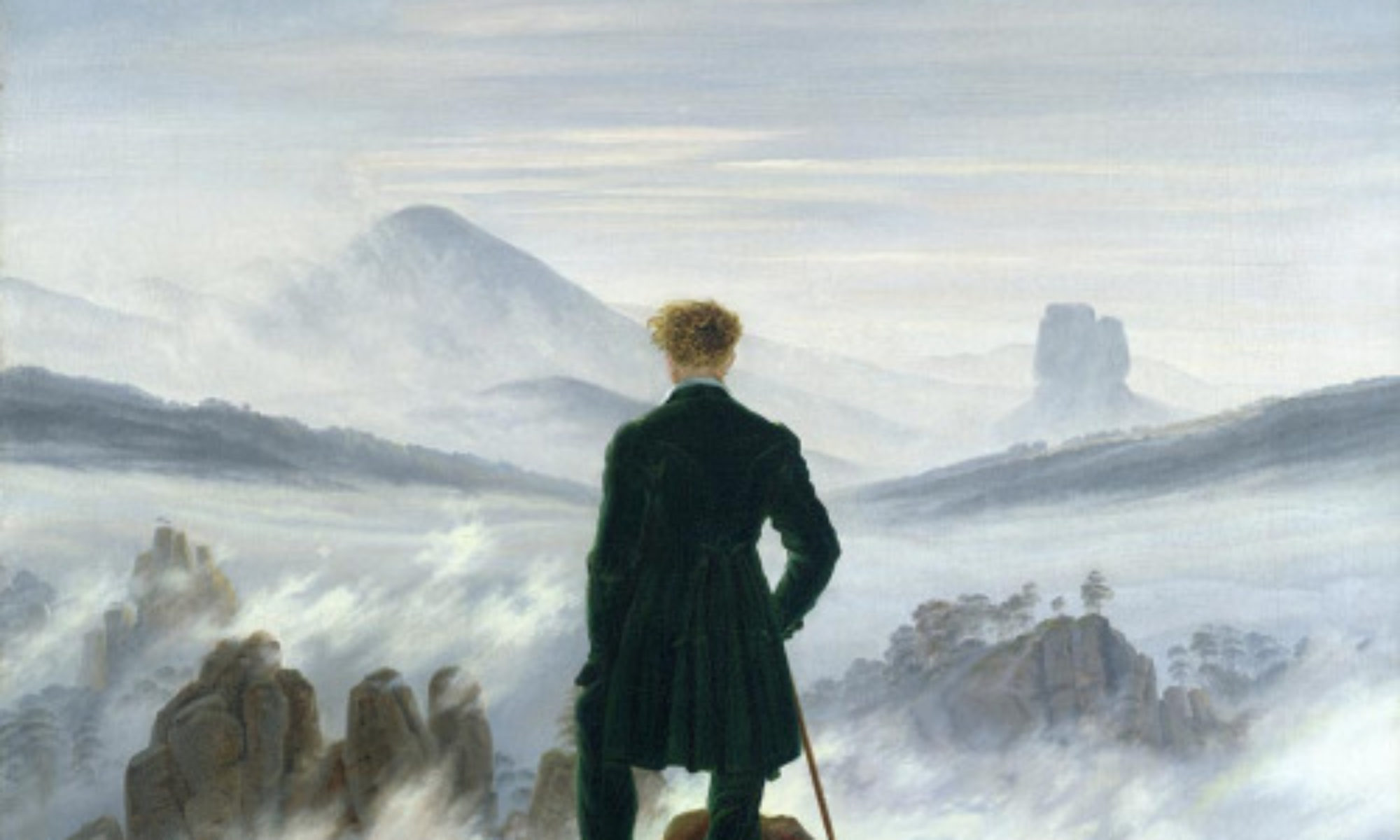
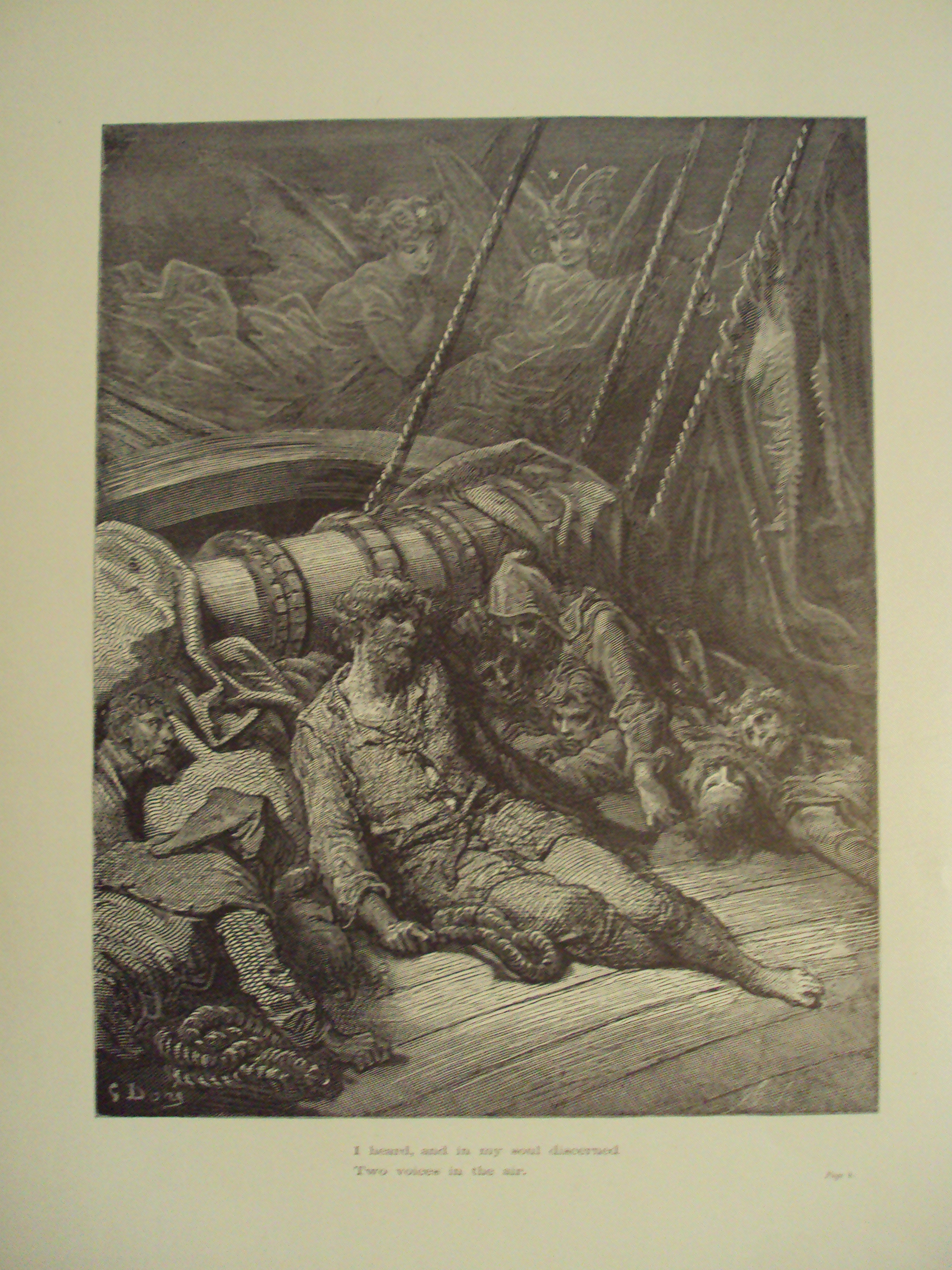
 It’s probably not a good first impression upon my new reader to admit that I did not actually re-read The Rime of the Ancient Mariner before I began this first post. I promise it was not out of apathy or laziness. You see, I’ve read the Mariner’s Tale at least ten times in my life, at least four times for school, the other times because my
teachers had instilled in me the beauty and power found within this strange and wonderful poem. This confidence in the material, really my own working knowledge of the poem, allows me to focus instead upon a work of art that has played a significant role in my appreciation of the work. Continue reading “Of Images, Sublime, and the Necessity of Keeping Crossbows Off Ships”
Report from the 12th Biennial IGA Conference: Gothic Migrations
By Caroline Winter
I haven’t been to too many conferences yet, but I imagine that blithe comments about necrophilia and incest are relatively rare, and them being met with easy laughter is rarer still. Perhaps I shouldn’t have been surprised that this happened at the conference of the International Gothic Association (IGA), but I didn’t expect the atmosphere to be so lighthearted. That’s not to say that there wasn’t serious scholarship happening; to the contrary, the amount of fascinating research presented on everything from Shakespeare to Supernatural was a little overwhelming.
Continue reading “Report from the 12th Biennial IGA Conference: Gothic Migrations”
Report from the Front: Professor Jeffrey N. Cox on the Waterloo Bicentennial
June 18, 2015 marked the two-hundredth anniversary of the Battle of Waterloo, that decisive event that signaled the end of the Napoleonic Wars and, more broadly, constant military conflict on the European continent since 1756. Notable not only for Napoleon’s defeat by the combined forces of England, Prussia, and the Netherlands under the command of the Duke of Wellington and the Prince of Orange, Waterloo remains one of the bloodiest military conflicts in history with nearly 48,000 causalities in only ten hours. Yet, even more than a political turning point, Waterloo left an inedible mark on the period’s cultural productions; as graduate students studying Romanticism, we remember the battle in terms of the massive literary and artistic output it inspired. From Wordsworth’s “Thanksgiving Ode” to a theatrical production at Sadler’s Wells that included the song ‘The Bellerophon, or Nappy napped,'” Waterloo became a permanent fixture in Europe’s cultural memory. Continue reading “Report from the Front: Professor Jeffrey N. Cox on the Waterloo Bicentennial”
Power Over the Land
One major aspect of Romanticism that draws me to it over and over is the deep and ever intense experience of we feel at the vast and powerful places in our landscapes that leave us feeling in awe of nature and – perhaps – at the whim of it. This quality is called the sublime, and is a feeling of some perpetual study in aesthetics and, whether it be spiritual or artistic, I find myself returning to works over and over that tangle with the immensity of nature.

Crystal River Nuclear Plant, Morning, Crystal River, Florida (January 1982)
Continue reading “Power Over the Land”
Summer Camp for Library Types: A Week at Rare Book School
 “Go be smart. Don’t forget to wash your hands.” These two pieces of wisdom, spoken by RBS Director Michael Suarez, marked the end of daily mid-morning or mid-afternoon breaks during my week at Rare Book School at the University of Virginia. This thirty-year-old program encompasses the love and care of books from a myriad of different angles: collecting, cataloging, reading/transcribing/interpreting, identifying and describing, even binding and printing. The list goes on, all courses focused on developing the skills of librarians, collectors, editors, booksellers, conservators, and scholars through the historical study of books and how we make them accessible. One course, five days, 6+ hours per day of non-stop book-talk. No water, unwashed hands, or writing utensils other than pencils allowed in any of the classrooms: a classroom treated like an archive, or an archive treated like a classroom. In other words, heaven for book lovers like me. Continue reading “Summer Camp for Library Types: A Week at Rare Book School”
The Visionary Power of M.H. Abrams
I happened to be revisiting The Prelude this morning in preparation for a class when I came home to learn of the passing of M.H. Abrams. At the bottom of the obituary that I read, The Ithaca Voice pulled together memories of Abrams that were posted for his 100th birthday celebration a few years back. E.D. Hirsch wrote this:
“Here are 3 Abrams-isms lodged in my memory after many decades.
After a wayward 2 years at Cornell, including some disagreements with my sophomore English professor, I came to see you (around 1947/8) about an honors program you were starting. After a few minutes of chat, I confessed that I had just made a C in sophomore English. You said “You’re in. It takes a lot of talent to make a C in that course.”
My favorite scholarly Abrams-ism: good criticism requires “a keen eye for the obvious.”
My favorite airport-waiting-room Abrams-ism: I ask you: Have you read “A Sea of Thighs?” You replied without a pause: “No, I haven’t seen hide nor hair of that one.”
Bring Out Yer Dead: Why Edinburgh's "Public" Dissections are Important

Last month, word began to spread that Edinburgh University will be offering anatomy lessons. This does not sound all that unusual: it’s one of the oldest and most prestigious medical schools in the world, of course the study of anatomy should be at the forefront of the curriculum. What makes this exciting, however, is that the university is offering anatomy lessons using real cadavers, and the lessons will be open to the public. The first mention I saw of this boasted that this is the “First public anatomy lectures planned in the UK since Burke and Hare,” referring to the infamous 1828 case in which William Burke and William Hare delivered over a dozen bodies through the back door of Dr. Robert Knox’s dissection theater for use in teaching anatomy, bodies that were killed for that very purpose (and for the meager sum it paid). Continue reading “Bring Out Yer Dead: Why Edinburgh's "Public" Dissections are Important”
NGSC E-Roundtable: The Pedagogy of Romanticism
INTRO: Renee Harris, Emily Zarka, and Daniel Nutters will focus their roundtable discussion on pedagogy around two essays by Mark Edmundson included in his recent book Why Teach? In Defense of a Real Education. The essays are entitled “The English Major” and “Teaching the Truths” and were previously published in The Chronicle of Higher Education (June 29th, 2013) and Raritan (23.1) respectively.

While Why Teach? contains a polemic against the bureaucratization of education and the corporate logic of professionalism that governs academia, it also offers a vision of a “real education” that rests upon many assumptions inherent to what we now call “romantic ideology.” What makes this book, and especially the two essays we will consider, such an appropriate text to consider for a roundtable on pedagogy on the NASSR Graduate Student Caucus blog is the manner in which it demonstrates the continued relevance of such highly charged categories as “genius,” “imagination,” “truth,” and all the motifs of a “natural secular” theology of art. At the core of Edmundson’s thinking is not just a familiar and clichéd humanist vision, but one that has survived the culture wars (see Edmundson’s edited volume Wild Orchids and Trotsky), the apparent anti-humanist theory (or as he puts it anti-literature philosophy) of the 1970s and 1980s (see his Literature Against Philosophy). Absorbing these consequential intellectual events has allowed Edmundson to assess our current academic scene and argue for a vision of education that builds upon his own experience of the changes witnessed and occurring in higher education. Continue reading “NGSC E-Roundtable: The Pedagogy of Romanticism”
Symposium on the Biological Turn in Literary Studies
Last month the Duke English Department and the Center for Interdisciplinary Studies in Science and Cultural Theory hosted a symposium on “the biological turn in literary studies.” It was, from my perspective, an exciting and successful event, and will likely be of interest to many of us in the NGSC. It would be very difficult for me to do justice to the first-rate talks of the individual presenters in only a brief description; below I offer merely a round-up of the premises of the different talks, and I would encourage everyone to check out the linked videos for any (and all!) of those talks that catch your attention. My great thanks to Rob Mitchell and Nancy Armstrong for organizing the symposium, and to Davide Carozza and Stefan Waldschmidt for making the whole thing happen and for making the videos available to a wider public!
Continue reading “Symposium on the Biological Turn in Literary Studies”
Geology, The Sleeping Giant
Geology is ever-present and abundant in the most expansive and also the most microscopic ways. I’ve been asked to serve on a panel next month at Southern Graphics Council International with three other printmakers who also incorporate geology as major themes in their work, and I’ve used this post as a research opportunity to develop my opening remarks. There are many ways that we use the history of the earth, rocks, and the crisis of the Anthropocene to make artistic statements. Some artists approach the work through the realm of the story teller. Others realize that our societal and economic structures depend on geological resources. Still others are interested in the multitude of phenomena that shape our world to create the landscapes we see before us. In all these ways we become thinkers that overlap artistic training with scientific thought and experimentation.
Continue reading “Geology, The Sleeping Giant”