
Last month, word began to spread that Edinburgh University will be offering anatomy lessons. This does not sound all that unusual: it’s one of the oldest and most prestigious medical schools in the world, of course the study of anatomy should be at the forefront of the curriculum. What makes this exciting, however, is that the university is offering anatomy lessons using real cadavers, and the lessons will be open to the public. The first mention I saw of this boasted that this is the “First public anatomy lectures planned in the UK since Burke and Hare,” referring to the infamous 1828 case in which William Burke and William Hare delivered over a dozen bodies through the back door of Dr. Robert Knox’s dissection theater for use in teaching anatomy, bodies that were killed for that very purpose (and for the meager sum it paid). Continue reading “Bring Out Yer Dead: Why Edinburgh's "Public" Dissections are Important”
Symposium on the Biological Turn in Literary Studies
Last month the Duke English Department and the Center for Interdisciplinary Studies in Science and Cultural Theory hosted a symposium on “the biological turn in literary studies.” It was, from my perspective, an exciting and successful event, and will likely be of interest to many of us in the NGSC. It would be very difficult for me to do justice to the first-rate talks of the individual presenters in only a brief description; below I offer merely a round-up of the premises of the different talks, and I would encourage everyone to check out the linked videos for any (and all!) of those talks that catch your attention. My great thanks to Rob Mitchell and Nancy Armstrong for organizing the symposium, and to Davide Carozza and Stefan Waldschmidt for making the whole thing happen and for making the videos available to a wider public!
Continue reading “Symposium on the Biological Turn in Literary Studies”
Geology, The Sleeping Giant
Geology is ever-present and abundant in the most expansive and also the most microscopic ways. I’ve been asked to serve on a panel next month at Southern Graphics Council International with three other printmakers who also incorporate geology as major themes in their work, and I’ve used this post as a research opportunity to develop my opening remarks. There are many ways that we use the history of the earth, rocks, and the crisis of the Anthropocene to make artistic statements. Some artists approach the work through the realm of the story teller. Others realize that our societal and economic structures depend on geological resources. Still others are interested in the multitude of phenomena that shape our world to create the landscapes we see before us. In all these ways we become thinkers that overlap artistic training with scientific thought and experimentation.
Continue reading “Geology, The Sleeping Giant”
Fellow-Feeling, Cognitive Science, and Keats
I’ve lately been dabbling in cognitive cultural studies in efforts to understand the physiological registry of emotions and how the second generation Romantics theorized the phenomenon as embodied or immersive reading. I thought for this post, I would give a little background on how I got to this area of study and why scholars have linked it to eighteenth and nineteenth century British thinkers and Romantic poets, in particular. I limit this post to Gabrielle Starr’s work, as her book Feeling Beauty focuses on the cognitive processes involved in aesthetic experience, and I am particularly interested in the aesthetic experience of reading poetry. Continue reading “Fellow-Feeling, Cognitive Science, and Keats”
The Year Without Summer; or, What Happened in 1816?
By Talia Vestri
With the rapid pace of today’s technologies, the news of any event happening anywhere in the world seems to travel at almost light speed to everywhere else. Whether through Twitter, Instagram, Facebook, or online journalism, the news of a missing jetliner in Southeast Asia or an earthquake in Japan can become common knowledge on the other side of the world almost instantaneously (unless, apparently, the event happens in Africa, but that’s an entirely different topic). Imagine, then, living in an era when the impact of a natural occurrence like a tsunami or hurricane would never be heard about for those who did not experience the phenomenon first hand—a time when news didn’t just travel more slowly, but sometimes didn’t travel at all. Continue reading “The Year Without Summer; or, What Happened in 1816?”
Objective Reading
Reading is not one thing but many. Most of all, reading is not passive. “In reality,” writes Michel de Certeau in the opening of The Practice of Everyday Life, “the activity of reading has on the contrary all the characteristics of a silent production.” But what are we producing? And what does the scholarly practice of reading do to this production?
As graduate students we often expect ourselves somehow to swallow texts whole—to get them. We try mightily to read texts simultaneously in terms of their own coherence, elisions, and indeterminacies as textual systems, of their unconscious procedural expression of determinant historical conditions of possibility, of their own stated and unstated relations to their intellectual precursors, and in the light of their reception by scholars or later links in the canonical chain; we strive to keep in mind texts’ political ramifications, how their formal-generic elements engage with other morphologically-related texts, and their relative sympathy or antipathy to various major philosophical concerns or strands of ideological critique; we read texts to find out whether we can instrumentalize our readings for the purposes of conference papers, dissertation chapters, or course syllabi—and maybe to determine whether we like them. More often than not, while reading I am also planning on passing along certain passages to colleagues or photocopying them for friends outside of the academy; wondering whether I could get a pirated PDF instead of waiting the several days for Interlibrary Loan or maybe shelling out the cash for a nice sixties paperback copy of my own, speculating about the biography of the author or the business-end realities of the academic press in question, and so on. Continue reading “Objective Reading”
Guest Post: Another Kind of “Gentlemen’s Club”: A Brief Illustrated History of an Institution
By Katherine Magyarody
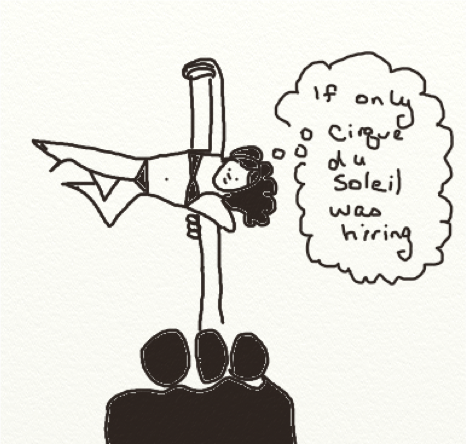 The contemporary gentlemen’s club may be encapsulated in the image of scantily clad women performing impressive acrobatic routines in front of a beery audience rather less capable of similar athleticism in a windowless building that clings to the seedier edges of town. It seems a fine irony that these strip joints, with their sticky, slick furniture, skewed sexual voyeurism and spilt beer take their moniker from establishments adjoining London’s centre of power, which excluded women, and had large windows from which the elite could watch the world outside without being seen.
Our modern gentleman’s club’s idea of the gentleman is as flat as its beer and as restricted as a bouncer’s facial expressions. There is a much more interesting story to be told, one that tracks the evolution of masculinity and gentility throughout the nineteenth century while touching on wider patterns of socialization. Continue reading “Guest Post: Another Kind of “Gentlemen’s Club”: A Brief Illustrated History of an Institution”
Dissertating with a Hammer: An Idiot’s Generalizations on Scholarship and Activism
I begin with two passages that will be the epigraphs to my dissertation:
Few critics, I suppose, no matter what their political disposition, have ever been wholly blind to James’s greatest gifts, or even to the grandiose moral intention of these gifts … but by liberal critics James is traditionally put the ultimate question: of what use, of what actual political use, are his gifts and their intention? Granted that James was devoted to an extraordinary moral perceptiveness, granted, too, that moral perceptiveness has something to do with politics and the social life; of what possible practical value in our world of impending disaster can James’s work be? And James’s style, his characters, his subjects, and even his own social origin and the manner of his personal life are adduced to show that his work cannot endure the question.
Of Mountains and Media: Versions of the Sublime
A few years ago I got a chance to see Marc Handelman’s Archive for a Mountain in person, and it got me thinking about the category of the sublime in a new way. The conceit of the work is straightforward–Handelman assembled into a single book every piece of data he could find about the Untersberg–but the product is impressive. Weighing in at a hefty 740 archival-quality pages of maps, images, brochures, essays, scanned microfilm, screenshots of Wikipedia entries, and more, the book has an excessive materiality of its own. But it also—in the way it inevitably provokes us to imagine even more material that might have been included—foregrounds the incredible constrictions that are necessarily imposed upon any subject in the process of representation, even in those renderings that we are tempted to label exhaustive or comprehensive. Its gesture towards a kind of vast and awe-inspiring archival noumenal that exists beyond the capacity of any single human or technological interface to represent it (as well as its mapping of this limit onto such a traditional representative of sublime Nature) seems distinct to me from other contemporary notions of the sublime, and actually seems to hearken back to the original problematic of the eighteenth-century sublime: how to represent a mountain?
Continue reading “Of Mountains and Media: Versions of the Sublime”
Romantics Today: Where art thou, Queer Theory?
By Talia Vestri
Ten years ago, literary scholars initiated some compelling re-evaluations of what the term “queer” in queer studies might now mean for twenty-first-century academia. By 2005, the radical wave of activism that had once propelled this theoretical trend had begun to dissipate, and it had been fifteen years since the publication of foundational texts like Eve Sedgwick’s Epistemology of the Closet and Judith Butler’s Gender Trouble. In social and political realms, LGBTQ human rights issues were making headway in the mainstream: Massachusetts had taken the initiative on marriage equality, Stonewall was an experience remembered by an earlier generation, and women’s studies courses and programs had sprung up around the country. By 2005, academic theorists had recognized that gender was a questionable and fluid term, that sex roles could be performative, and that the personal had become political. Where to go from here? Continue reading “Romantics Today: Where art thou, Queer Theory?”