Dialectical Effusions, or Why I love the Romantics – Part II

So, without further adieu, I will discuss the two working axioms and further elaborate on my reasons for loving the Romantics.
1. They were audacious and/or eccentric (perhaps I should just say “outrageous.”)
Some representative statements and exploits should suffice.

  • Coleridge and Southey‘s desire to establish a pantisocracy in America. Who does this? But how noble and grand that before Marx, some people did (or proposed doing it): an egalitarian commune. Wow. And these people are those we now call the Romantics.
  •  Coleridge on Hume (after the young Hazlitt asks for his take): “‘Hume? He stole his essay on miracles from South’s sermon!’ replied Coleridge. ‘He can’t even write. He’s unreadable’” (Wu 6). Yes, one of the 18th century’s greatest philosopher is summarily dismissed by the young Coleridge. Only someone with immense belief in their own talent would say such a thing and at the end of the 18th century when Hume’s status as a world-class philosopher was by then established.
  • The actress and writer Mary Robinson’s outrageous dalliance with the teenaged prince regent. Playing the role that made her famous, Perdita, in an adaptation of The Winter’s Tale, she speaks the following lines at a royal command performance: “… how to put on/This novel garment of gentility…/ …I shall learn/ I trust I shall with meekness, and an heart/Unalter’d to my Prince, my Florizel.” (Byrne 99). Her performance draws tears from the prince, as well as several bows–and his heart. After suffering bad press (though her ability to manipulate it was uncanny) due to her romantic attachments to the prince and to other powerful men (whom, it does not appear, the press smeared for their indiscretions though certainly for their politics), she is audacious enough to re-invent herself as a master poet and novelist. Of her, Coleridge said, “She is a woman of undoubted Genius…I never knew a human Being with so full a mind” (Byrne Epigraphs). From one genius provocateur to another.
  •  Lady Caroline Lamb, the ultimate femme fatale. She is known for writing the famous lines that have immortalized Byron: “[He was] mad, bad, and dangerous to know” (Hay 13). After their romance comes to an end (for Byron, that is) the aristocratic Caroline will not be ignored *cue Glenn Close in Fatal Attraction*. She forcefully makes herself known by breaking in to Byron’s residence and inscribing the following words in his copy of Vathek (an action filled with significance given Byron’s championing and practice of Greek Love and Beckford and his novel’s notoriety): “Remember me! Remember me!” Oh, and she also writes the novel Glenarvon–the titular character is a Byronic hero who is actually based on Byron…(wait, how does that work?)–quite possibly the first tell-all book written in the Gothic mode. Byron claimed that, upon her betrayal of him, he would pursue Caroline like Falkland had pursued Caleb. It appears that Lady Lamb turned the tables on this scenario.
  • Claire Clairmont, the not-so-famous family member (but look at the competition, though). I had always assumed she had been introduced to Byron by Mary and Percy in Switzerland but no: she wrote him before the famous trip. In an intrepid fan letter to Byron, the eighteen year old Claire commits the following lines to paper: “If a woman, whose reputation has yet remained unstained…if with a beating heart she should confess the love she has borne you many years…if she should return your kindness with fond affection and unbounded devotion could you betray her, or would you be as silent as the grave?” (Hay 78). He takes her up on her offer, though I’m not sure he didn’t betray her. But still, her letter and its fine sentence constructions render her boldly interesting.

2. They were pretty good writers too.
Whatever the criteria used to establish literary merit, their writing can be sharply ironic, lyrical, polemical, rhetorically persuasive, and often multi-generic. I’m not saying that each Romantic writer totally evinces these qualities (though I think some do) but, certainly, each exhibits mastery of at least one genre, if not two (or more). And even those that are associated with one genre, such as Wordsworth (though the 1802 Preface is pretty masterly as an essay if you ask me), are top-notch in that genre. As such, on any given day, I read the Romantics purely for their aesthetics or politics, though when writing papers, for both. But the point is that their writing is always engaging, wholly absorbing, whatever its genre, content, and politics.
(Is there an un-interesting Romantic writer? I’ve yet to find her or him. Let me know, though I suspect whoever this enigmatic figure is, something of major interest will be found in terms of their biography, writing, or political affiliations, watch.)
Politics: Conservative or liberal, Tory or Whig, the manifest political tendencies in the writing of several authors show Romantic writing to be irrevocably enmeshed with the political concerns of its day. Whether we are discussing Burke’s defense of the French monarchy (all monarchy, really) or Wollstonecraft’s Reflections on the Revolution in France or Byron’s impassioned poetic defense in “Song of the Luddites,” the intersection between history, polemical writing, and aesthetics is tightly welded together: one cannot have one without the others.
Lyricism: I was struck by Wordsworth’s lyricism. Now, I know about the sort of anti-Wordsworthian turn in Romantic studies (or so it seems to me). Or, I think scholars are perhaps reacting to the once powerful, institutionally-sanctioned equivalence between Romanticism and Wordsworth (or any of the Big Six at different times). I get it. But still. Never mind his so-called “conservative turn”: his poetry is so lyrical. The first lines of the Intimations Ode are etched in my memory: “There was a time when meadow, grove, and stream…did seem/apparell’d in celestial light….” And it gets better: “Whither is fled the visionary gleam? / Where is it now, the glory and the dream?” Wow. This longing for the luminosity of the past. Beautiful. (And I’m aware of the French Revolutionary undertone but, nevertheless, I still sometimes just want to read it for its cadence and beauty, its power to stir something melancholy and ineffable in me…) And I am one to be seduced by style, easily, as my obsession with Ayn Rand in my early twenties proves. She, by the way, wrote a book titled The Romantic Manifesto…talk about misreading (though Rand and my eventual turning from her writings and teachings are subjects for another day. Suffice to say that I do not consider her a Romantic nor do I now consider myself a Randian.)
Anyway, to conclude I’ll say that as with all obsessions, scholarly and otherwise, I believe they originate in some primal scene, in a trauma experienced during one’s formative years. Discussing what such primal scenes might be in my life are beyond the scope of this blog, though I have no aversion to discussing them—ask me at a conference sometime. I will say, however, that I am continually propelled and assailed by contradictions, that is, I am almost always besieged by contradictory impulses. For instance, some days, I want to live in a world where transcendence is possible. On such days, I happen to believe in extraterrestrials and want to experience what some UFO specialists designate as Theophony (a connection with all and with God) which occurs in one of the stages following an alien abduction. I’ve even thought about camping out and keeping a night’s watch for sight of aliens. I sometimes converse with my ancestral deity, Ometeotl Moyocoyani (“He who invents or gives existence to himself”), as if I were chatting with my neighbor about the weather. And I’ve also thought about reading Hermetic scrolls in order to discover the ritual, symbolic steps I need to take in order to lose consciousness of myself while entering into communion with the plenitude of the Universe. Transcendental knowledge. Yes, I seriously have thoughts about this. And, so, there are the Romantics whose lyricism and content provide somewhat of transcendental moments.
On other days, the political unconscious aggressively asserts itself: not only Romantic texts but also newspaper headlines, advertisements, the idea of transcendence, and the unjust social order all scream out their ideological construction. It is with Jacobinical fervor that I begin to re-focus on political and economic crises and on the privations suffered by various underclasses. When I do, my pursuit of transcendence seems a tad misguided and quietistic. I struggle, always, with my decision to pursue graduate school while several communities I hold close to my heart continue to struggle, while I’m writing seminar papers on Percy’s “Alastor”. But I’m ok with this. Now. And this is because the Romantics are (incredibly!) with me on all these issues, as well. In fact, I audaciously venture to say that the Romantics speak not only to these contradictory impulses but to every desire (earthly or transcendental), impulse (political or artistic), occurrence–momentous or mundane–under the sun.
Folks, I can’t wait to start the English PhD program this fall.
 

Works Cited

Byrne, Paula. Perdita: The Literary, Theatrical, Scandalous Life of Mary Robinson.

           New York: Random House, 2004. Print.

Hay, Daisy. Young Romantics: The Tangled Lives of English Poetry’s Greatest  

          Generation. New York: Farrar, Straus and Giroux, 2010. Print.

Wu, Duncan. William Hazlitt: The First Modern Man. Oxford: Oxford University Press,

         2008. Print.

Processing the WPRP Exhibit; Or, Making an Argument with Books in Cases

The Women Poets of the Romantic Period (WPRP) exhibit, called “Landmarks,” is just a few weeks away from opening in CU Libraries. The opening is set to coincide with the June 7 start of the 20th-Anniversary British Women Writers Conference, an international professional-level conference that I am co-organizing this year. When we’re done curating the WPRP exhibit, we’ll have an in-house exhibit in 8 enormous cases in the Rare Book Room as well as an online exhibit of around 20 scanned works and extended explanatory captions, photographs, and a video production. I’ve been feeling less like a dissertating PhD student and more like a contestant on Project Runway lately, working with fabric, mylar, props like shells and even a preserved spider, a museum exhibit designer, photographers, a period music consultant, and even videographers. The cast of collaborators is long and brings together librarians; graduate students in English, musicology, and museum studies; undergraduate library assistants; computer scientists and media artists; literary and art historians; and more. And thanks to the extremely friendly and collegial tone set by Debbie Hollis, the head of CU Libraries Archives and Special Collections, we are happy and very busy collaborators.
At this point, the cases are full and designed and objects are most likely in their final places, though I will no doubt futz with them more as we near the exhibit opening. My current task is to compose the script for the photographer/videographer of the exhibit and to serve as the general editor of the large collection of captions that will describe these objects online and in the video. In other words, I’m documenting the argument that I want the objects on display to make. Or rather, as I’ve found, I’m documenting the argument that the objects on display create. (I will publish these on my blog when they are complete and my collaborators are ready to release them.)
When making arguments with objects in cases, the objects, like Keats’ Grecian Urn, are anything but silent. The objects seem to arrange themselves first and the argument reveals itself afterward. This process is more physical and far less of the purely cerebral process that I have grown so used to with writing essays or dissertating. Trying to make the objects’ display conform to the argument I imagined for them did not work for me. After working with them for a year, I’ve been influenced as much by the physical and visual qualities of these books, pamphlets, manuscripts, and letters as I have by their textual content. I have spent far more time working with some of them than with others — for example, I painstakingly transcribed Mary Cockle’s letter and then worked with Susan Guinn-Chipman, another colleague in Special Collections, to piece together the parts that were difficult to read. Due to the time spent handling and reading these artifacts in cradles, in the stacks, on shelves, and on tables in Special Collections, and also the occasions I used them to teach my undergraduate literature classes, I have been influenced by their physical properties and arrangements in space and these traits have influenced my attentions and the argument I feel that the exhibit makes.

My argument for this exhibit, therefore, is based heavily on physical constraints and visual properties of the exhibit as well as my research gathered from reading these literary artifacts and thinking about them in the context of the Romantic literary era. Curating the exhibit was a mixed process of object placement based on:

  • the 200+ works in the collection that I read from June 2011 through January 2012 (my reading list was based on numerous factors, including titles and spines that grabbed my attention, ability to find them on the shelves, recommendations from other scholars, personal interests, and more)
  • pragmatism (certain objects only fit in certain cases)
  • aesthetics (certain objects only show well in certain cases)
  • my personal research interests (visual media, travel writing, the picturesque, and the gothic)
  • the arc of my desired argument as the path from one case or section to the next
  • the arc of the argument that the objects, when placed in the display cases, created and that influenced the argument I set out to make.
  • other factors I’m unintentionally leaving out

For example, the argument that I set out to make was focused on the collection as one that lent itself to the study of travel writing in the Romantic era, how print traveled, and what that had to do with women authors and complex relationships between form and gender in print culture. However, when placing objects in the front of the exhibit, in the cases closest to the door, I realized that the exhibit is as much about changing ideas of what constitutes the domestic as it is about that which lies beyond the home. This realization grew out of thinking about the Stainforth’s position in the case next to the literary annual with the beaded cover, and after pulling the Taylors’ Rhymes for the Nursery out of this case to place elsewhere. This led me to rethink the thematic organization of the exhibit. Originally, there were just two categories–natural destinations and social destinations–but these quickly expanded into three to include the domestic as our starting place. Furthermore, between the domestic and natural destinations, I noticed a collection of works, including the Taylors’ numerous works of children’s literature, that engage the Gothic aesthetic and provide a link between home, nature, and social destinations. I settled on four categories and a flow from book objects representing the domestic and home, to the gothic, to nature, and finally to social destinations and social movements. (Of course, many of these books could be placed in multiple categories.)
Perhaps a good question to ask is: where is the argument in this exhibit? Does it emanate from the objects’ placements, the path of the visitor/viewer through the exhibit, or my textual explanations of the relationships between these objects and their home in the greater collection? How does the digital exhibit and collection influence or affect the in-house exhibit, and vice versa? And what about the additional documentary components of video and photography of the exhibit? It’s a lot to curate and even more to interpret. I admit that from where I stand right now, I’m lost in the process and on deadline, to boot.
As we know, readers and interpreters will read and interpret how they will; one cannot force readers’ paths of critical attention any more than I can control which case visitors to this exhibit will want to look at first. The case by the door is the obvious choice, but who knows, a viewer may be drawn to the red cloth in the Gothic case in the back of the room, or the promise of the spider specimen hidden therein. Despite my lack of control, I will offer my exhibit argument as a way to thoughtfully present a microcosm of the magnificent ~500-work WPRP collection. The argument and the path from case to case will, in theory, lead scholars, readers, and visitors into the collection either in the Rare Book Room or online and will draw renewed attention to Romantic-era women poets who are have changed print culture and literary history.
[Author’s note: this post was originally published on my research blog: http://kirstynleuner.wordpress.com.]

Dialectical Effusions, or Why I love the Romantics – Part I

As a recently admitted student to a doctoral program in English, for my first blog I figured I would reflect on why I am pursuing the study of British Romanticism. Be forewarned: some of my reasons are un-academic, wildly emotional even, and in some ways flagrantly partake of the Romantic ideology (See McGann). But I’m ok with this.
I will organize my reasons for my love and pursuit of Romantic studies around two working axioms: 1) “The Romantics were audacious and/or eccentric” and 2) “Their writing is pretty good, too.” I will conclude by reflecting on my (almost) libidinal reasons for my attraction to the Romantics–(you have to read up to the ending, see?)
Before elaborating on each axiom, I will first discuss how I stumbled across the Romantics and then proceeded to fall wildly in love with them and their writing. As a junior Honors English major, I had a day left before deciding on an honors elective seminar. The following course title leaped out at me: “Sex, Drugs, and Rights: Experimentation in the British Romantic Era”–with a course title like that, who wouldn’t be immediately intrigued by the Romantics? I signed up right away. I showed up to class and we began to work our way through the “Rights” portion of the syllabus. We read William Godwin’s Caleb Williams and Mary Hays’s Victim of Prejudice against the backdrop of the so-called Pamphlet Wars: Burke contra the French Revolution, Wollstonecraft contra Burke, and so on. The idea that the political and the aesthetic and their intersectionality were at this period so urgently and publicly debated grabbed a hold of my imagination.
Moreover, being a double major in Chicana/o Studies, the idea that civil rights and reformist politics were not solely an American 1960s phenomenon, threw off my sense of a progressive sense of history–an aporia: before the 1960s, the British (of all people!), were in the vanguard of reform and demanding civil rights for women, the working class, etc? And as far back as the 1790s? The thought was staggering and led to more questions, one being: what happened to civil rights reform in England and the U.S. in the 1790s1960s interval? These types of historical questions set the tone for the rest of the semester and have continued to inform my studies of the Romantics and of Civil Rights history & literature, generally. (I recently discovered the concept of “postmodern Jacobinism” in Orrin Wang’s Fantastic Modernity: Dialectical Readings in Romanticism and Theory which provided me with the means for theorizing the link between the French Revolutionary 1790s and the Civil Rights movements of the 1960s.)
We also read De Quincey’s Confessions and Coleridge’s “Kubla Khan” and William Beckford’s Vathek. (Here, I will only discuss De Quincey). Wow. Though De Quincey’s elaborate and operatic drug-induced hallucinations fascinated me to no end, the first half of the book–the “sober” portion–also grabbed my attention. Here was this son of a merchant who though materially impoverished, knew his Greek and Latin (something he reminds his reader of continuously and at one point, I think, claims to know better than an uppity man of the cloth). De Quincey’s self-representations were contradictory but intriguing. On the one hand, he is quick to remind readers of his classical learning; while on the other, even as he strains to define himself against London’s lumpenproletariat, there is a sense of empathy for the disempowered, evidenced especially in his sympathy for his friend, the prostitute Ann, and for the orphan girl. Of course, his drug use and its mental effects were interesting too, filtered as they were through orientalia and grotesquely beautiful imagery, all interspersed with philosophical ruminations. All these elements combined to give a sense of a troubled but brilliant mind (his syntax was so fine, too, so precise yet poetic). In short, the class whet my appetite for more of the same: complex and disturbing political material packaged in pleasing (to me) aesthetic form.
After finishing up the class, I then took several other Romanticism courses (with Romanticist Ranita Chatterjee), such as a “The Construction of Romanticism: Wordsworth and Shelley” and “The Traumas of the Godwin-Shelley Circle,” and continued to read primary and critical texts during my free time. I read Percy’s “The Mask of Anarchy” and De Quincey’s satirical essay “On Murder Considered as a Fine Art.” As far as criticism, I perused sources diverse in their ideological orientation, such as Wang’s book, M.H. Abrams’s The Mirror and the Lamp: Romantic Theory and the Critical Tradition, Frances Ferguson’s Solitude and the Sublime: The Romantic Aesthetics of Individuation, and Tilottama Rajan’s Supplement of Reading: Figures of Understanding in Romantic Theory and Practice. These not only helped me engage with the changing conceptions of what constitutes Romantic Literature but also to become aware of the extent to which critical methods enable these and other scholars  to read, extend, and problematize Romantic Literature. It seemed to me that Romantic texts were somehow inherently capable of generating new readings, inexhaustible in their capacity to stretch and bend to the probing eyes of scholars who used novel theoretical lens.
Once, while reading Mary Shelley’s The Last Man under a canopied tree on my campus, I had the thought that Romantic Literature, through its aporias–in Mary Shelley’s novel, the narratological disjunction caused by the prologue which mentions that the “last” man’s ensuing narrative is edited by two tourists—was like this organic, mystical clay that continuously took on amorphous shapes, receptive to the critic-claymaker’s deft touch. Yes, I had this very strange thought that is very Romantic and a little screwy. (But it only certifies—makes me certifiable?—that I’m pursuing the right literary period.)
Romanticism, on a bad day, makes me grumble, “These interesting writers are nuts.” On a good day, reading these writers stimulates my own inner-Romantic lunacy.

Work Consulted

McGann, Jerome J. Introduction. The Romantic Ideology: A Critical Investigation. By McGann Chicago: University of Chicago Press, 1983. 1-20. Print.

 Stay tuned for Part II…

On Creature Comforts

my fav ex-gymnast's kitty kat

James Harriet calls cats the “connoisseurs of comfort,” which is perhaps why so many academics are cat-lovers. Like having Of Grammatology on your nightstand, having a cat close at hand reminds you what it would be like to move through the world expressing yourself utterly as you see fit.
There is an inverse relationship between the size and comfort of one’s desk and the size of one’s research topic. When learning about, say, the entire political spectrum of Western Europe, you sit in a lecture hall in a tiny, left-handed desk at the end of the row, with schoolbag and jacket mashed underfoot, drinking scalding Starbucks from a paper cup clutched between your knees, which is surely leaving red marks on the insides of your thighs. The desk space is more suitable as an elbow rest. The chair seems to have been designed for torture. Even the professor looks uncomfortable, hiding up there behind the lectern. So, as the history of radical political change sweeps by you on power point slides, and the impossibility of note-taking becomes more and more apparent, you are likely to sigh and hope the information will be made available online. This is the plight of the undergrad. To be cramped, to be physically uncomfortable, to be held in check by what Althusser would recognize as the regulatory organization of classroom chairs which all face forward so that we must rub up against our peers but never look at them.
On the other hand, grad students—individuals whose educational spectrum has narrowed over the course of many years to a pinpoint (pinnacle?) of specific research interests—do not fit in tiny desks. We think tiny desks are bullshit. Grad students tackle the necessity of study-surfaces in one of two ways: either we dispense with desks altogether, bringing our MacBooks to coffee shops, where, for the price of a caramel macchiato we spend the afternoon balancing our research on our thighs; or, we take over large surfaces like kitchen tables and those long study-benches in the library, of which we require at least two-people’s-worth of length. In order to craft our tiny, complex arguments about the relationship of enthusiasm to the impotence of language in Hölderlin’s Hyperion (oh, wait, that’s just me), we require at least six books of literary criticism to be spread about us. We need our binders of photocopied articles close at hand. It is absolutely necessary that the fridge/our book bags be filled with snacks, and that the coffee maker be either warming up, actively brewing coffee, or keeping fresh coffee warm and at the ready. We require, in other words, all our creature comforts to be on hand.
Yet comfort is a fickle, tricksy feline. As soon as you think you’ve got her figured out, that little, Puritanical voice inside your head (the one that is terrified that you will never finish your dissertation, never get a job, never really be a success as an academic) notices how cozy you are and admonishes you, reminds you not to get too comfortable.
“Don’t get too comfortable!” With a self-indulgent little chortle, those exact words slid through my consciousness this morning. But what does that even mean, I asked myself. Is that some kind of a threat? Is my comfort impinging on anyone else’s comfort? Is there a limited amount of comfort in the world? Is there not enough to go around? DOES COMFORT NEED A BAIL OUT? Probably. Unlike money, however, I don’t believe comfort can be created out of thin air. Mein Gott! A small tangent, forgive me. What I was meaning to say is that even though I do everything in my power to create a life of ease and aesthetically pleasing coziness, I have this deep-rooted suspicion of comfort. Perhaps it’s too petite bourgeois, a bit too middle class. An aristocrat takes comfort for granted and seeks instead passion, adventure, intensity; he goes hunting for lions and some such, while the rest of us seek apartments with good central heating and a bowl of gourmet mac and cheese (gouda). Mostly, however, my suspicion of comfort arises from the fact that I make a direct correlation between comfort and productivity, which is to say that I fear that if I get too comfortable I will cease to produce scholarly work. This is why I need TAships and a (couple of) part-time job(s): just to keep me running around enough to make true comfort impossible.
Cats are comfortable because they refuse to be otherwise. But then again, they are also cats, and as Christopher Hitchens so aptly notes,
“Owners of dogs will have noticed that, if you provide them with food and water and shelter and affection, they will think you are god. Whereas owners of cats are compelled to realize that, if you provide them with food and water and shelter and affection, they draw the conclusion that they are gods.”
Finally, from this I take comfort. Comfort in the fact that I am neither a hopelessly naïve pup nor a sociopathic kitten, and will undeniably and reliably always return to the research at hand.

Reading List Adventures

This is the semester I am struggling to put together my reading list for the comprehensive exams. I have to admit it’s a rather exhausting process, much more exhausting than I initially planned for. I entered into the PhD thinking I had a firm grasp on what I wanted to do – pursue eco-criticism and animal studies in Romanticism. I’ve found out that’s a rather hard thing to do. Going into a relatively interdisciplinary field requires a lot of thinking about different kinds of texts, themes, and theories. Anyone who has read texts dealing with race or gender will tell you that animal metaphors work to separate different kinds of people. So, are these metaphors in some way worth talking about, given their obviousness in the texts? In what ways do they change as the Industrial Revolution takes hold and separates, in a somewhat larger way, mankind from nature? The most important question (for me at this point, anyway) is how can I begin to get a hold on this issue in time to create a cogent and defined 120-odd booklist?
As I began working on it, I knew that environmental metaphors animated critical gender discussions in the Romantic era. In Vindication of the Rights of Women, Mary Wollstonecraft argues that women are poisoned by their own culture, “for, like the flower which are planted in too rich a soil, strength and usefulness are sacrificed to beauty.” Yet, “the perfection of our nature and capability of happiness” is partially based upon “man’s pre-eminence over the brute creation.” Those are obvious metaphors, but the way in which they position a woman in relation to the environment intrigues me. I thought about several canonical works from the period, and then I consulted several anthologies as well as these lengthy lists:
http://graduate.engl.virginia.edu/oralsonline/
http://www.columbia.edu/cu/english/grad_orals.htm
http://www.english.ucla.edu/index.php/Current-Students/graduate-reading-list
There’s a lot of texts on there, some that I was only peripherally familiar with and some that I had never encountered before. I looked for texts written by women or texts that dealt with the question of women that also involved the environment or animals. As you can imagine, that led to a rather long list filled with novels, poetry, plays, travel essays, literary essays, and theory tracts.
Then, I had a sort of revelation that I was not expecting and it came from an odd place. I began looking at pretty pictures of dresses.
Yes, you read that right. Pretty dresses. When it is winter and I feel bogged down by reading, and grading, and writing, I like to look at art, clothes, and houses from the period I study. It’s mentally invigorating, but that might just be an excuse I tell myself to look at beautiful dresses.
I noticed through my cursory searching a rather huge difference between women’s fashion pre- and post-Romantic Era fashion, especially in terms of how much of the body is shown and what is on the linen.  Dresses changed from being highly structured and covered in flowers to being more flowing with less natural decorations. I am in no way claiming to be an expert on women’s fashion. How correct or incorrect these observations are is less important than the effect it had on my list-making. I began to wonder how animals and the environment were utilized to produce certain kinds of bodies. That began to narrow down my list, and it also gave me a clearer picture of what else to put into the list.
My advice for this whole process is pretty simple:
1.)   Look around a lot. Consult examples of lists, anthologies, your Amazon wish-list. You’ll need to balance the canonical, but also find the exciting, bizarre, and strange you believe you might want to read.
2.)   Be available for inspiration in whatever form it happens to take. Go to a museum. Go outside. Talk to your pet. Eat a good meal. Give your mind a moment to relax and you’ll find the Ah-ha!


The Speculative Turn and Studies in Romanticism

It might be fair to say where philosophy goes literary criticism follows, but the current destination is a little unclear.  Today’s graduate students of romanticism work with professors who rose up in academia when philosophical camps presented themselves in plain sight; one was either “influenced” by Derrida’s phenomenology, Foucault’s genealogies, Lacan’s brand of psychoanalysis, or some other wing of continental philosophy.  At this year’s MLA conference in Seattle I listened for hints of literary criticism’s current trajectory.  Mostly, I heard Fredric Jameson’s name but not so much in regards to a future direction.  However, peeking over the disciplinary line reveals a philosophical shift that has gained momentum in the last five years, commonly referred to as the “speculative turn.”
The speculative turn is a turn in the sense that the conversation has moved away from the linguistic one.  Speculative philosophy is generally metaphysical, systematic, and works outside the domain of the hard sciences.  The most recent emergence of speculative philosophy is interesting because of its investment in materialism and realism, and its engagement with the hard sciences.  Steering away from idealism (commonly associated with Kant and his successors), suggests that reality exists independent of human agency.  For many literature students, to declare one’s work materialist in 2012 will sound redundant, because materialist accounts of history in English departments have been prevalent for decades.  But that work was materialism without metaphysics, a discussion absent of the Absolute or the thing-in-itself, for better or worse.
What distinguishes the speculative turn is its posited problem, what Quentin Meillassoux calls “correlationism” (5).[i]  In short, correlationism is the insistence of the relationship between the concept of a thing and the thing itself, and it is this relationship that prohibits access to either.  Romanticists studying Kant and company know this story well; this “relationship” is what Kant refers to as the “transcendental schema,” a mediator between the object and the mind’s concept of that object (B 177, 181).[ii]  But, in Ray Brassier’s “Concepts and Objects,” included in the who’s who of continental materialism and realism, The Speculative Turn (2011), he says it is taken for granted that the “difference” or relationship between the thing and its concept is anything but conceptual (64).[iii]  To assume the difference is conceptual delimits the relationship to a strictly human imposition.
From the example of how one might interrogate a correlationist situation (Brassier uses George Berkeley to illustrate his point), it is clear that continental materialism and realism pursue further ways of engaging with the world without positioning the human as somehow detached or above the world engaged with.  Such an anti-anthropocentric line has been re-charged in late by Deleuze, especially in his critique of representation.  But if correlationism reinforces the linguistic turn’s abandonment, and hence the abandonment of representation, that does not necessarily mean “language is dead.”  The death of language holds especial concern for romanticists because English departments carry the burden of such a potential death.  Rather, the turn suggests that if an inquiry is to access anything immediately, to begin and end the investigation with language is to never even start.
So how does the speculative turn impact literary studies and studies in romanticism, in particular?  To be clear, philosophy and literary criticism are not the same.  There were many books of literary criticism from the 1980s and 90s “influenced” by deconstruction, but these books merely use a method in order to approach literary texts, which, initially, was not the method’s aim.  In some sense then, the new philosophical turn is quite remote from literary studies.  On the other hand, when the philosophy giant moves, its gravity impacts the academic milieu in general.  The fact that the speculative turn reasserts materialist and realist philosophy undoubtedly encourages a similar embrace in literary fields.  Especially for romantics, this re-emphasis is historically significant because Rousseau (our man!) largely marks the turn away from his hard-lined materialist predecessors.  But Rousseau is a signpost, not a gravestone.
The theories Rousseau sought to overturn did not die so much as criticism has preferred to focus on less thingly topics.  Materialist readings of romanticism have been lost for years, traded in for borderline idealist, dialectical ones. For instance, almost no critical reading of Wordsworth appears without citing the excellent and comprehensive Wordsworth’s Poetry by Geoffrey Hartman (1964), whose bibliography just so happens to dismiss W.H. Piper’s pantheistic materialist account of the romantic imagination, The Active Universe(1962).[iv] Current studies will not merely return to Piper’s history of ideas though.  Taking an object-oriented approach, coined by Graham Harman in his Tool-Being (2002), romantic studies might zero in on the object itself, independent of any relationship at all.[v]
In some sense, this “new” move is as much a return to the old as any new move is.  At the same time, it’s a return with a difference.  Derrida is back on the scene, but Martin Hägglund’s atheist Derrida.  Schelling has a starring role, but thanks to an increase in translations and Iain Hamilton Grant’s focus, the emphasis lands on Naturphilosophie.  In romantic studies, I suspect, given the recent emphasis on the more scientifically inclined Erasmus Darwin (e.g. Dahlia Porter’s work), a renewed interest in Newton and Locke will follow—hopefully, along with some “minor” figures that have gone overlooked.  In other words, if the speculative turn signals anything to us, it’s that we can do more.


[i] Meillassoux, Quentin.  After Finitude.  Trans. Ray Brassier.  London: Continuum, 2008. Print.
[ii] Kant, Immanuel.  Critique of Pure Reason.  Trans. Norman Kemp Smith.  New York: St. Martin’s Press, 1965.  Print.
[iii] Brassier, Ray.  “Concepts and Objects.”  The Speculative Turn: Continental Materialism and Realism.  Eds.  Levi Bryant, Nick Srnicek, and Graham Harman.  Melbourne: re.press, 2011. Print.
[iv] I was pleased to see an endorsement—not a ringing one—of Piper in Paul Fry’s excellent, Wordsworth and the Poetry of What We Are (2009).
[v] Harman, Graham.  Tool-Being: Heidegger and the Metaphysics of the Object.  Chicago: Open Court, 2002. Print.

Now Playing: Byron's Manfred

Lord Byron’s first drama Manfred was published in 1817. While the play proved a commercial success, it never made it to the stage. In 1820, however, Marino Faliero was published and began being performed at Drury Lane later that year. As Thomas L. Ashton points out, Byron’s play is severely edited. Therefore, like Coleridge’s Remorse, the scholarly critic has multiple objects of inquiry: the original version of the play, the staged production, and the text of that production.
But perhaps what is most interesting about the staging of Marino Faliero is Byron’s response. In 1821, Byron published a collection of dramas containing Sardanapalus, Cain, and The Two Foscari separately from his regular verse. Contemporary reviewer William Gifford and Victorian commentator Matthew Arnold see the collection as the poet’s attempt to distance his weak dramatic experimentations from the rest of his work. Yet the features of this volume demand more attention. The collection lacks the usual Byronic trappings; most notably there is no frontispiece of the poet himself. Also, in his 1821 review of Sardanapalus, John Gibson Lockhart asks why Byron and his publisher John Murray decided to release the new collection during the same week that John Constable released Pirate, the new Walter Scott novel. Byron fought Murray to have his three dramas published at the end of theater season, despite the fact that such a release date would make the collection a commercial rival with Britain’s other top selling writer.
What if one of the plays in Byron’s 1821 collection made it to the stage in the poet’s lifetime? What are the implications of staging a play that the author contends was not written for the playhouse? In other words, what happens when the play is remediated? Furthermore, what happens to our scholarly narratives if we foreground the medium of the playhouse? Does Byron’s position in the canon change (he has proven disruptive and does not appear in certain foundational works including Natural Supernaturalism)?
Wordsworth and Coleridge’s early dramatic efforts have received attention but what of other prominent writers who forayed, or attempted to, into the playhouse? What are we to make of the fact that William Godwin continued writing plays, only one of which was staged and only once, when he had found success as a political philosopher and novelist? How are we to read the fact the only work of Shelley’s that needed a second edition in his lifetime was The Cenci?

Romanticism: A State of the Union

Inspired by the President’s recent State of the Union address, I have decided to offer you, my Romantic brethren, a review of the state of Romantic studies. Despite our brooding Byronic ways, our Union is getting stronger. The house of cards may indeed have fallen, but our field is not languishing on the marble steps. Moneta will come!
::obligatory applause break::
The 2010 NASSR Conference in Vancouver, British Colombia took the idea of “Romantic Mediations” as its theme. Participants were encouraged to submit proposals that explored communication technologies and print culture. As the call for papers makes clear, “The era that saw the invention of semaphore, telegraphy, the continuous-feed press, and the difference engine, the Romantic in all its senses might be characterized as a period of significant experimentation in media and ideas of mediations” (NASSR). While many papers engaged with new inventions and their effects on Romantic era works – I heard an excellent paper regarding the influence semaphore had on theatrical gesturing practices – others utilized the concepts and language of media and mediation in order to offer new and perhaps more precise ways of engaging with and understanding key Romantic writers and texts.
The issues and concerns of last year’s NASSR conference are also being addressed by McGill University’s ongoing collaborative endeavor “Interacting with Print: Cultural Practices of Intermediality 1700-1900.” Founded in 2005, the interdisciplinary and interinstitutional research group headed by Susan Dalton, Andrew Piper, Tom Mole and others sets out to investigate “how people interacted with printed matter, how they used print media to interact with other people and how printed texts and images interacted within complex media ecologies.” The group focuses on the relations and interactions between various media. In order to more accurately, in its terms, “situate” print, the collaborative group sets out to debunk three prevalent scholarly “myths”: that print displaced other media, that print equals letterpress or engraving, and that print culture is national culture. In the online manifesto for “Interacting with Print,” the group claims that their “research activities will provide a more specific understanding of print’s place in the production, dissemination and reception of culture in a period that saw the development of mass media.” Print, as this quotation makes clear, was only one of many mediums for producing and disseminating culture and oftentimes incorporated other forms of media such as printed images.
Together, the conference and working research group speak to a set of issues being addressed by current critics of the Romantic period. Many scholars, including myself, have asked why this interest in media and mediation is emerging at the present moment. I believe that the answer, at least in part, lies in the new descriptions and definitions of the Romantic period and Romanticism offered by thinkers like Walter Ong and Friedrich Kittler. In his 1982 work Orality and Literacy, Ong claims that the Romantic desire for “autonomous utterance” is facilitated by print and speaks to the “alliance of the Romantic movement with technology” (158). That is, print mediates the Romantic desire for interiority and individuality. According to Ong, there is a clear correlation between the mediums of Romantic art, in this instance print, and the prevalent artistic ideology of the period. Relying on and citing Ong’s work with notable frequency, John David Black’s recent book The Politics of Enchantment: Romanticism, Media, and Cultural Studies labels Romanticism as one of the effects of print: “Coming some three centuries after the invention of the mechanical press, romanticism was the mature cultural expression of the cumulative effects of Gutenberg’s breakthrough” (134). This quotation makes Romanticism the result of the proliferation of print that started with Gutenberg’s press.
Similarly to Ong, Kittler’s landmark work Discourse Networks 1800/1900, published in 1985 in the original German and translated into English in 1990, draws attention to the relationship between media and Romanticism. Especially important to Kittler’s text is Foucault’s essay “Maurice Blanchot: The Thought from Outside.” In this early work, Foucault develops what David Wellbery calls “a lexicon of exteriority” (xii). The French thinker sets out to distinguish between language itself and “the apparatuses of power, storage, transmission, training, reproduction, and so forth that make up the conditions of factual discursive occurrences” (Wellbery xii). Like Foucault before him, Kittler’s work situates what is said or written in a secondary position and instead focuses on these “apparatuses.” His decision to title his 1987 follow up work Gramophone, Film, and Typewriter further underscores the important role communication and storage apparatuses play in his thinking. For Kittler, scholars are always dealing with media, with the technological possibilities of any given epoch because it is through the media of a given moment that “something like “poetry” or “literature” can take shape” (Wellbery xiii). As Thomas Streeter points out, Kittler “suggests that one should understand romanticism, not as a collection of texts or a historical period, but as a way of organizing discourse through practices of writing, reading, and relating” (777). Streeter and other critics, however, also feel that Kittler’s work often places too much emphasis on technologies and, at times, veers towards techno-determinism. Yet, these criticisms aside, the German thinker’s influence over contemporary literary studies in general as well as Romantic criticism is undeniable.
Clifford Siskin and William Warner’s collection of essays, This Is Enlightenment, elaborates upon the ideas present in Discourse Networks as well as Gramophone, Film, and Typewriter. The two critics argue that every history constructed by literary scholars has its benefits but a history of what they term “mediation” has the potential to “clarify both the singularity of each local event and what those events have in common” (11). They “use “mediation” here in its broadest sense as shorthand for the work done by tools, by what we now call “media” of every kind – everything that intervenes, enables, supplements, or is simply in between” (4). In this passage we can begin to see the similarities to Ong, Foucault, and Kittler’s focus on the technologies and “apparatuses” of given historical moments. Siskin and Warner, who were the keynote speakers at the NASSR conference referred to at the start of this post, show that “mediation was always necessary but the forms of mediation differ over time” and therefore there exists “a history of mediation” (9). Under this new framework, the Enlightenment becomes “an event in the history of mediation” (1). The Enlightenment was facilitated by a historically specific set of forms of mediation such as print, reading, writing, and other associational and relational practices.
Naturally, redefining the Enlightenment in such a manner leaves critics of the Romantic and Victorian eras asking what place in the new history their own periods hold. Siskin and Warner address this question in their 2011 article in The European Romantic Review, “If this is Enlightenment, Then What Is Romanticism?” According to the article, “Enlightenment is an event, Romanticism is an eventuality, and Victorianism is a variation” (290). The forms of mediation do not change or proliferate in equal measure. That is, some moments, in this instance the Enlightenment, have both a greater variety and number of forms of mediation than others. The claim that Romanticism can be seen as an “eventuality” also reflects John David Black’s claim that Romanticism is the “mature cultural” result of the Gutenberg press.
If the “apparatuses” of storage, transmission, communication, etc. are worthwhile objects of inquiry and if the Enlightenment is an event in the history of mediation, then how is the current scholar of the Romantic period to engage with and comment upon a work or a collection of works? Or, as John Richetti asks in his review of the This Is Enlightenment collection, “How would foregrounding mediation change the kinds and areas of inquiry in our own epoch?”
Yours in Romanticism,
Randall Sessler, NYU

Using Zotero

Intro: Zotero’s my new favorite research tool. Why? Because it’s a Rhizome. But what isn’t (nowadays)? No, seriously. It is a rhizome and it happens to be a rhizome of the most useful sort. Zotero helps to visualize the relations between ideas, images, and texts in a way that few other research tools allow. For those unfamiliar, Zotero’s a powerful citation management program, frequently used as an extension of Firefox (but also can be used as a standalone application) that makes possible multiple points of entry and useful exits from information you’ve assembled in your research. Moreover, and maybe most importantly, Zotero offers a degree of scholarly peace of mind by backing up all your citations and notes on their server automatically, courtesy of the Mellon, Alfred P. Sloan Foundations and others. You receive 100 MB of space free, but can move into the 1 GB tier for only $20/year. I’ve been using Zotero pretty extensively for about six months and have used only about 9% of my storage space.
While perhaps the best introduction to Zotero can be found on their website (http://www.zotero.org/support/quick_start_guide), I’ve set out as my task (complete with screenshots) to show how I use this incredible tool in my own early graduate research (#bravery) in hopes it may spark some ideas that might be helpful you all in your own respective scholarly practices.
How I Found Out About Zotero & How I Found Zotero Useful: I discovered Zotero last spring on the recommendation of my adviser–who’s a wonderful advocate for the absorption of digital technologies into Art History methods. I found downloading the program easy  (http://www.zotero.org/download/). After beginning to use Zotero, I quickly became impressed with how great it is to save even basic citations for later use–why I even refused to use EndNote as an undergrad, I don’t even know.

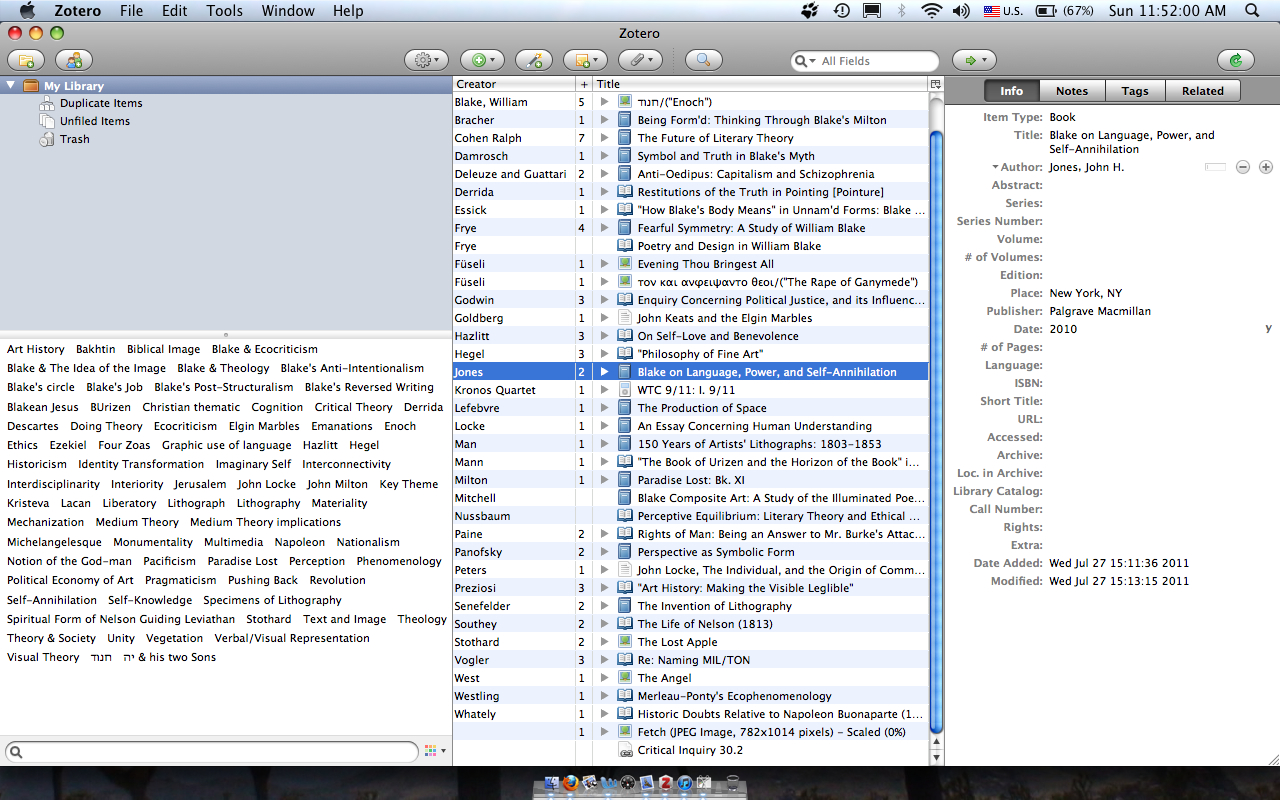
Zotero Main Screen Grab

I quickly became captivated by the usefulness of the “tag-function” as a means of exploring the interrelations between information. Indeed, in my case, this function allowed me to organize the flow of information between primary images, texts, and secondary source material in a really effective way. For instance, working on Blake and self-annihilation has generated certain challenges for me in navigating between where the idea comes up in Blake’s poetry, in the visual fields of the illuminated books, in other Blakean artistic media (his watercolors, his lithograph, etc.), its relation to period specific primary text materials, and more contemporary critical theory. Zotero allows me to see these phenomenon in relation to the ideas of scholars who have previously explored them, easily.
Quick & Dirty examples: For instance, hitting the tag “Self-Annihilation” allows me to visualize connections between the following range of texts, images, and tags I’ve created:
To the left, the blue tag indicates the primary idea I’m pursuing, while the remaining black tags indicate what other tags are related to the primary idea. To the right, Zotero displays what texts and images are tagged with the primary idea. As a second step, let’s say I’m interested in self-annihilation as it relates to Blake’s Enoch lithograph, specifically. To find new connections, I’d highlight both the tags “Self-Annihilation” and “Blake’s Enoch.”
The tag-function has allowed me to connect the lithograph to a diverse array of materials: two images I had tagged (but forgotten) as similar immediate objects of interest (“Christ Offers to Redeem Man” from Blake’s Butts Paradise Lost watercolor series and Jerusalem, pl. 41), a Hazlitt essay that I saw as exhibiting similarly self-annihilative concerns, and one of my favorite selections from Anti-Oedipus. Indeed, and also helpful, in this regard, is the ability to store copies of files–and namely images–within your personal Zotero database. With the way I use the interface, a simple click will load a stored image

(In the screen grab:) William Blake. “Christ Offers to Redeem Man” in Illustrations to Milton’s “Paradise Lost” (Butts Set), 1808. The William Blake Archive. Ed. Morris Eaves, Robert N. Essick, and Joseph Viscomi. 7 November 2011 <http://www.blakearchive.org/>.

Conclusion: In the end, after using Zotero for the last six months, I can’t even imagine going back to paper-based research note taking. It will be interesting to see how these new technologies drive humanities research forward in the future, and what new and more complex connections might be forged in all our studies. I also recognize that I’m not the only NGSC member who uses Zotero, and would appreciate comments on what tips and tricks you all have for using the program in your own work.

'Tis The Season to Apply for Research Fellowships

It’s that time of year… and no, I don’t mean for busting out the Holiday music (for that please refrain until after Thanksgiving.  Thank you.).  This, my friends, is the season to consider applying for research fellowships!  With so many thrilling archives around, full of material ripe for analysis, it would really be a shame for scholars like us not to use them in our research—especially because libraries often offer us money to do so!  Both short- and long-term fellowships are available at many major libraries and archives, and although some of these are reserved for scholars who already have their doctorate degrees, others specifically aim to help PhD candidates complete their dissertations or research for a specific article they plan to publish.
Of course, to get a fellowship you have to apply, and the competition is stiff—which is exactly the reason I’m posting about it right now.  If you’ve found a specific archive with which you want to spend some quality time, it behooves you to start NOW, drafting your application and asking people to write your letters of recommendation.  For the libraries I’ve looked at, most fellowship application deadlines fall between December 1st and March 1st.
I’m still new to writing research fellowship applications myself, but I’ll pass along a few pieces of advice I’ve been counseled to keep in mind.  They’re pretty intuitive, but worth mentioning nevertheless.
First, define your target.  There’s no sense in visiting a specific archive if it doesn’t have the materials that will be useful to you, or if those materials are also available somewhere closer to home. Also, libraries will see no sense in supporting your visit if you don’t have a specific project for which to use their materials.  Thus, it’s imperative that you clearly articulate both the nature of your specific research project, and what role the library’s holdings play within that project.  The former is (I think) one of the most challenging things we do in this profession, but the latter is pretty easy to manage: comb through the library catalogues and start making lists of items you would look at if you could.  Although many library catalogues are not comprehensive, searching them and making wishlists will help you get the lay of the land, so to speak, and plan future academic projects and research trips, whether or not you get the fellowship.  In your application, mention some of these specific items from your list (and check in Worldcat to make sure they’re not also at the library of your home institution!).
Second, know your audience.  Most committees assessing applications consist of librarians  whose job it is to match their knowledge of the library’s holdings to projects that will use these holdings to develop exciting new ideas.  Even if readers do have training in your field, it is unlikely that they will be experts in your specific area.  Therefore, your project description should eschew all jargon, so as to be lucid and interesting to an intelligent general reader.  Preserve your sense of the project’s intervention and be specific about what’s at stake, but craft it for people who are not necessarily Romanticists.  (This is a useful skill to hone for the job market as well!).
Third, write with authority. While avoiding jargon, show that you have a solid understanding of what your work will accomplish, as well as the competence to accomplish it.  Avoid passive voice: instead of saying “It will be demonstrated that…,” go for “I will demonstrate that….”.
Fourth, specify expected outcomes.  What will this fellowship enable you to do?  Finish a chapter? Complete an article for publication?   You don’t need more than a sentence or two, but you should show that your research will result in production of a tangible piece of scholarship.  Your readers aren’t going to pay you just to think about stuff—they need to know your work is going somewhere.
Fifth, organize, organize, organize.  Most of these applications are quite short, meaning you must pack a serious punch in very few words.  Have a thesis statement, clearly articulate your project’s intervention and importance in your field, and be as clear and precise as possible.  Ask colleagues and professors to read your proposal, and then be willing to revise (sometimes repeatedly).  Again, whether or not you get the fellowship, this process is useful just for your yourself! It will help you comb through the tangled web of thoughts and find the golden thread that holds it all together—the ultimate quest of any project, right?
There are big, comprehensive archives, and small, specialized archives, so I thought we could start building a list of favorites!  Below I provide links to three fellowship-offering biggies: huge institutions with something for everyone.  But there are so many others!  If you know of a great archive, or have experience using it (like Michele at the Huntington, or Jacob at the Yale Center for British Art, or Kelli at the British Library), please leave a note in the comments!
Newberry Library (Chicago, IL) – Dec. 12, 2011
Huntington Library (San Marino, CA) – Dec 15, 2011
Beinecke Library (Yale) – March 2, 2012 (also, they have a Fall application in October)
Others for you to look up, or comment on: New York Public Library, McNeil Center for Early American Studies, The American Antiquarian Society, Winterthur Library, the Library Company of Pennsylvania, the Massachusetts Historical Society, Dumbarton Oaks Library, the Getty Research Institute, Kew Library (Royal Botanic Gardens), RHS Lindley Library. . . .
Again, we’d love to hear your recommendations or personal experiences with any useful archives! Thanks for sharing.
Happy Application Days to All!
-Kelli