The Orient as Other in Kubla Khan
By Lucille Starer Marshall
Orientalism, as defined by Edward Said, is a mode of knowledge production that sustains a basic distinction between the East and West. Orientalism produces cultural theories, political accounts, and literary representations of the Orient that maintain the world’s imbalances of power. At a time of Western imperialism and national cultivation, Romantic writers participated in constructing the image of the Orient. Through poetic style, diction, and narrative, authors established a distinct Other in order to assert the superiority of Western civilization. We encounter such Orientalism in Coleridge’s Kubla Khan. Continue reading “On First Looking Into…Kubla Khan”
Thoughts on Teaching Jane Austen
I am currently teaching a class with the very long title The Modern Self in the World: Literature and Art across Modernity, from Donne and Dürer to Baldwin and Cool Hand Luke. As with my other class (on American literature), I’ve used my teaching opportunities as a graduate student to escape the burden of academic and professional decorum. My classes, in other words, might be retitled, “books I like to read, want to read, and think you should read.” They are not lectures or surveys, but rather reading groups where my students and I try and make sense of the various texts we confront. Continue reading “Thoughts on Teaching Jane Austen”
On His Birthday: Dylan Thomas, Wordsworth, nostalgia and poetry.
Today is the hundredth anniversary of the birth of Dylan Thomas, my first and best love in poetry. Lionized by the culture industry but ignored by the academy, this milestone date will hopefully present an opportunity to reassess the value of Thomas’s work, which I feel is sadly neglected.
It is something of a commonplace for Thomas to be associated with the ‘romantic’ tradition, or to be called a Romantic poet. Continue reading “On His Birthday: Dylan Thomas, Wordsworth, nostalgia and poetry.”
On First Looking Into…Coleridge's Conversation Poems
Coleridge and the Sound of Music in the Conversation Poems
By Zoe Baker-Peng
Methinks it should have been impossible
Not to love all things in a world so filled,
Where the breeze warbles, and the mute still air
Is Music slumbering on its instrument.
(‘The Eolian Harp,’ 30-33)
As I read Samuel Taylor Coleridge’s conversation poems for the first time, in particular ‘The Eolian Harp,’ ‘The Nightingale,’ and ‘Frost at Midnight,’ the frequent pairing of nature and music struck me as intriguing. Throughout these poems, Coleridge examines the relationship between the organic world and musical sounds, and uses music to further illustrate and explain the composition of natural scenes. Continue reading “On First Looking Into…Coleridge's Conversation Poems”
Romantics Today: Where art thou, Queer Theory?
By Talia Vestri
Ten years ago, literary scholars initiated some compelling re-evaluations of what the term “queer” in queer studies might now mean for twenty-first-century academia. By 2005, the radical wave of activism that had once propelled this theoretical trend had begun to dissipate, and it had been fifteen years since the publication of foundational texts like Eve Sedgwick’s Epistemology of the Closet and Judith Butler’s Gender Trouble. In social and political realms, LGBTQ human rights issues were making headway in the mainstream: Massachusetts had taken the initiative on marriage equality, Stonewall was an experience remembered by an earlier generation, and women’s studies courses and programs had sprung up around the country. By 2005, academic theorists had recognized that gender was a questionable and fluid term, that sex roles could be performative, and that the personal had become political. Where to go from here? Continue reading “Romantics Today: Where art thou, Queer Theory?”
Misunderstanding Music Theory
By Andrew Welch
I’ve a problem I suspect is endemic to academia: the hopeless, near-pathological attraction to disciplines, fields, discourses, and texts I can’t understand, and likely never will. Is there a name for this malady? The worst part is that once a once-opaque knowledge begins to make sense, it loses its mystique. Perhaps this condition would be more tolerable if it didn’t so closely resemble the delusion of chivalric romance—or, for that matter, the troubled frisson of orientalism. I know that I know an understanding is just a calcified and stable misunderstanding. Whatever I think I know, I don’t. And any knowing is always dissolvable and resolvable. But once knowledge starts to feel understood—however poorly—something changes. It no longer exists out there, as something mysterious and opaque: it’s now in here, joined to my conceptual armature. Once appropriated, a concept becomes part of the machinery of appropriation. Continue reading “Misunderstanding Music Theory”

Peripatetic Scholarship, or, the Romance of Ideas
I’m reading from a used copy of Wordsworth’s Complete Poetical Works; there’s no date in the front matter other than a note giving the textual provenance as an earlier edition from 1857, but the pages are densely-columned and Biblically thin, and an inscription reads “To Rose with love. 1909.” The thing is hard to read and unwieldy, and I realize that I tend to forget that during the vast majority of Wordsworth’s reception history, readers didn’t pick up Broadview Press’s Lyrical Ballads, complete with both 1798 and 1800 editions, prefaces, notes, contemporary reviews, and scholarly appendices. Systematicity may seem like a professional mandate, but it’s also a luxury of modern scholarship. Continue reading “Peripatetic Scholarship, or, the Romance of Ideas”
Rethinking Workspace
My husband got a new job as a software developer, and right now he’s working from home. I have found in the short time since he took this new position that we cannot both work from home at the same time. The work environment he cultivates to be productive does not jive with my own. I like to work from my couch, preferably with a dog or two sleeping next to me. I like to have the television on but muted, and the front windows open to let in natural light. My husband works in the adjacent room, our office, with two computer screens in front of him, listening to the comedy station on Pandora and holding videoconferences with his development team intermittently throughout the day. My threshold for how many stand up routines I can endure is severely low, I must admit. So in the last month, I have been transitioning to an on-campus work routine. Continue reading “Rethinking Workspace”
On First Looking into…The Lucy Poems
By Gabriela Minden
Upon delving into the second edition of Wordsworth and Coleridge’s Lyrical Ballads (1800) for the first time, I was struck by the disparity between the Lucy poems and the rest of the collection. The Lucy poems are elegiac, written about a mysterious female figure whose nature seems to change from poem to poem, and they seem to constitute their own corpus that does not quite mesh with the other poems in the collection. In hopes of clarification, I turned to Coleridge’s explanation of his and Wordsworth’s artistic goals in composing Lyrical Ballads. Continue reading “On First Looking into…The Lucy Poems”
NGSC E-Roundtable: "Three Ways of Looking at Romantic Anatomy"
Introduction
Emily, Laura, and Arden are three graduate students who share interests in Romantic medical science and anatomy. We illustrate our contrasting methods in responding to this article (“Corpses and Copyrights”), which discusses the history of dissection in England through pictures of a medical textbook, William Cowper’s Myotomia reformata, or A New Administration of the Muscles (London, 1724) and legal issues with respect to both bodies and texts as shared properties. The article celebrates the connections between literary and medical fields through its focus on Laurence Sterne’s body-snatched corpse, and the rediscovery of his anatomized skull in the 1960s. In this collaborative post, we each respond to the question: how can our distinctive approach cast new light on such a text? Within the specific field of dissection, we focus on different approaches and questions with respect to the imaginative work of illustration and fiction to depict the body, the power of the body (and its parts) as an object and artifact, and the gendered nature of dissection and the spectacle it created.
Laura Kremmel is a PhD candidate at Lehigh University, specializing in Gothic literature, particularly in the Romantic period, but with teaching interests across all manifestations of the Gothic. Her dissertation considers Gothic literature in the context of medical theory and the Gothic’s imaginative ability to experiment with the limits of those theories and offer literary alternatives. She has also published on zombies and is currently developing an online class on ghosts and technology.
Emily Zarka is a PhD student in Romanticism at Arizona State University focusing on gender and sexuality studies and representations of the undead in the period. She is interested in tracing the literary history of horror monsters from the modern period, and exploring the different ways in which men and women write about and reflect on the undead. Emily has given public talks on why zombies matter, and has an upcoming publication exploring the undead in Wordsworth, Coleridge and Dacre.
Arden Hegele is a PhD candidate at Columbia University, with a dissertation focusing on Romantic medicine and literary method. Her most recent work explores Wordsworth and Keats’s hermeneutic engagement with post-Revolutionary techniques of human dissection, and she will soon be teaching a self-designed course about Frankenstein.
Laura
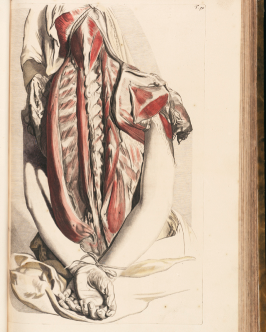
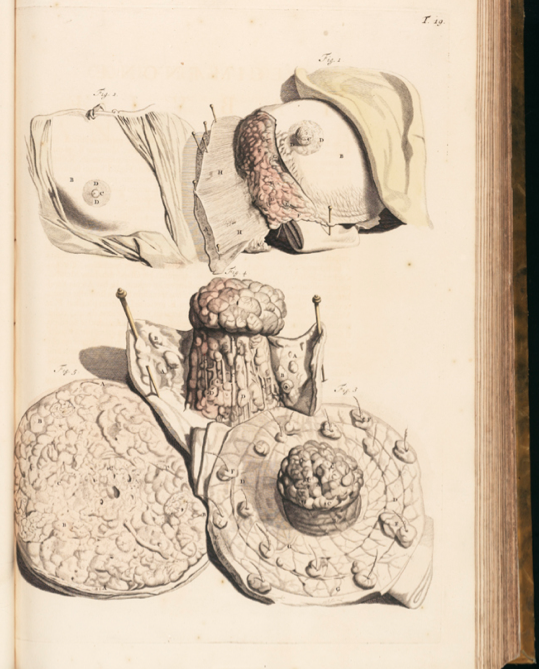
I love the ideas brought up in this article that conflate the actual bodies on the dissection table and the bodies depicted in the illustrations, and I’m most interested in the aspects of this comparison that get left out in able to make that conflation possible. What immediately strikes me about medical images of the eighteenth century is the sterility of the body and the cleanliness of it, which would not be an accurate depiction of the body on the dissection table: we’re missing all the fluids and the deformity of decay that would have made the body an object of repulsion and abjection. These “ugly” aspects worried Dr. Robert Knox (of Burke and Hare fame), who was disgusted by the interior of the body and thought that seeing it would actually ruin an artist’s sense of beauty (Helen MacDonald writes about this in her book, Human Remains (2006)). In his Great Artists and Great Anatomists (1825), Knox pleads with the artist to always draw a dead arm next to a living arm in order to preserve a division between the dead body as an object of disgust and the beauty of the living. Earlier, in the introduction to his Atlas of Anatomy of the Human Gravid Uterus,” William Hunter explains that there are two ways to illustrate the cadaver: to draw it exactly as it is shown, thus accurately reproducing one single body, OR to draw it taking into consideration all of the other bodies you have seen, thus producing an informed idealization of the body. Hunter himself claims that he much prefers this second, more imaginative method of depicting anatomy.
Thus, the illustrations take on the ability to fictionalize the body to some extent, prioritizing a style that would serve a pedagogical purpose, if not a realist one. It emphasizes the act of seeing the body, but only seeing the right kind of body. The same is true for preparations made of the body, and John Hunter is famous for making thousands of these: isolated and “prepared” parts of the bodies that would become preserved for the purpose of teaching anatomy (and, indeed, to carry on the idea of the body as property and commodity, unique preparations and parts of the body were a common gift to and from physicians). This is also the way in which fiction plays with ideas of the body, uninhibited by the limits of current medical knowledge. Physicians understood the essential role of the dissected body for understanding anatomy, but physiognomy remained somewhat in the shadows: without opening a living body, it was difficult to grasp how it worked. Thus, they were frustrated by exactly the distinction to which Knox refers. The Gothic is particularly interested in the interior of the body–a large part of which produces fear and shock–and it has an ability to stretch the limits of the body, both living and dead, in ways medicine could not. Writers like Matthew Lewis took the opposite approach to most medical illustrations, embracing the abject body and all its dripping, oozing effects, exploring new ways for the body to function in the process, expanding ideas of vitalism, circulation, and digestion.
Many writers of the Gothic were physicians themselves or close to medical thought, such as Mary Shelley and Lord Byron (close to John Polidori), and dramatist Joanna Baillie (niece of John and William Hunter and brother of Matthew Baillie, who spearheaded an interested in autopsy). The underlying principles of dissection are inherent in many of these works, especially the emphasis on empirical observation of the body in order to understand it. Much critical work has been written about Baillie’s play De Monfort (1798), which ends by displaying two bodies side-by-side (a murderer and his victim) in a type of moral autopsy. The murderer, De Monfort, had been so affected by seeing the corpse of the man he killed that it drove him mad and caused his death. In cases like this, the emphasis on seeing the body, whether on the dissection table, the illustration, or the stage, enters into other areas, such as commercial gain (as the article explains), as well as justice.
Arden
What I find compelling in this article is the emphasis on body-snatching as a way of experiencing a privileged intimacy with a literary legend: here, the act of dissection becomes a physical method for the exegesis of both a literary body and a body of work. As “Corpses and Copyrights” describes, Sterne’s body was taken from his grave and recognized as being the author’s by students in the autopsy theatre. This particular grave-robbery of a literary lion was, apparently, a chance one, prompted by the medical school’s need for demonstrational corpses. As Keats’s hospital training confirms, most corpses for autopsy in the Romantic period were indeed procured by body-snatchers, who were paid off by Sir Astley Cooper and other major surgical instructors. And, since some European medical schools guaranteed their students 500 bodies annually, odds were good that students would eventually identify their “Man in the Pan.”
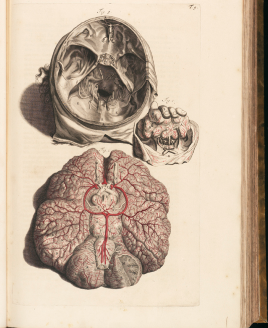
But, with the disinterred shade of Shakespeare’s Yorick hanging over Sterne’s corpus (“Alas, poor Yorick! I knew him well, Horatio”), we do have to wonder about Sterne’s actual disinterment as serving a more deliberate purpose. As Colin Dickey’s book Cranioklepty (2010) discusses, the purposeful body-snatching of artists was surprisingly prevalent during the Romantic Century. Other artists suffered similar fates to Sterne’s: Haydn, Beethoven, and Mozart’s skulls were reportedly stolen from their graves by admirers (in Mozart’s case, since he was buried in a pauper’s grave, the future thief placed a wire around his neck before burial to help identify him later); in 1817, a malformed skull reported to be Swedenborg’s was offered up for sale in England; Schiller’s skull was mounted by a noble friend in a glass case in a library in 1826; and Sir Thomas Browne’s skull entered the Norwich and Norfolk Hospital Museum in 1848. More familiarly, the physical tokens of the Romantic poets continued to circulate after their deaths: Shelley’s heart was snatched from the funeral pyre and preserved in wine, while (in spite of his request to “let not my body be hacked”), Byron’s autopsy was published, his internal organs were scattered throughout Europe, and his corpse was disinterred in 1938 and lewdly examined in the family crypt. Even now, the Keats-Shelley house at Rome boasts various physical relics of the poets, including locks of their hair.
Why were (and are) Romantic artists’ dissected bodies so fascinating? For me, the anatomizing of Sterne’s skull, which bears marks of abrasions from medical implements, reflects on an important moment in the advances of surgical dissection and autopsy at the end of the eighteenth century, as the parts of the dissected literary body became relics for reanimative reading. Though Sterne’s dissection might be coming out of the anatomy in a satirical tradition (like Burton’s Anatomy of Melancholy [1621]), as Helen Deutsch describes in Loving Dr Johnson (2005), at the end of the eighteenth century, the autopsy of a literary giant could bring the reader into an intimate encounter with the truths of his or her body, and even offer a kind of memorializing reanimation. In the case of Johnson, the Preface to the 1784 published account of his postmortem (“Dr Johnson in the Flesh”) described the corpse as “a work of art” that was still “of importance to his friends and acquaintances,” and the postmortem text is positioned as a way for the bereaved Johnsonian to reanimate the body through a deep encounter with its fragmented parts. Boswell’s Life of Johnson (1791) picks up the same language of reanimation through dissection: the directly reported records of Johnson’s speech allow the reader to “see him live,” in contrast to other biographies “in which there is literally no Life.” For Deutsch, this is part of a broader eighteenth-century trend of sentimental dissection: the body of the eponymous heroine in Clarissa (1748), for instance, is “opened and embalmed,” and Lovelace promises to keep her heart, which is stored in spirits, “never out of my sight.” (The real-life corollary of this is perhaps the circuitous journey of Percy Shelley’s heart, the “Cor Cordium” acting as postmortem metonym for the poet’s self). For the Romantics, insight into a fragmented body part seems to have had a reanimating quality for the whole body, and, as I think about it in my dissertation, I find links between medical dissection of human bodies, and practices of excisional close reading of organic literary forms, during the Romantic period.
Emily
Upon examining these illustrations and the accompanying article, I was immediately struck by the gendered implications, namely the differences between male and female dissection and how those acts were illustrated. The article claims that “Usually, the bodies used were those of criminals or heretics – predominantly males in other words. The occasional dissection of a woman, it being a public event, attracted large numbers of spectators by the prospect of the exposure of female organ.” Given the ideas of the time that the female body was somehow more sacred or special because of the presumed virtue of the female sex, it does not seem unsurprising that the male body would be more readily violated after death in such a way. However, the connotations of penetration from the scalpels, forceps, and other tools of dissection seem relevant here especially because they all were wielded by a masculine hand. These sharp blades and other disruptive instruments separated, cut and otherwise maimed flesh in an extremely intimate way. When this was occurring with male corpses, there are of course homoerotic undertones, but what really seems relevant is how this violation of phallic metallic apparatuses was deemed taboo except in rare cases. This might in part explain the public audience that attended female dissections as suggested above. Not only was flesh usually hidden promised to be revealed, but the feminine body was in death capable of being poked and prodded in ways living human males could only dream of. The intimacy of such an act becomes fetish as the public gathers to watch the male scientist push the scalpel further and further into the most intimate areas of a woman’s body.
The framing images displayed in “Corpses and Copyrights” appear to validate the theory that even dead bodies were gendered and sexualized in traditional ways. The first image of the series is the front view of a beautiful, naked woman accompanied by props and scenery reminiscent of Neoclassical art and the Grecian and Roman sources that movement drew its inspiration from (see the Roman copy of Praxiteles’ Venus). The only two places marked on this woman’s body are the breasts (A) and vagina (B), highlighting the parts of her body directly associated with sex and reproduction. We can assume that those areas were meant to be detailed one another page in their segmented, dissected form; when the sex separates from the body and becomes an object of its own. Detaching the female form from the person it belongs to would hardly be considered shocking given the culture of the time. The final image in the illustrative series is another woman (possibly the same one, but with a different artistic arrangement), only this time is is her backside that is drawn and marked. Here the letters adorning her body are more numerous, with areas such as the spine, calves and shoulders given special attention in addition to her bottom. I am fascinated by the artists decision to show only a complete female form, although I am not surprised. To me it suggests not only that the female body, at least in its intact form, is considered more beautiful, but that again the connections between sex and death dominate.
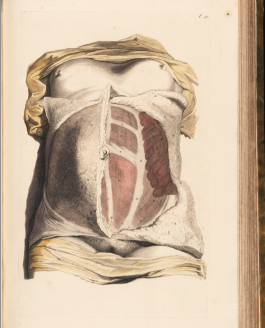
Additionally, the “corpse as commodity” idea challenges the idea of death as escape for men and women alike. For in a culture where women were considered property of men both theoretically and legally, death might be a release from such patriarchal control, albeit in an extremely morbid way. As “Corpses and Copyrights” asserts, “the body was not regarded as property” once dead, and therefore the female could finally be free from her masters, at least in theory. The value given to corpses and prevalence of grave robbing for medical and scientific purposes perverts this supposed freedom by once again giving monetary value to the body, and as the popularity of public female dissections suggests, yet again makes the female form a more rare and valuable object to possess. All of which proves that during the period, nothing could be separated from the politics of patriarchy and gender.
(All images in this post are from Cowper’s Myotomia reformata, and first appeared in “Corpses and Copyrights.”)