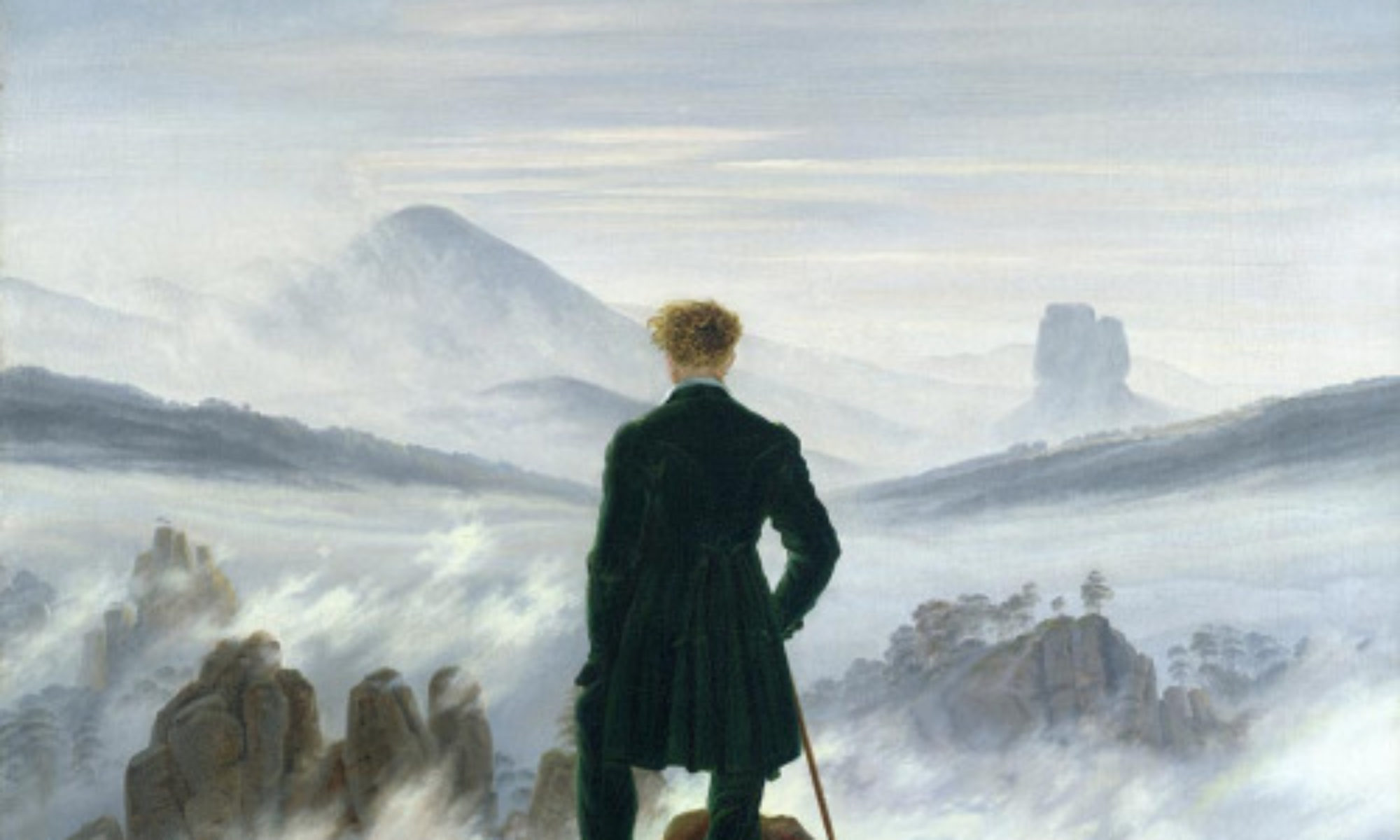
This follows up on my previous post, concerning the necessity of renewing resolve and reorienting goals for the forthcoming academic year. Over the last month, in starting to capitalize on the commitments I explored there, I’ve increasingly realized the importance of utilizing reflective writing to actively work through the process of beginning the dissertation, and for the first time really envisioning what type of scholar I’d like to become through that particilar endeavor. As I imagine is the case for most romanticists, certain professional investments have started to become clarified as a result of engaging in the intense, challenging, and rewarding project of dissertation writing–in my case, guided by reading Donald Hall’s The Academic Self, Jean Botkin’s Writing Your Dissertation in Fifteen Minutes a Day, and Timothy Morton’s Ph.D Advice. To honestly think through these core themes that I’m realizing connect work, communities, and more (and, especially, because I’ll be going on the predoctoral fellowship market next year, and think the activity will be helpful for writing research statements), I’ve developed a series of fifteen questions to answer to better understand how areas of academic research, values, and goals are shaped by a longer history of development, different institutions, multiple great mentors, and romanticist friendships. In this blog–an unconventional one, admittedly–I am posting these questions I’ve generated, in hopes that they might be helpful for other grads to think through. I also invite others to post additional questions in the comments you’ve found helpful in creating fulfilling academic trajectories. Continue reading “Constructing an Academic Self: The Worksheet”
Confessions of a Crazed Ph.D. Student, or, A Very Honest Account of Exams Preparation
I am currently wading neck deep in the quagmire that is comprehensive exam preparation. Countless fellow students warned me ahead of time that this would be the most challenging aspect of my pursuit for a doctoral degree. While that remains to be seen, I can admit that the last few months have been exhausting to say the least. Below, I will narrate some of the realities I have thus far experienced, both good and bad, with as much honesty as possible. Whether you can relate, commiserate, or completely disagree with me, I hope that my transparency will help prepare others for their own exams.
You will have an “oh, sh*t” moment.
There will come a point where you think you have a handle on your list, that you are on top of your reading and this whole thing will be a piece of cake. It’s not. Continue reading “Confessions of a Crazed Ph.D. Student, or, A Very Honest Account of Exams Preparation”
Sleep, Dreams, and Poetry
Endymion is one of the funniest heroes in Romantic poetry, mainly because he is so frequently fainting and falling asleep. He sleeps so often that I struggle to separate his waking and sleeping, a common problem for Keats that I want to talk about in this post. I have written previously about shared feeling and cognition, and dreaming is a particularly interesting case study for these topics, I think.
Let me catch you up to the ideas I’ve been toying with for my dissertation. I have come to believe that for Keats communion across time and space is enabled by acts of reading and the shared feelings reading encourages. Feelings circulate, via a text, among the bodies engaged in acts of reading (or other aesthetic experiences), and feeling is always an embodied cognitive experience. Therefore communion is realized (not just imagined) in the embodiment of transferred or circulated affect, a reactivation or revitalization of feelings in the moment of reading. From these assumptions, I begin my study of sleep and dreams. Continue reading “Sleep, Dreams, and Poetry”
A Summer Scotland Tour

I submitted final grades on Friday, and after granting myself a long weekend to relax (i.e. clean my house and sleep a full 8 hours each night), I am settling into my summer. I am on fellowship for the next year, and without teaching responsibilities, I am writing full time. But, I do have travel plans to punctuate the summer slog and give me much needed inspiration and respite. Like many of you, I have NASSR in Winnipeg this August, where I get to see friends, colleagues, and scholar-idols. But what’s foremost on my radar is the History of Distributed Cognition Workshop in Edinburgh next month.
As I have mentioned before, I have the pleasure of participating in this workshop at the University of Edinburgh to discuss and refine my chapter on Keats’s and Wordsworth’s contrasting visions of embodied reading. The workshop is only three days, but I’ve decided to stay abroad for a week. Initially, I toyed with the idea of traveling south after the workshop. My heart is and always will be in London, and I’m very comfortable traveling around England. I’ve been there often enough to feel a pseudo-mastery of navigating the country, and by now, I feel it’s my second home. Continue reading “A Summer Scotland Tour”
The Art of the Book and Romanticizing Landscape
For several months now, I have had the pleasure to work on a project with my friend and fellow artist Cat Snapp. On a Texas summer evening, we discussed over dinner our overlapping interests in the outdoors and the influence it has on our work. Through connection to the geological past or ties to personal culture, we each use print media to speak about the personal, historical, and psychological relationships we have with the world around us. At a certain point, we realized that the project that would best unite our voices and express the feeling we wanted was a letterpress printed artist’s book. It has the power to be intimate with the reader, yet it transcends the starkness of simple text on a page – it can reach into places travelled and landscapes desired.
Continue reading “The Art of the Book and Romanticizing Landscape”
Guest Post: A "Radiant" Digital Edition of Wordsworth's Prelude?
By Peter N. Miller
Dedicated readers of William Wordsworth’s The Prelude must at some point grapple with the disconcerting question of which version of the poem they’re looking at.
In 1799 Wordsworth produced a fair-copy manuscript of what would later be called The Two-Part Prelude. Between 1801 and 1805 the poet drastically revised this material to create a longer autobiographical poem, which consisted at various points of five books, eight books, and thirteen books. Wordsworth continued to revise the work over the coming decades, breaking Book 10 in two in 1829 to create a fourteen-book Prelude. His most substantial final revisions came in 1839, yet the poem was still not published, in any form, until shortly after the poet’s death, in 1850. To confuse matters further, Wordsworth never actually called The Prelude by that name. For him it was always “the poem to Coleridge.” The poet’s widow, Mary Hutchinson, suggested the title The Prelude. There is not a poem called The Prelude, it would seem, but multiple poems, each with a certain claim to legitimacy. Continue reading “Guest Post: A "Radiant" Digital Edition of Wordsworth's Prelude?”
Will the Real Mr. Darcy Please Stand Up?
By Talia Vestri
Jane Austen was in the news again last week—I know this, because when I log onto Google News, it offers tailored entries based on my previous web searches and sticks them right at the top of the feed. I honestly don’t know whether to be delighted or terribly disturbed by this fact. But artificial intelligence issues aside, I found this most recent bout of Austenmania to be quite a curious one.
It’s not a rare occasion these days that Miss Jane appears in the news, especially during this decade that celebrates “200 years since…” each of her famous tomes, published during the 1810s. Austen’s popularity endures: in 2013, Britain announced it will finally commemorate her in currency (Austen will appear on the 10-pound note, beginning in 2017) and last month she even got a musical in Chicago.
The most recent news cycle that got my attention (to be fair, it was hardly a sidebar item) highlights a new book that claims to make a striking and long sought-after discovery: the “true” identity of the real-life Mr. Fitzwilliam Darcy—and (sadly) it’s not Colin Firth. Continue reading “Will the Real Mr. Darcy Please Stand Up?”
Guest Post: Reading, or Ardor
By Andrew Welch
Rereading Keats’s Poems of 1817, I’m struck by how many pieces belong to the noble & distinguished tradition of poetry that frets about its own inadequacy. Keats begins “To My Brother George” in accordance:
Full many a dreary hour have I past,
My brain bewilder’d, and my mind o’ercast
With heaviness
What’s wrong, dear Keats?
I’ve thought
[…]
That I should never hear Apollo’s song
[…]
That still the murmur of the honey bee
Would never teach a rural song to me:
That the bright glance from beauty’s eyelids slanting
Would never make a lay of mine enchanting,
Or warm my breast with ardour to unfold
Some tale of love and arms in time of old.
Continue reading “Guest Post: Reading, or Ardor”
NGSC E-Roundtable: The Pedagogy of Romanticism
INTRO: Renee Harris, Emily Zarka, and Daniel Nutters will focus their roundtable discussion on pedagogy around two essays by Mark Edmundson included in his recent book Why Teach? In Defense of a Real Education. The essays are entitled “The English Major” and “Teaching the Truths” and were previously published in The Chronicle of Higher Education (June 29th, 2013) and Raritan (23.1) respectively.

While Why Teach? contains a polemic against the bureaucratization of education and the corporate logic of professionalism that governs academia, it also offers a vision of a “real education” that rests upon many assumptions inherent to what we now call “romantic ideology.” What makes this book, and especially the two essays we will consider, such an appropriate text to consider for a roundtable on pedagogy on the NASSR Graduate Student Caucus blog is the manner in which it demonstrates the continued relevance of such highly charged categories as “genius,” “imagination,” “truth,” and all the motifs of a “natural secular” theology of art. At the core of Edmundson’s thinking is not just a familiar and clichéd humanist vision, but one that has survived the culture wars (see Edmundson’s edited volume Wild Orchids and Trotsky), the apparent anti-humanist theory (or as he puts it anti-literature philosophy) of the 1970s and 1980s (see his Literature Against Philosophy). Absorbing these consequential intellectual events has allowed Edmundson to assess our current academic scene and argue for a vision of education that builds upon his own experience of the changes witnessed and occurring in higher education. Continue reading “NGSC E-Roundtable: The Pedagogy of Romanticism”
Fellow-Feeling, Cognitive Science, and Keats
I’ve lately been dabbling in cognitive cultural studies in efforts to understand the physiological registry of emotions and how the second generation Romantics theorized the phenomenon as embodied or immersive reading. I thought for this post, I would give a little background on how I got to this area of study and why scholars have linked it to eighteenth and nineteenth century British thinkers and Romantic poets, in particular. I limit this post to Gabrielle Starr’s work, as her book Feeling Beauty focuses on the cognitive processes involved in aesthetic experience, and I am particularly interested in the aesthetic experience of reading poetry. Continue reading “Fellow-Feeling, Cognitive Science, and Keats”