How Iain Banks Helps Me Teach Romanticism


In the past week, dozens of tributes to Scottish writer Iain Banks, have appeared online— hundreds, if you count the smaller, no less poignant, expressions of grief and thanks via social media. Banks died of cancer on June 9th, two months after releasing a statement to his readers announcing his illness and the devastating news of his short life expectancy. Publishing consistently since the early 80s, he leaves behind a significant body of work, including both general fiction and science fiction under the name Iain M. Banks. Though we were “prepared,” the loss hits his fans hard and sooner than expected. Here is my tribute to this Great writer, one that I feel both unqualified and strongly compelled to write. Banks is certainly not a Romantic writer, so it may seem strange for me to write about him here. I discovered his novels only within the past few years, and I’ve still only read a handful of them. Yet, these works have made a lasting impression on me and, more to the point of this post, on my classroom, often paired with Romantic texts.
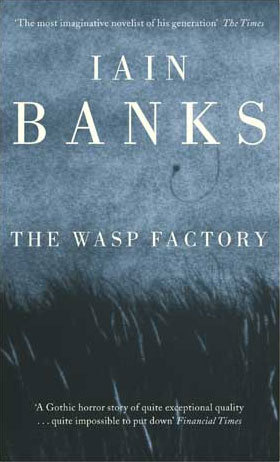
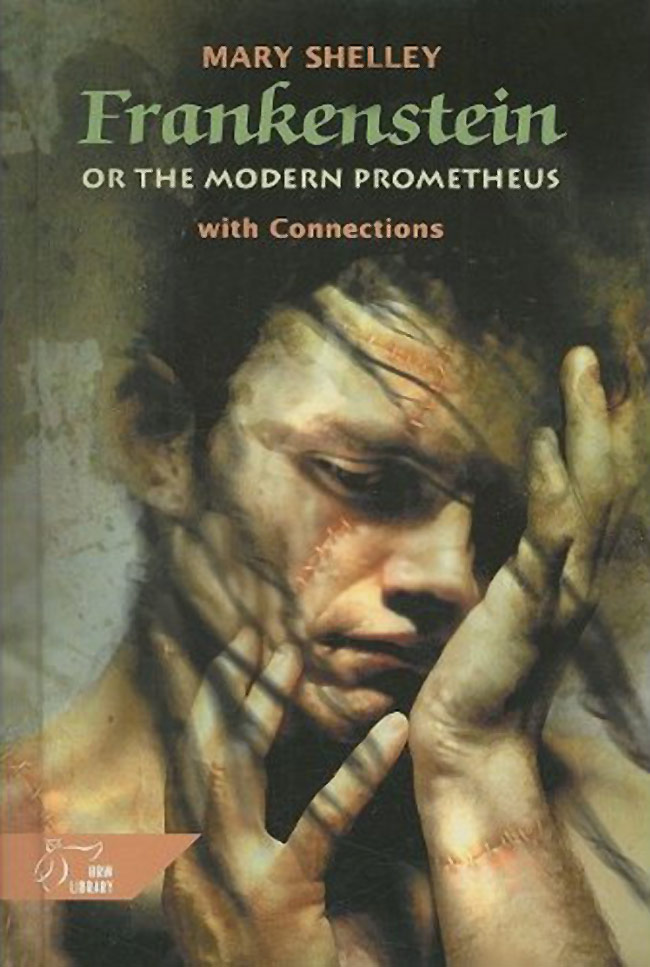
                  

Mary Shelley’s Frankenstein has been analyzed and interpreted in many different contexts, providing endless possible readings and uses. For some students, the possibilities are exciting, but, for others, they are also overwhelming. Frankenstein is one of the most teachable Romantic novels for the college classroom, but it can be difficult to convince students not accustomed to reading nineteenth-century texts (or not used to reading much in general) to have the patience to tread through unfamiliar prose styles in order to appreciate the novel’s worth. I think I can assume that many of us have taught this novel and had this experience at some point. There are many strategies to prepare students for the foreignness of earlier texts, but one that I frequently use is to pair a Romantic novel with a more contemporary novel. Twice, I have taught Frankenstein with Iain Banks’s The Wasp Factory (1984) in my freshman literature and composition classroom, a combination that exposes students to two types of literature: both qualify as Gothic, but we see it from two very different time periods and styles. After a week or so of feeling their way through Frankenstein, keeping characters straight and starting to construct understandings of settings and major themes, students develop a tenuous relationship with the text. Then I introduce them to a character named Frank.

“I represent a crime…” (10).

The Wasp Factory tells the story of this disturbed, sixteen-year-old, first-person narrator and his daily routines as he recounts his experiments and murders (that’s right, murders) on his family’s isolated Scottish land. His father, himself a reclusive mad scientist of sorts, has been seminal in Frank’s unstable (my students use the word “insane”) character. Frank, a god in his domain, spends his time fabricating and performing private rituals involving small animals and insects, creatures whose lives and deaths Frank orchestrates in order to tell the future or reinforce his surveillance and control over his island. The crowning glory of these devises is, of course, the wasp factory, a machine constructed from a giant clock face that holds twelve possible deaths for the wasp Frank releases into it. The death chosen by the wasp holds a wealth of information for our narrator. Frank is a powerless character desperate for power, abandoned by his mother and brother. Sound familiar? Frank, despite his age, has killed three times, and the twist ending blows my students’ minds.

“My dead sentries, those extensions of me which came under my power through the simple but ultimate surrender of death, sensed nothing to harm me or the island” (19).

Following up Frankenstein with The Wasp Factory solidifies students’ understandings of both novels by comparing and contrasting. Both texts are inherently about the construction of monstrosity on different levels, as well as human agency in matters of life and death. The creature and Frank are both considered to be monstrous outsiders for their behavior and appearances, but both have also been “created” by their father figures, practically devoid of any female influence. They are not unlike Victor in this sense, as well. They generate power through manipulation of their limited resources with conventionally inacceptable (again, “insane”), behaviors. All three construct their own forms of justice and morality based on adversity, environment, self-delusion, and a striving for power. The students compare and contrast these elements with little prompting from me as Frank and his world accentuate the choices and characteristics of Victor Frankenstein and his creation, not to mention the common themes of nature, science, motherhood, destruction, revenge, madness, etc.

“The factory said something about fire” (23).

The Wasp Factory is not a Romantic text, and that is what makes it so useful in this context: accessible and entertaining, it acts as a stepping stone between the students’ own interests and experiences and those of the early nineteenth century. Students have told me that The Wasp Factory is “the first book I’ve read that has actually made me think.” Another student became so fascinated with the spatial descriptions of Frank’s island that he went out and found a map of the book online, then did the same for Frankenstein. Banks’s novel is incredibly visual, and students want to visualize other texts just as clearly. They squirm at the more graphic, gruesome parts in the novel, but they can’t stop talking about them. The book complicates their own assumptions regarding characters as likable/unlikable and right/wrong and what those judgments are based on. They find Frank frightening and (again) “insane,” yet develop such an affection for him, one that they find themselves extending to the Creature and even to Victor. Writing about both texts together, they explore the complexity of character motives. They learned that liking a character does not mean that they can trust him, and that brings them even closer to that character.

“The wasp factory is beautiful and deadly and perfect” (154).

The strangeness of Banks’s novel, set in a familiar time and told with accessible and beautiful language, opens up a door to welcome other types of strangeness into the classroom, even a strangeness going back almost 200 years. A monster and his creations are always in good company. Iain Banks, thank you for your monsters and your creations. They will continue to teach us so much, not least to enjoy brilliant and important literature.            

Banks, Iain. The Wasp Factory. 25th Anniversary Edition. London: Abacus, 2009.
                                                                                               

On Starting the Dissertation: The Reading List that Keeps on Listing

A few weeks ago, The Chronicle of Higher Education posted a series of brief discussions about the third year of studying for a PhD. The title is what caught my attention: “A Common Time to Get Stuck,” by Julia Miller Vick and Jennifer S. Furlong. The observation seems to be that the leap from coursework to exams or from exams to dissertation (typically the third year) causes a significant jolt in the way we’re used to learning and producing work, and I whole-heartedly agree. The third year for my department means that students have just completed their exams and are now faced with the daunting task of formulating a dissertation proposal and finally starting the long, hard work of diving right in. I thought I’d add my own two cents on what makes this such a pivotal, exciting, and (in some ways) frustrating and terrifying year.
Furlong says, “The familiar rhythm of reading lists, paper submissions, and semester-long deadlines gives way to a more ambiguous challenge—developing an original research project that meets the standards for scholarship in an academic discipline.” Familiar is the perfect word for it: we’ve all been in school for decades… we know what how class works, we know how homework works, we know how writing papers works. I don’t know that I’d call it easy, but we at least know all the dance steps and that, somehow, it all gets done no matter how many all-nighters it takes.
Vick adds, “It is also a time when students have to start answering to themselves more than to their professors and mentors. After comprehensive exams are passed they need to become their own taskmasters and work without, in many cases, external deadlines and demands.” So, suddenly you go from having packed schedules, syllabi, and exam reading schedules to… anything and everything. Or, at least it feels that way. Suddenly, you have years of work ahead of you without a set structure, constructing an argument that could take on a life of its own at any moment. Anything could be useful, so you must read everything. All the books. This leads me to my next point.
A few days ago, I came across a second piece of online writing—this one a blog article on Book Riot— which seemed to speak directly to the title of the article in The Chronicle: “When You Realize You Can’t Read All the Things,” written by Jill Guccini. All the frustration of this title realization comes through as she describes the many situations in which you find yourself acquiring new books… but not actually reading them as they pile up into “mini cityscapes on your floor.” This is especially true for academics in the humanities, for whom reading is both work and play, and getting new books is both extremely pleasurable and sadly stressful. What a crime to leave them, unread, to get dusty and yellowed on the shelf… but I know I am guilty as charged.
Now, bear with me: these two articles are related. When you’re working short term on coursework or exams, you can find some solace in that you only have to keep it up until the deadline comes and goes. We would all study for exams forever if there weren’t a deadline to stop us, and thank god there is. I’m wondering if part of the “getting stuck” Vick and Furlong talk about has to do with the few years of dissertation work begun in the third year feeling like forever and a somewhat narrow field feeling like “all the things.” So, if I’m writing about body parts in Frankenstein, then I have to read the novel and all the critical books and articles on it. Then I should read all about Mary Shelley and the Shelley circle and anyone who influenced that circle and maybe all of Shelley’s other work…and also follow up on this, this, and this footnote. Then, okay, body parts: I should read all the medical discourse when Shelley was writing and maybe what people thought before she was writing and also after she was writing, and maybe some of the current medical discourse on amputation and organ donations, and, why not, maybe some stuff on bodysnatching and army doctors. Now, what about any kind of literary theory: Kristeva and Lacan and Deleuze and Freud and Bakhtin. And theory on the history of the period and of novel form and novel circulation and the two different editions and where it was sold and how much it cost and what kind of paper it was printed on and who bought the first copy. And each article or book as an extensive bibliography that should be gone through with a fine-tooth comb. I’m being a little ridiculous, but see what I mean?
Beginning the dissertation is the ultimate in you-can’t-read-everything frustration because not only do you have a million things you want to read, but there’s the added pressure that you feel you need to read them in order to create something worthwhile. And Vick is right: yes, we’re answerable to our advisors and our committees and to future job applications, but at this point in the game, when all your work is chosen by you and made extremely important because of that, there is an incredible sense of self-worth but also a lot of nervousness in regards to living up to your own expectations. Can you ever read enough to satisfy yourself? The answer (and the point to this whole academic game we play) is no. I think what I’m learning as I’m still in this dangerous third year is that, no, you really can’t read all the things. Somehow that makes me feel a little better.
I would have loved to give better advice in this post rather than just some observations, but I feel too close to the beginning still to assess what is working and what isn’t. I’d like to invite fellow bloggers and readers to respond, though!
What worked for you when you were starting your dissertation that kept you from trying to “read all the things”?

The First-Year Ph.D. Experience: Language Exams

This blog marks the first of a series Cesar Soto and I are collaborating on highlighting “The First-Year Ph.D. Experience.” In doing so, we’ll be honestly exploring what we have learned–and are in the process of learning–as beginning Ph.D. students in Romantic studies. In documenting our experiences, we hope to begin creating an archive for subsequent students to utilize in making the transition to the doctoral level as smooth and enjoyable as possible. In addition, since César and myself have entered with M.A. degrees, we would very much like to invite comments from those who gone directly from the B.A. to the Ph.D. While my next post in this series will deal with what’s been less and more successful for me in terms of time management, César will be looking at navigating his experience in experimenting with theoretical frameworks. For now, the wine-press that is language requirements.
Intro: While they vary greatly by department, language reading exams (or coursework) may seem like imposing milestones to many incoming and continuing doctoral students’ minds. In all cases, however, moving past these requirements as efficiently as possible marks a good point of departure for further work. As someone who began their graduate work not having yet studied either language required of them–but having since passed a French reading exam and begun work on German for reading knowledge–I thought it would be helpful to develop a post detailing how I’ve gone about fulfilling this requirement. Though, I’m equally interested in hearing how other romanticists have worked through language study–particularly those who work both on literature and art of the continent (or elsewhere!).
Don’t Wait / Study Early, Study Often: It goes without saying, but it is helpful to know at least prior to the summer before beginning a program what the language requirements are. In my experience, those few months before starting represent a good opportunity to drill the knowledge necessary to produce a strong working translation of a critical text, as required. Working through flashcards in between reading selected articles is to my mind the most effective way to go about language study. But who wants to do this when there’s compelling and more immediately rewarding coursework to be done?
Devise a Strategy & Stick to It: In June 2010 before starting at Oregon, I picked up a used copy of a standard French for Reading Knowledge textbook. From there, I distilled the salient rules of grammar, syntax, morphology, and basic vocabulary into flashcards–going through one chapter per day, five days per week. This made what seemed to be an insurmountable task much more manageable. I repeated this strategy again when I started at Northwestern this year, and it worked. I’ve also started studying German similarly over the fall and winter terms. However, this isn’t to be didactic. Just to detail what worked for me. Of course, there are myriad ways to go about structuring your own strategy. Experiment, find what works for you, and go from there (and share it in the comments!).
Lean on Previous Language Study: When I was an undergraduate I did Italian and Ancient Greek, knowing I wanted likely to do a Ph.D. at some point, but not knowing that in Art History my language requirements are set. Of course, neither language counted directly towards my doctoral work. In the end, though, each gave me a framework for understanding how Romance and inflected languages work, respectively. I conceptualized learning to read French as re-filling in the frame Italian gave me. I’m doing the same thing now with German and Ancient Greek. The point is, use the structures of previous engagements with languages to move present studies forward.
During the Exam: While everything hinges upon how your language exams are evaluated, some of the best advice I’ve gotten is to avoid attempting to translate directly. Thinking through translation with reference to reading arguments is a good way to structure this. How I personally go about this is to: (1) skim the work, using the sentence structures and vocabulary in order to forge an idea of the text’s trajectory, (2) identify the argument that’s being made, and the premises that support it in the text, and (3) translate from there. Perhaps this is oversimplifying the matter, but, in September, for instance, I wasn’t looking to produce a translation that Mallarmé would approve of. I just wanted to fulfill a requirement, and move on.
It Will All Get Done, Even If It Takes Multiple Attempts: Most students I’ve known require multiple attempts to fulfill language requirements. In addition, continuing to drill flashcards and take language courses can also enrich one’s time in graduate school. This may end up being me with German. Who’s to say. In any event–optimistically stated–language study can be a way to get out of what Blake called “the same dull round,” and crucially engage with a much wider body of materials and scholarship than what would otherwise be possible. A wine-press, indeed–but a necessary one, in fact.

Love Letter to Mr. Lewis

As I mentioned in one of my earlier posts, the original Gothic tradition met with some pretty extreme ambivalence from other writers and pretty staunch criticism from reviewers in the late eighteenth century. Matthew G. Lewis—the writer of The Monk, who also happened to be an MP—got the brunt of abuse from those critical of his stories of terror and gore.  He mentions in one of his many undated letters to his mother, “You will observe that the Morning Herald continues to call [me] Monk Lewis, and to abuse me as much as formerly.” Though The Monk and much of Lewis’s poetry push the boundaries of the genre he helped create, I have found much of Lewis’s drama, including his best-known play, The Castle Spectre, to be surprisingly cautious and even conservative in terms of the supernatural. [i] In the same letter, however, he describes the failure of his play The Captive, which “proved much too terrible for representation, and two people went into hysterics during the performance and two more after the curtain dropped. It was given out again with a mixture of applause and disapprobation….”[ii]  Lewis, persisting in his penchant for creating tales of wonder and terror, was, nonetheless, not writing from an ivory tower but seemed keenly aware of the reception of his works. His letters reveal him to be especially sensitive of the impact his scandalizing works would have on the reputation and sensibility of his family, and he apologized profusely to his father for the outcome of The Monk, blaming his misjudgment of its reception on his youth (he was only 19 when it was published). After that, he sent some of his literary endeavors to his mother or his sister to edit for objectionable passages and eventually released a censored version of his novel.
Attracting severely negative attention from critics, Lewis also attracted his fair share of parody and satire.  The anonymous collection of poems, Tales of Terror followed the publication of his own collection, Tales of Wonder, an accumulation of original poems by himself and others such as Sir Walter Scott and Robert Southey as well as translations of German pieces. There is no evidence to suggest that Lewis is in any way associated with Tales of Terror beyond being the model for its creation: it is unlikely that he contributed to it in any way, and it is a mistaken attribution in an early biography and a later combined version of Tales of Terror and Wonder that instilled this misguided authorship through to the present time (Thomson 239).[iii] One poem in particular found in Tales of Terror, “Grim, King of the Ghosts; or the Dance of Death” is dedicated to Lewis, making it especially improbable that he was involved in its authorship. On the other hand, it is thought that Tales of Terror ridicules and reproaches Tales of Wonder by its exaggerated mimicry of it. This also seems unlikely or overly simplistic, at best. Douglass Thomson says, in his article on the relationship between the two texts, that Tales of Terror is “less an attack on Lewis than an homage to him, a carrying-on of the good fun that Lewis had with his own production. ‘Grim’ underscores the fact that that parody is, if not the sincerest form of flattery, at least a form of imitation and tribute” (17).[iv]
In a very roundabout way, this fine line between condemnation and appreciation is the point I want to make in this post, and it extends beyond these two published volumes. Lewis was a source of criticism and disdain, as well as humor and real adoration in many contexts. I recently discovered a fantastic little “tribute” to him in the National Library of Scotland, a fourteen-page poem entitled “The Old Hag in a Red Cloak: A Romance,” attributed to George Watson-Taylor.  On the surface, the moral of the story and last stanza of the poem seems to make it very clear that the writer disapproves of Lewis’s antics:
If you wish me the moral, dear Mat, to rehearse,
‘Tis, that nonsense is nonsense, in prose or in verse,
That all, who to talents claim any pretense,
Should write not at all, or should write COMMON SENSE.
However, if the writer disagrees with Lewis’s style or subject matter, it certainly does not stop him from reading more or less everything that Lewis has ever written.  Only half of those fourteen pages contain the short poem. The bottom half of each page boasts two or three extensive footnotes detailing each and every reference to a line or a character in one of Lewis’s works.  For example, the first page reads:
Matthæus was little, Matthæus was young,
Of wonders he chanted, and quaintly he sung; i
Thro’ fire, and water, and clouds could he see, ii
For this bard, a profound necromancer was he. iii
i. “Lord Ronald was handsome, Lord Ronald was young,  / The Greenwood he travers’d, and gaily he sung, &c.” “The Grim White Woman”
ii. The Cloud King, the Water King
iii. This spectre, the Grim White Woman she was.
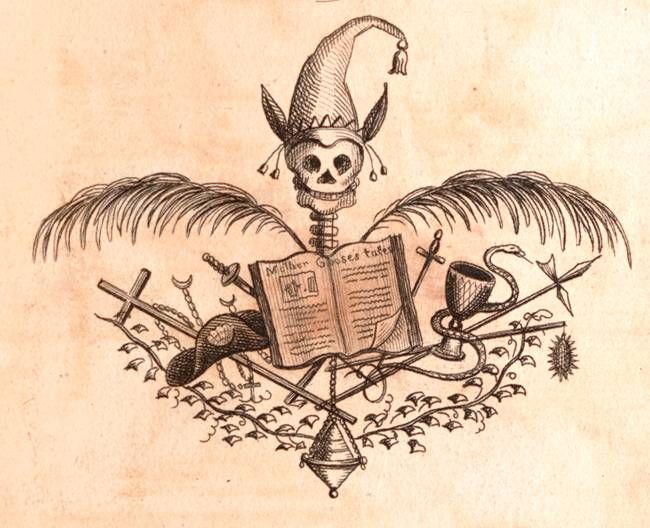
Matthæus is, of course, Matthew Lewis, referred to for most of the poem as simply “Mat.” The plot follows the consequences of Mat refusing to give a poor old woman a sixpence to buy some bread. The old woman turns out to be Mother Goose, a witch-like figure who torments him for both denying her the money and getting her kicked out of bookshops. She calls on all of the creatures of her literature to accost him. He tries to call on his own creations, but they fail him, and he is forced to admit that she rules the “realms of romance” and to vow to write more appropriate literature. Most of the footnotes just relate the lines from the particular poem the writer is mocking, but others give more detailed information. One provides a laundry list of “ghosts and hobgoblins, and horrible shapes” found in popular romances of the day, with which the reader should be familiar. This guy has done his homework! As Thomson says, “as imitation of a pre-existing style comprises an essential feature of parody, this satiric mode especially depends upon a degree of identification with its satiric object” (2). It’s clear from the detailed lists of Lewis’s creatures throughout the poem that a real enjoyment went into describing them, even though it is hidden behind the guise of criticism. I might suggest that it feels like a guilty love-letter to a writer and type of writing that had become fashionable to criticize but also fashionable (among a different sort, perhaps) to read. Crafting a poem with such subject matter, despite the didactic symbolism and moral, also speaks to a writer who has learned a thing or two from what he has read. It speaks to the complicated love/hate relationship endured by the Gothic as well as the Gothic tradition’s invitation to parody and a little bit of fun.


[i] At least part of the reason for this caution is due to the censorship restrictions on drama and the uneasiness with showing the supernatural on stage. Jeffrey Cox has a fantastic explanation of this in his introduction to Seven Gothic Dramas, Ohio University Press, 1993.
[ii] “The Captive” closed in 1803, so this letter was sent sometime after March of that year. The letter is simply dated “Wednesday___”. Papers Concerning Matthew Gregory Lewis, 1792- circa 1834.
[iii] Douglass Thomson gives a thorough overview of this in an appendix about Tales of Terror in his 2009 Broadview edition of Tales of Wonder.
[iv] Thomson, Douglass H. “Mingled Measures: Gothic Parody in Tales of Wonder and Tales of Terror.” Romanticism and Victorianism on the Net. (May 2008) 50: 22 paragraphs. http://www.erudit.org/revue/ravon/2008/v/n50/018143ar.html

Editing Lyrical Ballads: Wordsworth's Decision to Remove "The Convict"

Only one poem from the original 1798 edition of Lyrical Ballads does not appear in the two volume 1800 edition: Wordsworth’s “The Convict.” The specific political goals of the poem do indeed make it difficult to situate among the other works in the collection (with the exception of Coleridge’s “The Dungeon”). For most critics, “The Convict” is out of keeping with the rest of the poems in the first edition of Lyrical Ballads. When scholars such as Celeste Langan and Quentin Bailey do engage the poem, they usually do so under the larger category of vagrants or vagrancy. In other words, the convict, like Martha Ray of “The Thorn,” the mad mother, and the idiot boy, is one of the marginal figures that Wordsworth’s poetry pulls to forefront. Yet the convict receives his title not from a loquacious speaker or a gossipy group of townspeople but from a formal political institution. Furthermore, while crime, even violent crime, is implied in several poems in Lyrical Ballads, in “The Convict” clear action is taken. For example, while the speaker of “The Thorn” claims that “some had sworn an oath that she [Martha Ray] / Should be to public justice brought,” no punishment ever occurs (323-3). “The Convict,” in contrast, depends upon the presence of “public justice”  for its very title.
Yet, for all of its differences, I want to suggest that the “The Convict” does share one crucial feature with the other poems in Lyrical Ballads: the centrality of the speaker. By examining the physical and imaginative movement of Wordsworth’s sympathetic speaker, I will show how “The Convict,” to a certain extent, “fits” with the larger project of the collection. When we turn to the poem, we see encounter the speaker standing on a mountain slope in the “glory of evening” (1). Reluctantly, he leaves his idyllic surroundings to visit the convict within the “thick ribbed walls” and “the glimmering gate” of his prison (9,11). As Kenneth Johnston notes, the poem “turns very abruptly from its opening scene of natural beauty to a highly articulated scene of human suffering” (419). The subject of the poem, an individual convicted of committing a crime, has already faced public judgment. There is also, as Quentin Bailey and others have noted, no suggestion that the convict is innocent. As judgment has been made and the guilty convict imprisoned, the public’s engagement with him, it would seem, is at a close.
In the fictional scenes of “The Convict,” Wordsworth’s speaker is able not only to represent the convict’s sad state but also use his “fancy” to see what lies in the man’s heart. Gazing at the convict as he sits staring dejectedly at his fetters, the speaker claims “’Tis sorrow enough on that visage to gaze, / That body dismiss’d from his care; / Yet my fancy has pierced to his heart, and pourtrays / More terrible images there” (17-20). Although the mere sight of the convict’s “visage” is “sorrow enough,” the speaker is able to push further, to offer more insight. Through his “fancy,” Wordsworth’s speaker can look not only on the convict’s “matted head,” neglected body, and the crippling effects imprisonment has on his body, but also gaze into the convict’s “heart” and find “the more terrible images there.” It is telling that rather than revealing details of the convict’s crime, these “terrible images” show the degree to which the convict “wishes the past to undo” (22). According to the speaker, the convict’s “crime, through the pains that o’erwhelm him, descried, / Still blackens and grows on his view” (23-4). The speaker suggests that it is remorse for his crime that “blackens” the convict’s appearance. Such insight, or perhaps more accurately, imaginative speculation, is possible in the fictional scenes of Wordsworth’s poem.
According to the speaker, the monarch has the potential to alleviate the convict’s sufferings. He imagines how different the convict’s situation might be if the king were standing in his place: “When from the dark synod, or blood-reeking field, / To his chamber the monarch is led, / All soothers of sense their soft virtue shall yield, / And quietness pillow his head” (25-8). Like his own movement from the mountain slope to the prison, the speaker imagines the king leaving a dark church or a bloody battlefield to come to the convict’s chamber. The speaker locates the monarch in three value-laden spaces: the church, the battlefield, and the prison are all places in which the public is constituted and acts (thinking here of Locke, Kames’s “publick” from Historical Law-Tracts, and Bentham). In others words,  Wordsworth’s speaker refers to places that became metonymic for the common interest, places where the public is constituted. The monarch entering the convict’s cell is endowed with the necessary agency to assist him.
At the close of the poem, the speaker rewrites this earlier episode by imagining what he would do if he commanded the power of the monarch. The convict, so weighed down by his condition, lets out a tear which the speaker proceeds to read: “The motion unsettles a tear; / The silence of sorrow it seems to supply, / And asks me why I am here” (42-4). In the speech act that follows, the speaker offers his answer:
“Poor victim! no idle intruder has stood
With o’erweening complacence our state to compare,
But one, whose first wish is the wish to be good,
Is come as a brother thy sorrows to share.
“At thy name though compassion her nature resign,
Though in virtue’s proud mouth thy report be a stain,
My care, if the arm of the mighty were mine,
Would plant thee where yet thou might’st blossom again.” (45-52)
In these lines, the speaker identifies himself as a special type of observer. Unlike the “idle
intruder” who visit the convict’s cell to compare his state to that of the imprisoned criminal, Wordsworth’s speaker expresses a desire “to share” the convict’s “sorrows.” As Bailey points out, the speaker distinguishes himself from more sentimental visitors and the moralizing of writers like Robert Southey because in late eighteenth century Britain “visits to a prison could too easily be assimilated by the literature of sentimentality and suffering” (7). “The Convict,” then, strives to avoid falling into these generic pitfalls and puts forward a suggestion for penal reform. It is also important to note that in the closing stanza, the speaker states that the personified abstractions of “compassion” and “virtue” have named and judged the convict. The phrase “thy name” could refer to the title of the poem itself. The title of “convict” is a name that has been assigned to this man by “public justice,” which in turn has led to him being abandoned and condemned by “quietness,” “compassion,” and “virtue.”
Many critics have recognized the influence of Godwin in the poem’s crucial
final two lines and their call for reform. Emile Legouis points out that, like Godwin’s Political Justice, Wordsworth’s poem calls for “transportation as a substitute for capital punishment” and “kindness and compassion” for the convicted (309). The speaker’s desire to relocate the convict is indeed clear, but many critical studies do not consider the manner in which the speaker expresses this desire. The final eight lines of the poem can be read as the speaker’s attempt at a performative speech act. If “the arm of the mighty” were the speaker’s to command, his words would perform an action: they would transport the convict, “plant” him somewhere where he “might’st blossom again.” Such a closing further connects Wordsworth to Godwin. As Angela Esterhammer points out, Jeremy Bentham “interpreted laws as verbal utterances exchanged between sovereigns and subjects” (554). While Bentham describes laws as speech acts, Godwin believes, as is clear in Political Justice, that language’s “only legitimate purpose is the communication of truth” and that words should never do anything (Esterhammer 555). According to Esterhammer, for Godwin, “all speech acts that attempt to exert control over future behavior ultimately work against the improvement of society because they institutionalize error, protect existing abuses, and prevent reform” (557). In other words, temporality troubles
contracts, oaths, pledges, promises, and all other performative speech acts.
Bentham’s classification of laws and Godwin’s, to borrow the title of Esterhammer’s
essay, “suspicion of speech acts” provide an useful context for examining the close of “The
Convict.” The speaker imagines himself in a position to make a verbal utterance that would carry with it the weight of the law. “If” he commanded the power of the monarch,  the speaker’s words would enact the very political reform that critics have identified in Godwin and Wordsworth.
While Godwin’s main anxiety about performative speech acts centers around time, the anxiety of Wordsworth’s speaker appears to have more to do with who has the capacity to make a performative utterance. “The Convict,” then, documents two types of representative failure. First, the “fancy” of the speaker shows the reader what lies in the convict’s heart after his judgment and imprisonment. Secondly, as is evident throughout the poem and forcefully so at its close, the monarch and “public justice” do not represent the will of the sympathetic speaker.
Perhaps the poem’s attempt to represent more “accurately” a marginalized figure and its meditation on the failure of political representation more generally connects it to the larger democratic purpose of Lyrical Ballads that will be announced in 1800.
 

Some Light Relief, or: Richardson’s Pamela is an Au Pair in 2012

It’s May! And that means that a lot of us academics are taking a deep, post-end-of-term-marking breath, and treating ourselves to the smallest of little vacations… a mini-vaycay, a staycation, an excursion, or what I have recently learned Germans call an Ausflug. In keeping with the theme of respite, here is a little light relief in the form of a pleasant comic fiction. Enjoy!

Richardson’s Pamela is an Au Pair in 2012;

or, Virtue Confounded.

***
In a Series of Letters
from a Hip Young Beauty, To her Parents.
***
Now first Published
In order to cultivate the Principles of Virtue and Moral Uncertainty
In the Youth of Both Sexes

VANCOUVER
MMX

Dear Mom and Dad,
Seriously bad news: the old lady who owns this joint just bit the dust. I’m getting transferred, and I don’t know if there’ll be a wifi connection at the new house, so hang tight. I can Facebook you from my Blackberry at Starbucks.
Your Dutiful Daughter,
Pamela Andrews
***

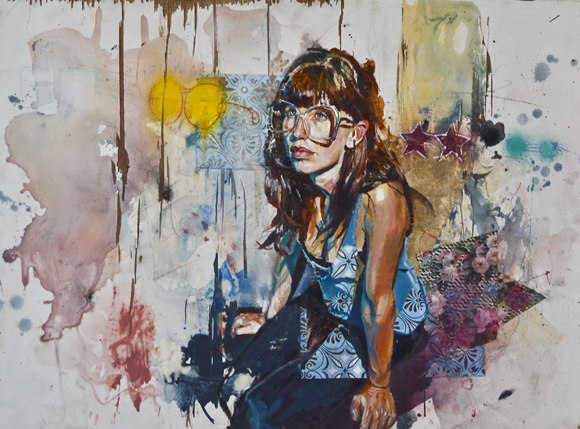
"A Moment" by Vancouver artist Drew Young

Dear Mom and Dad,
As I was closing my laptop, the son of the old lady walks into my room unannounced and scares the %^&* out of me. He’s a total creeper. Must be pushing 40. He just stood there looking at me and smiling. What a weirdo.
Peace Out,
Pamela
***
Dear Mom (just between us),
The creepy son, Mr. B, offered to keep me on for DOUBLE the wages. AND he gave me a gift card for Victoria’s Secret. What should I do?
Kisses,
Pam
P.S. Can you top up my Vi$a? I miss spending quality time with you, and like, shopping. You are the greatest Mom ever : )
***
Dear Mom and Dad,
Mom, your letter made me feel way better about staying. You are right, money doesn’t grow on trees.
Mr. B treats me really well. He gave me some of the old lady’s clothes. VINTAGE cha-CHING! I got 3 pairs of high-waisted dress pants, 4 silk tops with totally retro gold buttons, 1 excellent Valentino dress that I might sell on eBay, 2 cashmere scarves, and Chanel sunglasses. The old lady was RICH. Now I guess it all belongs to Mr. B. …LUCKY!
Your Dutiful Daughter,
Pam xoxox
***
Dear Mom (don’t tell Dad, okay??)
Mr. B was totally hitting on me just like, two seconds ago, when I was walking down the hallway to find a dustpan. He told me I was the most beauteous creature to ever walk the earth, and my eyes were the pillars against which men might build their lives, which I don’t really get but whatevs. Creeper!
Oh em gee.
Pammy
***
More from Drew Young

Dear Mom,
He kissed me! It just happened!
[This message has been sent via Facebook Mobile]
Your truly shocked daughter,
Pam
***
Dear Mom,
So I was like, OVER the whole thing, because I screamed, and then he kinda yelled, and then I cried, and he gave me permission to never speak to him again, plus he gave me $500 cash, and some new earrings, but THEN. OMG. Then, I was in my room getting ready for bed and I can hear some weird-ass noises coming from the closet. So I open the door and it’s HIM. He’s in MY CLOSET. So I scream some more, and he’s like, “don’t worry, it’s no problem, it’s no problem.” So I was like %^&* you and told him I QUIT.
So there.
Love,
Me, Pamela.
***
Dear Mom,
I can never forgive him for being SO WEIRD, but he has increased my salary and promised I can give notice after the holidays are over. So…
Virtue safe!
Love
Pam
***
Dear Mom,
OMFG I think Mr. B wants to sleep with me. WTF.
FML,
Pam
***
Dear Mom,
If you don’t know what those abbreviations stand for, I can’t tell you.
Love,
Pam
***
Dear Mom,
Today Mr. B came into my room while I was listening to Grizzly Bear and reading Nylon, pinned me to the bed and started kissing me all over my face and neck and I was like, “Back off you Pedophile!” And he was like, “You cannot hold on to your virtue forever! One day, you MUST give yourself up, and because I find you extremely attractive and I have more money than you, it should be to me!” And then he started to unbutton my shirt, and it was kind of hot, but I knew better, because of what happened to the blonde chick on Gossip Girl, so I screamed, “My virtue is all that I have!” And with superhuman strength I threw him off me, ran downstairs, and phoned child protective services.
I’m gonna sue the bastard for all he’s got!
Marriage is for L-O-S-E-R-S,
xoxo
Pamela

Reading List Adventures

This is the semester I am struggling to put together my reading list for the comprehensive exams. I have to admit it’s a rather exhausting process, much more exhausting than I initially planned for. I entered into the PhD thinking I had a firm grasp on what I wanted to do – pursue eco-criticism and animal studies in Romanticism. I’ve found out that’s a rather hard thing to do. Going into a relatively interdisciplinary field requires a lot of thinking about different kinds of texts, themes, and theories. Anyone who has read texts dealing with race or gender will tell you that animal metaphors work to separate different kinds of people. So, are these metaphors in some way worth talking about, given their obviousness in the texts? In what ways do they change as the Industrial Revolution takes hold and separates, in a somewhat larger way, mankind from nature? The most important question (for me at this point, anyway) is how can I begin to get a hold on this issue in time to create a cogent and defined 120-odd booklist?
As I began working on it, I knew that environmental metaphors animated critical gender discussions in the Romantic era. In Vindication of the Rights of Women, Mary Wollstonecraft argues that women are poisoned by their own culture, “for, like the flower which are planted in too rich a soil, strength and usefulness are sacrificed to beauty.” Yet, “the perfection of our nature and capability of happiness” is partially based upon “man’s pre-eminence over the brute creation.” Those are obvious metaphors, but the way in which they position a woman in relation to the environment intrigues me. I thought about several canonical works from the period, and then I consulted several anthologies as well as these lengthy lists:
http://graduate.engl.virginia.edu/oralsonline/
http://www.columbia.edu/cu/english/grad_orals.htm
http://www.english.ucla.edu/index.php/Current-Students/graduate-reading-list
There’s a lot of texts on there, some that I was only peripherally familiar with and some that I had never encountered before. I looked for texts written by women or texts that dealt with the question of women that also involved the environment or animals. As you can imagine, that led to a rather long list filled with novels, poetry, plays, travel essays, literary essays, and theory tracts.
Then, I had a sort of revelation that I was not expecting and it came from an odd place. I began looking at pretty pictures of dresses.
Yes, you read that right. Pretty dresses. When it is winter and I feel bogged down by reading, and grading, and writing, I like to look at art, clothes, and houses from the period I study. It’s mentally invigorating, but that might just be an excuse I tell myself to look at beautiful dresses.
I noticed through my cursory searching a rather huge difference between women’s fashion pre- and post-Romantic Era fashion, especially in terms of how much of the body is shown and what is on the linen.  Dresses changed from being highly structured and covered in flowers to being more flowing with less natural decorations. I am in no way claiming to be an expert on women’s fashion. How correct or incorrect these observations are is less important than the effect it had on my list-making. I began to wonder how animals and the environment were utilized to produce certain kinds of bodies. That began to narrow down my list, and it also gave me a clearer picture of what else to put into the list.
My advice for this whole process is pretty simple:
1.)   Look around a lot. Consult examples of lists, anthologies, your Amazon wish-list. You’ll need to balance the canonical, but also find the exciting, bizarre, and strange you believe you might want to read.
2.)   Be available for inspiration in whatever form it happens to take. Go to a museum. Go outside. Talk to your pet. Eat a good meal. Give your mind a moment to relax and you’ll find the Ah-ha!


Using Zotero

Intro: Zotero’s my new favorite research tool. Why? Because it’s a Rhizome. But what isn’t (nowadays)? No, seriously. It is a rhizome and it happens to be a rhizome of the most useful sort. Zotero helps to visualize the relations between ideas, images, and texts in a way that few other research tools allow. For those unfamiliar, Zotero’s a powerful citation management program, frequently used as an extension of Firefox (but also can be used as a standalone application) that makes possible multiple points of entry and useful exits from information you’ve assembled in your research. Moreover, and maybe most importantly, Zotero offers a degree of scholarly peace of mind by backing up all your citations and notes on their server automatically, courtesy of the Mellon, Alfred P. Sloan Foundations and others. You receive 100 MB of space free, but can move into the 1 GB tier for only $20/year. I’ve been using Zotero pretty extensively for about six months and have used only about 9% of my storage space.
While perhaps the best introduction to Zotero can be found on their website (http://www.zotero.org/support/quick_start_guide), I’ve set out as my task (complete with screenshots) to show how I use this incredible tool in my own early graduate research (#bravery) in hopes it may spark some ideas that might be helpful you all in your own respective scholarly practices.
How I Found Out About Zotero & How I Found Zotero Useful: I discovered Zotero last spring on the recommendation of my adviser–who’s a wonderful advocate for the absorption of digital technologies into Art History methods. I found downloading the program easy  (http://www.zotero.org/download/). After beginning to use Zotero, I quickly became impressed with how great it is to save even basic citations for later use–why I even refused to use EndNote as an undergrad, I don’t even know.

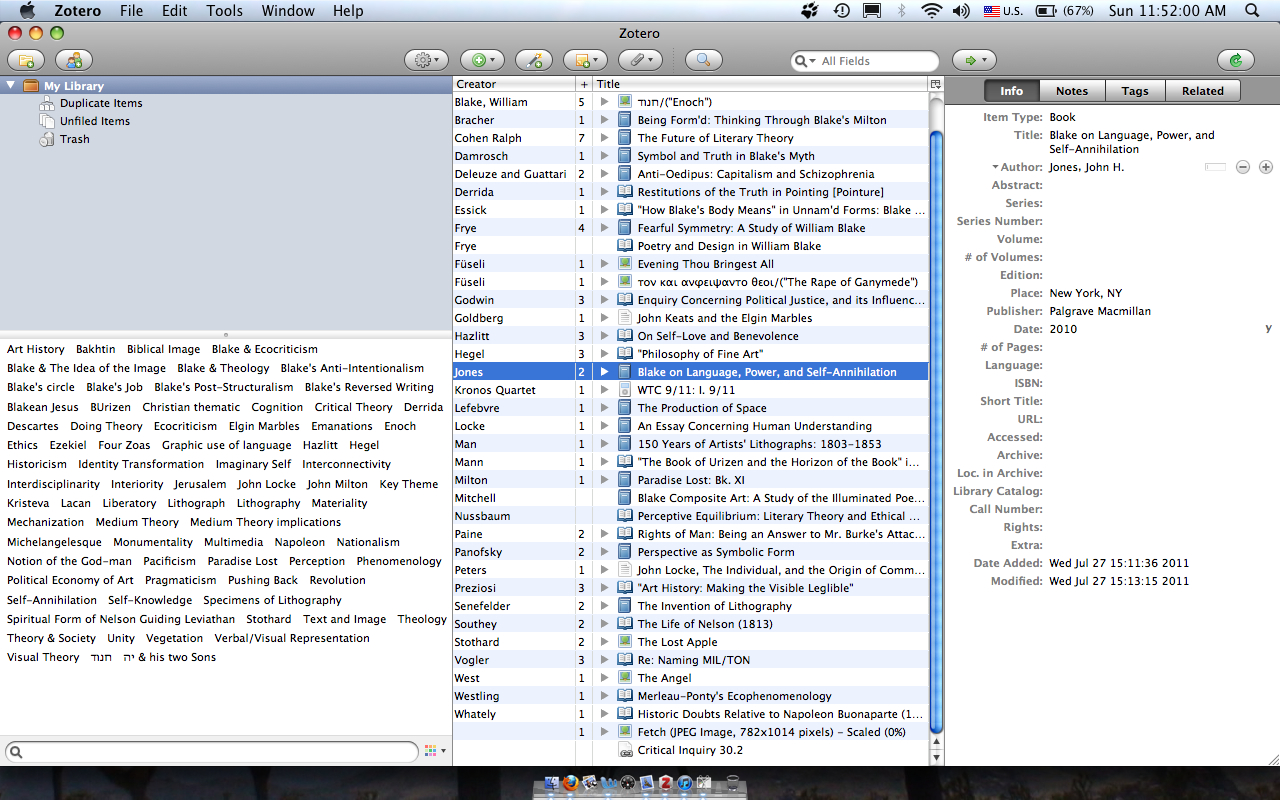
Zotero Main Screen Grab

I quickly became captivated by the usefulness of the “tag-function” as a means of exploring the interrelations between information. Indeed, in my case, this function allowed me to organize the flow of information between primary images, texts, and secondary source material in a really effective way. For instance, working on Blake and self-annihilation has generated certain challenges for me in navigating between where the idea comes up in Blake’s poetry, in the visual fields of the illuminated books, in other Blakean artistic media (his watercolors, his lithograph, etc.), its relation to period specific primary text materials, and more contemporary critical theory. Zotero allows me to see these phenomenon in relation to the ideas of scholars who have previously explored them, easily.
Quick & Dirty examples: For instance, hitting the tag “Self-Annihilation” allows me to visualize connections between the following range of texts, images, and tags I’ve created:
To the left, the blue tag indicates the primary idea I’m pursuing, while the remaining black tags indicate what other tags are related to the primary idea. To the right, Zotero displays what texts and images are tagged with the primary idea. As a second step, let’s say I’m interested in self-annihilation as it relates to Blake’s Enoch lithograph, specifically. To find new connections, I’d highlight both the tags “Self-Annihilation” and “Blake’s Enoch.”
The tag-function has allowed me to connect the lithograph to a diverse array of materials: two images I had tagged (but forgotten) as similar immediate objects of interest (“Christ Offers to Redeem Man” from Blake’s Butts Paradise Lost watercolor series and Jerusalem, pl. 41), a Hazlitt essay that I saw as exhibiting similarly self-annihilative concerns, and one of my favorite selections from Anti-Oedipus. Indeed, and also helpful, in this regard, is the ability to store copies of files–and namely images–within your personal Zotero database. With the way I use the interface, a simple click will load a stored image

(In the screen grab:) William Blake. “Christ Offers to Redeem Man” in Illustrations to Milton’s “Paradise Lost” (Butts Set), 1808. The William Blake Archive. Ed. Morris Eaves, Robert N. Essick, and Joseph Viscomi. 7 November 2011 <http://www.blakearchive.org/>.

Conclusion: In the end, after using Zotero for the last six months, I can’t even imagine going back to paper-based research note taking. It will be interesting to see how these new technologies drive humanities research forward in the future, and what new and more complex connections might be forged in all our studies. I also recognize that I’m not the only NGSC member who uses Zotero, and would appreciate comments on what tips and tricks you all have for using the program in your own work.

My First Acquaintance with Visual Artists & Ballerinas in Eugene

Fig. 1. Faye Mullen, still from: "to never forever-à jamais," 2011. Salt, Three story building, Artist's body. Three-channel video installation, 6min24secs. © Reproduced by permission of the artist.

Looking back, each term of my first year of grad school has offered its own distinct set of lessons. This quarter, after some really good experiences, I’ve realized just how crucial it can be to connect not only with like-minded passionate scholars in the field, but with contemporary practicing artists as well. As a result, I’ve arrived at a greater appreciation of the importance of getting outside my own work, concerned as it is with art and literature of the historical past, to interact and network with creative minds working today, particularly those with similar interests in critical theory. Early on in the term I had the opportunity to to see the Eugene Ballet Company’s final performance of the season that featured a visually stunning experimental performance called Tyranny of the Senses. Later, for this year’s University of Oregon Art History Symposium, we hosted an artist’s talk given by a really fabulous performative video installation artist and sculptress Faye Mullen (MFA Student, University of Toronto) who spoke on one of her latest video pieces, to never forever-à jamais. I’ve included examples of both here in hopes that some of you might take a moment to look at the works and respond as well, being that it is after all (and at last) summer break.
Also, on your end, I’m interested in seeing you all comment on a couple of other things:
(1) The type of interchange that occurs in your respective departments between creative writers and literary historians. If there isn’t any, would this be something you’d find desirable?
(2) Whether or not you feel that you’ve benefited from exchanges across the divide between creative writers/artists and scholars.
In Lawrence Hall–at the UofO–us cultural historians are definitely very much the minority. We’re surrounded by architects and artists working in a variety of media, running the gamut from printmaking, metalwork/jewelery, new media, to painting. Oftentimes, even in Art History seminars, we’re outnumbered by architects and artists. I feel as though I’ve really benefited from a dialogue between those who study art and those who create it. So, I’d definitely love to hear whether or not there are similar dynamics that go on in English graduate programs.
That said, to share a couple specific works with you all, I have to say that I’m totally captivated by choreographer Gillmer Duran and composer Brian McWhorter’s Tyranny of the Senses. The ballet left an indelible impression on me for the way it collides contemporary dance, projected images, and a soundtrack that pans intensely across the stereo-field (think U2-Joshua Tree).

One of the things I’ve found most exciting, in chatting with a couple ballerinas from the company that have subsequently become a part of my core group of grad school friends, is the recognition that shared concerns on both sides of the scholarly/artistic divide can really line up. Since my interests in critical theory are primarily geared towards understanding the process by which works generate their meanings through continuing processes of (reader/viewer)ly interaction, I was most struck by a conversation I recently had with one of the ballerinas who talked about the way Duran’s work created a space in which she and the other dancers are actively encouraged to re-interpret each individual performance through their own acts of improvisation against the ballet’s multimedia elements. For me, it was really cool to see that the post-structural concepts we’re exposed to as scholars actually do resonate with the ways in which contemporary practicing artists working in a variety of media think about their own work.
Lastly, and along these same lines, I thought it a good idea to share with you all Faye Mullen’s work (given that it engendered such a good discussion at this year’s grad symposium up here) (fig. 1; For a 9 minute excerpt of the 52 minute piece, please click here.) In my view, Mullen’s art really engages some crucially important issues related to the contemporary domestic-sphere that, because of its embodied exploration of identity, for me recalls Mary Wolstonecraft’s ideas concerning the detrimental way dependence of mind and body are integrally related. I found it interesting in talking with her after the talk that theory still drives work on both sides of the artist/scholar divide. At least in Canada, artists are strongly encouraged to deploy theory in explaining their art when applying for public grant funding. What really impressed me was that, while some artists react negatively to such a demand playing being placed on their work, others view it as a challenge that can spark the absorption of additional layers of creativity into their artistic practice, something that I imagine resonates with the way many of us might view the role and continued relevancy of critical theory within the humanities.
Increasingly, I’m realizing that the divide between scholarly and creative work runs even thinner that I’ve initially believed. Hope you enjoy taking a look at these works, as I have, and I strongly encourage comments, since I’d love nothing more than to continue the conversation.

The Myth of Summer Vacation

This time of year I am regularly regarded by my friends and family outside of academia as someone who is “off for the summer.” In my imagination, someone who is off for the summer gets a tan from working or playing in the yard during the day, kicks back on her front porch to enjoy a refreshing iced tea with her favorite lazy reading, takes her dog for hikes, and has the time to organize her closets and rid her house of the things that she hasn’t used since who knows when (and promptly takes them to the local Goodwill or Salvation Army to prevent further consideration). I often find myself frustrated when others imply that my job as a graduate teaching assistant affords me this sort of luxury. On the other hand, I recognize how fortunate I am to be away from the office for three months or so (that is, if I am not teaching a summer course or finding some other office to call home for a brief stint). If doing so is financially feasible, I do not have to teach a single class or report to the office for meetings until August; unquestionably, this is a privilege—a privilege that few fields offer.
Recent discussions here at the NGSC blog regarding the potential for academics to constantly be “on the clock” have me thinking about the relationship between work and summer (thanks Brittany Pladek!). Despite the seemingly popular notion that we all spend our summers “off,” as Kelli Towers Jasper pointed out, summer often means finding a way to pay the bills. We graduate students work odd jobs, pick up a summer class, tutor at Barnes and Noble and the local library, offer our skills at summer camps and so on. In fact, summer often means forcing ourselves to stick to a schedule even more stringent and demanding than that of the fall or spring semesters. We must find time to earn a(nother) living, continue our research, write a blog/article/chapter, plan for our fall courses, and the list goes on. This doesn’t seem to be exclusive to contingent faculty and graduate students, though; for full-time faculty the summer offers the chance to work on their own research and spend time away from the seemingly constant pile of undergraduate and graduate marking.
I recently crafted my summer reading schedule and found myself looking at a list of things I “must read by September,” rather than a list of things I’ve been hoping to read since…well, I can’t even remember. Here again emerges (at least the potential for) the always-working, always-on-the-clock academic. So, NGSC readers, I wonder, can we “clock out” just a bit this summer? Do the summer months afford you time away from the office, so to speak? If so, how do you spend your time?