A Summer Scotland Tour

I submitted final grades on Friday, and after granting myself a long weekend to relax (i.e. clean my house and sleep a full 8 hours each night), I am settling into my summer. I am on fellowship for the next year, and without teaching responsibilities, I am writing full time. But, I do have travel plans to punctuate the summer slog and give me much needed inspiration and respite. Like many of you, I have NASSR in Winnipeg this August, where I get to see friends, colleagues, and scholar-idols. But what’s foremost on my radar is the History of Distributed Cognition Workshop in Edinburgh next month.
As I have mentioned before, I have the pleasure of participating in this workshop at the University of Edinburgh to discuss and refine my chapter on Keats’s and Wordsworth’s contrasting visions of embodied reading. The workshop is only three days, but I’ve decided to stay abroad for a week. Initially, I toyed with the idea of traveling south after the workshop. My heart is and always will be in London, and I’m very comfortable traveling around England. I’ve been there often enough to feel a pseudo-mastery of navigating the country, and by now, I feel it’s my second home. Continue reading “A Summer Scotland Tour”

Interview: Dr. Patricia Fara

The Romantic Period’s scientific achievements affected all aspects of writing and poetry, especially as the public witnessed new discoveries. Captain James Cook’s circumnavigation of the globe influencing Coleridge’s writing of “The Rime of the Ancient Mariner” and William Bligh’s mutiny on the Bounty influencing Byron’s “The Island” are two examples of this fascination. Joseph Banks, an English naturalist, botanist, and patron of the natural sciences participated in Captain Cook’s voyage and has remained an important figure in Romantic science scholarship as well as the history of science.
Dr. Patricia Fara is one of the scholars who has written about Banks and Romantic science. Famous for publishing work beloved by both academia and the wider public, Fara urges scholars to resist limiting themselves with disciplinary boundaries, categorizations, and stiff formalities. Filled with fascinating historical context and beautiful prose, reading Fara’s work is both intellectually stimulating and fun. Continue reading “Interview: Dr. Patricia Fara”

NASSR 2015 Program & Pedagogy Contest

I’m delighted to announce that NASSR 2015 has released a program! Highlights of the August 13-16 conference in Winnipeg will include: tours of the archives of the Hudson’s Bay Company (the world’s oldest continuously-operating corporation) and the Canadian Museum for Human Rights; plenaries by Joel Faflak (Western) and Nancy Yousef (CUNY-Baruch); and an Aboriginal Rights Roundtable. Also of note — in addition to participating in many panels, the members of the NASSR Graduate Student Caucus will be hosting a professionalization panel and a pub night.
I also have an update about the NASSR Pedagogy Contest, sponsored by the NASSR Advisory Board, the NASSR 2015 Organizing Committee, and Romantic Circles. Please send in your syllabuses by June 5th to be considered for the Pedagogy award (which comes with a cash prize of $250). Here are the instructions:
TO SUBMIT:
Please send a document of between 3-5 pages to nassrpedagogycontest@gmail.com by June 5th.  Please include a cover letter with identifying information, which should be left off all other documents.  Initial queries and questions are welcomed.
Potential materials might include but are not limited to:
– A cover letter and explanation of the submission, including an argument as to the course or project’s pedagogical innovation and benefits
– Syllabus or parts of a syllabus
– Assignment sheets
– Multimedia or digital materials

NGSC E-Roundtable: The Pedagogy of Romanticism

INTRO: Renee Harris, Emily Zarka, and Daniel Nutters will focus their roundtable discussion on pedagogy around two essays by Mark Edmundson included in his recent book Why Teach? In Defense of a Real Education. The essays are entitled “The English Major” and “Teaching the Truths” and were previously published in The Chronicle of Higher Education (June 29th, 2013) and Raritan (23.1) respectively.
Unknown-1
While Why Teach? contains a polemic against the bureaucratization of education and the corporate logic of professionalism that governs academia, it also offers a vision of a “real education” that rests upon many assumptions inherent to what we now call “romantic ideology.” What makes this book, and especially the two essays we will consider, such an appropriate text to consider for a roundtable on pedagogy on the NASSR Graduate Student Caucus blog is the manner in which it demonstrates the continued relevance of such highly charged categories as “genius,” “imagination,” “truth,” and all the motifs of a “natural secular” theology of art. At the core of Edmundson’s thinking is not just a familiar and clichéd humanist vision, but one that has survived the culture wars (see Edmundson’s edited volume Wild Orchids and Trotsky), the apparent anti-humanist theory (or as he puts it anti-literature philosophy) of the 1970s and 1980s (see his Literature Against Philosophy). Absorbing these consequential intellectual events has allowed Edmundson to assess our current academic scene and argue for a vision of education that builds upon his own experience of the changes witnessed and occurring in higher education. Continue reading “NGSC E-Roundtable: The Pedagogy of Romanticism”

The Modernization of Elizabeth Bennet

By Talia Vestri

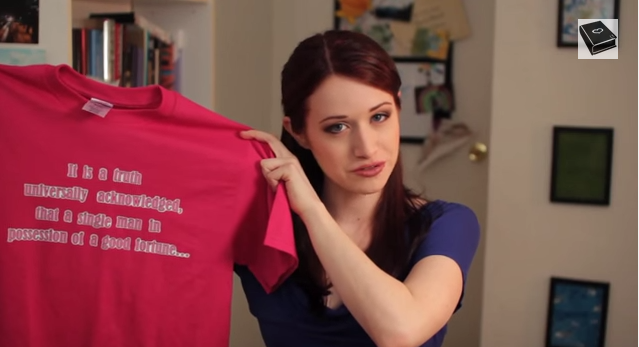
“It is a truth universally acknowledged that a single man in possession of a good fortune… must be in want of a wife.” One of the most well-known lines in literature has been reiterated once again—except that this time, it’s plastered on a bright fuchsia T-shirt.
Screen Shot 2015-03-05 at 4.47.31 PM
So begins The Lizzie Bennet Diaries (2012-2013), an Emmy-winning web series that reworks Pride and Prejudice for the modern age, featuring an endearing but sarcastic twenty-something Lizzie Bennet played by newcomer Ashley Clements.
Continue reading “The Modernization of Elizabeth Bennet”

Planning My First Brit Lit Survey

At my university, the opportunities to teach an upper-level course are present but few. After passing comprehensive exams, you can apply to teach a survey course corresponding to your area of specialty. The second-half of British literature is particularly hard to come by, and typically a PhD candidate gets to teach it once before graduating. This is my semester, and I am thrilled!
I have been teaching general education classes for six years. I can count the number of English majors I have taught on one hand. But now, I have two full classes of English majors or minors, who ask me questions like, “Percy Shelley? Any relation to Mary Shelley?” (Isn’t it crazy to remember a time when we didn’t know every intimate detail of the Shelleys’ marriage?).
I am two days in. And here’s what I can report so far: I love my job.
Continue reading “Planning My First Brit Lit Survey”

Dissertating with a Hammer: An Idiot’s Generalizations on Scholarship and Activism

I begin with two passages that will be the epigraphs to my dissertation:

Few critics, I suppose, no matter what their political disposition, have ever been wholly blind to James’s greatest gifts, or even to the grandiose moral intention of these gifts … but by liberal critics James is traditionally put the ultimate question: of what use, of what actual political use, are his gifts and their intention? Granted that James was devoted to an extraordinary moral perceptiveness, granted, too, that moral perceptiveness has something to do with politics and the social life; of what possible practical value in our world of impending disaster can James’s work be? And James’s style, his characters, his subjects, and even his own social origin and the manner of his personal life are adduced to show that his work cannot endure the question.

Continue reading “Dissertating with a Hammer: An Idiot’s Generalizations on Scholarship and Activism”

Hero Worship, Discipleship, and the Romantic Imagination: On Spivak’s Aesthetic Education

“And so I go, asking the students to enter the 200-year-old idiomaticity of their national language in order to learn the change of mind that is involved in really making the canon change. I follow the conviction that I have always had, that we must displace our masters, rather than pretend to ignore them.” So writes Gayatri Spivak at the conclusion of a chapter entitled “The Double Bind Starts to Kick In” in her recent tome An Aesthetic Education in the Age of Globalization. Is Spivak too, I ask, such a master that we must displace if we are to abide by her own conviction? This is a question I want to pursue as I consider her treatment of British romanticism in this mammoth work. Continue reading “Hero Worship, Discipleship, and the Romantic Imagination: On Spivak’s Aesthetic Education”

Thoughts on Teaching Jane Austen

I am currently teaching a class with the very long title The Modern Self in the World: Literature and Art across Modernity, from Donne and Dürer to Baldwin and Cool Hand Luke. As with my other class (on American literature), I’ve used my teaching opportunities as a graduate student to escape the burden of academic and professional decorum. My classes, in other words, might be retitled, “books I like to read, want to read, and think you should read.” They are not lectures or surveys, but rather reading groups where my students and I try and make sense of the various texts we confront. Continue reading “Thoughts on Teaching Jane Austen”

From Jane Austen to Quentin Tarantino: How Movies Can Help Us Teach Literature

You don’t want to watch a movie with me. No, really. I consider it a test of true friendship if someone can sit through two hours of me constantly pausing, rewinding and talking over the figures on screen. It’s a bad habit I cannot break. After helping teach a film and media class this semester however, I don’t think I should.
While my near constant commentary might be distracting to say the least, it isn’t meaningless. I am often pointing out how camera angles, body language, costumes, set design, lighting all come together to hint at a future plot point or reveal some sort of narrative truth. I can often predict the ending to a movie, which never ceases to be a sort of useless party trick for my friends and family, but underneath that novelty however, lies real critical thinking. Continue reading “From Jane Austen to Quentin Tarantino: How Movies Can Help Us Teach Literature”