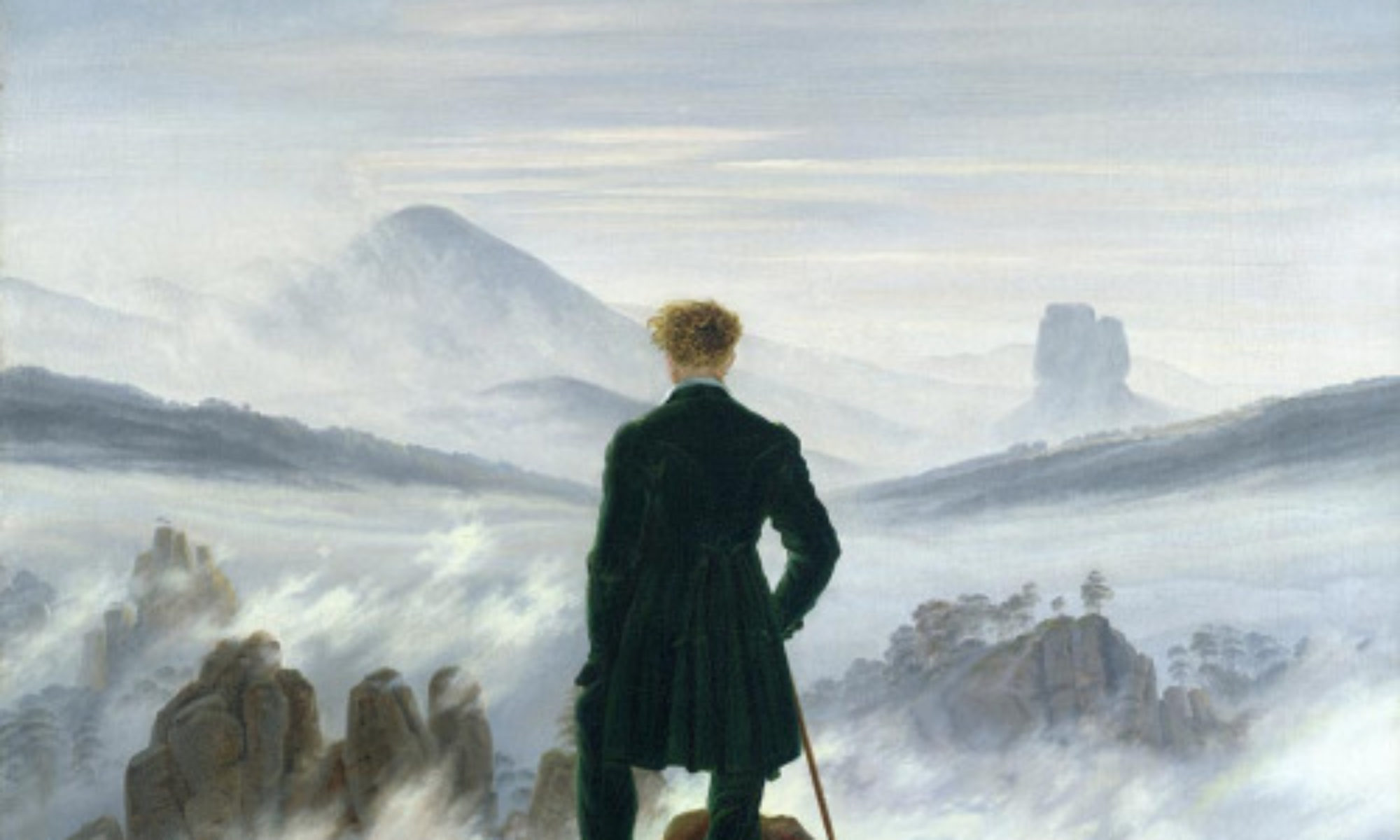
 It’s nearing the end of the year, finals are over, papers are due, but we’re literature majors here, so of course the only thing that matters is the symbolism of winter. The year is dying and ready to sleep forevermore — bringing in its death a spark of new life, new possibilities, and the mass cultural/capitalistic orgy that is the Christmas season. Parting with the cynicism, however, I decided that rather than construct coherent argument, I would instead remember a moment from one of my Romanticism courses and muse on the experience. Continue reading “A Bird’s Song, and Two Men Divided by Death, United by Age”
Charles Dickens vs. Leigh Hunt: Charity, Social Reform, and the Problem of Hell
My sister and I have two very important holiday traditions: 1) we always go to a haunted corn maze before Halloween, and 2) we always watch The Muppet Christmas Carol before Christmas. We don’t often admit to the second tradition (and when we do, we kind of pretend that we only enjoy the Muppets “ironically”), but it’s something we’ve done for as long as I can remember. It just doesn’t feel like Christmas until Katie and I are sitting on the couch, singing along to the song “Marley and Marley” while two enchained muppet ghosts rattle around the TV screen, bemoaning their eternal punishment.

Continue reading “Charles Dickens vs. Leigh Hunt: Charity, Social Reform, and the Problem of Hell”
How Far Feminism?
By Talia Vestri
It is rare that I ever have the pleasure of walking into my classroom to find students enthusiastically discussing our subject matter. Since for the most part I teach courses on poetry or nineteenth-century novels, my eighteen-year-old, twenty-first-century students tend not to get too riled up about the nuances of iambic tetrameter or “ye olden days” characters found in historic fiction (and can I blame them, really?).
Recently, however, I witnessed what other courses with more obviously controversial material might be experiencing on a more regular basis: my students were animated—and not just animated, but even aggravated!!—by the readings for their latest assigned task. They were asked to compare Mary Wollstonecraft’s Vindication of the Rights of Woman and her fictional Maria, or the Wrongs of Woman with a few contemporary articles. These latter essays suggest that women who choose today to “opt out” of the work force for the sake of raising children are still, at heart, somehow in line with the feminist agenda.
When I stepped into the room, the students were arguing about just how far—or not—feminism has come. Continue reading “How Far Feminism?”
Romantics as Rappers, Superheros, Real Estate Tycoons, and Immortal Allusions of Power
 There’s a scene in an episode of the animated series Samurai Jack where the Scotsman encounters an old man in the port who wishes him to tell him a tale. When the Scotsman asks what it is there’s a long pause before the old man cackles out, “The Rime of the Ancient Mariner!”
The Scotsman then bellows, “Heard it!” and shoves him out of the way. Continue reading “Romantics as Rappers, Superheros, Real Estate Tycoons, and Immortal Allusions of Power”
Reading Romanticism Today: Artistry of the Sublime
By Talia Vestri
In my last post, I previewed my newest introductory-level literature course, “Reading Romanticism Today,” where my freshman writing students and I have just wrapped up a unit on “Nature and the Sublime.” As Seth Wilson recently reminded us, the concept of the “sublime” can be a wily one to pin down, even for (or maybe, especially for) scholars who study authors that were themselves fascinated by this aesthetic and philosophical notion.
For the purpose of this course, we’ve been exploring the “sublime” by mashing together some of Romanticism’s greatest hits—Wordsworth’s “Tintern Abbey,” Shelley’s “Mont Blanc”—with contemporary media pieces, such as a recent documentary on the Cosmos hosted by astrophysicist Neil DeGrasse Tyson (discussed in September’s post). The paper assignment that culminated this unit asked students to find their own example of the sublime in an artwork they would choose from Boston’s Museum of Fine Arts. The pieces could be from any historical moment, but each one had to connect to a Romantic poem. Here, I offer some of the students’ fascinating finds: Continue reading “Reading Romanticism Today: Artistry of the Sublime”
Teaching Close Reading: Nietzsche, Metaphor and Romantic Poetry
This fall, I’ve been assigned to instruct a class called ‘Introduction to Writing about Literature.’ While the course is designed to transmit a specialized skill-set (textual analysis), it’s not organized around a historical period, event, or philosophical discourse. As an instructor, I’m required to jump around—across periods, genres and continents—in an effort to give students the most comprehensive possible familiarity with literature in English. The only thing that holds the course together is a persistent focus on form and figuration. This is both liberating—it’s great to get close to some of my favorite texts in the classroom–and a little terrifying—unmoored from thematic, historical and philosophical contexts, I’ve found myself wondering if I know anything about how literary language works. In this post, I’ll outline some of the theoretical and pedagogical dilemmas I’ve bumped up against teaching close reading and then explain how I’ve decided to talk about metaphor and figuration in my requirement-level lit course. Though the post turns on my own experiences, I’m hoping that the problems and solutions that I address here may be relevant to readers working out their own ideas about how to teach and test close reading skills.
Continue reading “Teaching Close Reading: Nietzsche, Metaphor and Romantic Poetry”
Dear Mr. Southey, Jump in a Lake: Byron and Epic Humor

There’s a recurring question that springs to mind whenever I sit in the Starbucks in the Barnes & Noble in my little East Texas town and stare up at the mural of authors who all seem to have transcended time and space to have coffee alongside the hipsters: who put Oscar Wilde next to George Eliot, Rudyard Kipling, and Trollope? Seriously, is it any wonder that the man looks so bored? Wilde shouldn’t be surrounded by those Victorian fogies, he should be sipping gin with Truman Capote, Christopher Hitchens, Walt Whitman, and the one man who would almost certainly guarantee a good time, and who also happens to be the focus of this  essay, George Gordon, Lord Byron. The reason for such inclusion is simple: Byron could be an absolutely trenchant satirist when he wanted to be. Byron, like Wilde, Capote or Hitchens, could bring out his own breed of sharp wit whenever someone at a dinner party decided to be cleverer than him, only to be left decimated in a single sentence by his superior rhetorical ability. I know this is a platitude, but sometimes I really wish I could have been a fly on the wall whenever Byron let loose one of those glorious aphorisms that sealed his entrance into the hall of “Truly Spectacular One Liners,” if only to see and understand how it was that Rodney Dangerfield sealed his membership before the poet. (Then again, when you’ve starred in Caddyshack, your “Immortality card” is pretty much secure, unless you’re that blond kid who was the protagonist, and does anybody have any clue what happened to that guy?) Continue reading “Dear Mr. Southey, Jump in a Lake: Byron and Epic Humor”
Juvenilia: The Syllabus!
I’ve been musing for a while about how much fun it would be to organize a class for undergraduates centered around the theme of creative writing by youthful authors. Perhaps because of the Romantic association between individuality, genius, and youth (an idea that persists in present-day cultures of information technology), 18th- and 19th-century literature is wonderfully full of examples of juvenile authorship. In this post, I’ll just name a few examples of texts that might pair well together in a class on juvenilia in the 18th and 19th centuries, with special focus on the Romantic period. I’d welcome the additional suggestions of readers! Continue reading “Juvenilia: The Syllabus!”
Of Images, Sublime, and the Necessity of Keeping Crossbows Off Ships
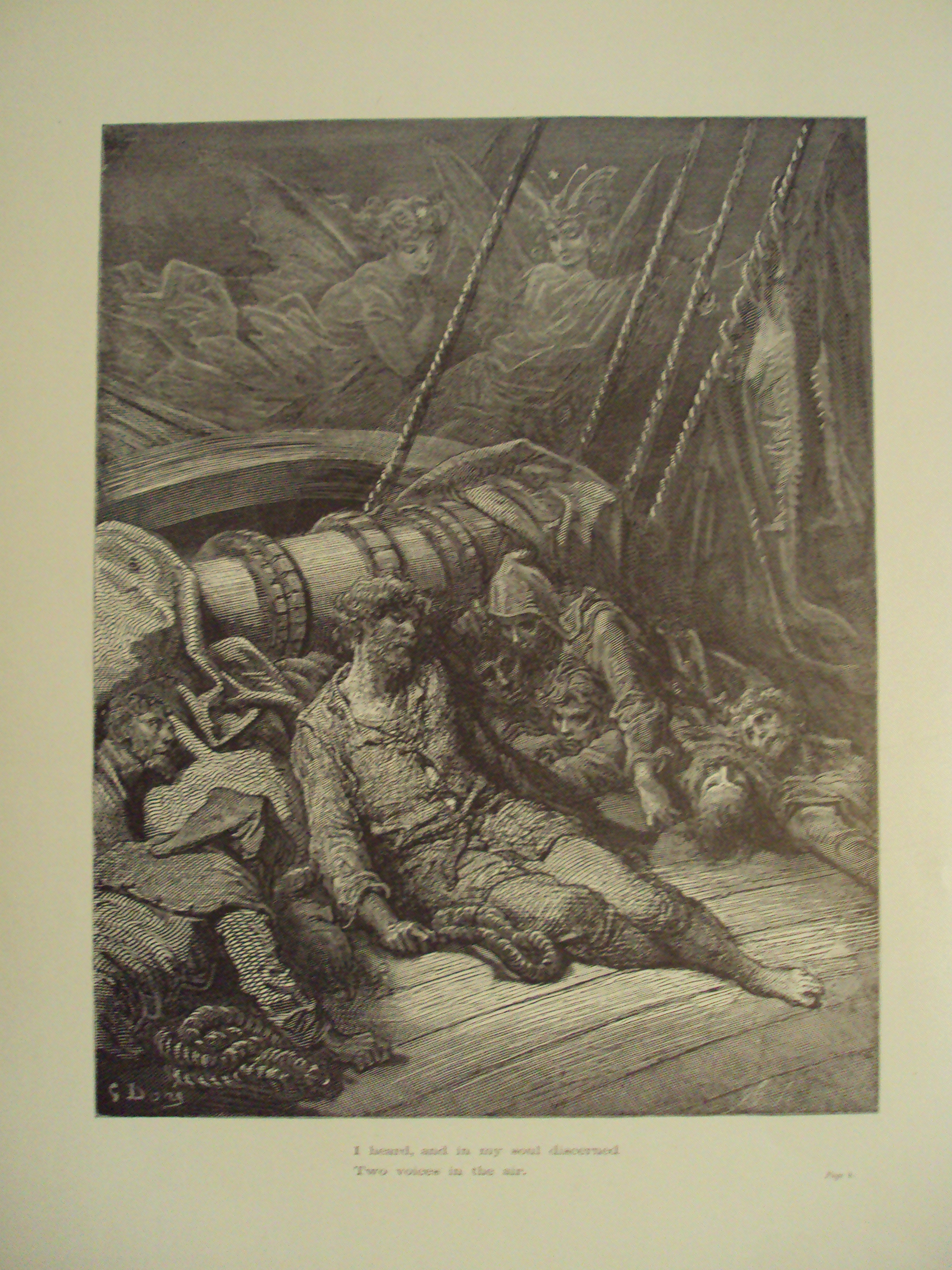 It’s probably not a good first impression upon my new reader to admit that I did not actually re-read The Rime of the Ancient Mariner before I began this first post. I promise it was not out of apathy or laziness. You see, I’ve read the Mariner’s Tale at least ten times in my life, at least four times for school, the other times because my
teachers had instilled in me the beauty and power found within this strange and wonderful poem. This confidence in the material, really my own working knowledge of the poem, allows me to focus instead upon a work of art that has played a significant role in my appreciation of the work. Continue reading “Of Images, Sublime, and the Necessity of Keeping Crossbows Off Ships”
Reading Romanticism Today (A Pedagogical Experiment)
By Talia Vestri
The title of this week’s post echoes the title of my newest course, which I’m currently three weeks into teaching. “Reading Romanticism Today” is one of the English department’s introductory courses advertised as “Freshmen Seminars in Literature.” These classes satisfy our College of Arts and Sciences’ first-year composition requirement.
Having taught several of these intro-level seminars in both the English and Writing Program departments, I’ve designed courses on poetry, fiction, and contemporary media. I typically organize the syllabus around a particular theme, like “the modern American family” or “poetry of the self.” I have not yet focused one on any particular historical period. But since this was likely to be one of the last courses I’ll teach while still a doctoral student, I wanted to develop a syllabus that not only falls within my field of research, but that also pushes beyond a straightforward poetry survey. Continue reading “Reading Romanticism Today (A Pedagogical Experiment)”