By Julia Malykh
The enchanting sensuality of Lord Byron’s closet drama Manfred (1816) lies in its depiction of a power struggle. On encountering the text, it is easy to underappreciate Byron’s magnetic innovation by writing off Manfred as a fictionalized account of the poet’s incestuous relationship with his half-sister Augusta Leigh—in keeping with his personal reputation as “mad, bad and dangerous to know.” Upon a closer look, however, it becomes clear that Byron’s dramatic poem is a series of tableaux depicting power struggles between a Byronic hero, Manfred, and a Byronic heroine, Astarte. Continue reading “On First Looking into…Manfred”
More Frankenstein(s): Cumberbatch, Miller, and the National Theatre
By Talia Vestri
Like Arden, I, too, have been burning with curiosity about the recent critical reactions to several Frankenstein adaptations. But rather than valiantly sacrifice my time to the gods of Hollywood mediocrity as she so nobly does in her last post, I managed to escape the sub-par recreation of I, Frankenstein and instead turned my intrigue towards a much more mainstream and accepted performance: Danny Boyle’s 2011 National Theatre stage production of Frankenstein, featuring the incomparable Jonny Lee Miller and Benedict Cumberbatch. Continue reading “More Frankenstein(s): Cumberbatch, Miller, and the National Theatre”
Of Mountains and Media: Versions of the Sublime
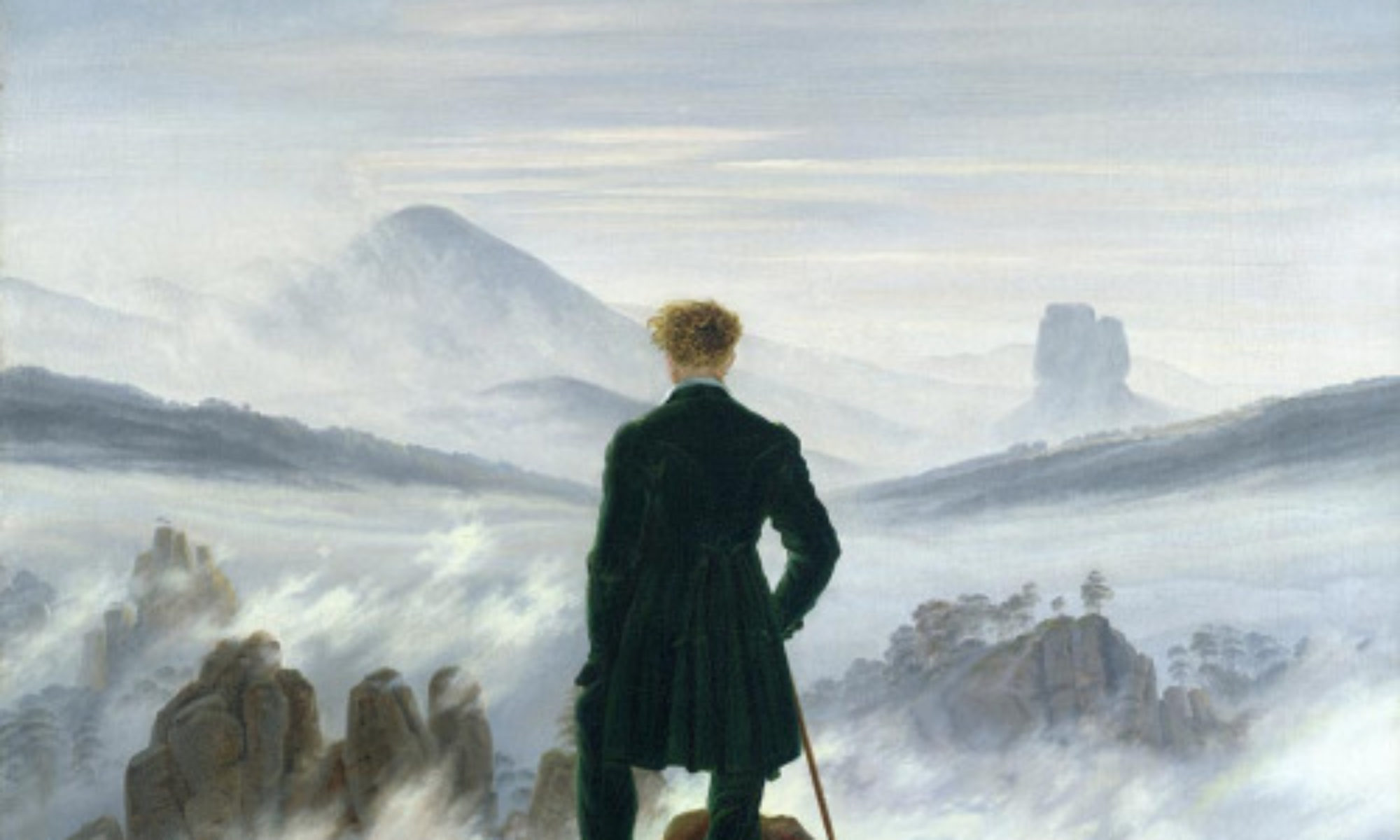
A few years ago I got a chance to see Marc Handelman’s Archive for a Mountain in person, and it got me thinking about the category of the sublime in a new way. The conceit of the work is straightforward–Handelman assembled into a single book every piece of data he could find about the Untersberg–but the product is impressive. Weighing in at a hefty 740 archival-quality pages of maps, images, brochures, essays, scanned microfilm, screenshots of Wikipedia entries, and more, the book has an excessive materiality of its own. But it also—in the way it inevitably provokes us to imagine even more material that might have been included—foregrounds the incredible constrictions that are necessarily imposed upon any subject in the process of representation, even in those renderings that we are tempted to label exhaustive or comprehensive. Its gesture towards a kind of vast and awe-inspiring archival noumenal that exists beyond the capacity of any single human or technological interface to represent it (as well as its mapping of this limit onto such a traditional representative of sublime Nature) seems distinct to me from other contemporary notions of the sublime, and actually seems to hearken back to the original problematic of the eighteenth-century sublime: how to represent a mountain?
Continue reading “Of Mountains and Media: Versions of the Sublime”
On First Looking Into…Kubla Khan
The Orient as Other in Kubla Khan
By Lucille Starer Marshall
Orientalism, as defined by Edward Said, is a mode of knowledge production that sustains a basic distinction between the East and West. Orientalism produces cultural theories, political accounts, and literary representations of the Orient that maintain the world’s imbalances of power. At a time of Western imperialism and national cultivation, Romantic writers participated in constructing the image of the Orient. Through poetic style, diction, and narrative, authors established a distinct Other in order to assert the superiority of Western civilization. We encounter such Orientalism in Coleridge’s Kubla Khan. Continue reading “On First Looking Into…Kubla Khan”
I Watch I, Frankenstein
This unapologetic lead balloon of a film has created controversy among Romanticists. What gives? I sacrificed myself to find out.
“He’s alive! But you might wish he wasn’t.”
For the last number of months, I’ve been surprised by how often I, Frankenstein has reared its malformed CGI head in discussions about Romanticism. The film, which came out in January 2014 and has a 3% approval rating among critics, seems oddly difficult to dismiss. The film’s “near viral” negative response has resulted in a curious sort of academic Whack-a-Mole, as dismayed scholars continually reject any influence of anything “like this” on their work and teaching. But like any supernatural villain, I, Frankenstein always comes back — and so, it is lamented, the film is bound to make an eventual appearance on some ill-fated undergraduate syllabus. Continue reading “I Watch I, Frankenstein”
On First Looking Into…Coleridge's Conversation Poems
Coleridge and the Sound of Music in the Conversation Poems
By Zoe Baker-Peng
Methinks it should have been impossible
Not to love all things in a world so filled,
Where the breeze warbles, and the mute still air
Is Music slumbering on its instrument.
(‘The Eolian Harp,’ 30-33)
As I read Samuel Taylor Coleridge’s conversation poems for the first time, in particular ‘The Eolian Harp,’ ‘The Nightingale,’ and ‘Frost at Midnight,’ the frequent pairing of nature and music struck me as intriguing. Throughout these poems, Coleridge examines the relationship between the organic world and musical sounds, and uses music to further illustrate and explain the composition of natural scenes. Continue reading “On First Looking Into…Coleridge's Conversation Poems”
From Jane Austen to Quentin Tarantino: How Movies Can Help Us Teach Literature
You don’t want to watch a movie with me. No, really. I consider it a test of true friendship if someone can sit through two hours of me constantly pausing, rewinding and talking over the figures on screen. It’s a bad habit I cannot break. After helping teach a film and media class this semester however, I don’t think I should.
While my near constant commentary might be distracting to say the least, it isn’t meaningless. I am often pointing out how camera angles, body language, costumes, set design, lighting all come together to hint at a future plot point or reveal some sort of narrative truth. I can often predict the ending to a movie, which never ceases to be a sort of useless party trick for my friends and family, but underneath that novelty however, lies real critical thinking. Continue reading “From Jane Austen to Quentin Tarantino: How Movies Can Help Us Teach Literature”
Misunderstanding Music Theory
By Andrew Welch
I’ve a problem I suspect is endemic to academia: the hopeless, near-pathological attraction to disciplines, fields, discourses, and texts I can’t understand, and likely never will. Is there a name for this malady? The worst part is that once a once-opaque knowledge begins to make sense, it loses its mystique. Perhaps this condition would be more tolerable if it didn’t so closely resemble the delusion of chivalric romance—or, for that matter, the troubled frisson of orientalism. I know that I know an understanding is just a calcified and stable misunderstanding. Whatever I think I know, I don’t. And any knowing is always dissolvable and resolvable. But once knowledge starts to feel understood—however poorly—something changes. It no longer exists out there, as something mysterious and opaque: it’s now in here, joined to my conceptual armature. Once appropriated, a concept becomes part of the machinery of appropriation. Continue reading “Misunderstanding Music Theory”

On First Looking into…The Lucy Poems
By Gabriela Minden
Upon delving into the second edition of Wordsworth and Coleridge’s Lyrical Ballads (1800) for the first time, I was struck by the disparity between the Lucy poems and the rest of the collection. The Lucy poems are elegiac, written about a mysterious female figure whose nature seems to change from poem to poem, and they seem to constitute their own corpus that does not quite mesh with the other poems in the collection. In hopes of clarification, I turned to Coleridge’s explanation of his and Wordsworth’s artistic goals in composing Lyrical Ballads. Continue reading “On First Looking into…The Lucy Poems”
Guest Post: Songs of Urban Innocence and Experience
By Katherine Magyarody
I was recently chatting to a friend about the NASSR Graduate Student Caucus and the suggestion that posts could include original poetry. It is an exciting prospect, but also vexing. What might contemporary poetry on a Romanticist blog look like? If someone wrote something similar in tone to Keats’s early faux-Spenserian verse would anyone find value in it? Did it have to be an Ode? Was there anything in our proximity as remote and beautiful as the Lake District? Looking around, I nearly concluded that the world is too much with us. Continue reading “Guest Post: Songs of Urban Innocence and Experience”