In December of 1811, Leigh Hunt’s Examiner featured the gruesome news of two families murdered near Ratcliff Highway, in London’s East End. These murders attracted prolonged public attention: The Examiner and The London Times, for example, both followed the “Horrid Murders” from December 8th through January of the following year and invoked them over the next decade as a standard against which all other horrific crimes were measured. The murders also inspired a satiric essay by Thomas de Quincey, first published in 1827 in Blackwood’s Magazine, entitled “On Murder, Considered as One of the Fine Arts.” In it, he describes murder as an art form and the Ratcliff murders as the pièce de résistance. The Regency’s public interest in this crime has an uncanny cousin in our modern-day fascination with police procedural TV shows, and I’d like to suggest that we can see the newspapers’ representation of this moment—particularly because of de Quincey’s essay—as an early exploration of a “True Crime” genre that, narratively, features the same foundations as the serial television shows many are drawn to today.
First, a note about De Quincey’s essay. It features a transcribed lecture presented by a member of the fictional Society of Connoisseurs in Murder—I’ll refer to him as SCM here. These members “profess to be curious in homicide; amateurs and dilettanti in the various modes of bloodshed” and “criticise [murders] as they would a picture, statue, or other work of art” (1, 2). After the murder is “over and done,” SCM—quoting anecdotes from Coleridge and Wordsworth for support—claims that we can “make the best of a bad matter” and “treat it aesthetically” (12). An aesthetic treatment of murder involves examining its “design, [. . .] grouping, light and shade, poetry, sentiment” (5), and SCM has elaborate rules for the characterization of the murder’s victim, place, and time. He calls the early nineteenth century the “Augustan age of murder” (40), and he lionizes Williams—the man accused of committing the Ratcliff murders—as the Milton or Michelangelo of murder, claiming that his crimes are “the sublimest and most entire in their excellence that ever were committed” (54).
Continue reading ““True Crime” in the Regency: why the Romantics would have been addicted to Law and Order”
Juvenilia: The Syllabus!
I’ve been musing for a while about how much fun it would be to organize a class for undergraduates centered around the theme of creative writing by youthful authors. Perhaps because of the Romantic association between individuality, genius, and youth (an idea that persists in present-day cultures of information technology), 18th- and 19th-century literature is wonderfully full of examples of juvenile authorship. In this post, I’ll just name a few examples of texts that might pair well together in a class on juvenilia in the 18th and 19th centuries, with special focus on the Romantic period. I’d welcome the additional suggestions of readers! Continue reading “Juvenilia: The Syllabus!”
Romantics, they’re just like you and me: Health fads of the 18th and 19th centuries
If there was one thing* I was completely unprepared for in my pursuit of a PhD, it was the toll grad school would take on my body. After working for several years post-college, I found returning to student life more physically draining than I expected: I hadn’t fully anticipated that my slightly older body would need more sleep and better food than it did in college, that the fonts on my computer would require some magnifying, or that my right wrist would come to demand the support of a carpal tunnel brace. While I realize the hardships of excessive sitting pale in comparison to, say, those of transportation to Botany Bay, that awareness couldn’t fully stop me from dwelling on the chair-bound grad student lifestyle’s surprising tendency to hurt, in places expected…and unexpected.
Perhaps it’s no surprise that as I learned how to take better care of myself as a grad student, I found myself gravitating towards health-related topics in my research. Or perhaps I simply felt vindicated by medical opinion new and old, both of which emphasized the evils of too much sitting. Indeed, Swiss physician Samuel August Tissot’s Essay on Diseases Incident to Literary and Sedentary Persons (1768; translated into English, 1769) would not seem out of place among the numerous recent articles detailing the threat posed by chairs, comfy and otherwise. Tissot’s medical advice is far from the only text that calls to mind current health preoccupations. In this post, I want to highlight a few of my favorites:
Continue reading “Romantics, they’re just like you and me: Health fads of the 18th and 19th centuries”
Female Cross-Dressers in 18th-Century and Romantic England
Welcome back, readers! As Managing Editor, I am excited to say that we have an all-star lineup of new bloggers, roundtables, and conferences to share with you this Fall. (For the identities of these mysterious new bloggers, who represent a wide selection of American and Canadian universities, take a look at Our Writers).
In the midst of getting organized for the new semester of NGSC blogging, though, I’m also preparing to give a presentation for my friend Katie Gemmill’s undergraduate seminar at Columbia, which she has brilliantly titled “Miss Behaviour: Transgressive Women in 18th-Century British Fiction.” In response to the assigned primary-source texts on dress, disguise, and gender, I will be providing some historical background for female cross-dressing during this period. Since I think blog readers are just as likely as students to be intrigued by the topic, I’ll introduce to you now some fascinating (and, most importantly, * real *) cases of female cross-dressing and concealed identity — especially in the context of same-sex relationships — in the eighteenth and nineteenth centuries. Continue reading “Female Cross-Dressers in 18th-Century and Romantic England”
Dickens in Eden, 2.0
NASSR-time is upon us, and I am very excited to see many of our Romanticist writers and readers in Winnipeg! Readers can expect an update on the conference — and particularly the sessions for graduate students — next week. But first, I’d like to give my report on The Dickens Universe 2015, which I attended for the first time at UC Santa Cruz at the beginning of this month. This annual week-long event is part academic conference, part professionalism workshop, part Victorian reenactment, and part summer camp: it brings together faculty and graduate students from the US and abroad, but also “Road Scholars” of all ages whose admiration for Boz brings them back each year to discuss a new novel. And, while Dickens isn’t strictly part of the Romanticist repertoire, the conference has much to offer for the aspiring nineteenth-century aficionado/a. Continue reading “Dickens in Eden, 2.0”
Austen's Names and Romantic Espionage
I was very excited to hear about Margaret Doody’s new book, Jane Austen’s Names: Riddles, Persons, Places (University of Chicago Press, April 2015). In this text, Doody traces the etymological contexts for the nomenclature of each of Austen’s characters, while exposing curious patterns of naming throughout her corpus. Who knew that Austen’s Marys were uniformly negative, or that, with the name “Fitzwilliam,” Mr Darcy naturally followed as the inheritor of William Collins’s suit for Elizabeth’s hand?

When I peeked into the book itself, I was impressed with the etymological research, and I was inspired to think about how the names could be explained further with historical correlatives. The Romantic-era histories behind the names give the characters even more flair, while showing Austen’s awareness of some of the most fraught and intriguing elements of English public life — including espionage. Continue reading “Austen's Names and Romantic Espionage”
A Summer Scotland Tour
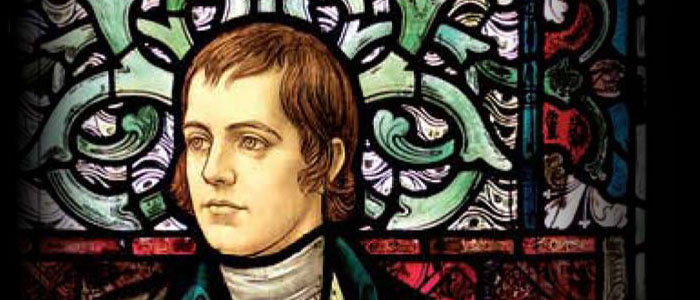
I submitted final grades on Friday, and after granting myself a long weekend to relax (i.e. clean my house and sleep a full 8 hours each night), I am settling into my summer. I am on fellowship for the next year, and without teaching responsibilities, I am writing full time. But, I do have travel plans to punctuate the summer slog and give me much needed inspiration and respite. Like many of you, I have NASSR in Winnipeg this August, where I get to see friends, colleagues, and scholar-idols. But what’s foremost on my radar is the History of Distributed Cognition Workshop in Edinburgh next month.
As I have mentioned before, I have the pleasure of participating in this workshop at the University of Edinburgh to discuss and refine my chapter on Keats’s and Wordsworth’s contrasting visions of embodied reading. The workshop is only three days, but I’ve decided to stay abroad for a week. Initially, I toyed with the idea of traveling south after the workshop. My heart is and always will be in London, and I’m very comfortable traveling around England. I’ve been there often enough to feel a pseudo-mastery of navigating the country, and by now, I feel it’s my second home. Continue reading “A Summer Scotland Tour”
Will the Real Mr. Darcy Please Stand Up?
By Talia Vestri
Jane Austen was in the news again last week—I know this, because when I log onto Google News, it offers tailored entries based on my previous web searches and sticks them right at the top of the feed. I honestly don’t know whether to be delighted or terribly disturbed by this fact. But artificial intelligence issues aside, I found this most recent bout of Austenmania to be quite a curious one.
It’s not a rare occasion these days that Miss Jane appears in the news, especially during this decade that celebrates “200 years since…” each of her famous tomes, published during the 1810s. Austen’s popularity endures: in 2013, Britain announced it will finally commemorate her in currency (Austen will appear on the 10-pound note, beginning in 2017) and last month she even got a musical in Chicago.
The most recent news cycle that got my attention (to be fair, it was hardly a sidebar item) highlights a new book that claims to make a striking and long sought-after discovery: the “true” identity of the real-life Mr. Fitzwilliam Darcy—and (sadly) it’s not Colin Firth. Continue reading “Will the Real Mr. Darcy Please Stand Up?”
Guest Post: Ways for English Graduate Students to Scare Landlords with Terrible Fridge Magnet Poetry
By Katherine Magyarody-Sigal
A few days ago, I climbed the stairs to my apartment and encountered my landpeople, who let me know that they had been in to check on some electrical wiring. They are extremely nice and shy about coming into our space. Anyways, I made it up the final flight of stairs and dumped my bookbag onto the kitchen table. And I looked over. And I froze. And I hoped that in their journey across the apartment, they did not look at the kitchen table and did not see the cookie sheet there, on which I had composed the worst fridge-magnet poetry ever. Poetry…not even poetry…words that makes me seem delusional, lovelorn, possibly homicidal. It begins:
if nevermore
I mourn that kiss
my silent scream
will make him howl Continue reading “Guest Post: Ways for English Graduate Students to Scare Landlords with Terrible Fridge Magnet Poetry”
The Modernization of Elizabeth Bennet
By Talia Vestri
“It is a truth universally acknowledged that a single man in possession of a good fortune… must be in want of a wife.” One of the most well-known lines in literature has been reiterated once again—except that this time, it’s plastered on a bright fuchsia T-shirt.
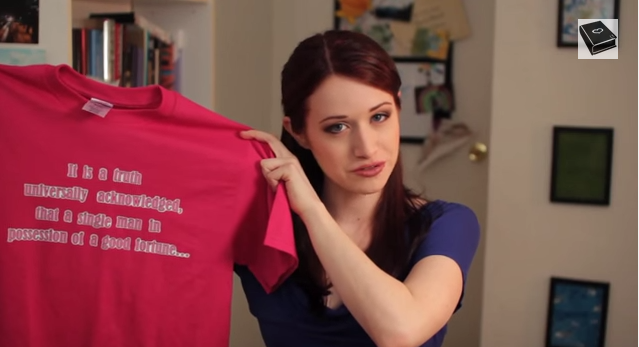
So begins The Lizzie Bennet Diaries (2012-2013), an Emmy-winning web series that reworks Pride and Prejudice for the modern age, featuring an endearing but sarcastic twenty-something Lizzie Bennet played by newcomer Ashley Clements.
Continue reading “The Modernization of Elizabeth Bennet”