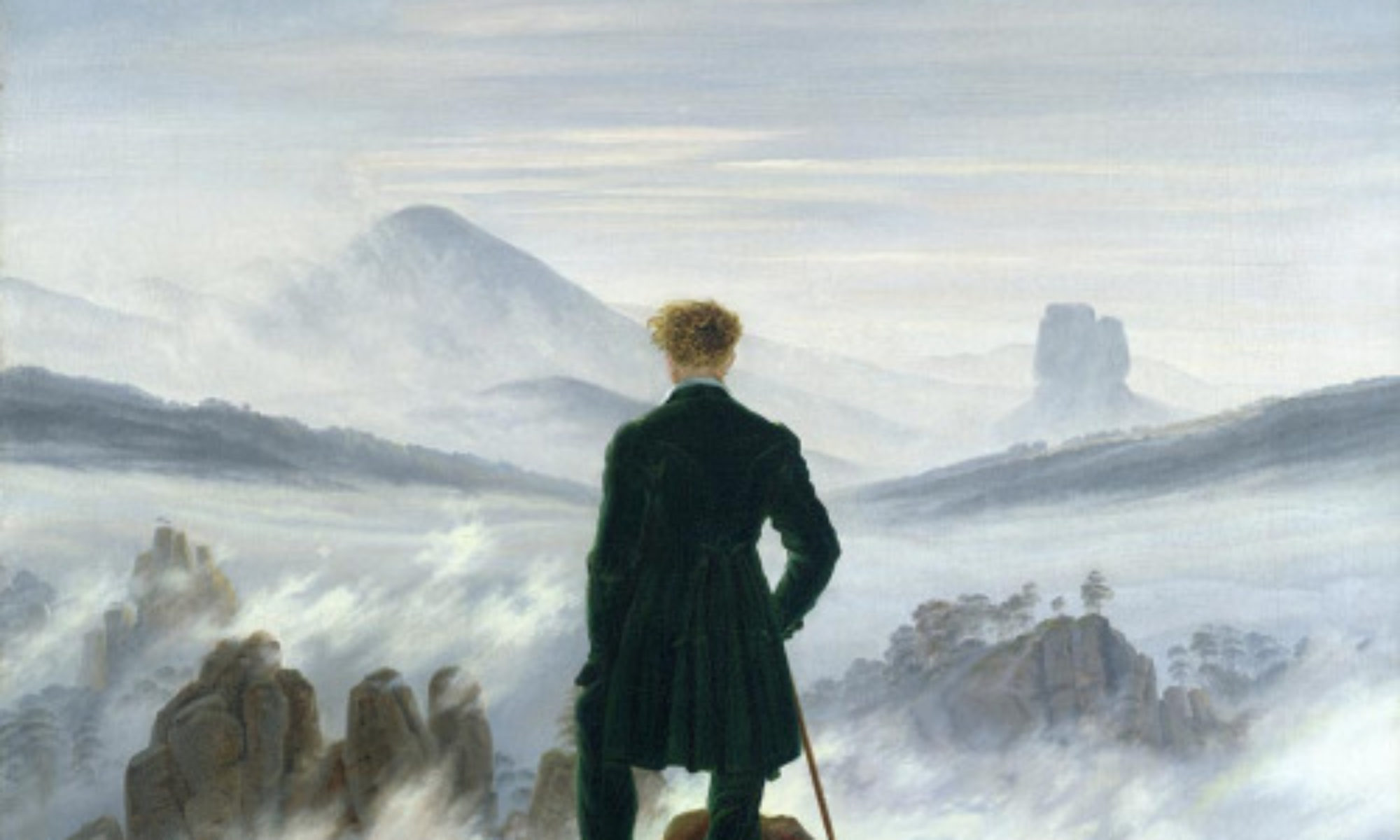
 I am 5’ 6.” I am 120 pounds. I have a scar on my left arm. I have silver hair. I am an Amazonian warrior with a halberd. My name is Trish-la.
Obviously this is not actually what I look like or who I am. My name is Deanna Stover. I have never held a halberd, let alone been any sort of warrior (although my hair is beginning to turn silver. Thank you graduate school applications). No, I play Dungeons and Dragons. What I’ve just described are the basic stats of the first character I ever developed and played. It was 2000, I was 10 years old, and I stumbled into the game because a friend’s mom ran a game for the neighborhood kids.
First of all, let me make this clear: I am no expert about D&D. I can, however, give everyone a brief background of what the game is: D&D is a table-top role playing game (RPG). It is also a game that inspired a lot of controversy and negative reactions in the 1980s. People claimed that it promoted witchcraft (how 15th- and 16th-century!) and devil-worship. Role playing games still have a negative connotation associated with them; you should see the reactions people have when they find out I play Dungeons and Dragons. There’s also very little understanding about what D&D actually is. Typically people believe it is a video game (and there are those around), but a table-top RPG is different.
A Dungeon Master (DM) develops a basic story line and the “party” (typically around four to six players in my experience) influences the way that story will work out through their own decisions, interactions with other characters, and the luck of the dice. The dice involved are not just your average 6-sided dice; the die we use most is 20-sided. D&D is very hard to understand without playing. However, as I will explain, these games may spark a particular interest in those of us who love literature.
Flash forward to 2012. I didn’t remember playing my first campaign, let alone the dusty binder where I kept my character sheet (this helps you keep track of your stats, your skills, your weapons, and any other information you may need during the game) and my accumulation of die. I didn’t remember any of this until a few friends once again introduced me to D&D. However, I fell in love all over again. In the past year, I’ve participated in three campaigns, and I am a walk-in character in a fourth. I have literally laughed and cried my way through these adventures.
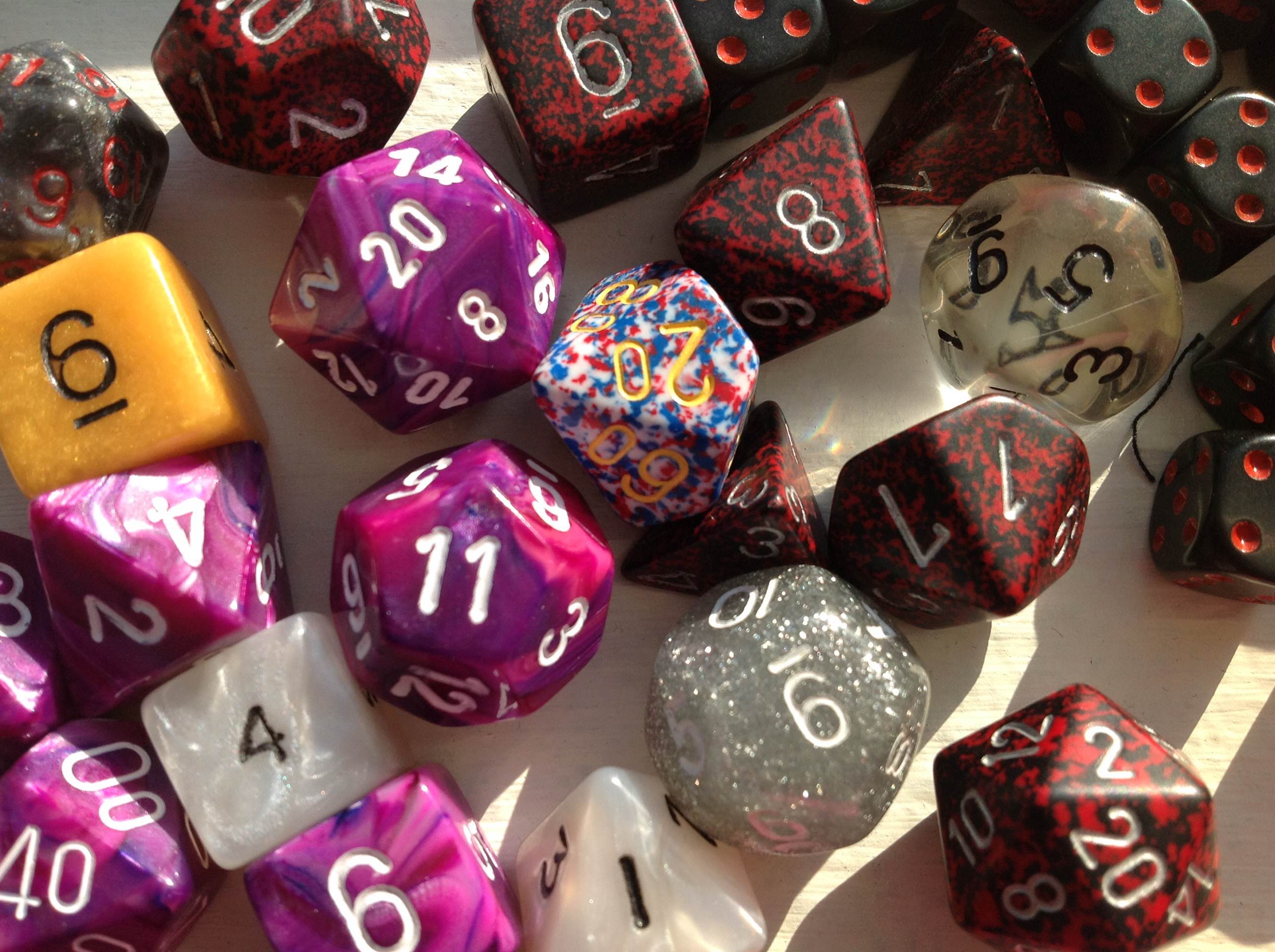 So, what does this have to do with literature? Well, not only is Dungeons and Dragons inspired by literature and mythology, it involves the creation of new narratives every session. In that dusty binder from my first foray into D&D, I have these instructions: “The players are like characters in a book that you, the players, are writing with the [DM].” Playing as an adult, I am ever more aware of the truth behind this statement.
Admittedly, the literature that inspired D&D is typically associated with the 1960s and 1970s, something that may be foreign to those of us who are interested in the 19th-century, but the connection between D&D and all literature students is still a vibrant one. I am not a creative writer, I am definitely not an actress, and I never even played video games as a child, but the attraction to this game is still strong. The communal storytelling is what makes it so appealing and, honestly, there are some elements of each campaign that reference Romantic and Victorian literature; the campaign I’m currently in has some Swiss Family Robinson-esque elements tied in. But for me the most entertaining part of D&D is feeling like I am a part of a Choose Your Own Adventure novel every time I step into the room.
Perhaps you can see this post as a recruitment for D&D or even RPGs in general, and on some level I suppose it is, but what I am really trying to point out is that, even while I spend most of my life now nose-deep in 19th-century literature and papers I have to grade, D&D is what keeps reminding me what is so magical about words. I have watched the DM create a world all his own (albeit influenced by D&D lore, Roman and Greek mythology, and even modern video games), and I have participated in its creation. In the end, D&D is just five people sitting in a room for six hours every week speaking to each other, spinning a story and interacting through words alone, but only there can I become a warrior woman or even a half-dragon. Through our simple words and a few rolls of a die, a whole new world is born—it is literature through participation.
What I Learned About Truth in Pursuit of Reality
In response to Deven’s post regarding her journey toward archaeology via the pursuit of reality, I wanted to use the resonance I felt in her story as a jumping off point for my own post about the nature of reality. While I am compelled by approaches to understanding defined by logic and reason, I find myself sometimes working against both in my role as an artist. I make work in a system that allows for the full creation of possibility and ideas – a world that ascribes to sets and grouping but also readily casts them off in order to make great leaps and bounds of the imagination. Contemporary artists, unfettered by traditional labels that have served much of western art history (though still enriched by that history), move about from media to media, always seeking the best solution to visual questions. Art of the mind is valued as well as art of the hand, and at that juncture, pragmatic fixes need not be applied. As a printmaker interested in geology and compelled by the scientific method, I was searching for artistic solutions that had practical, empirical answers. I wanted to find the place where art and science met. Perhaps after one too many philosophy papers, I decided to close the book on abstract ideas and go out into the field.
Much of my work deals with narrative and the quest for the truth in that space. Truth, for me, was about getting to the heart of what really happened on a cold day in December that has long since passed and can now only be accessed through memories. I have no observable data or evidence. The reality of each moment is a driving concern, and if I can create output of those moments, perhaps they will be easier to analyze and interpret. The prints that I create deal with specific times and places, and I can correlate that nicely with rocks in the field that I learned about through geological field exploration. For instance, pick a memory from your childhood, say, around fourth grade. Were there other people there?
What kind of day was it?
Can you recall what you were wearing?
In the epochs of the history of this earth, that blink in your existence could be akin to a river flooding in the Late Cretaceous. Perhaps some plant matter is trapped in with the sediments rushing over the banks, a picture of that day in the memory of the earth, now lithified. Literally, set in stone.
People will remember things differently, and focus on separate parts of events. Humans get details wrong and let their emotions dictate how they feel about certain memories. The earth, however, could only ever tell you the truth. It records events as they happen, and if you wanted to find out the story – “the reality” – all you need to know is how to read the rocks.
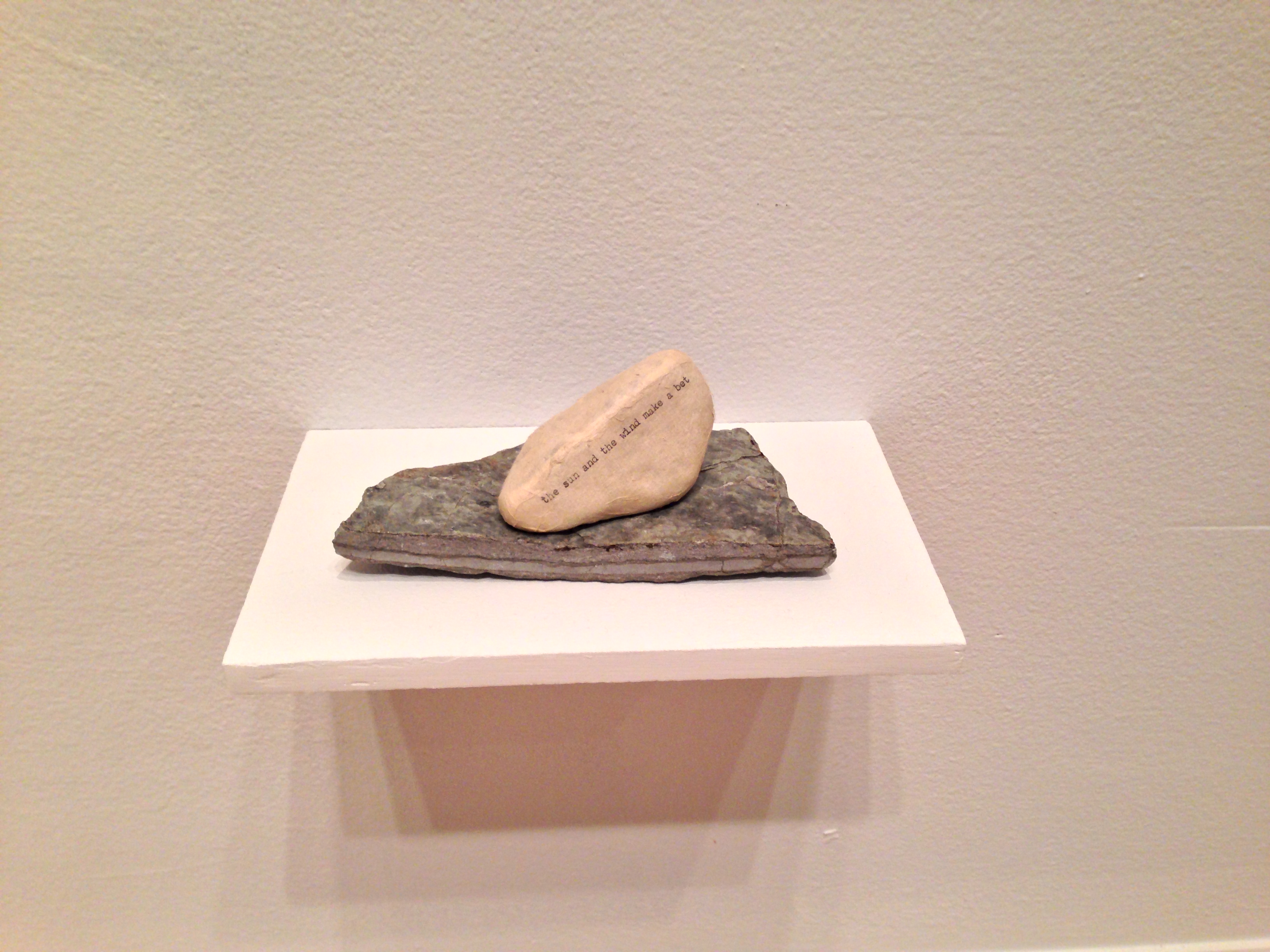
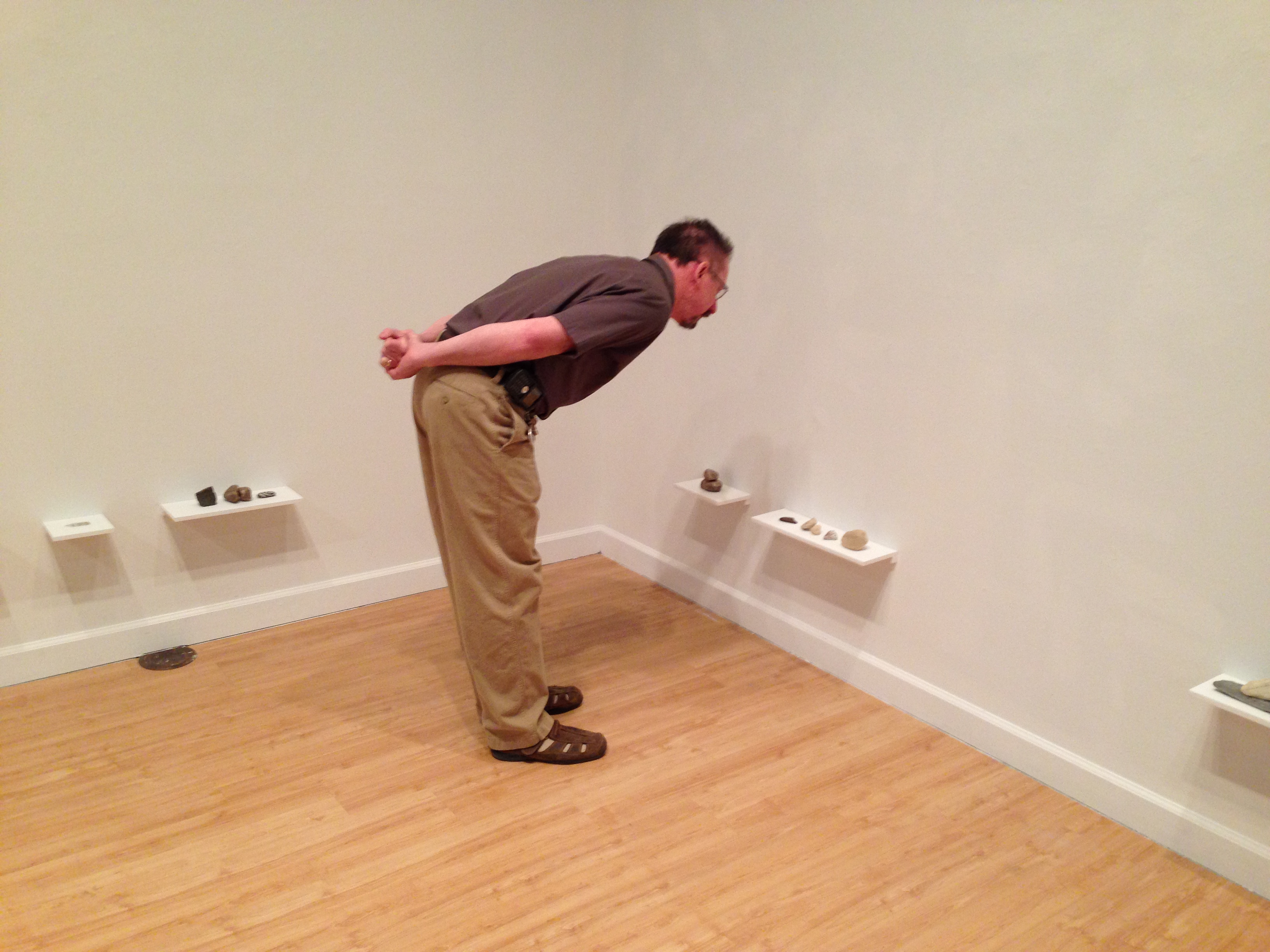
Going forward with this proposition, in late 2012 I set about making an installation titled Wonders of the Rocks: Passages I – IV. It is a collection of various hand-collected granites, gypsum, shale and limestones, placed onto shelves of varying widths. Each shelf contains a set of rocks meant to signify some narrative or implied story amongst the grouping. Some of the rocks used in the piece were covered with my own interpretation, or memory, of that rock so that you could no longer see its real story underneath. The piece is hung low on the wall and arranged in a linear format, meant to be “read,” as one literally reads rocks in the field, looking ever downward. I wanted the viewer to come to this piece and kneel down or bend over as one does when searching for samples. If the meaning of some small passage was lost to the passerby who did not fully engage with the piece, to me this is symbolic of the geologist who loses sight of the details and fumbles even the smallest of notes. A misinterpreted strike and dip of strata could change how one reads a formation entirely, much the same with small intonations in the translation of a foreign text.
I am still working on the idea here between what is meant by the signs and signified, but now I am incorporating cues from language. Maps still play a role to me as guides in making meaning for geological work, but the idea that these rocks can transcend that and become a new language interested me. I’d attempted to construct a meaning, a language, and a truth from reality – actual pieces of the geological record of the earth. I specifically thought of the work One and Three Chairs, executed by Joseph Kosuth in 1965. He gives us an artifact, documentation, and an explanation, but wherein lies the truth? At one point, a member of my committee had to tell me, “You need to let go of this idea of the truth.” I had become stubbornly attached to the idea that each rock was telling me a true story. It is okay to walk away from a set of rocks and misunderstand them, as their language is multifunctional, in a constant state of change (literally from sedimentary to metamorphic to igneous), and open to vast interpretation. There is no one set of passages that can equal one meaning, much the same in language.
But the question persisted: What do we hold the most important? The thing or the idea of the thing?

Along the way I began to think of reality and truth as the same. I could hold a rock physically in my hand, inspect it under a microscope, classify it, and make a very good estimation about how it was formed. Touching a rock was, to me, like picking up a page from the history book of the world. Each rock was a true statement, and if I collected enough of them, I would start to have an alphabet from which to begin a new language.
If these minerals and rocks are important to me as signs, so is what is signified. When I look back at Kosuth’s Chairs, I am reminded of a print that brings this entire endeavor back around again for me. Blue Print, 1992, by Abigail Lane is one of a series of inked chairs that has a felted inkpad in the seat. The placement of the chair so near the wall, the print of the bodily mark hung nearby, almost as evidence but more as connection, calls forth the Kosuth as an artistic antecedent. The print in this artwork acts on several levels: as a record of an action, as a tie-in to the sculpture, and as an image for visual consumption. There is a language beginning to take shape in the print, which is made directly from the body. Almost like a trace fossil found near an outcrop, you can safely guess that one came from the other.

http://abigaillane.co.uk/
I wanted to tell the story of place and of memory with 100% accuracy, but here’s the rub – even in geology you cannot do that. You can make very educated statements and qualified guesses, but there will always be some unknown factor. In the sciences, they warn of “observational bias” tainting your results, but in the art world, observational bias is the most important thing you’ve got.