The Dream of Art in Batman

“Thou art a dreaming thing, / A fever of thyself” – Keats

https://www.youtube.com/watch?v=sQn-vulThcY
Jack Nicholson’s the Joker is the Romantic Visionary artist in extreme. His version of the apocalypse emerges from his diabolical imagination and his scheme to poison Gotham’s commercialized vanity. This is, to recall a quote I used in a previous post, the Romantic Vision on steroids: Continue reading “The Dream of Art in Batman”

One Thought Fills Immensity

This experimental post responds to the question I’ve been posing for myself for some time: what should I post when preparing for my exams, and have little time for words in the form of a blog? My answer came by way of an assignment I set for myself as part of my contemporary art and ecology exam reading  list. Watching the “Ecology” episode of Art21, I was struck by the sculptor Ursula von Rydingsvard’s recalling of a time in her life when words were at a premium. In response, she spoke of continuing to “drink of the world by visual means.” And so, in this post, I wish to simply leave you all with a series of objects that have moved me to thought in various ways while studying for my nineteenth-century and contemporary art exams. I welcome comments on what responses to the images readers of the blog might have. Continue reading “One Thought Fills Immensity”

Objective Reading

Reading is not one thing but many. Most of all, reading is not passive. “In reality,” writes Michel de Certeau in the opening of The Practice of Everyday Life, “the activity of reading has on the contrary all the characteristics of a silent production.” But what are we producing? And what does the scholarly practice of reading do to this production?
As graduate students we often expect ourselves somehow to swallow texts whole—to get them. We try mightily to read texts simultaneously in terms of their own coherence, elisions, and indeterminacies as textual systems, of their unconscious procedural expression of determinant historical conditions of possibility, of their own stated and unstated relations to their intellectual precursors, and in the light of their reception by scholars or later links in the canonical chain; we strive to keep in mind texts’ political ramifications, how their formal-generic elements engage with other morphologically-related texts, and their relative sympathy or antipathy to various major philosophical concerns or strands of ideological critique; we read texts to find out whether we can instrumentalize our readings for the purposes of conference papers, dissertation chapters, or course syllabi—and maybe to determine whether we like them. More often than not, while reading I am also planning on passing along certain passages to colleagues or photocopying them for friends outside of the academy; wondering whether I could get a pirated PDF instead of waiting the several days for Interlibrary Loan or maybe shelling out the cash for a nice sixties paperback copy of my own, speculating about the biography of the author or the business-end realities of the academic press in question, and so on. Continue reading “Objective Reading”

Guest Post: Another Kind of “Gentlemen’s Club”: A Brief Illustrated History of an Institution

By Katherine Magyarody
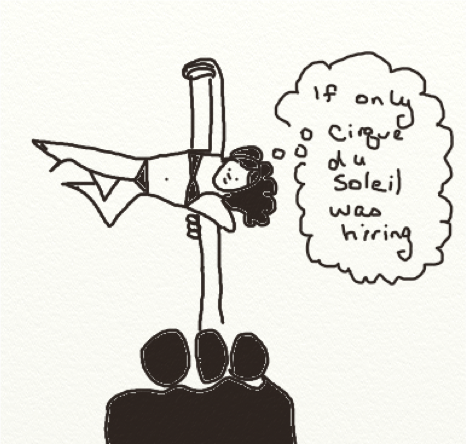
Cirque du soleilThe contemporary gentlemen’s club may be encapsulated in the image of scantily clad women performing impressive acrobatic routines in front of a beery audience rather less capable of similar athleticism in a windowless building that clings to the seedier edges of town. It seems a fine irony that these strip joints, with their sticky, slick furniture, skewed sexual voyeurism and spilt beer take their moniker from establishments adjoining London’s centre of power, which excluded women, and had large windows from which the elite could watch the world outside without being seen.
Our modern gentleman’s club’s idea of the gentleman is as flat as its beer and as restricted as a bouncer’s facial expressions. There is a much more interesting story to be told, one that tracks the evolution of masculinity and gentility throughout the nineteenth century while touching on wider patterns of socialization. Continue reading “Guest Post: Another Kind of “Gentlemen’s Club”: A Brief Illustrated History of an Institution”

Dissertating with a Hammer: An Idiot’s Generalizations on Scholarship and Activism

I begin with two passages that will be the epigraphs to my dissertation:

Few critics, I suppose, no matter what their political disposition, have ever been wholly blind to James’s greatest gifts, or even to the grandiose moral intention of these gifts … but by liberal critics James is traditionally put the ultimate question: of what use, of what actual political use, are his gifts and their intention? Granted that James was devoted to an extraordinary moral perceptiveness, granted, too, that moral perceptiveness has something to do with politics and the social life; of what possible practical value in our world of impending disaster can James’s work be? And James’s style, his characters, his subjects, and even his own social origin and the manner of his personal life are adduced to show that his work cannot endure the question.

Continue reading “Dissertating with a Hammer: An Idiot’s Generalizations on Scholarship and Activism”

Poem: Now

This is an older poem – not one explicitly written with anything to do with Romanticism in mind. But I think my mental image of the speaker owes a great deal to the mythic Romantic genius figure (as seen by himself, of course!). I’ve been starting to think about connections between Romanticism and current genre fiction – more to come!
Now
Now, darling, you know that we’re living in sci-fi –
I have seen this city from the sky
And it’s the gleaming metropolis of everyone’s dreams.
This bonfire of lights below us seems
So alien – what strange planet do we walk
Across now?
Honey, I’m not going to talk
About an alien invasion,
How their spies (so adeptly disguised) are already in position;
I’m not going to try to tell you, dear, that we
Have robotic brains. You misunderstand me.
Listen: I come to you as a prophet to his people, glorious and
Holy, reaching out my hand
To you my flock, descending from the height of this airplane.
I deign
To tell you the truth, beloved (and how!) –
I have seen the future, and it is now.

More Frankenstein(s): Cumberbatch, Miller, and the National Theatre

By Talia Vestri

Like Arden, I, too, have been burning with curiosity about the recent critical reactions to several Frankenstein adaptations. But rather than valiantly sacrifice my time to the gods of Hollywood mediocrity as she so nobly does in her last post, I managed to escape the sub-par recreation of I, Frankenstein and instead turned my intrigue towards a much more mainstream and accepted performance: Danny Boyle’s 2011 National Theatre stage production of Frankenstein, featuring the incomparable Jonny Lee Miller and Benedict Cumberbatch. Continue reading “More Frankenstein(s): Cumberbatch, Miller, and the National Theatre”

Understanding the Past through Sculpture

I reach over my workdesk to find a suitable bookmark. I come up with a postcard of the Carlsbad Caverns, and I place it into the exhibition catalogue that I’m engrossed in. As a slight aside and a confession, I have stacks of old postcards. I’ve been collecting them since my teens. I have always loved their bygone-era designs, but now find that I’ve been literally taking pictures of places I’d hoped to see someday. Greek sculptures, highway motels, the desert southwest of the United States, and the White Cliffs of Dover are just some of the amassed places or experiences I’d hoped to have. Continue reading “Understanding the Past through Sculpture”

Poem: Rideau Canal

Hello all! I wrote this poem after reading a bunch of Wordsworth’s sonnets (although – a bunch is a relative term, since I read somewhere recently that he wrote 535). In terms of both content and especially  rhyme scheme, this poem was written with some of those sonnets in mind. I should also mention that the Rideau Canal is a beautiful waterway running right through the middle of Ottawa. In the winter it is literally a road, as people skate on it (it’s a big tourist attraction, but there are also those who take the opportunity to skate to work).

Rideau Canal

The water is a photo: strips and stills,
Darkrooms. The sun has nestled lower, deep
In branches that dip down to let it creep
Across them. Slowly sinking as it spills
Over the sky, messy, breaking, it fills
The –
            No – the water is a painting, and
The ripples moving brushstrokes, and the land
A frame; the sun a sloppy stain that kills
Or blisters colour.
                                   Best to say, maybe,
The water is a road. And as the sun
Slips down into the city, almost one
Might think the light that’s settling there could see
A path on which to build and blind, one long
Highway to run from night, and to grow strong.