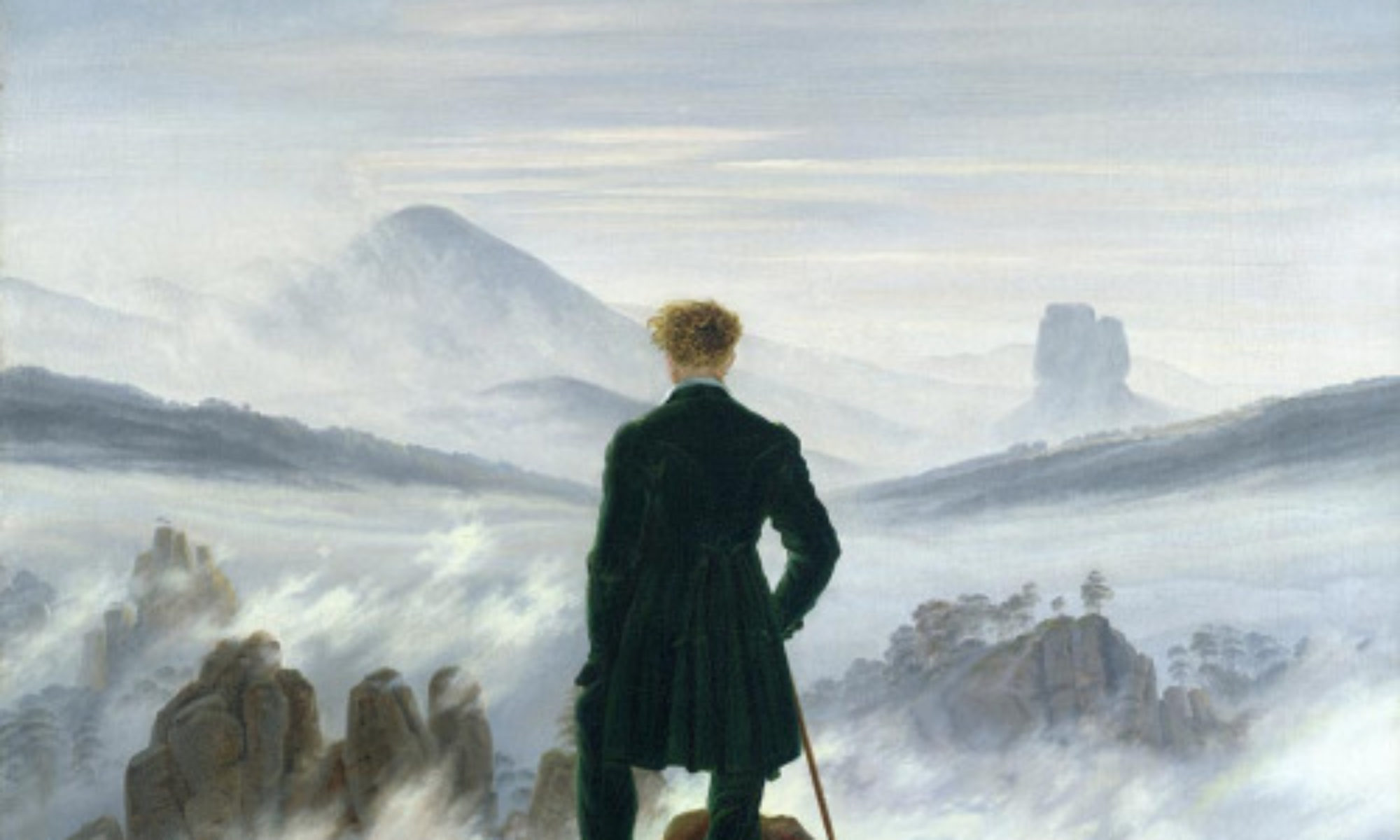
This final poem is one I’ve been working on over the last year – the first thing I started thinking about when I joined this project was the (inescapable) connection between colonialism and Romanticist relationships with “the land.” There is a long tradition in Canadian poetry (and American, to an extent) of writing about the settler/pioneer’s emotional connection to the land, one which seems to involve a battle between being controlled by the land (and ultimately driven insane) and being the one in control.
Of course, what is not so much lost as outright ignored in this kind of writing is the existence of other peoples and cultures with their own relationships with the natural world, most obviously in this context the aboriginal peoples of Canada. “The Canadian poets” (by no means an indictment of all Canadian poetry! rather, the name is meant to underscore how unaware the speakers are of other kinds of Canadian poetry) literally gloss over other voices speaking their own relationship between themselves and the landscape around them.
Some of the poems I had in mind in particular, drawn from different time periods and genres, are Earle Birney’s “Bushed,” Gwendolyn MacEwen’s “Dark Pines Under Water,” and Margaret Atwood’s “Progressive Insanities of a Pioneer,” all of which are beautiful poems and well worth reading.
Continue reading “Poem: Canadian Romanticism”
Poem: Outside a chapel
Another older poem (although revised for this blog) – in the Romantic tradition of reflecting on older buildings! The chapel I had in mind is at Trinity College, University of Toronto: http://www.trinity.utoronto.ca/about/chapel/chapel_history.html
Outside a Chapel, the Windows Are Dull
it is the bricks instead, the wall
a jagged ladder –
sandstone scraping itself
up to the prayerful slope
of slate rooftiles that cling
to copper,
broad beam
corroded by contact
with the sky.
Poem: Tulip Festival
Spring came almost shockingly fast to Ottawa this year, and the annual tulip festival has been going on for the past week. I walk past it on my way to and from work every day and can’t help feeling a little overwhelmed, although not quite willing to be as effusive as a real Romantic would be. Line 12 of this poem is referencing a bit the poem “Tall Tales” by one of my favourite poets, Gwendolyn MacEwen: “Poets and men like me who fight for something/contained in words, but not words” (ll. 15-16).
Continue reading “Poem: Tulip Festival”
The Art of the Book and Romanticizing Landscape
For several months now, I have had the pleasure to work on a project with my friend and fellow artist Cat Snapp. On a Texas summer evening, we discussed over dinner our overlapping interests in the outdoors and the influence it has on our work. Through connection to the geological past or ties to personal culture, we each use print media to speak about the personal, historical, and psychological relationships we have with the world around us. At a certain point, we realized that the project that would best unite our voices and express the feeling we wanted was a letterpress printed artist’s book. It has the power to be intimate with the reader, yet it transcends the starkness of simple text on a page – it can reach into places travelled and landscapes desired.
Continue reading “The Art of the Book and Romanticizing Landscape”
Poem: When I consider the mind
Since beginning to write for this blog, I’ve been thinking back to a paper I once wrote on Keats’ “Ode to Psyche.” The poem is fascinating to me because of the way it describes the poet’s mind as a sort of bower in which Psyche may live. I’ve written a poem in response to this image, although I’m not so much interested in the poem itself (it’s not exactly Keats!) as in how it has allowed me to think more about the mind as a growing thing.
Continue reading “Poem: When I consider the mind”
Blake in Song: Interview with Composer Ben Scheer
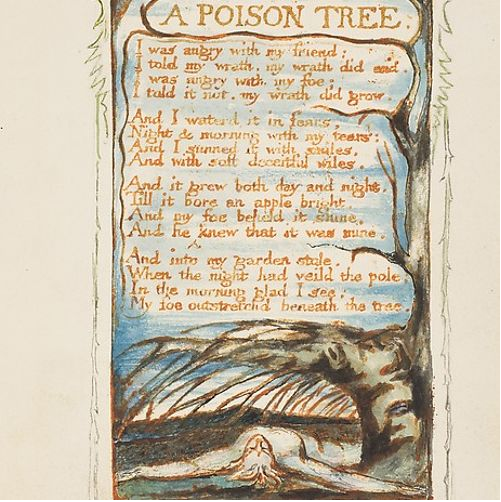
In this post, I have the very great pleasure of interviewing the contemporary composer Ben Scheer about his new artistic production. Ben, who studies composition and violin at the Eastman School of Music, has just written and released a new work for voice and piano based on William Blake’s poem “A Poison Tree,” from the Songs of Experience (1794). A recording of the piece, which features the soprano Rebecca Herlich and the pianist Forrest Moody, is available on Soundcloud here. Ben answers my questions about his contemporary setting of Blake’s poem after the jump.
 Continue reading “Blake in Song: Interview with Composer Ben Scheer”
The Modernization of Elizabeth Bennet
By Talia Vestri
“It is a truth universally acknowledged that a single man in possession of a good fortune… must be in want of a wife.” One of the most well-known lines in literature has been reiterated once again—except that this time, it’s plastered on a bright fuchsia T-shirt.

So begins The Lizzie Bennet Diaries (2012-2013), an Emmy-winning web series that reworks Pride and Prejudice for the modern age, featuring an endearing but sarcastic twenty-something Lizzie Bennet played by newcomer Ashley Clements.
Continue reading “The Modernization of Elizabeth Bennet”
Geology, The Sleeping Giant
Geology is ever-present and abundant in the most expansive and also the most microscopic ways. I’ve been asked to serve on a panel next month at Southern Graphics Council International with three other printmakers who also incorporate geology as major themes in their work, and I’ve used this post as a research opportunity to develop my opening remarks. There are many ways that we use the history of the earth, rocks, and the crisis of the Anthropocene to make artistic statements. Some artists approach the work through the realm of the story teller. Others realize that our societal and economic structures depend on geological resources. Still others are interested in the multitude of phenomena that shape our world to create the landscapes we see before us. In all these ways we become thinkers that overlap artistic training with scientific thought and experimentation.
Continue reading “Geology, The Sleeping Giant”
Concert Notes: Byron's Hebrew Melodies at 200
Last night, I performed five of Lord Byron and Isaac Nathan’s collaborative work of music and poetry, the Hebrew Melodies (1815), with the lovely and talented soprano Catherine Hancock at a private home in New York City. This was the New York premiere of Byron’s songs: there’s no record of the Hebrew Melodies being performed in American nineteenth-century periodicals, and although the musical settings were popular in the early decades of the nineteenth-century, the score was out of print from the 1850s until 1988, when Paul Douglass and Frederick Burwick produced a scholarly edition to coincide with the bicentennial of Byron’s birth. So, though we were working with music that was exactly 200 years old, the material was very new for our listeners. Theodor Adorno once said that the second-generation Romantics were “the locum tenentes of nonexistant great English composers.” But what was the music that was being written and played during English Romanticism? Our concert sought an answer to this question. Continue reading “Concert Notes: Byron's Hebrew Melodies at 200”
Poem: Winter Song
I’ve been thinking about the concept of wildness in the context of winter, and the idea of delirium seemed worth exploring to me. I had the skating episode of Wordsworth’s Prelude (Book I ll. 452-489) in mind, and especially the passage that begins with the wonderful line, “When we had given our bodies to the wind” (479).
Winter Song
Now, in the delirium of winter
I eat my breath
Warm and dribbling down thick scarves
And sip at wind
So thick it lies water-heavy in my mouth.
Meanwhile my vision, distracted,
Has lost the boundaries of sun, ice, snow,
All of them covered in wind
That drags them into each other.
But behind the wind
The cold slips in
Soft like snow,
Clearing out the heat
In brain and body.
The world is perfected –
Snowbanks sheared to stiff edges,
The blue lines of their shadows neat beside them,
The sunrise growing on trees,
The air;
And as the wind breaks on my cheekbones
I am sharpened to a blade
Against ice.